
Jawline & Chin Acne
Why do I keep breaking out around my chin and jawline?
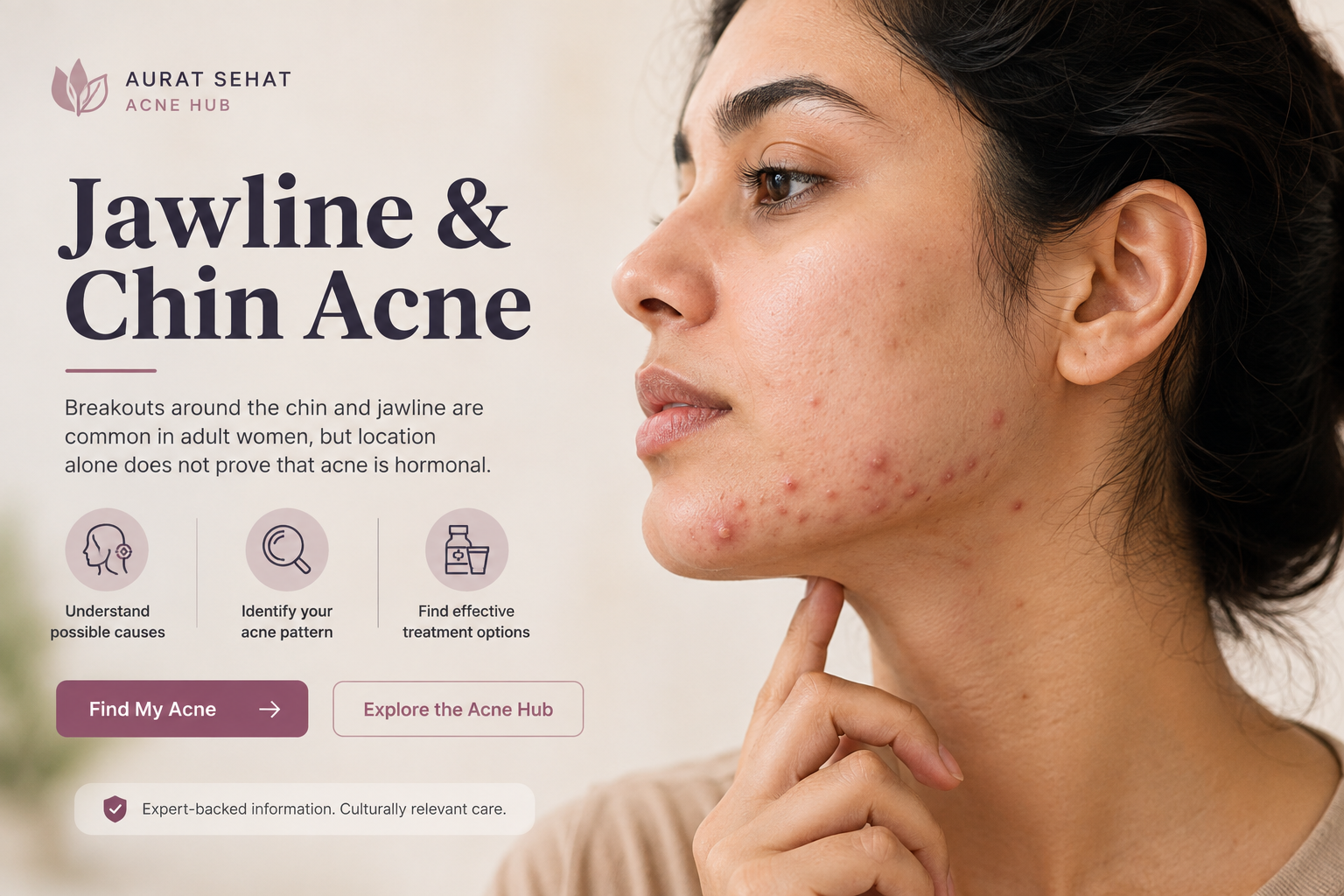
Acne around the lower face is common in adult women. Hormones can influence this pattern, but the location of your breakouts alone does not prove that your acne is hormonal.
The type of spots you have, when they appear, your menstrual pattern, skincare products, hair removal and other factors can provide much more useful clues.
Is jawline acne always hormonal?
Some women notice lower-face breakouts that repeatedly flare around their menstrual cycle. Others have jawline acne without any obvious hormonal symptoms.
Hormonal clues are present
Hormonal influence becomes more worth considering when acne occurs alongside clues such as:
- repeated flares around periods
- irregular or infrequent periods
- increased facial or body hair
- scalp hair thinning
- other features suggesting androgen excess or PCOS
No obvious hormonal clues
Jawline acne can still develop through ordinary acne biology: clogged follicles, excess sebum and inflammation.
Skincare products, hair products, friction, occlusion, touching the face and hair-removal irritation may also contribute.
Think your breakouts may be cycle-related?
Our dedicated hormonal acne guide explains the signs that make hormonal influence more likely and how treatment differs.
Read Hormonal Acne in Women →What does jawline & chin acne look like?
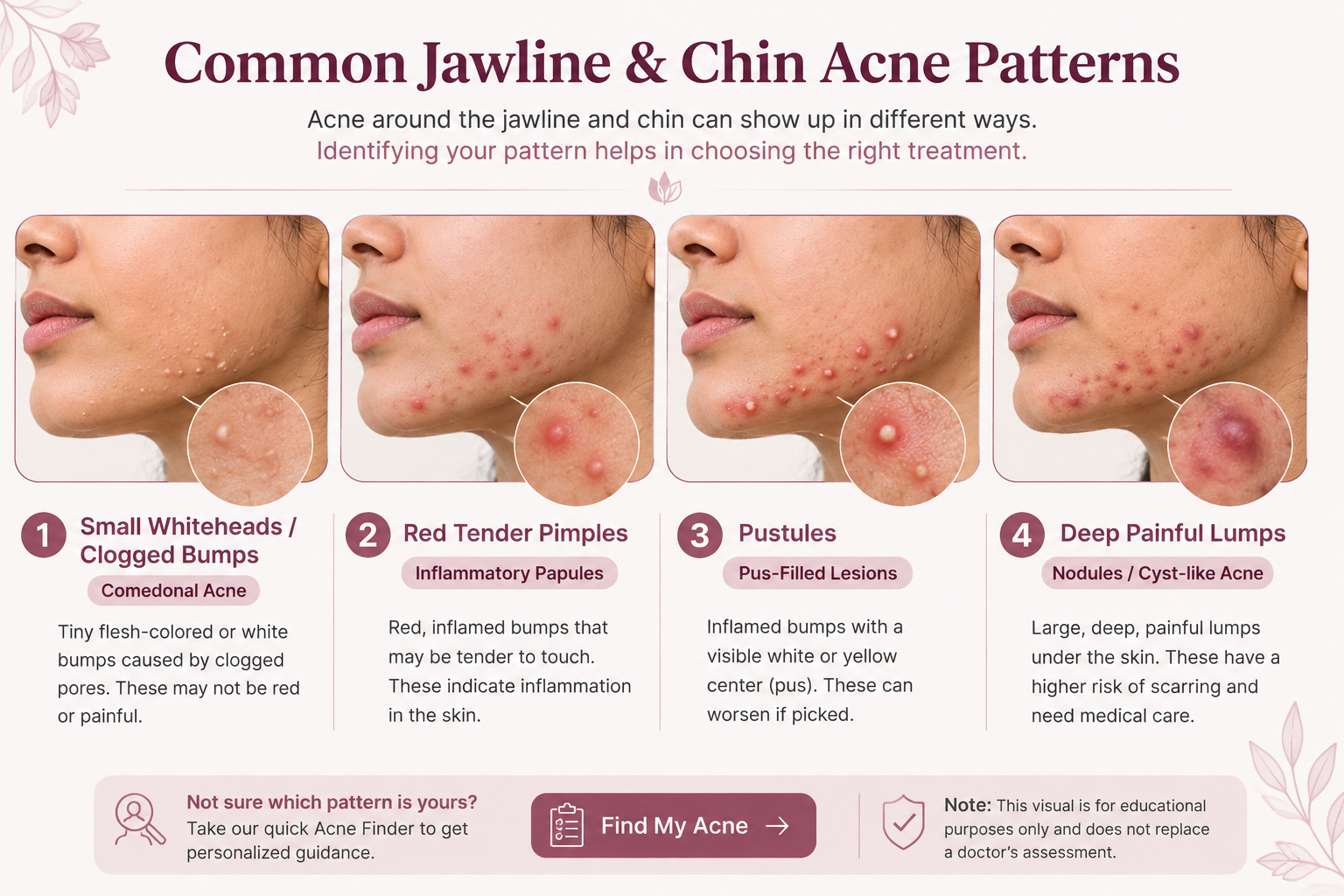
The location may be similar, but the actual acne lesions can be very different. Identifying the lesion type helps determine which treatments are most useful.
Small whiteheads or clogged bumps
Tiny flesh-coloured or white bumps are usually closed comedones caused by clogged follicles.
Red tender pimples
Red raised bumps without visible pus are inflammatory papules.
Pustules
Inflamed pimples with a visible white or yellow centre contain pus and should not be squeezed.
Deep painful lumps
Nodules and cyst-like lesions form deeper in the skin and have a greater risk of leaving permanent scars.
Why does acne appear around the jawline?
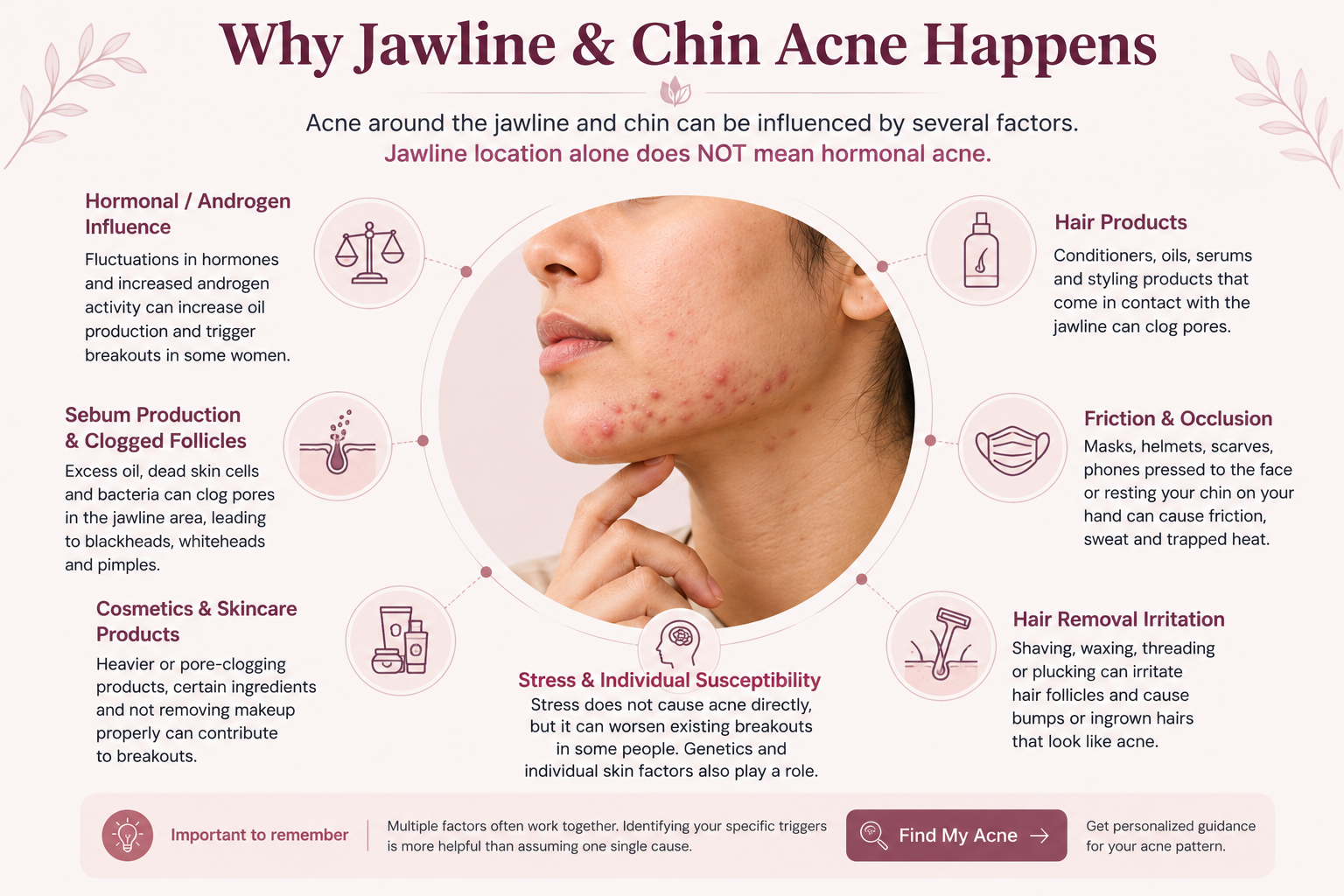
Acne forms when hair follicles become blocked and inflamed. Several factors can influence that process around the lower face, and more than one may be operating at the same time.
Hormonal influence
Androgen activity can increase sebum production and contribute to acne in susceptible women.
Sebum & clogged follicles
Oil, follicular plugging and inflammation are central parts of acne biology regardless of exactly where the acne appears.
Cosmetics & skincare
Some products may contribute to clogged pores, particularly when they are heavy or not well suited to acne-prone skin.
Hair products
Oils, conditioners or styling products that repeatedly contact the side of the face and jawline may aggravate breakouts in susceptible skin.
Friction & occlusion
Masks, helmet straps, scarves, phones or repeatedly resting the chin on a hand can trap sweat or create friction.
Hair removal
Threading, waxing, shaving and plucking can irritate follicles and sometimes produce bumps that resemble acne.
Could PCOS be involved?
PCOS can be associated with acne because increased androgen activity can influence the sebaceous glands and hair follicles. But acne on the jawline by itself does not diagnose PCOS.
PCOS becomes more worth considering when acne occurs alongside features such as:
Acne plus irregular periods or excess hair?
Explore AuratSehat’s dedicated PCOS resources rather than assuming the diagnosis from your acne pattern alone.
Explore the PCOS Hub →Do I need hormone tests?
Hormonal evaluation is more likely to be considered when acne occurs with irregular periods or other clinical signs suggesting androgen excess.
The appropriate tests — if any — depend on your symptoms, menstrual history, medicines and clinical assessment.
What actually helps jawline & chin acne?
There is no special medicine that treats acne simply because it appears on the jawline. Treatment is chosen according to the type, severity and behaviour of your acne.
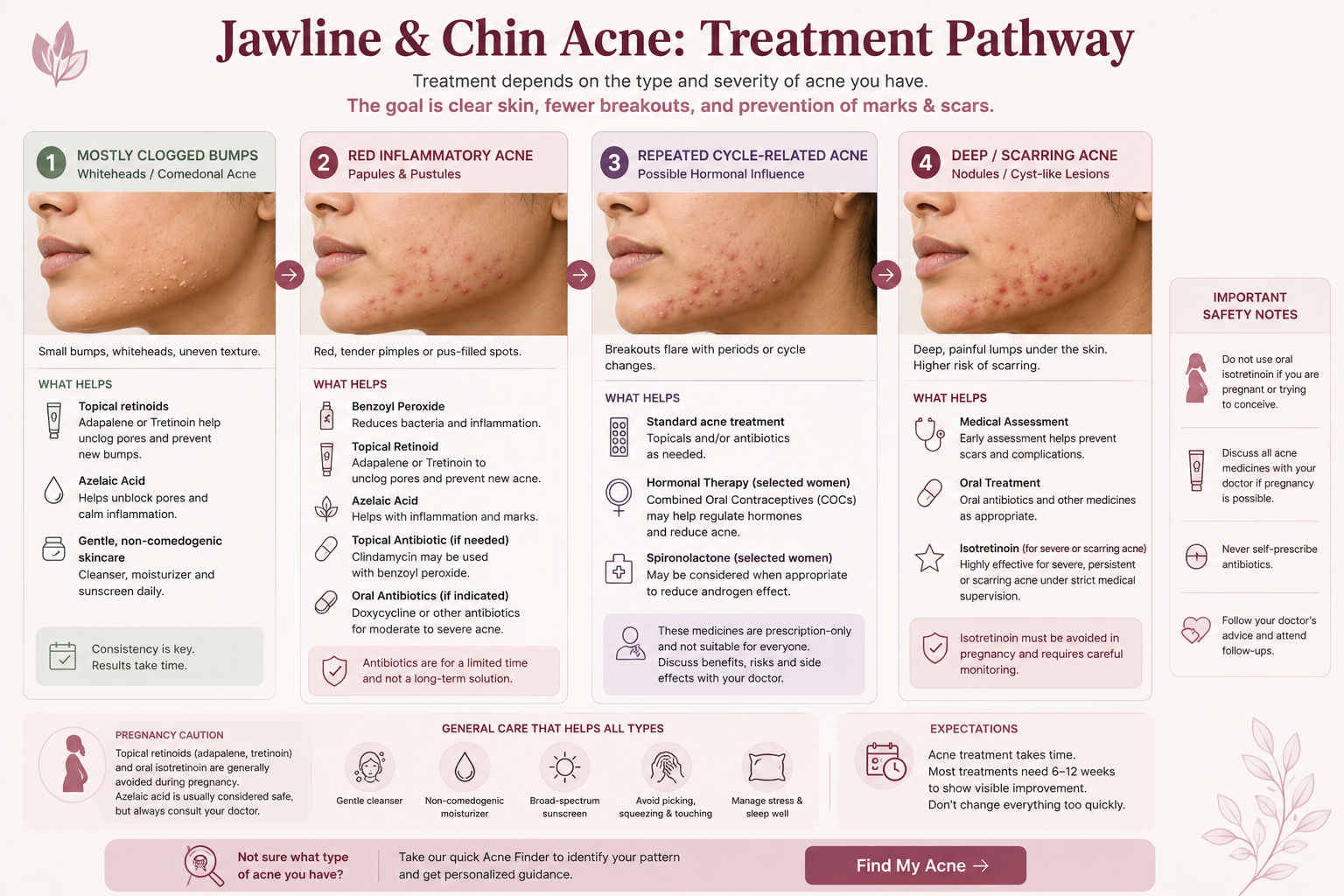
① Mostly clogged bumps & whiteheads
When the main problem is comedonal acne, treatment focuses on keeping follicles from becoming blocked.
Common options may include:
- adapalene or tretinoin
- azelaic acid
- gentle non-comedogenic skincare
Topical retinoids can cause dryness or irritation when first introduced, so they are often started gradually.
② Red inflammatory pimples & pustules
Inflammatory acne often needs treatment that addresses both follicular blockage and inflammation.
Depending on severity, options may include:
- benzoyl peroxide
- a topical retinoid such as adapalene or tretinoin
- azelaic acid
- selected topical antibiotics when medically appropriate
- selected oral antibiotics for more significant inflammatory acne when clinically indicated
③ Repeated cycle-related breakouts
Acne that repeatedly worsens with menstrual cycles may have a hormonal component, but standard acne treatment still matters.
For appropriately selected women, clinicians may consider hormonal treatments such as:
- certain combined oral contraceptives
- spironolactone
These medicines are not appropriate for everyone. Pregnancy plans, medical history, other medicines and contraindications all need to be considered before treatment.
④ Deep, painful or scarring jawline acne
Repeated nodules or cyst-like lesions deserve earlier medical assessment because deep inflammation can leave permanent scars.
Treatment may include stronger combination therapy, appropriately selected oral treatment and, for some people with severe, persistent or scarring acne, isotretinoin under medical supervision.
Want the full acne treatment guide?
See how topical medicines, oral treatments and treatment pathways fit together across different acne patterns.
Acne Treatment Guide →What if the bumps appear after hair removal?
The chin and jawline are common areas for threading, waxing, shaving and plucking. These methods can irritate hair follicles and sometimes trigger ingrown hairs or folliculitis.
Avoid repeatedly picking or squeezing these bumps. If they are persistent, painful, very itchy, spreading or repeatedly occur after hair removal, medical assessment can help clarify what they actually are.
Can touching or squeezing make jawline acne worse?
Many people unconsciously rest their chin on a hand, touch the jawline while thinking, or repeatedly check and squeeze spots.
Touching is not the fundamental cause of acne, but repeated friction and picking can irritate already inflamed lesions. Squeezing deeper spots can increase inflammation and the chance of persistent marks or scarring.
Don’t squeeze deep spots
Pressure may drive inflammation deeper rather than simply “emptying” the lesion.
Reduce repeated friction
Notice habits such as resting the jaw on your hand or pressing a phone repeatedly against the same area.
Keep treatment consistent
Acne medicines need time to work. Frequently changing your entire routine can make irritation harder to interpret.
Pregnant or trying to conceive?
Oral isotretinoin must not be used during pregnancy. Topical retinoids such as adapalene and tretinoin are also generally avoided during pregnancy.
If you are pregnant, planning pregnancy or think you may be pregnant, review your acne medicines with your doctor rather than continuing or starting treatments on your own.
What about jawline acne marks & scars?
Inflamed jawline acne can leave brown, grey or reddish areas after the active spot settles. These flat colour changes are not the same as true acne scars.
Flat dark or red marks
These are usually post-inflammatory colour changes and can gradually fade with time and appropriate treatment.
Acne Marks & Dark Spots →Indented or raised areas
Changes in the texture or contour of the skin are more consistent with true acne scarring.
Acne Scars →When should I see a doctor?
Consider medical assessment if:
- you repeatedly develop deep or painful jawline lumps
- acne is beginning to scar
- appropriate acne treatment is not improving your breakouts
- acne suddenly becomes unusually severe
- you also have irregular periods, excess facial/body hair or scalp hair thinning
- you are unsure whether the bumps are acne, folliculitis or ingrown hairs
- acne is significantly affecting your confidence, mood or quality of life
Keep your skincare simple
A gentle cleanser, suitable moisturiser and sunscreen can support acne treatment. Avoid aggressive scrubbing and introducing many strong active ingredients at the same time.
Your routine should support the treatment — not become another source of irritation.
Acne Skincare Routine →Is this part of adult acne?
Lower-face acne is common in adult women, but adult acne can appear across the cheeks, forehead, chin, jawline and other areas.
If your main question is why acne has continued into adulthood or appeared for the first time as an adult, our broader guide may be more useful.
Adult Acne in Women →Find your acne pattern
Answer a few simple questions about what your breakouts look like, where they occur and how they behave, then explore the most relevant AuratSehat acne guide.
Medical note: This article provides general health education and is not a substitute for diagnosis or individual treatment from a qualified healthcare professional.