
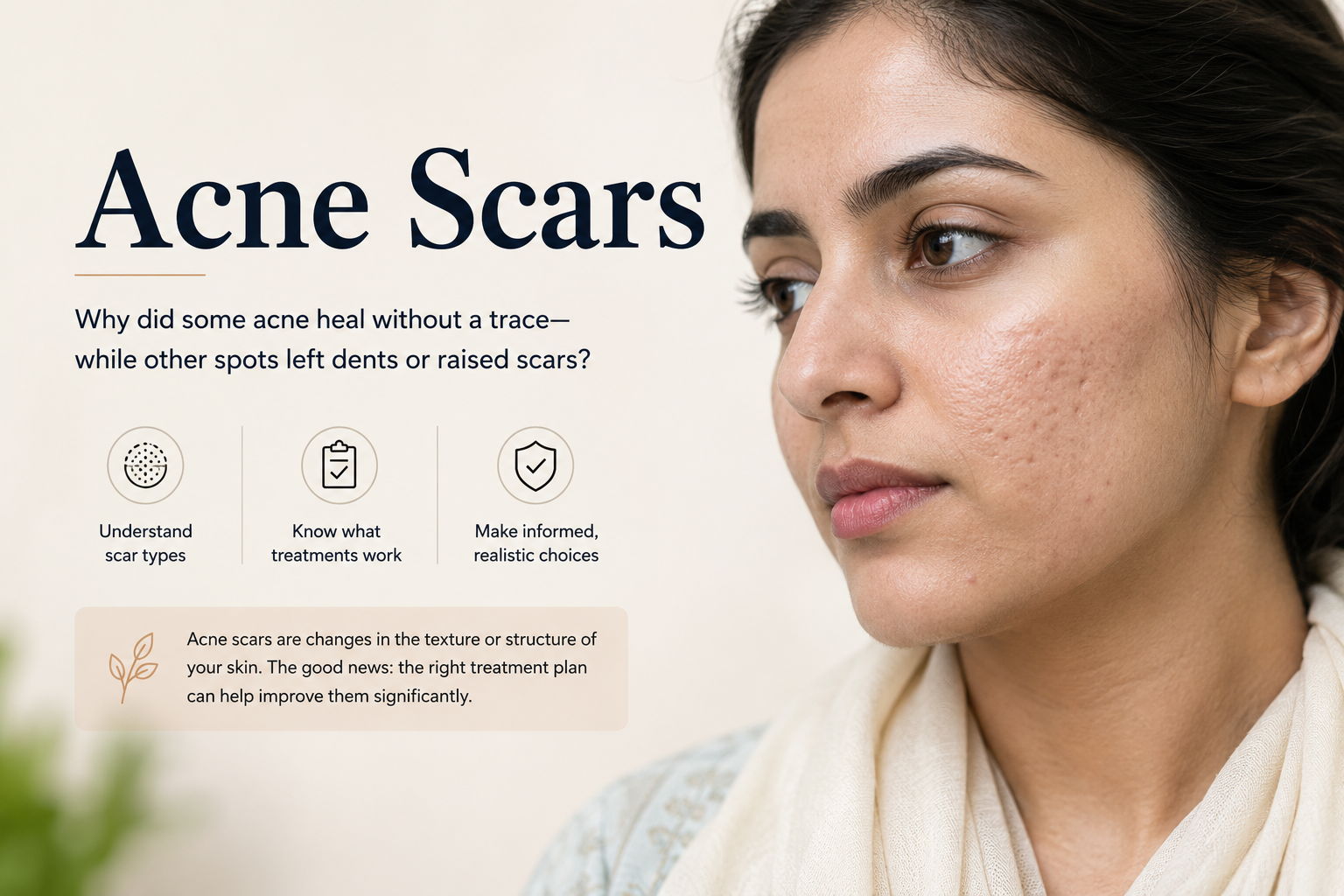
Acne Scars
Why did some acne heal without a trace — while other spots left dents, pits or raised scars?
Acne scar or acne mark?
Colour change. The skin stays flat, but a brown, grey, pink or red mark remains after acne.
Read Acne Marks & Dark Spots →Texture change. A dent, pit, depression or raised area remains because the structure of the skin has changed.
What type of acne scar do I have?
Acne scars do not all form in the same way. Identifying the shape of a scar is important because different scar types respond to different treatments.
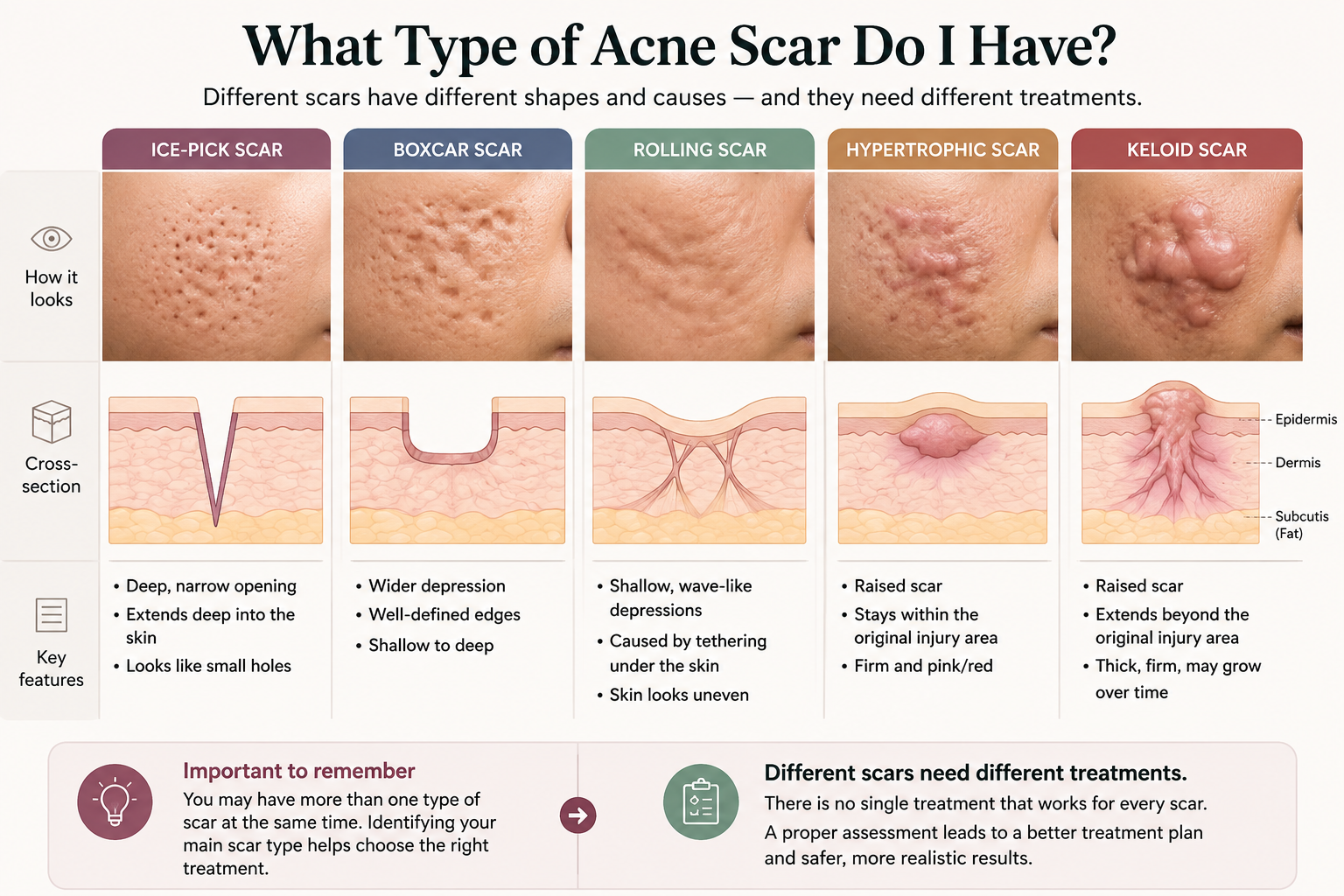
Ice-pick scars
Small, narrow scars that extend relatively deeply into the skin. They can look like tiny holes or enlarged pores.
Boxcar scars
Broader depressions with more defined edges. They may be relatively shallow or extend deeper into the skin.
Rolling scars
Wider, shallow depressions that can give the skin an uneven or wave-like appearance. Fibrous tissue beneath the skin can tether the surface downward.
Hypertrophic scars & keloids
These contain excess scar tissue rather than a depression. Hypertrophic scars remain within the original injured area, while a keloid can grow beyond its original boundaries.
You may have more than one scar type. Someone can have ice-pick, boxcar and rolling scars at the same time. This is one reason acne-scar treatment often involves a combination plan rather than one procedure.
Why does acne cause scars?
Scarring is more likely when acne inflammation extends deeper into the skin. The damaged tissue then has to repair itself.
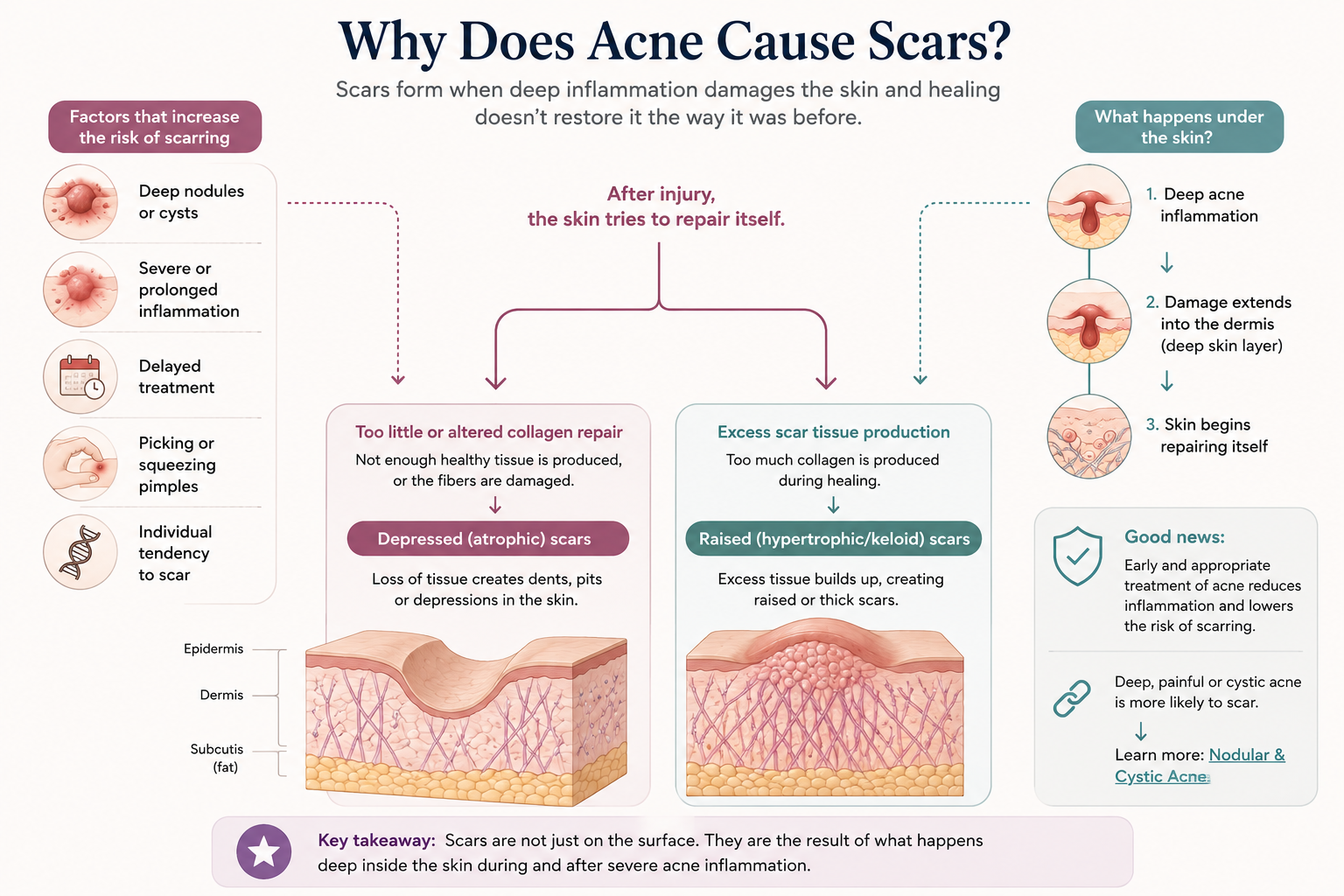
Too little or altered repair
Loss and remodelling of supporting tissue can leave the skin depressed, producing atrophic scars such as ice-pick, boxcar and rolling scars.
Excess scar tissue
In some people, healing produces excessive scar tissue, resulting in a hypertrophic scar or keloid.
Scarring is more likely with:
- deep nodules or cystic acne
- severe or prolonged inflammation
- delayed treatment of significant acne
- picking, squeezing or repeatedly traumatising spots
- an individual tendency to develop scars or keloids
Deep, painful acne deserves early treatment because preventing another scar is usually easier than treating an established one.
Will my acne scars disappear on their own?
Usually not completely.
Pigmentation or redness around a scar can fade, sometimes making the scar appear much less noticeable. Very shallow irregularities may also soften somewhat with time.
But an established depression, deep pit, tethered scar or raised scar represents a structural change in the skin. It does not behave like a simple dark spot that can gradually fade with pigmentation treatment.
Set the right expectation before treatment
Acne-scar procedures generally aim to make scars shallower, smoother and less noticeable.
Which treatment works for which acne scar?
This is the most important principle in acne-scar treatment: choose the treatment according to the scar.
A procedure that works well for one scar type may produce limited benefit for another.
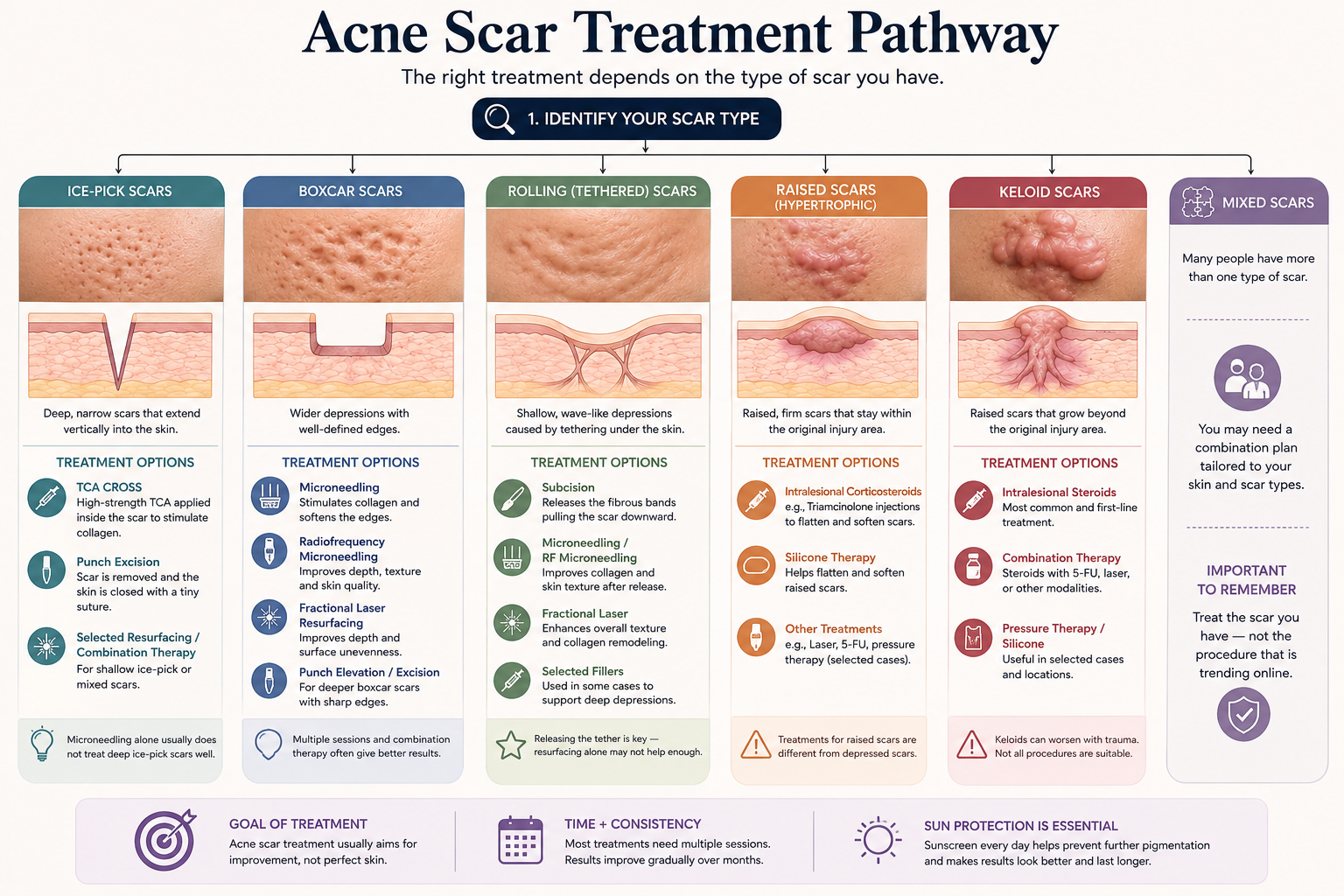
Ice-pick scars
Ice-pick scars are narrow but can extend relatively deeply. Because of their depth, simply resurfacing the skin surface may not adequately treat every ice-pick scar.
TCA CROSS involves carefully placing high-concentration trichloroacetic acid into selected scars to create controlled injury and stimulate remodelling.
Some particularly deep scars may instead be suitable for punch excision, where an individual scar is surgically removed.
Boxcar scars
Boxcar scars vary considerably. A shallow boxcar scar and a deep, sharply edged boxcar scar may need different approaches.
Shallower scars may respond to collagen-remodelling treatments such as microneedling, radiofrequency microneedling or selected fractional laser resurfacing.
Deeper, sharply defined scars may sometimes be better suited to punch elevation or punch excision, often as part of a broader combination plan.
Rolling or tethered scars
Rolling scars often involve fibrous bands beneath the skin that pull the surface downward.
Subcision is particularly important for appropriately selected tethered scars. A needle or specialised instrument is passed beneath the scar to release fibrous attachments pulling the skin downward.
Once the tether is addressed, additional treatments such as microneedling, RF microneedling, fractional resurfacing or selected fillers may be used depending on the individual scar pattern.
Hypertrophic scars & keloids
Raised scars follow a completely different treatment pathway from depressed acne scars.
Intralesional corticosteroid injections, commonly using medicines such as triamcinolone, may be used to help flatten and soften selected raised scars and keloids.
Depending on the scar, other approaches can include silicone products, selected laser treatment and additional keloid-directed therapies.
Raised scars need extra caution
Treatments intended for depressed scars are not automatically suitable for keloids. Procedures that create additional skin injury can sometimes worsen keloid-prone scarring.
A suspected keloid should be properly assessed before undergoing cosmetic procedures.
Mixed acne scars
Mixed scarring is very common. You might have several ice-pick scars, wider boxcar scars and tethered rolling scars on the same cheek.
This means the best plan may deliberately combine procedures — for example, treating individual deep scars first and then using another technique to improve the broader skin texture.
You may need more than one procedure because you may have more than one scar type.
What about microneedling?
Microneedling
Microneedling creates controlled microscopic injuries in the skin, stimulating collagen and elastin production during healing.
It can improve the appearance of selected depressed acne scars, particularly when scar morphology is appropriate. Several treatment sessions are commonly required, and results develop gradually as the skin remodels.
It is not, however, a universal treatment for every deep ice-pick, tethered or raised scar.
Radiofrequency microneedling
RF microneedling combines needles with radiofrequency energy delivered into the skin. This produces controlled thermal injury beneath the surface and stimulates tissue remodelling.
It can be useful for selected atrophic scars and may form part of a combination treatment plan.
What about home dermarollers?
Home dermarolling is not equivalent to medically performed microneedling. Trying to recreate professional acne-scar procedures at home can lead to irritation, infection, trauma and additional pigmentation.
What about subcision?
Subcision is used mainly when depressed scars are tethered to deeper tissue.
A needle or specialised instrument is inserted beneath the scar to release the fibrous bands that are pulling it downward. This allows the depressed surface to lift and creates a healing response beneath the scar.
Subcision is often combined with other treatments such as microneedling, fractional resurfacing or selected fillers because releasing the tether and improving the surface texture are two different goals.
What about fractional CO₂ laser?
Fractional CO₂ laser creates controlled columns of injury in the skin, stimulating remodelling and new collagen formation. It can improve selected atrophic acne scars and overall surface irregularity.
But CO₂ laser is not automatically the best treatment for every acne scar.
Deep ice-pick scars may need more targeted treatment, while tethered rolling scars may require release with subcision before or alongside resurfacing.
Important for Pakistani and South Asian skin
Laser and other resurfacing procedures can sometimes cause post-inflammatory hyperpigmentation. Treatment settings, skin tone, recent sun exposure, preparation and aftercare therefore matter.
These procedures should be selected and performed by a clinician experienced with the patient’s skin type rather than chosen simply because a particular laser is popular.
What is TCA CROSS?
TCA CROSS stands for chemical reconstruction of skin scars using trichloroacetic acid.
Rather than applying acid across the whole face, a clinician carefully places a high concentration into selected individual atrophic scars, particularly appropriate narrow scars. The controlled injury triggers healing and collagen remodelling.
Multiple sessions may be required and complete disappearance of the scar should not be promised.
Do not try TCA CROSS yourself
High-concentration TCA can cause chemical burns, pigmentation changes and additional scarring when incorrectly applied. This is a clinician-performed procedure, not a home acid treatment.
Can creams remove acne scars?
Not established deep scars.
Skincare can still be useful. Appropriate acne treatment can prevent new scars, retinoids may improve acne and superficial texture, and sunscreen can reduce pigmentation that makes scars look more obvious.
But a cream cannot reliably release a tethered rolling scar, reconstruct a deep ice-pick scar or flatten every established keloid.
If the main thing you see is a flat brown, grey, pink or red colour change, you may be treating an acne mark rather than a structural scar.
How many sessions will I need?
There is no single number that applies to everyone.
Acne-scar treatment commonly takes place over several sessions because collagen remodelling develops gradually. The number and spacing of treatments depend on:
- which scar types you have
- how deep and extensive the scars are
- the procedure being used
- how your skin heals
- your skin tone and pigmentation risk
- whether several treatments are being combined
Be cautious of anyone promising that every acne scar will disappear completely after one procedure.
Prevent the next acne scar
Scar treatment is much less useful if deep inflammatory acne is still producing new scars.
If you continue to develop painful nodules, cysts or repeated inflammatory breakouts, active acne should be treated first or at the same time as the scarring plan.
- treat significant inflammatory acne early
- avoid squeezing and picking spots
- use a consistent acne treatment rather than repeatedly changing products
- seek medical treatment for deep or rapidly scarring acne
- use sunscreen to reduce additional post-inflammatory pigmentation
Deep painful acne?
Read our guide to nodules and cystic acne, which have a higher risk of leaving significant scars.
Nodular & Cystic Acne →Still breaking out?
Identify your current acne pattern before focusing only on the scars it has already left behind.
Find My Acne →When should I see a dermatologist?
Consider professional assessment if:
- deep or painful acne is continuing to create new scars
- you have several different scar types
- you have raised scars or possible keloids
- you are considering subcision, TCA CROSS, laser or punch procedures
- your scars are significantly affecting your confidence or quality of life
- you are unsure whether the problem is pigmentation or a true scar
Good acne-scar treatment starts with diagnosis, not with choosing a machine.
The goal is to identify what types of scars are present and then select the safest combination of treatments for those scars and your skin.
Are you still getting acne?
Treating old scars matters, but preventing the next one matters too. Use the AuratSehat Acne Finder to understand your current breakout pattern.
Find My Acne →