
The pimple is gone. Why is the mark still there?
Acne can leave behind brown, grey, pink or red marks long after the active spot has healed. Some are temporary colour changes. Others are true scars. Knowing which one you have changes what treatment can help.
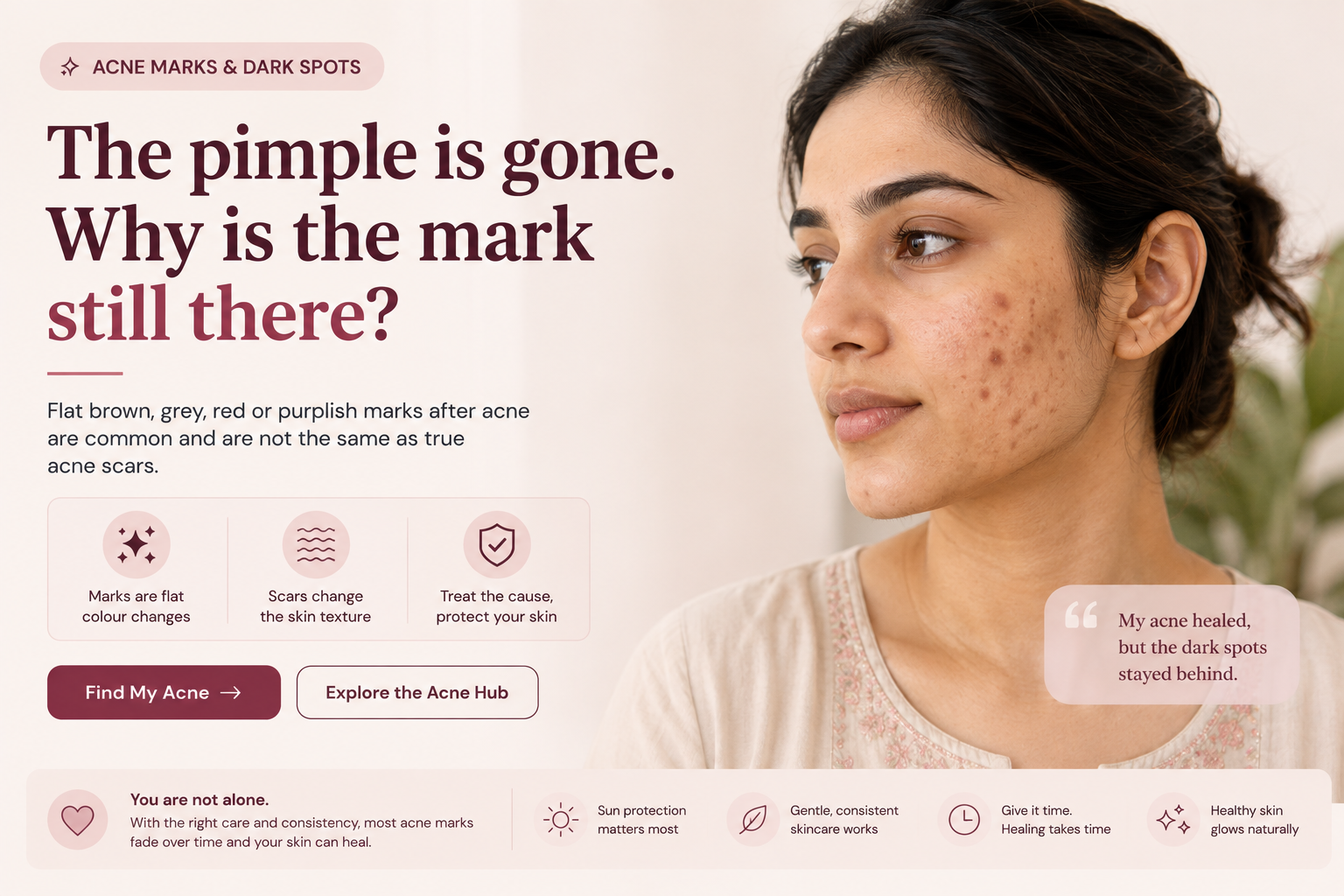
A flat dark spot left after acne is not automatically an acne scar. Often, the skin has healed but inflammation has left extra pigment behind. This is called post-inflammatory hyperpigmentation (PIH).
PIH is especially noticeable and often more persistent in medium to darker skin tones. Acne may also leave a pink or red flat mark called post-inflammatory erythema (PIE). A true acne scar, however, usually involves a change in the skin’s texture — such as a dent, pit, raised area or thickened scar.
Texture change = think scar
What kind of mark do I have?
Look at the surface of the skin as well as its colour. A dark patch and an indented scar may appear in the same place but need very different treatments.
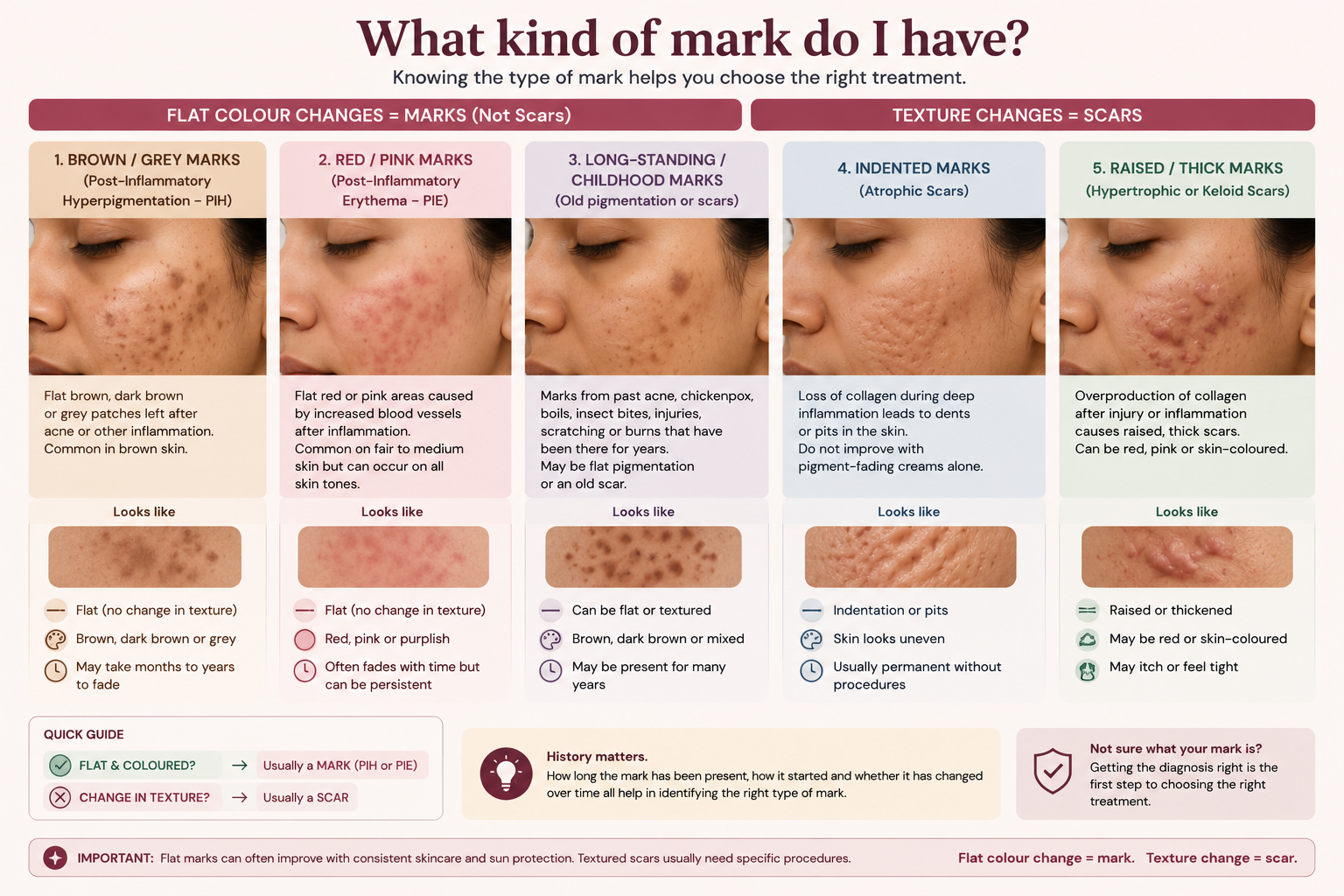
Brown or grey mark
Often post-inflammatory hyperpigmentation. Pigment remains after inflammation has settled.
Pink or red mark
May represent post-inflammatory erythema, related to vascular changes after inflammation.
Indented or pitted mark
This is more consistent with an atrophic scar rather than simple pigmentation.
Raised or thick mark
This may be a hypertrophic scar or keloid and needs scar-directed treatment.
Do you have pits, dents, rolling depressions or raised scars? Go to our Acne Scars guide .
Why do some acne marks stay for months or years?
When acne becomes inflamed, chemical signals involved in inflammation can disturb pigment production. Once the pimple disappears, excess pigment may remain in the area where the inflammation occurred.
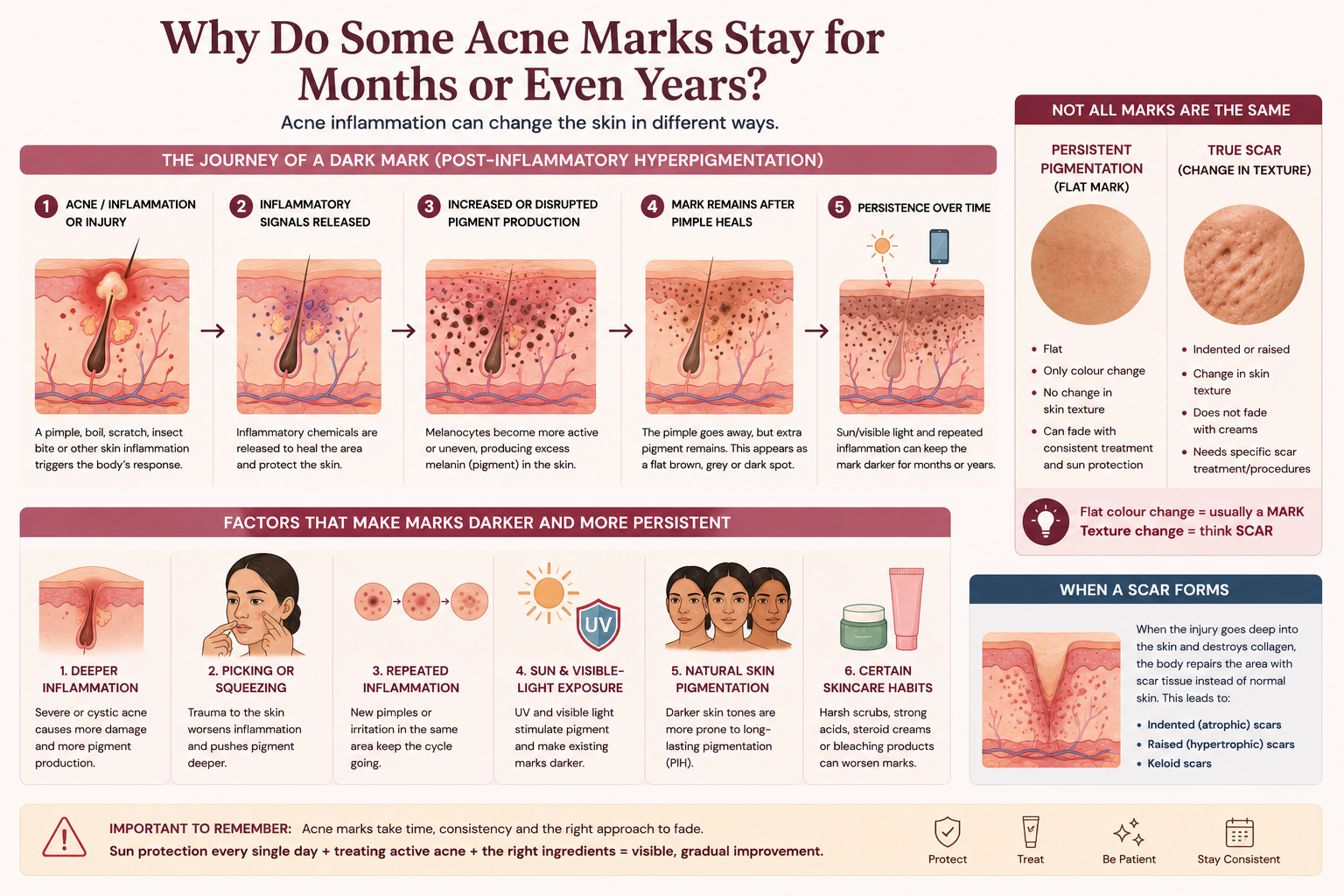
Marks may last longer when there is:
- deeper or more severe inflammation
- repeated breakouts in the same area
- picking, squeezing or scratching
- ongoing irritation from harsh skincare
- sun and visible-light exposure
- a natural tendency to develop more noticeable pigmentation after inflammation
A mark only a little darker than your natural skin tone can still take months to fade. Deeper grey-brown pigmentation may persist considerably longer. Trying stronger and stronger products is not necessarily the answer — irritation itself can create more pigmentation.
Not every longstanding mark is an acne dark spot. Old acne, chickenpox, boils, insect bites, eczema, scratching, wounds and burns can all leave lasting colour or texture changes.
Instead of automatically applying a whitening cream, first ask what the mark actually looks like.
What actually fades acne marks?
Treatment depends on whether you have active acne, flat pigmentation, persistent pigmentation or a true scar. There is no single cream that correctly treats all four.
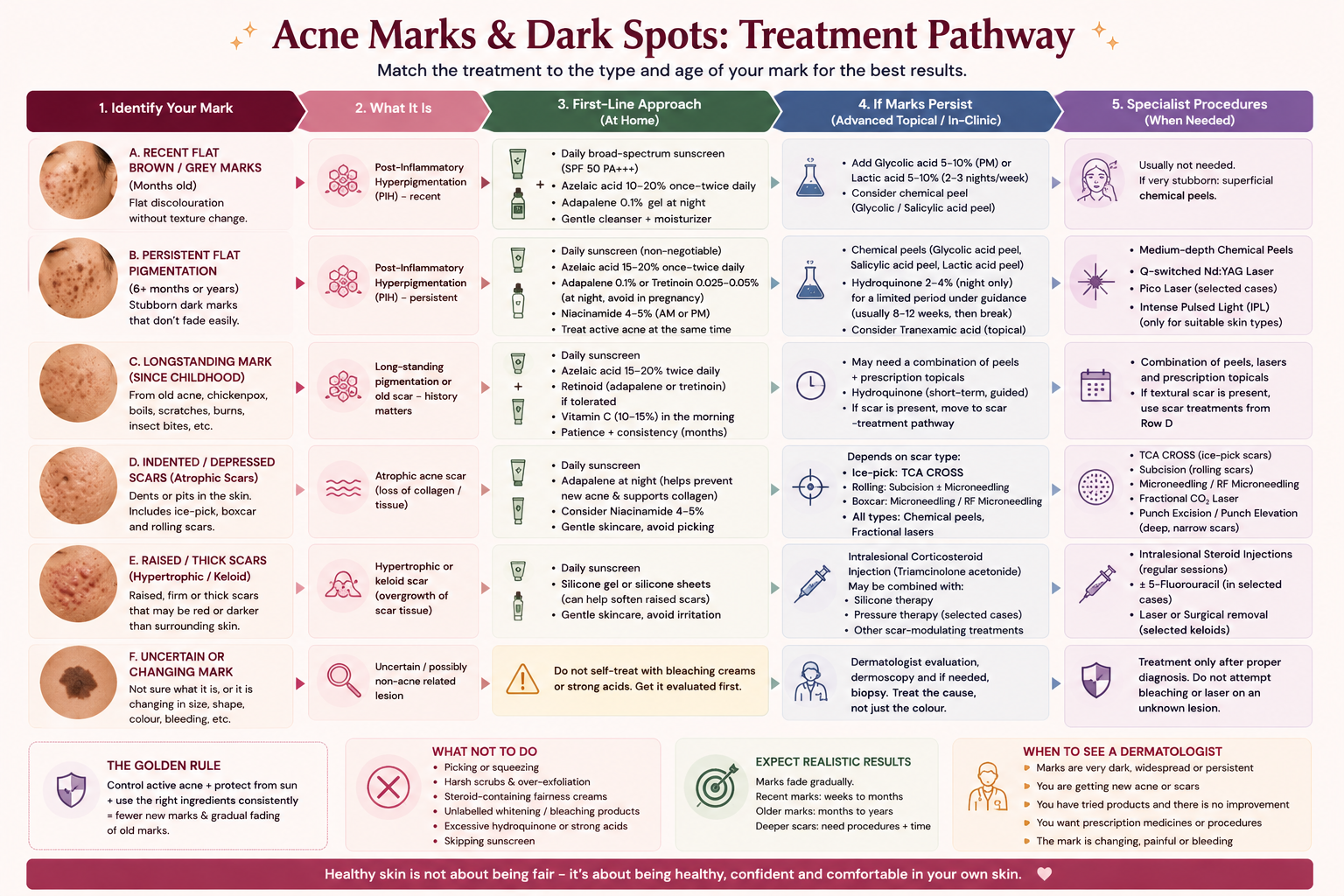
Stop new marks from forming
If acne is still appearing, treating the pigmentation alone creates a frustrating cycle: one mark fades while several new ones develop.
Your plan therefore needs to address the active acne and the dark marks together.
Depending on your acne pattern, treatment may include medicines such as benzoyl peroxide, azelaic acid, topical retinoids or other acne treatments chosen for your individual situation.
See the Acne Treatment Guide for the broader acne-treatment pathway.
Use sunscreen consistently
Sunlight can make post-inflammatory pigmentation darker and more persistent. For exposed areas such as the face, use a broad-spectrum sunscreen of at least SPF 30 every day.
In pigmentation-prone skin, a tinted sunscreen containing iron oxides may provide additional protection against visible light.
Sunscreen doesn’t “bleach” the mark. It reduces additional darkening and gives the other treatments a better chance to work.
Azelaic acid
Azelaic acid is particularly useful when acne and post-acne pigmentation occur together. It can help acne while also improving excess pigmentation.
It is often a practical option for people who want one active ingredient addressing both problems rather than stacking many irritating products.
Topical retinoids
Retinoids such as adapalene or tretinoin are primarily acne treatments, but they can also help post-inflammatory pigmentation and improve skin-cell turnover.
Start cautiously because dryness and irritation can occur. Using several strong exfoliating products alongside a retinoid may cause more irritation rather than faster improvement.
Topical retinoids should not be used during pregnancy. If you are pregnant, trying to conceive, or unsure whether a product is appropriate, discuss your treatment plan with a healthcare professional.
Niacinamide and vitamin C
Niacinamide and vitamin C are commonly used as supportive ingredients in pigmentation-focused skincare.
They may be helpful, but they should not turn a routine into a collection of six different serums. Consistency and tolerability matter more than the number of active ingredients you own.
Glycolic acid and selected chemical peels
Glycolic acid can be used in topical skincare or as part of professionally performed chemical peels. Selected glycolic or salicylic acid peels may help some patients with persistent superficial pigmentation.
More is not better. Excessive peeling, high-strength acids or poorly selected procedures can inflame the skin and make pigmentation worse — particularly in pigmentation-prone skin tones.
Hydroquinone
Hydroquinone can be effective for appropriately diagnosed hyperpigmentation, but it is not a product to use indefinitely or casually in every “fairness” routine.
Concentration, duration, diagnosis and other products being used all matter. Inappropriate or prolonged use can cause irritation and, rarely, a difficult-to-treat dark discoloration known as exogenous ochronosis.
If you think you need hydroquinone, particularly for longstanding or resistant pigmentation, use it as part of a properly supervised pigmentation plan.
What won’t fix a true acne scar?
A cream may improve colour around a scar, but it cannot reliably rebuild a significant dent, release a tethered rolling scar or flatten every keloid.
Indented scars
Depending on scar morphology and skin type, dermatologist-directed options may include microneedling, radiofrequency microneedling, subcision, TCA CROSS, fractional laser treatment, fillers, punch excision or punch elevation.
Raised scars or keloids
These need a different strategy. Treatments may include intralesional corticosteroid injections and other scar-specific approaches.
There is no single “best acne-scar procedure.” Ice-pick, boxcar, rolling and raised scars behave differently, and the patient’s skin type also affects treatment selection.
What NOT to put on stubborn dark marks
A stubborn mark can make aggressive “whitening” treatments tempting. But irritation, steroid misuse and unregulated products can leave the skin with a bigger problem than the original acne mark.
Be particularly cautious with:
- Unlabelled fairness or whitening mixtures whose full ingredients and concentrations are unknown.
- Steroid-containing creams used simply for whitening. Repeated inappropriate facial steroid use can damage the skin and cause acne-like eruptions and other complications.
- Mercury-containing skin-lightening products. Mercury exposure can cause serious systemic toxicity.
- Uncontrolled long-term hydroquinone use. More months and higher concentrations do not automatically mean better results.
- Multiple strong acids used together in an attempt to peel the pigmentation away quickly.
- Lemon juice, bleach and harsh DIY remedies. Irritation and burns can themselves cause additional pigmentation.
The goal is not to make your natural skin colour lighter. It is to treat abnormal pigmentation and help the affected area move closer to your normal skin tone.
A simple routine for acne + dark marks
Keep protection simple
- gentle cleanser
- selected acne/pigmentation treatment if appropriate
- non-comedogenic moisturiser if needed
- broad-spectrum SPF 30+ sunscreen
Treat without overloading
- gentle cleanser
- one appropriately selected active treatment
- moisturiser as needed
- avoid picking and aggressive scrubbing
Your exact routine depends on whether you have comedonal acne, inflammatory acne, sensitive skin, pregnancy, eczema or another skin condition.
For a full routine, see Acne Skincare Routine .
Pregnant or trying to conceive?
Don’t copy a standard pigmentation routine without checking the ingredients. In particular, topical retinoids such as adapalene and tretinoin should be avoided during pregnancy.
Pregnancy can also change pigmentation patterns, so a new facial pigmentation problem is not automatically an acne mark.
When should I see a doctor or dermatologist?
Consider professional assessment if:
- you are developing dents, pits or raised scars
- your acne is deep, painful or continuing to scar
- pigmentation continues despite a consistent sensible routine
- you are considering hydroquinone, chemical peels, lasers or scar procedures
- a longstanding mark has changed
- you are not sure the pigmentation was caused by acne
- you are pregnant or trying to conceive and need acne treatment
- dark marks or acne are affecting your confidence or quality of life
Still getting new acne?
Fading old marks is only half the job. Identify your current acne pattern so you can work on preventing the next marks from forming.
Find My Acne →Continue exploring Acne
Medical references
- American Academy of Dermatology — Hyperpigmentation and dark spots in darker skin tones
- American Academy of Dermatology — Acne clinical guidance
- DermNet — Post-inflammatory hyperpigmentation
- DermNet — Acne scarring
- U.S. Food and Drug Administration — Safety warnings regarding certain skin-lightening products