
Acne Skincare Routine
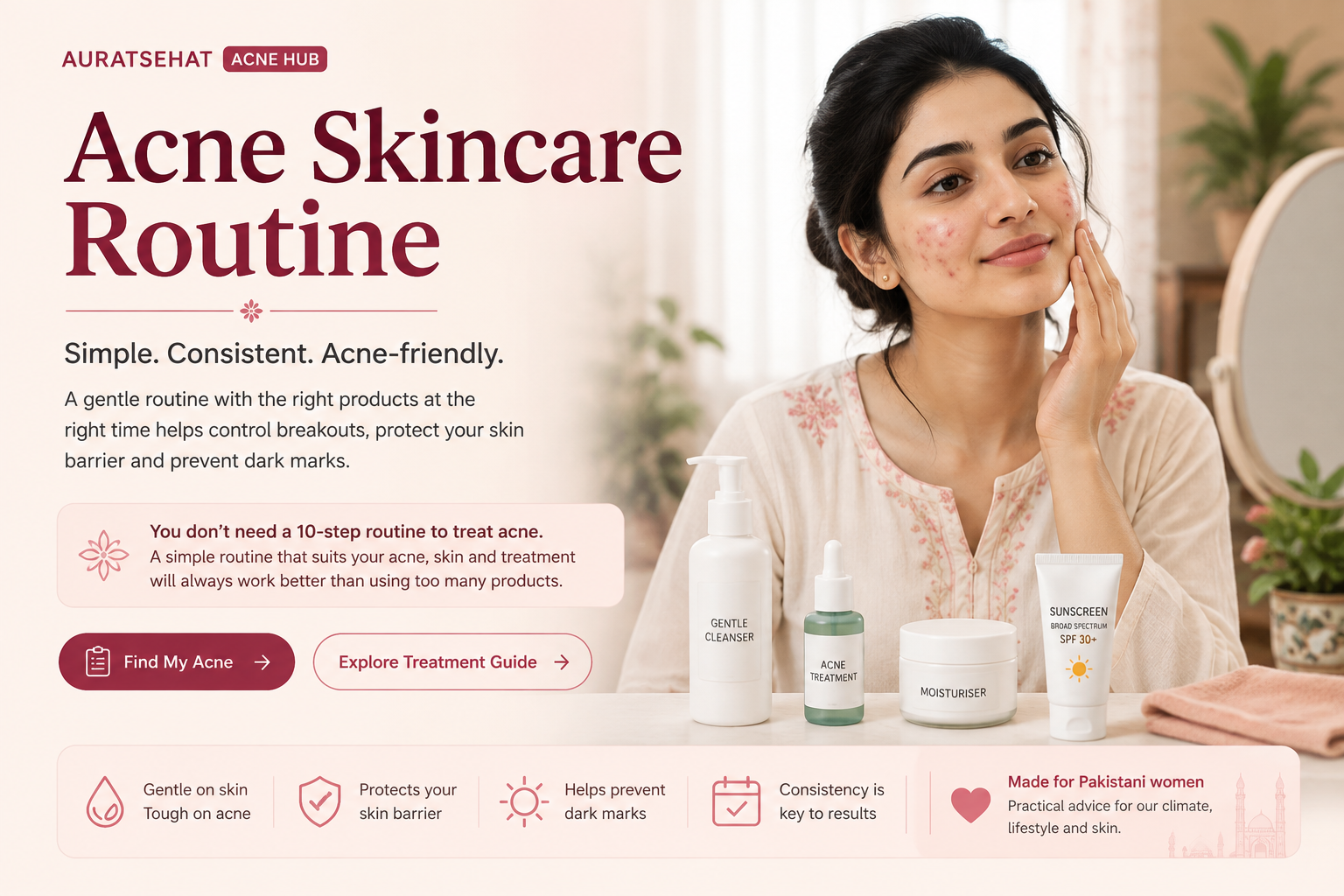
You do not need a 10-step skincare routine to manage acne. A simple routine built around gentle cleansing, the right acne treatment, moisturiser and sunscreen is often easier to tolerate — and easier to follow consistently.
What should an acne routine actually look like?
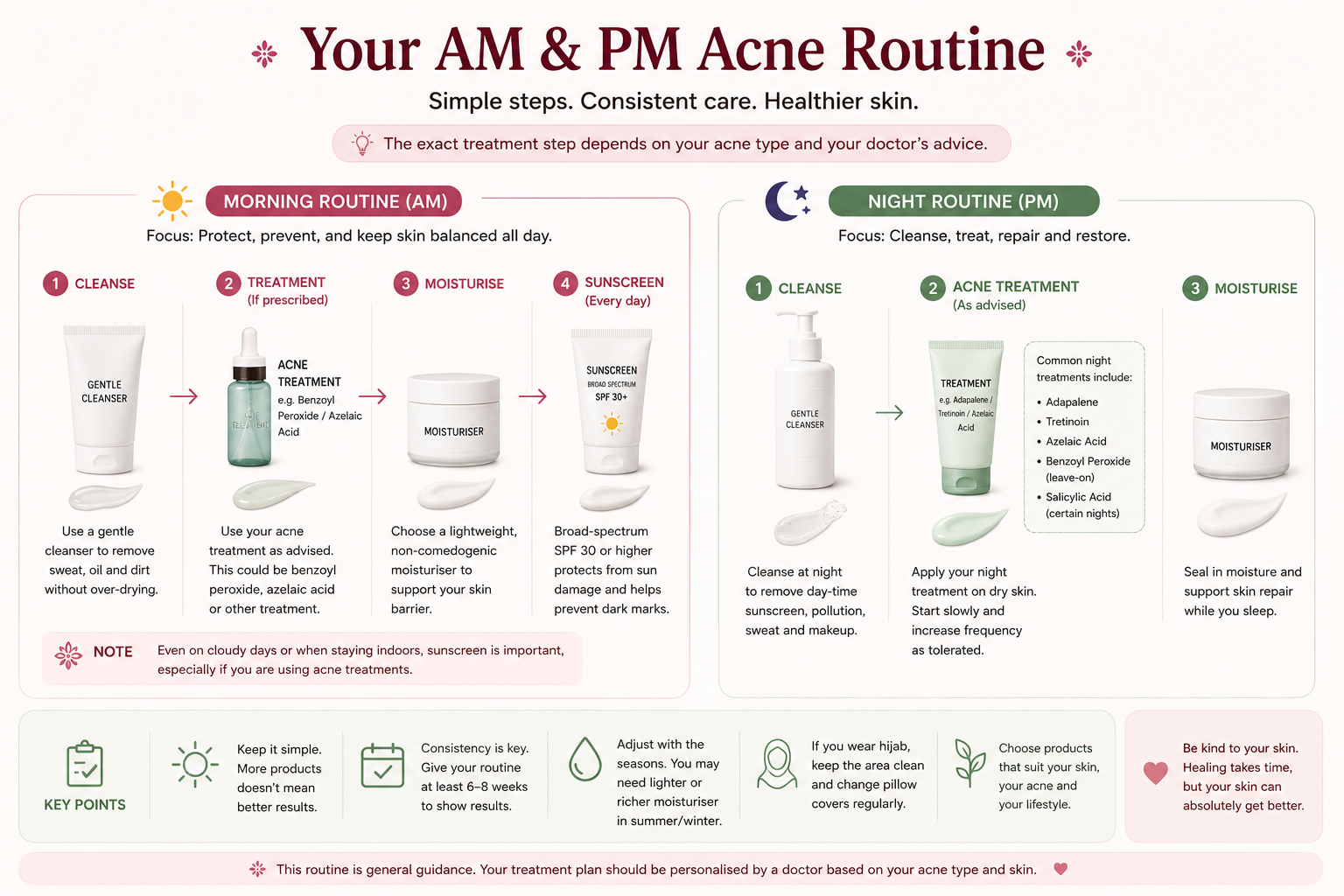
For most people, the basic structure can stay surprisingly simple. Your treatment may change depending on whether you mainly have blackheads, inflamed pimples, deeper acne, hormonal-pattern acne or sensitive skin, but the foundation is usually similar.
- Gentle cleanser
- Acne treatment if part of your plan
- Non-comedogenic moisturiser
- Broad-spectrum sunscreen
- Gentle cleanser
- Acne treatment
- Moisturiser
Some treatments are used once daily, some only at night, and some people are advised to start treatment only a few nights each week. Follow the instructions for the treatment you are using rather than assuming every acne ingredient should be applied twice daily.
Step 1: Choose a gentle cleanser
Acne does not mean your face is dirty. Washing harder or more frequently does not remove the process happening inside the hair follicle, and excessive cleansing can leave the skin dry, tight and irritated.
A good acne cleanser should ideally:
- remove sweat, oil, sunscreen and everyday dirt without leaving the skin painfully tight;
- be gentle enough for regular use;
- work with your acne treatment rather than constantly irritating your skin;
- be non-comedogenic where possible.
Washing once in the morning and once at night is enough for many people. You may also want to cleanse after heavy sweating, particularly in hot and humid weather.
Scrubbing brushes, rough washcloths and abrasive facial scrubs are not necessary for acne.
Acne skincare in Pakistan: heat, sweat and humidity
Pakistani weather can make acne skincare frustrating. During hot and humid months, sunscreen, moisturiser, sweat and oil can make the face feel heavy very quickly. That does not mean you should stop moisturising or wash your face every hour.
Instead, lighter gel or lotion textures may feel more comfortable in summer. In colder or drier weather, especially if you are using a retinoid or benzoyl peroxide, you may need a more moisturising formulation.
A hijab, dupatta, helmet strap, mask or other material does not automatically cause acne, but repeated heat, sweating, friction and occlusion can aggravate breakouts in some people. Keeping frequently used fabrics clean and avoiding excessive rubbing can help.
Step 2: Yes, acne-prone skin still needs moisturiser
People with oily skin often avoid moisturiser because they are worried it will cause more acne. But acne treatments themselves can dry and irritate the skin.
A suitable moisturiser can support the skin barrier and make it easier to continue treatment consistently.
If your skin feels oily
Look for a lightweight lotion or gel texture labelled non-comedogenic or suitable for acne-prone skin.
If your skin is dry or sensitive
A richer fragrance-free moisturiser may be more comfortable, particularly when using irritating acne treatments.
You do not need to choose products simply because they say oil-free. Formulation and how your own skin tolerates the product matter more.
Step 3: Sunscreen is part of acne care
Sunscreen does not treat acne itself, but it is an important part of the routine. Sun exposure can make post-acne pigmentation more noticeable and some acne treatments make the skin more vulnerable to irritation from sunlight.
Choose a broad-spectrum sunscreen that you can realistically wear every morning. For oily or acne-prone skin, lightweight fluid, gel or non-comedogenic formulations may feel more comfortable.
Where do acne treatments fit?
Your skincare routine should support your acne treatment — not become a second treatment programme containing six different active ingredients.
Which medicine is appropriate depends on your acne type, severity, pregnancy status, previous treatments and individual medical situation.
Benzoyl peroxide
Benzoyl peroxide can be useful particularly for inflammatory acne. It may cause dryness or irritation when first introduced, so some people need to start gradually. It can also bleach towels, pillowcases and clothing.
Adapalene or tretinoin
Topical retinoids help prevent follicular blockage and are particularly useful for comedonal acne as well as broader acne treatment plans. They are usually applied at night and can initially cause dryness, peeling or irritation.
Azelaic acid
Azelaic acid can be useful for acne and may also help post-inflammatory pigmentation. It is often better tolerated than some stronger irritating treatments, although stinging or irritation can still occur.
Salicylic acid
Salicylic acid can help with clogged pores and may appear in cleansers or leave-on products. But adding salicylic acid to a routine already containing multiple irritating actives can sometimes cause more irritation than benefit.
How should I layer acne products?
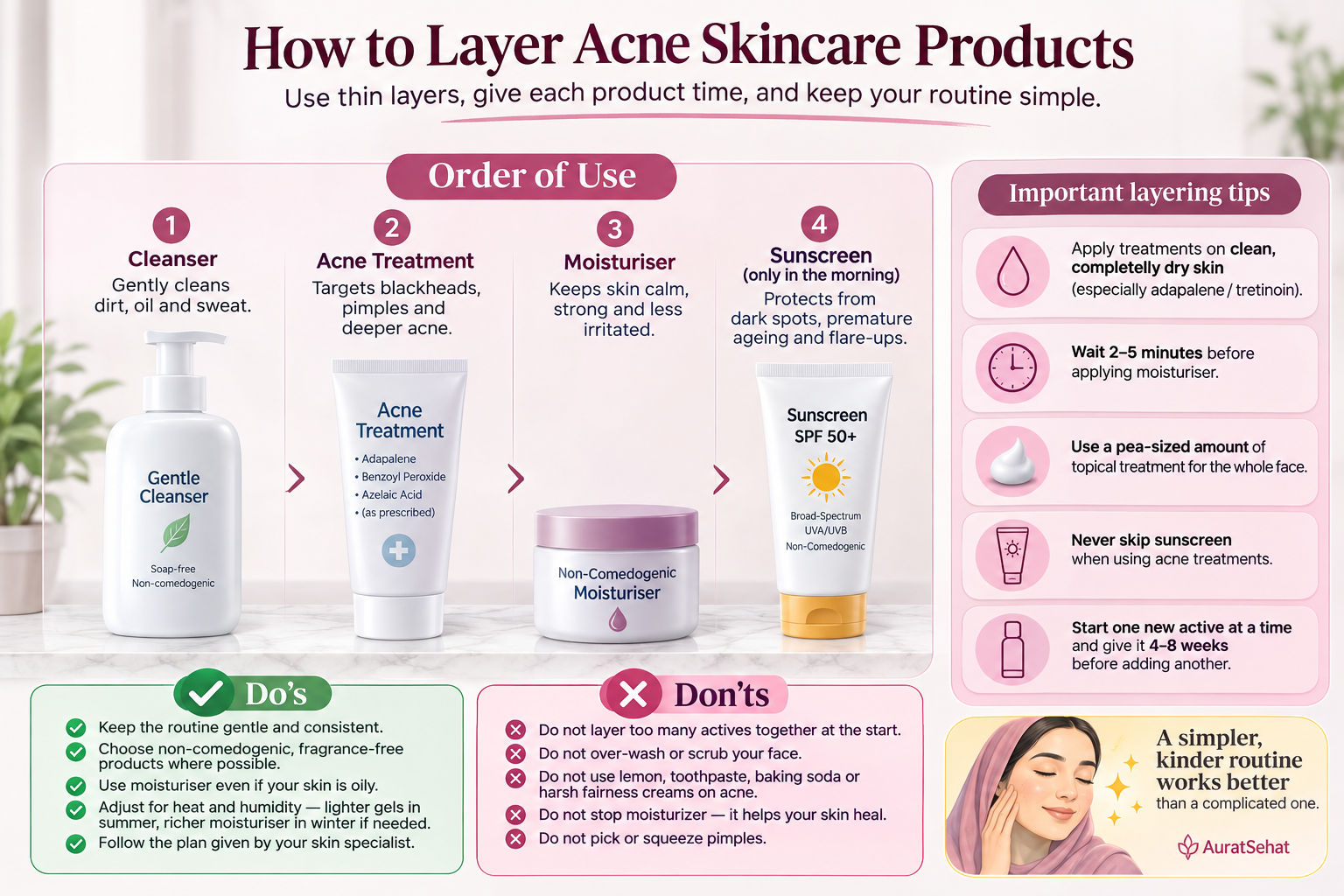
In most simple acne routines, think:
However, there is no prize for applying the greatest number of active ingredients. One appropriately chosen acne medicine used consistently is often more useful than repeatedly changing between acids, serums and spot treatments.
If a retinoid irritates your skin, some clinicians recommend applying moisturiser before and/or after the retinoid — sometimes called the “sandwich” approach — to improve tolerance.
Do not start everything at once
One of the easiest ways to make acne skincare fail is to start several new active ingredients on the same night.
If your skin then becomes red, burning and peeling, you will not know which product caused it.
A calmer approach
- Introduce one major active at a time.
- Start slowly if the treatment is known to be irritating.
- Use moisturiser consistently.
- Increase frequency only as tolerated and according to your treatment plan.
- Give treatment enough time to work before constantly switching products.
Is my skin “purging” — or just irritated?
The word purging is often used online for almost any breakout after starting skincare. That can be misleading.
Some treatments that influence follicular turnover, particularly retinoids, can be associated with an early temporary worsening of acne in some users. But severe burning, widespread redness, painful cracking, swelling or intense itching should not simply be accepted as proof that a product is “working.”
If you have very oily acne-prone skin
Oily skin can tempt you to use strong foaming cleansers, alcohol-heavy toners and repeated clay masks. These may make the face feel temporarily “squeaky clean” without treating the underlying acne.
Keep the same basic routine and choose lighter product textures instead: gentle cleanser, appropriately selected acne treatment, lightweight moisturiser and sunscreen.
If your acne-prone skin is dry or sensitive
Acne and sensitive skin can occur together. In this situation, the treatment may need to be introduced more cautiously.
Prioritise a fragrance-free gentle cleanser, a supportive moisturiser, and avoid stacking several acids or exfoliating products on top of prescription acne treatment.
Can I wear makeup if I have acne?
Yes. Having acne does not mean you must stop wearing makeup.
Where possible, look for products described as non-comedogenic or suitable for acne-prone skin. Remove makeup gently at the end of the day and keep makeup brushes and sponges reasonably clean.
Avoid aggressively scrubbing the face to remove foundation. If you wear heavy or water-resistant makeup, a gentle first cleansing step followed by your normal cleanser may be useful.
Do acne patches work?
Hydrocolloid acne patches can help protect certain superficial pimples from touching or picking and may absorb fluid from a spot that has already come to the surface.
They do not treat deep nodules or cysts beneath the skin and should not replace an appropriate treatment plan for ongoing acne.
Do I need to exfoliate?
Not necessarily.
Many acne treatments already affect follicular turnover. Adding frequent scrubs, exfoliating toners, glycolic acid, salicylic acid and retinoids together can easily result in irritation.
If exfoliation is used, it should fit into the overall routine rather than being treated as a separate requirement for “clean skin.”
What about shaving, threading and facial hair removal?
Facial hair removal can temporarily irritate acne-prone skin. Avoid repeatedly passing a razor over inflamed acne and be cautious with waxing or threading directly over irritated skin.
If you use topical retinoids or other irritating treatments, ask your clinician about whether these should be paused around procedures such as waxing, since the skin may be more sensitive.
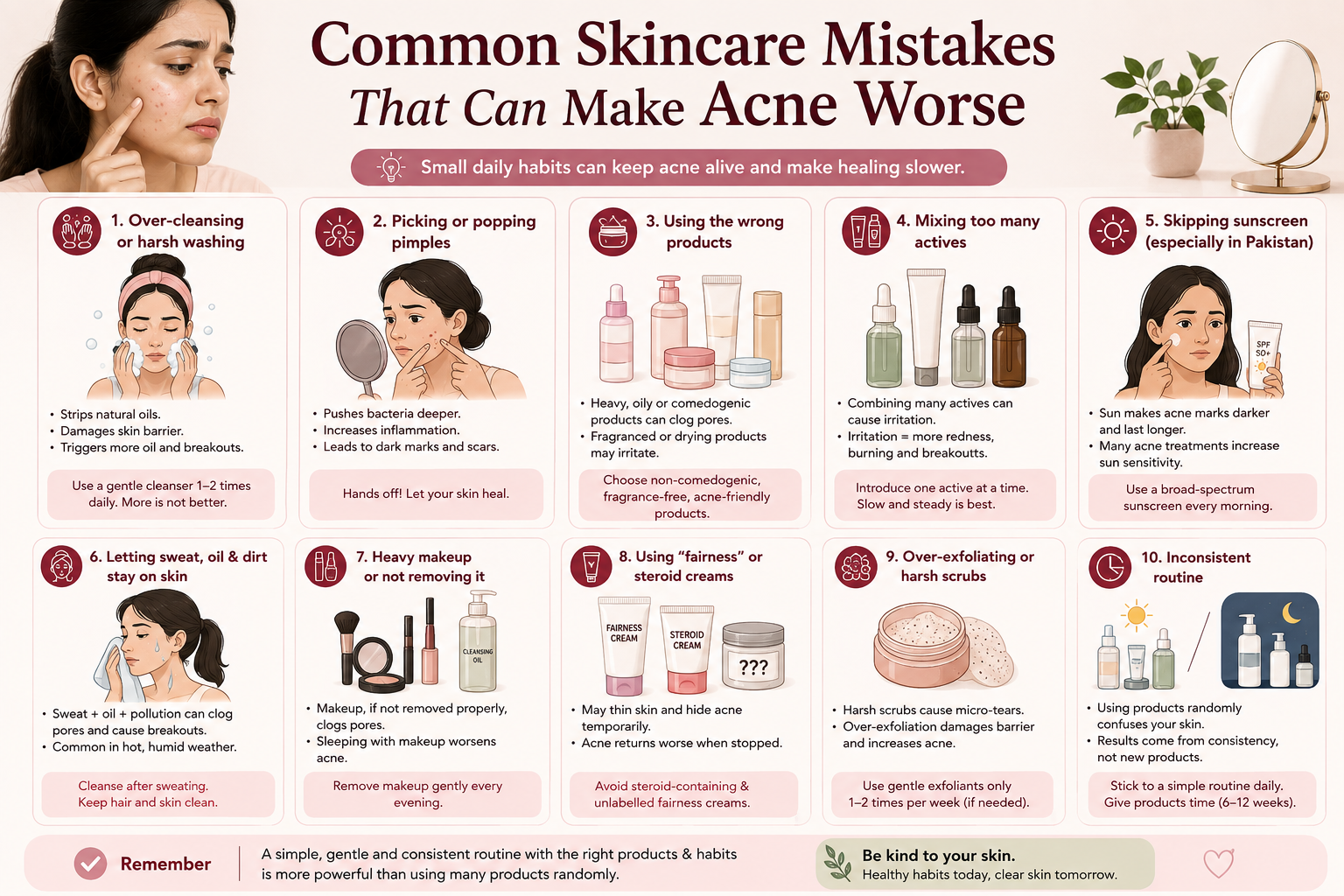
Common skincare mistakes that can make acne worse
Most acne skincare mistakes come from trying to do too much rather than too little.
What should you NOT put on acne?
Acne advice on social media frequently recommends ingredients that were never designed to be used as acne treatments.
Highly acidic and potentially irritating. Irritation can worsen redness and post-inflammatory pigmentation.
Toothpaste is designed for teeth, not facial skin. It can dry and irritate a pimple without properly treating acne.
It can disrupt the skin barrier and is not an evidence-based acne treatment.
Acne is not dirt trapped on the surface. Scrubbing can increase irritation and inflammation.
Be careful with “fairness”, whitening and mixed medicated creams
This is particularly important in Pakistan, where unlabelled or mixed creams may be sold for acne, pigmentation, “fairness” or rapid skin brightening.
Some combination creams may contain potent topical corticosteroids or other medicines that are not appropriate for long-term unsupervised facial use. Steroids can temporarily reduce redness while eventually worsening acne-like eruptions, thinning the skin and creating other complications.
Do I need expensive imported skincare?
No.
Acne does not respond according to the price of the bottle. A basic cleanser, suitable moisturiser, sunscreen and evidence-based acne treatment can form an excellent routine.
When comparing products, focus on what the product actually does, how your skin tolerates it, whether it fits your treatment plan and whether you can afford to use it consistently.
How long should I give my acne routine?
Acne treatment takes time. It is common to judge a routine after only a few days, but most established acne treatments need several weeks before meaningful improvement can be assessed.
The exact timeline depends on the treatment and severity of acne. If acne is worsening significantly, causing deep painful lumps or leaving scars, do not simply keep experimenting with skincare indefinitely.
When skincare is not enough
Seek medical assessment if you have:
- deep, painful nodules or cysts;
- acne that is beginning to scar;
- widespread moderate or severe inflammatory acne;
- acne that has not improved despite a reasonable treatment trial;
- significant dark marks or scarring affecting your confidence;
- adult acne with irregular periods or other signs of androgen excess;
- possible pregnancy while using acne medicines;
- a rash or eruption that may not actually be acne.
Not sure what kind of acne you have?
Blackheads, inflamed pimples, hormonal-pattern acne and deep painful acne do not all need exactly the same treatment.
Find My Acne →Continue through the Acne Hub
Acne Treatment Guide
Understand the major acne treatment options and how treatment changes with acne severity.
Read the treatment guide →Hormonal Acne in Women
Learn when hormones may be contributing to adult acne and which additional clues matter.
Read about hormonal acne →Nodular & Cystic Acne
Deep painful acne carries a higher risk of scarring and may need stronger treatment.
Read about deep acne →Acne Marks & Dark Spots
Learn why flat brown or grey marks remain after acne and what may help them fade.
Read about acne marks →The AuratSehat takeaway
Acne-prone skin does not need punishment. Cleanse gently, use the right treatment, moisturise, protect your skin from the sun and give your routine enough time to work.
Consistency usually matters more than complexity.
Still unsure what to use on your skin?
If your acne is painful, keeps returning, is leaving marks or scars, or you are confused about which skincare products or acne treatments are appropriate for you, you can ask AuratSehat.
Ask a Doctor for Free →