
Oily Skin Explained — Why Is My Face So Oily?
You wash your face in the morning. It feels clean. An hour or two later, your nose is shiny again. By afternoon your forehead feels greasy and your sunscreen may feel heavier.
Why does the oil keep coming back?
Because washing removes the oil already sitting on your skin. It doesn’t switch off the sebaceous glands underneath it.
What actually makes your face oily?
Inside your skin are tiny structures called sebaceous glands. They produce an oily substance called sebum.
Sebaceous gland
Produces sebum
Reaches skin surface
The problem is not that sebum exists. The problem is when your skin produces enough of it that you are persistently shiny, greasy, uncomfortable or prone to related concerns such as clogged follicles.
“I washed my face. Why is it oily AGAIN?”
A cleanser mainly removes sweat, dirt, products and oil that are already sitting on the surface of your skin.
Meanwhile, your sebaceous glands underneath the surface are still functioning. As new sebum reaches the surface, the shine gradually returns.
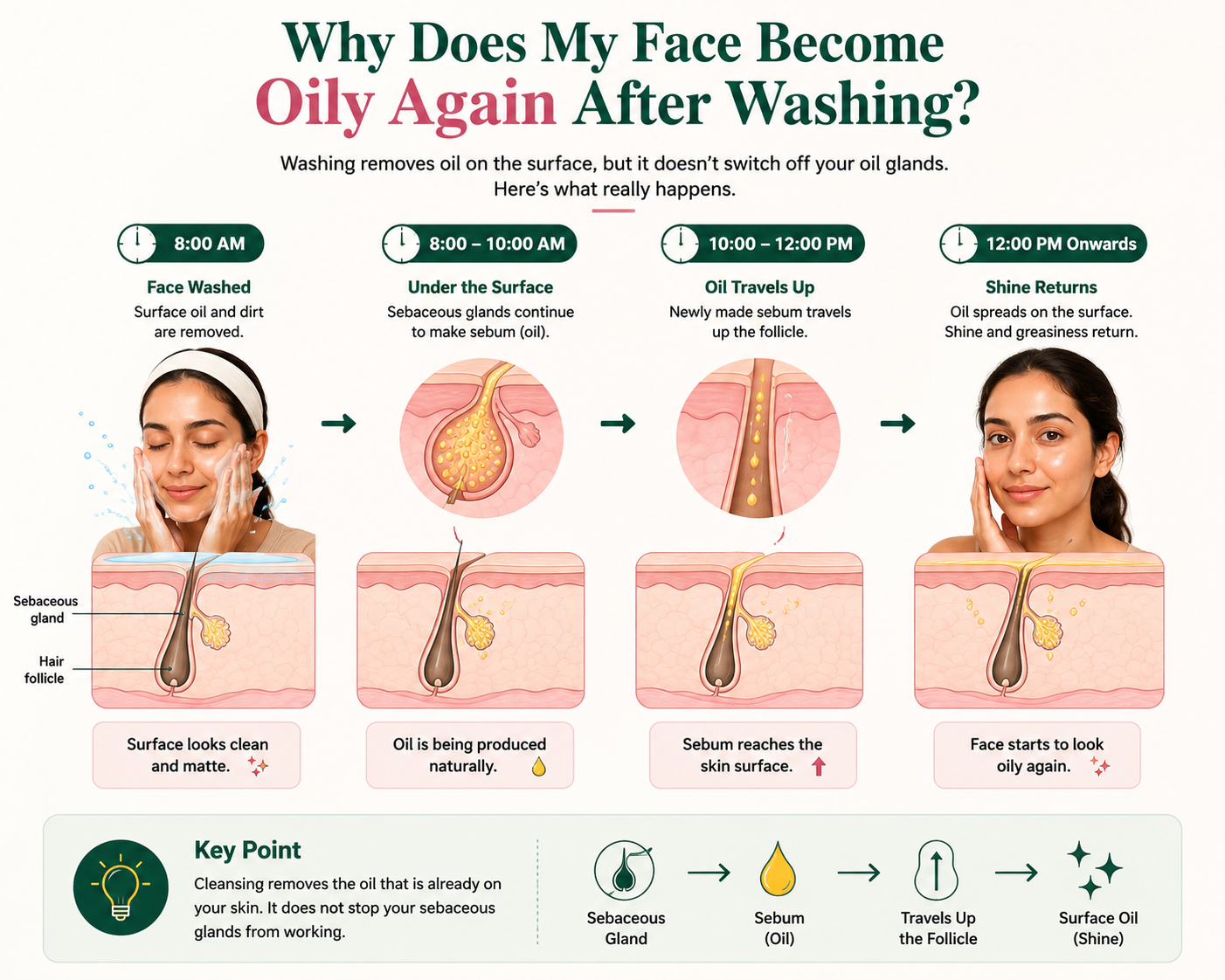
That’s why repeatedly washing your face every time you notice shine isn’t a good long-term strategy. You may keep removing the surface oil while doing nothing about the biology underneath.
Why do some women produce much more oil?
There isn’t one universal cause. Sebum production varies considerably between people and is influenced by several factors.
Genetics & Biology
Some people simply have naturally higher sebaceous activity than others.
Hormones
Androgens are important regulators of sebaceous glands—and women have androgens too.
Age
Sebaceous activity changes throughout life and commonly becomes much more noticeable around puberty.
Environment
Facial sebum and how oily your skin feels can vary with season, temperature and environmental conditions.
That does not mean everyone’s skin behaves identically. Sebaceous glands can differ in activity and local hormonal responsiveness between individuals.
Oily skin or combination skin?
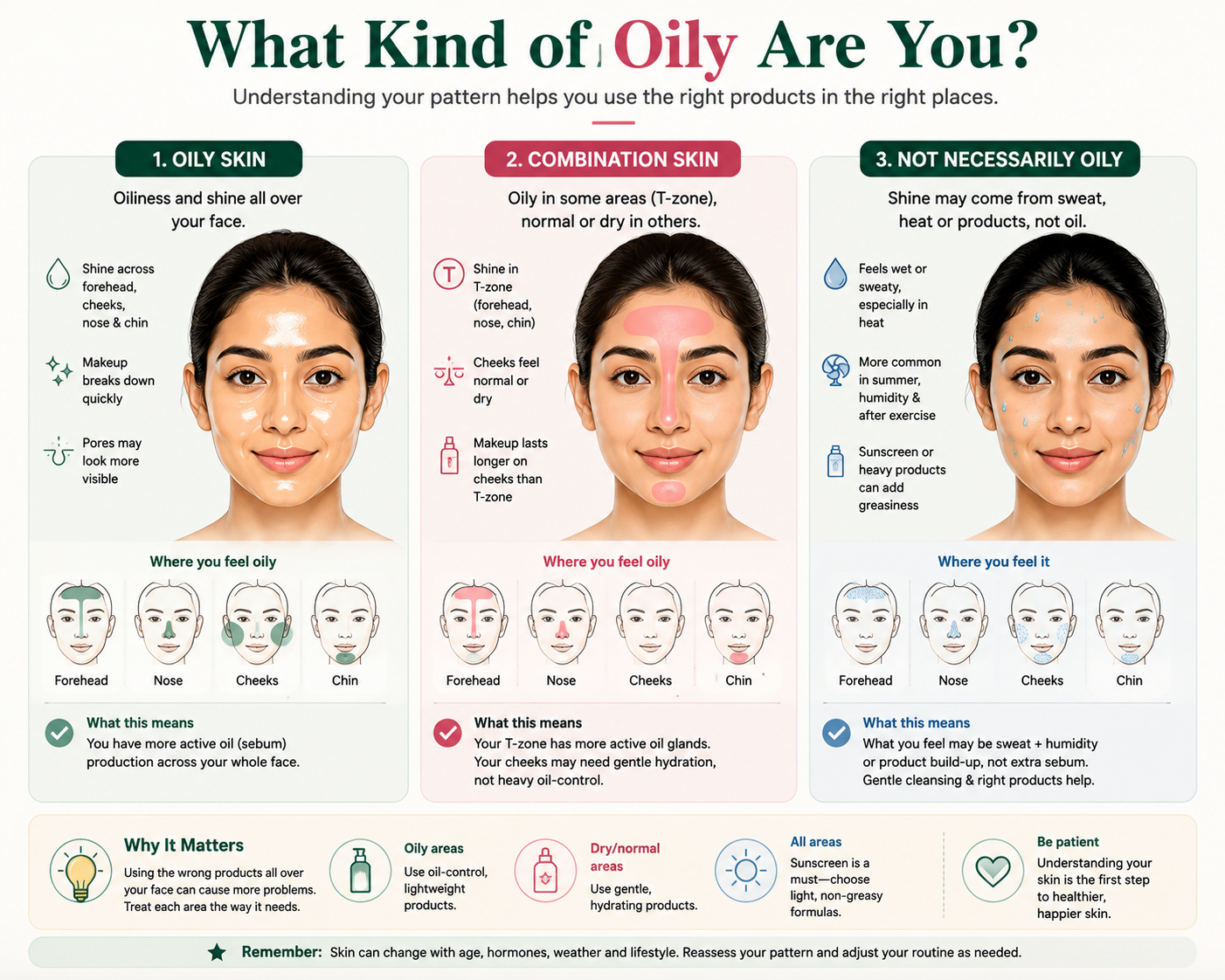
Not everyone who has an oily nose has uniformly oily skin.
✨ Oily Skin
Much of the face—including the cheeks—regularly develops noticeable oil or shine.
◐ Combination Skin
The forehead, nose and chin are oilier while the cheeks may be normal or dry.
💧 Mostly Sweating
If the shine appears mainly with heat or exercise, some of what you are noticing may be sweat rather than sebum.
Why is my nose SO much oilier?
Sebaceous glands are not distributed equally across your body. Areas such as the face and scalp contain many sebaceous glands, and facial oiliness can be particularly obvious around the nose and central face.
If your oily nose also seems covered with tiny grey, brown or black dots, however, you may be looking at more than oil.
Surface Sebum
The oil itself can create visible shine.
Sebaceous Filaments
Normal follicular structures can appear as tiny dots, especially on the nose.
Blackheads
Open comedones are different from normal sebaceous filaments.
If the dots and pores bother you more than the shine itself, read our dedicated guide to open pores, blackheads and sebaceous filaments .
Sweat and oil are not the same thing.
This distinction matters enormously in hot Pakistani weather.
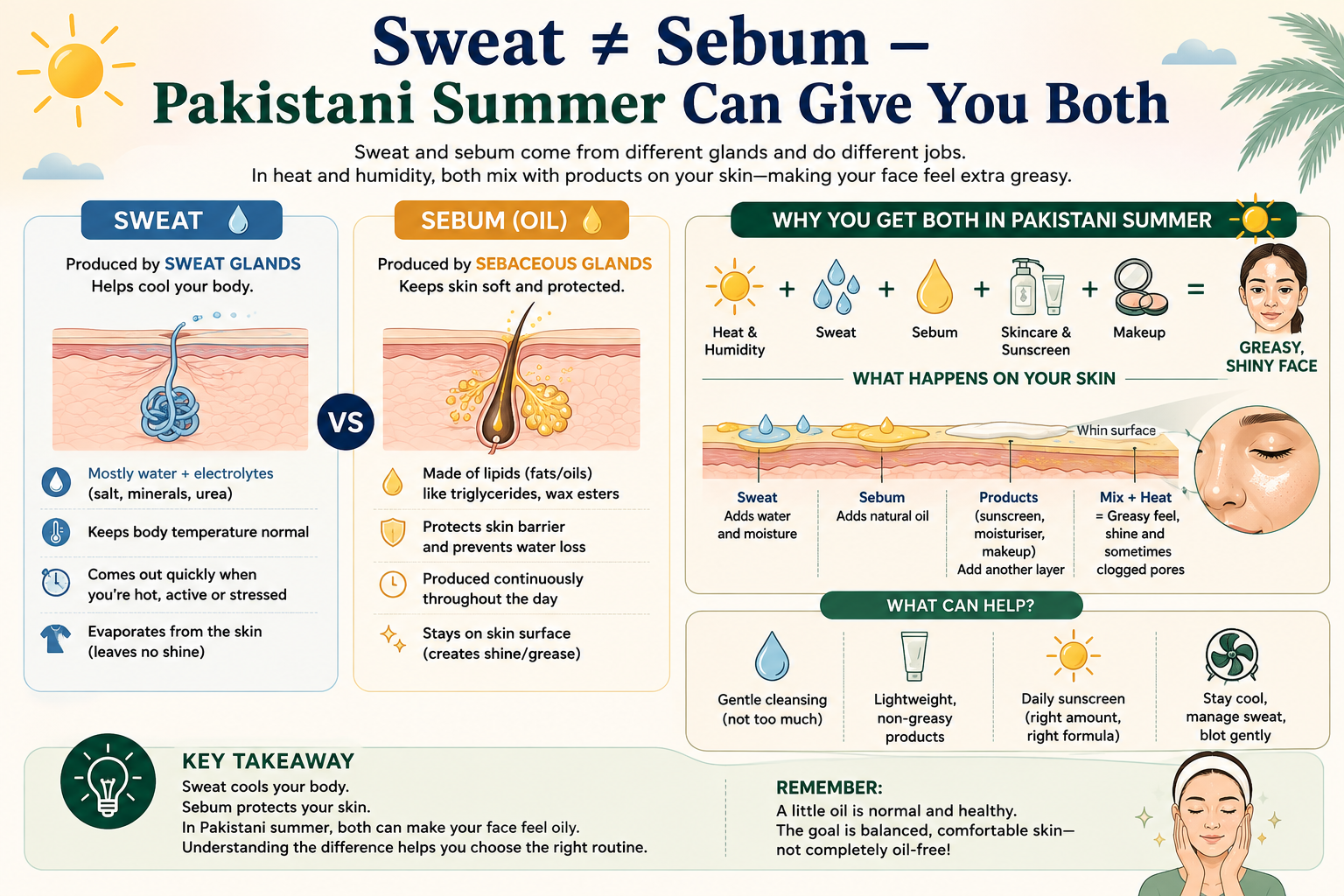
Sweat
Comes from sweat glands and is mostly water with dissolved electrolytes. One of its major jobs is helping your body regulate temperature.
Sebum
Comes from sebaceous glands and is lipid-rich. It contributes to the oily film on the skin.
Heat + sweat + your normal sebum + moisturiser + sunscreen + makeup can create a much greasier-feeling face by afternoon.
That doesn’t mean we need to claim that humidity simply “switches your oil glands into overdrive.” Skin physiology can vary with environmental conditions and seasons, but the experience of summer greasiness is also affected by sweat and everything layered on the skin.
“My face is oily but somehow it still feels dry.”
This sounds contradictory only if we assume that oil and water are the same thing.
SEBUM / OIL
Describes lipids produced by sebaceous glands.
HYDRATION
Relates to water within the outer layers of your skin.
Therefore, skin can be visibly oily while also feeling tight, rough, irritated or uncomfortable—particularly if the skin barrier has been disturbed by harsh products.
“Your skin is dehydrated, so it panics and produces extra oil.”
Oily skin and dehydration can coexist. But we should not automatically tell every person with oily skin that dehydration is the reason their sebaceous glands are producing excess oil.
And yes—this is also why having oily skin does not automatically mean moisturiser is unnecessary. The right texture matters.
Build an Oily-Skin Routine →Did washing too much MAKE your skin oily?
This is another situation where a reasonable warning has turned into an oversimplified internet explanation.
What harsh cleansing CAN do
Frequent washing and aggressive cleansers can leave skin dry, irritated, tight or uncomfortable.
What we shouldn’t automatically claim
That your skin “detects” every bit of dryness and immediately responds by dramatically increasing sebaceous-gland production.
Does eating oily food make your face oily?
Biryani, samosa or paratha → oily face?
The fat in an oily meal does not simply travel to your face and become the sebum on your nose.
Diet can interact with hormones, metabolism and skin disease in more complicated ways, but oily food = oily skin is far too simplistic.
Will drinking lots of water stop the oil?
Staying adequately hydrated is important for general health.
But drinking excessive amounts of water is not an established treatment for overactive sebaceous glands.
What Pakistani women commonly hear about oily skin
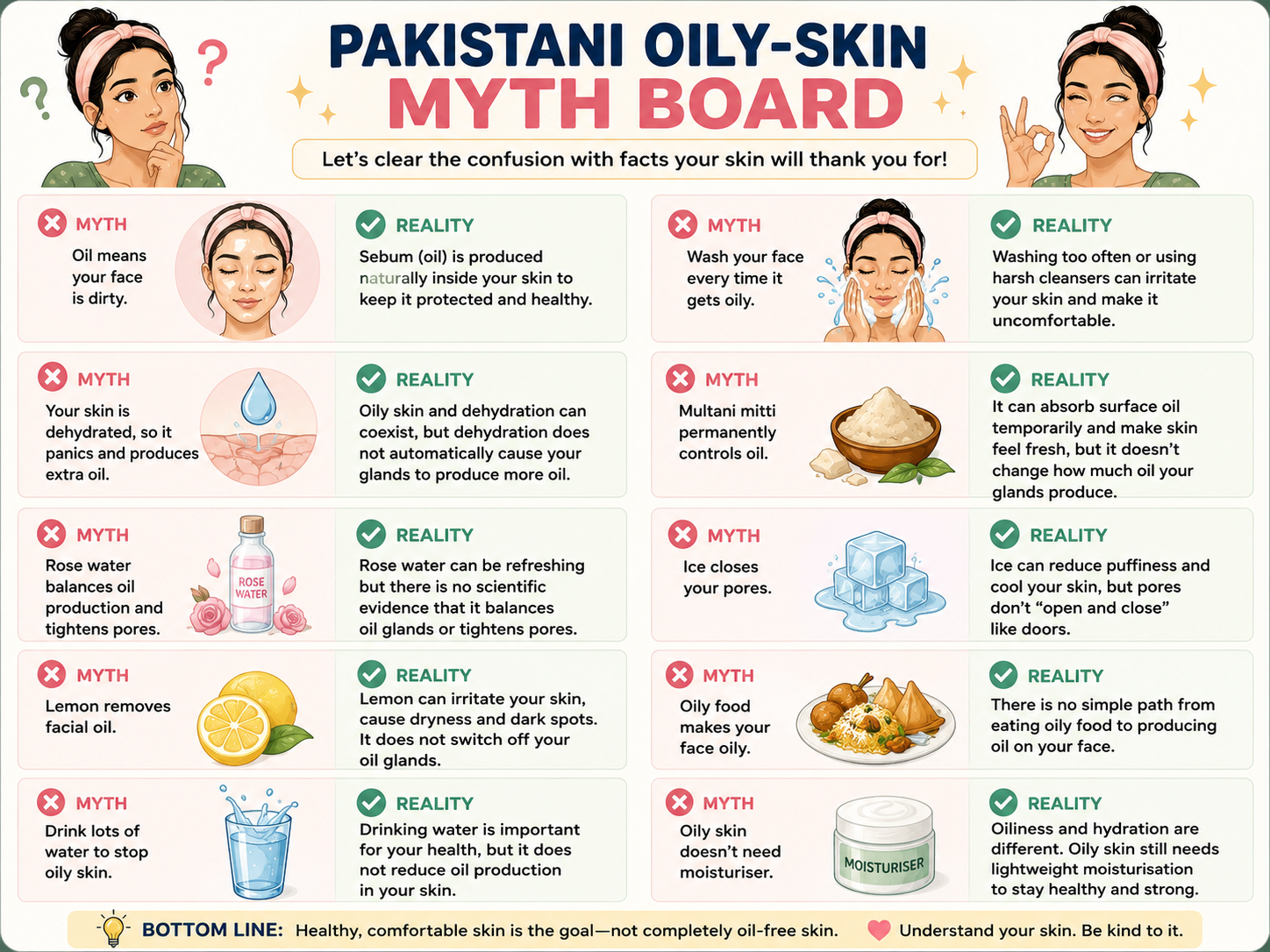
Some advice has a small truth hidden inside it. Some is simply exaggerated. Here’s the distinction.
🪨 Multani mitti
Clay can absorb some surface oil temporarily. That does not mean it permanently reduces how much sebum your glands produce.
🌹 Rose water
It may feel refreshing, but don’t rely on rose water as a proven way to “balance” sebaceous glands.
🧊 Ice
Cooling can temporarily change how skin looks and feels. Pores do not literally open and close like doors.
🍋 Lemon
Lemon juice is not a sebum treatment and can irritate facial skin.
What does “OIL CONTROL” on a bottle actually mean?
Social-media advertising can make every “oil-control” product sound as though it switches off your sebaceous glands. Usually, the reality is more complicated.
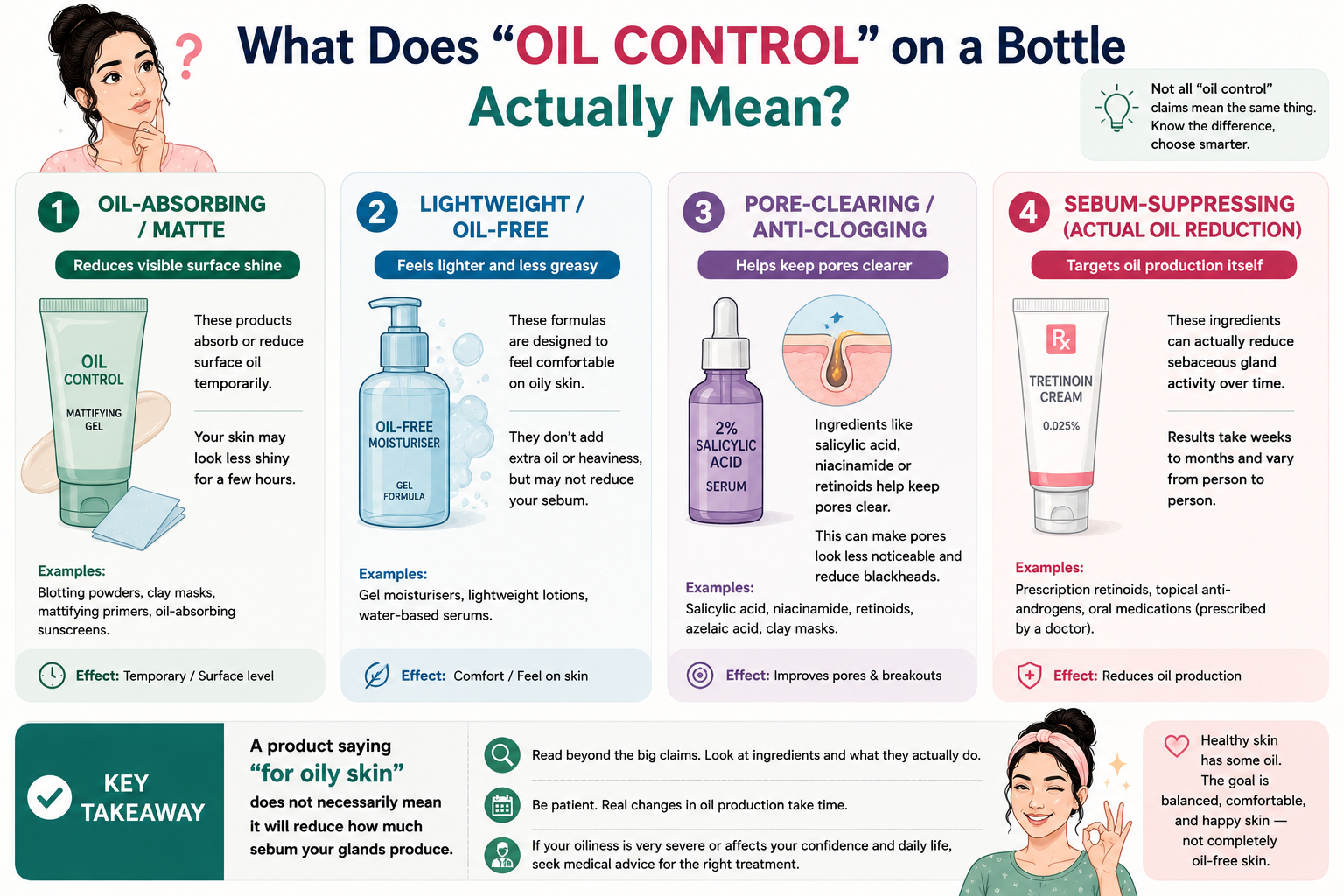
✨ Mattifying / oil absorbing
A product may absorb surface oil or reduce visible shine for a period of time. That is useful—but it isn’t necessarily changing the gland underneath.
💧 Lightweight / oil-free
This may primarily describe how comfortable or non-greasy the formula feels on oily skin.
🫧 Pore-clearing
Ingredients can help reduce follicular clogging or improve blackheads without necessarily producing a dramatic reduction in total sebum output.
⚕️ Sebum reduction
Actually changing sebaceous-gland activity is a different biological target. Some medical approaches can affect sebum much more strongly than ordinary cosmetic “oil-control” products.
If your oiliness remains severe despite a sensible routine, our guide to medical treatment for excessively oily skin explains what dermatology can—and cannot—do.
“My acne improved—but I’m STILL oily.”
That doesn’t necessarily mean your acne treatment failed.
Acne is not simply “too much oil.” It involves several interacting processes, including sebum, changes inside the follicle, inflammation and microorganisms.
Sebum
Follicular plugging
Inflammation & other factors
If breakouts—not shine—are your main concern, go directly to the AuratSehat Acne Hub .
Could oily skin mean PCOS?
Oily skin alone does not mean you have PCOS.
But androgens influence sebaceous glands, so oiliness becomes more meaningful when it appears as part of a wider pattern.
Pay attention if significant oiliness occurs alongside:
Those symptoms still don’t diagnose PCOS by themselves, but they can be a reason to look at the hormonal picture rather than treating facial oil in isolation.
Explore PCOS →What if your skin suddenly becomes much oilier?
If your face has always been oily, that may simply be part of your normal skin biology.
A major unexplained change deserves more attention—particularly when it appears alongside significant new acne, menstrual changes, increased facial/body hair, scalp hair changes or other new symptoms.
So… can you actually reduce oily skin?
Yes—but first decide what you actually want to improve.
Different strategies can improve surface shine, product comfort, clogged pores, acne or—in selected circumstances—sebaceous activity itself. Those are not all the same goal.
“I just want to know what products to use.”
Build a practical cleanser, treatment, moisturiser and sunscreen routine for oily Pakistani skin.
Build My Routine →“The dots on my nose bother me most.”
Learn the difference between visible pores, blackheads and normal sebaceous filaments.
Understand My Pores →“My biggest problem is actually pimples.”
Use our dedicated acne guides rather than treating oiliness as though it explains every breakout.
Go to Acne Hub →“I’m extremely oily despite doing everything properly.”
Understand when dermatological treatment may be considered and what can genuinely affect sebum production.
Explore Medical Treatment →Explore the complete Oily Skin section
This article explains why your skin becomes oily. For routines, pores, blackheads, sunscreen, makeup concerns and treatment, return to the AuratSehat Oily Skin Hub .
Still confused about your skin?
If your oiliness is severe, suddenly different, associated with acne or hormonal symptoms, or you’re unsure which products are appropriate, you can ask AuratSehat.
Ask a Doctor for Free →