
Medical Treatment for Excessively Oily Skin
Your cleanser is gentle. You have simplified your routine. You use sunscreen. Yet a few hours later your forehead, nose or entire face looks oily again. For some people, ordinary skincare simply cannot control how much sebum their skin produces.
So what can a dermatologist actually do? This Pakistan-focused guide explains prescription creams, hormonal treatment, isotretinoin, chemical peels, carbon laser and HydraFacial — including what may genuinely help and what is unlikely to permanently change your oil glands.
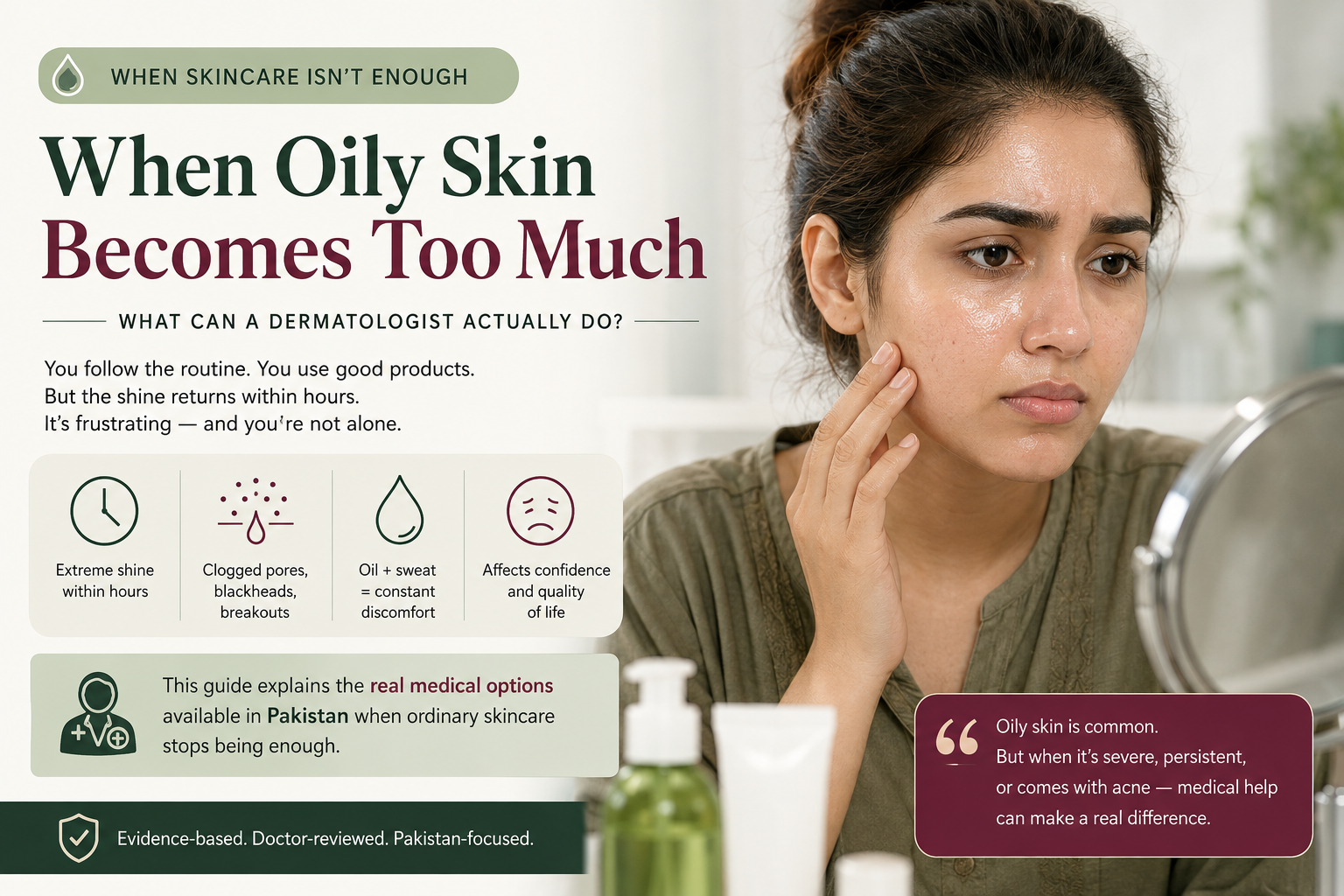
“Why is my face still so oily?”
Oily skin happens when the sebaceous glands produce more sebum than your skin needs. Genetics, age, hormones and climate can all influence this. Pakistan’s hot weather and sweating can make the problem feel even more obvious, but sweating and sebum are not the same thing.
Skincare can remove excess oil from the surface, reduce congestion and make oily skin much easier to live with. What it cannot always do is completely switch off naturally active sebaceous glands.
Is your skin truly oily — or have you irritated it?
More shine does not always mean your skin needs a stronger acid, harsher cleanser or another oil-control treatment.
More likely genuinely oily
- Shine repeatedly returns during the day
- Oil is noticeable across the T-zone or much of the face
- Blackheads or clogged pores are common
- Makeup or sunscreen breaks down quickly
- Your skin does not feel persistently tight or sore
Consider irritation or barrier damage
- Skin feels tight immediately after washing
- Burning, stinging or redness is common
- You are combining several acids or acne medicines
- Skin is flaky yet still becomes shiny
- Oiliness worsened after aggressive treatment
If you keep stripping already irritated skin, adding stronger treatment may only make the situation more uncomfortable. This is one reason a dermatologist may simplify your routine before escalating it.
When is it worth seeing a dermatologist?
Oily skin by itself is extremely common and does not automatically require medical treatment. A dermatologist becomes more useful when there is another problem underneath or when the oiliness is genuinely difficult to manage.
Oil + acne
Persistent pimples, inflamed acne, nodules or repeated breakouts may need proper acne treatment rather than more oil-control products.
Oil + clogged pores
Frequent blackheads and closed comedones may respond better to treatments that work inside the follicle.
Oil + hormonal clues
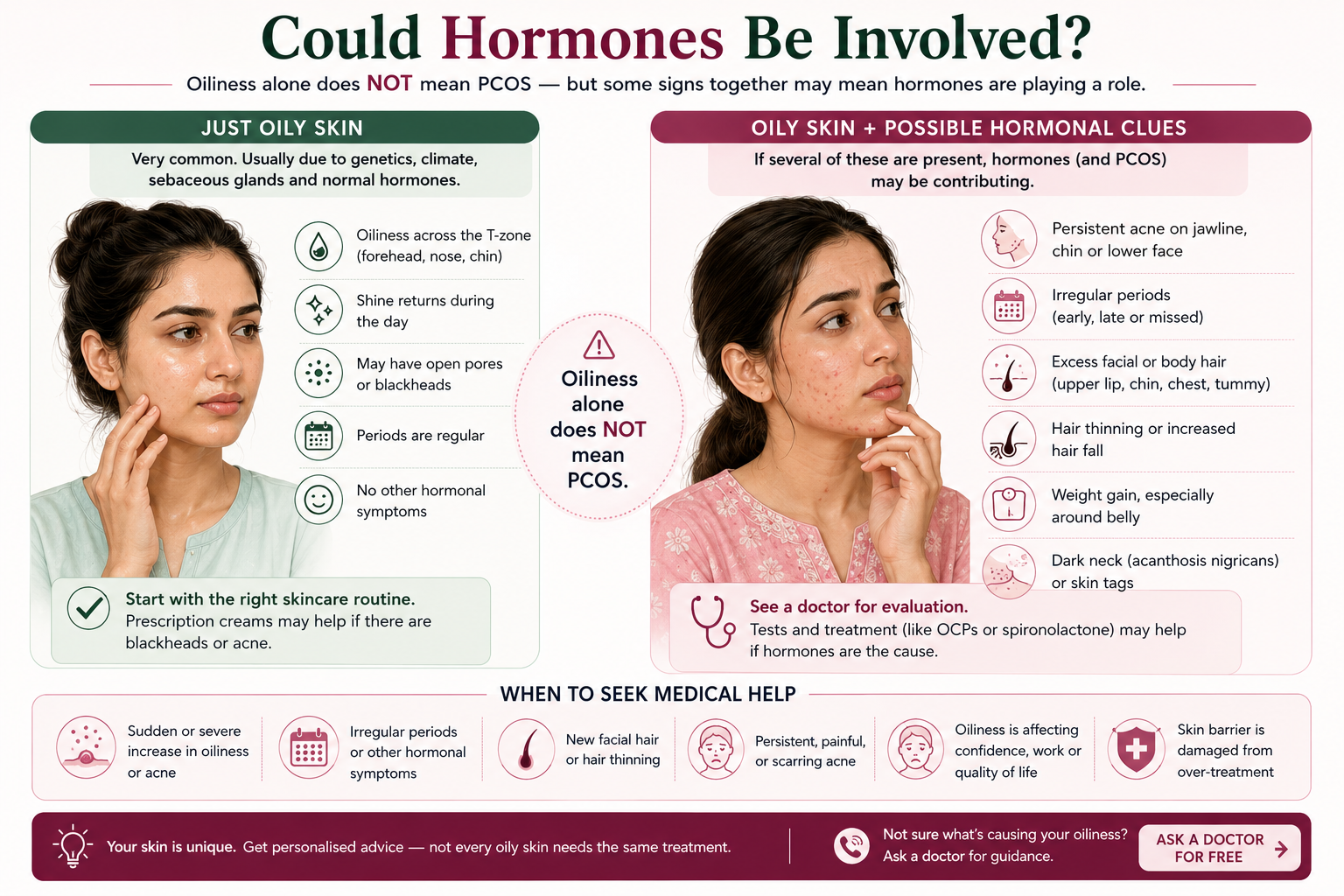
Irregular periods, jawline acne, excess facial hair or scalp thinning may justify looking beyond skincare.
Severe oiliness can bother you — but treatment should still match the cause.
The strongest medicine is not automatically the best medicine. The goal is to identify whether the problem is surface oil, clogged pores, acne, hormonal stimulation or severe sebaceous-gland activity that accompanies a condition requiring systemic treatment.
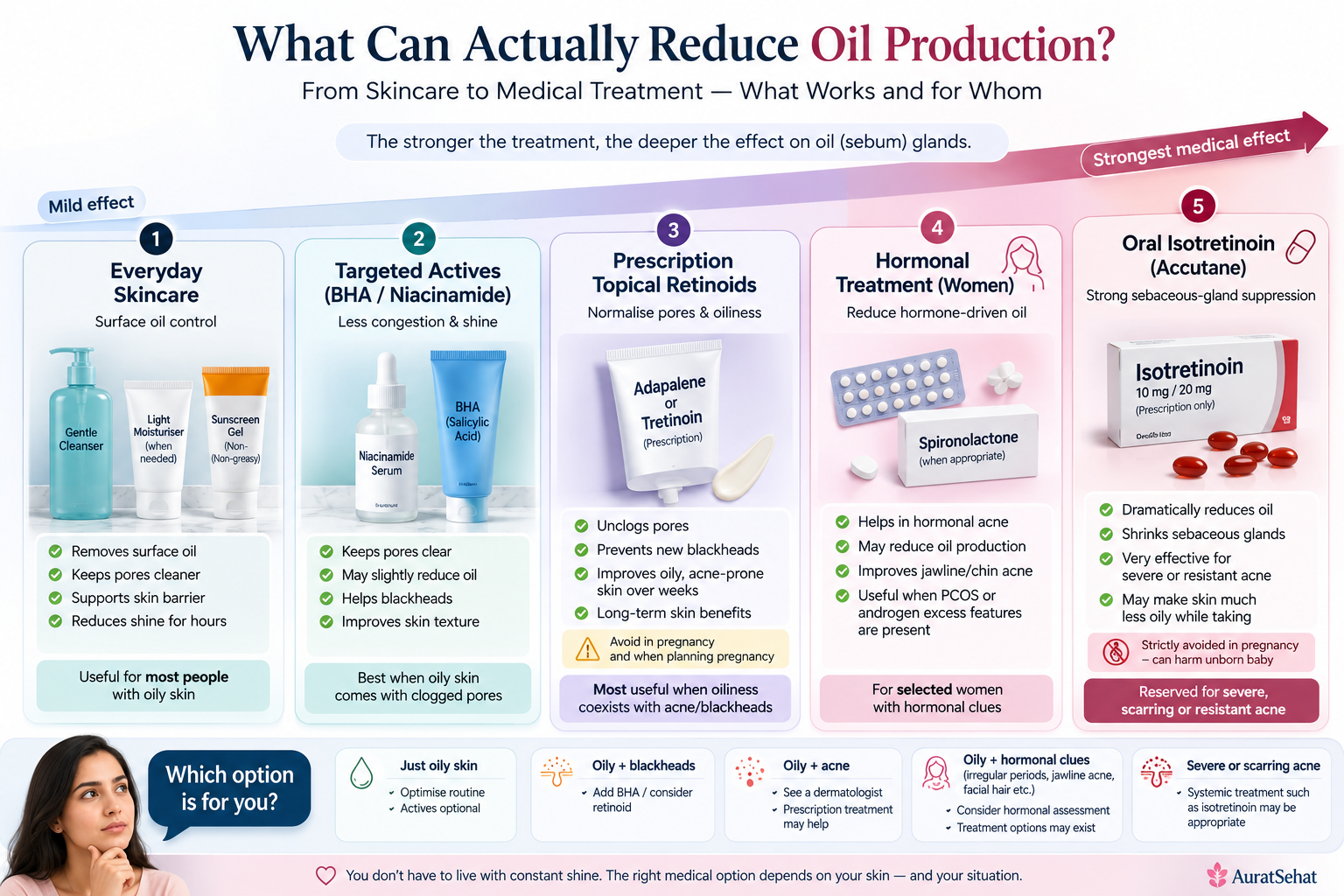
Where do prescription topical retinoids fit?
Topical retinoids such as adapalene and tretinoin are among the most important medicines used for comedonal and inflammatory acne. They help normalise the way cells shed inside the follicle, which makes pores less likely to become blocked.
This is particularly useful when excessive oiliness occurs together with blackheads, whiteheads or acne.
Think “oily + clogged” rather than simply “oily.”
Retinoids are established acne medicines. They should not be presented as a magic cream that permanently switches off normal sebaceous glands.
The American Academy of Dermatology includes topical retinoids among its strongly recommended acne treatments.
Adapalene
Frequently used for acne and clogged pores. It is often easier to tolerate than tretinoin, although dryness and irritation can still occur.
Tretinoin
Another established prescription retinoid used for acne and comedones. Pakistani generic formulations are widely available and can be relatively inexpensive.
Pregnancy matters here too.
Topical retinoids are generally avoided during pregnancy and when planning pregnancy. If you are pregnant, may be pregnant or are trying to conceive, discuss acne treatment with a healthcare professional rather than starting a retinoid yourself.
If the “dots” bothering you are mainly nose blackheads or sebaceous filaments, read our guide to Open Pores, Blackheads & Sebaceous Filaments before assuming you need prescription treatment.
Could hormones be contributing to your oily skin?
Sebaceous glands respond to androgens. These hormones are naturally present in women as well as men. In some women, increased androgen activity can contribute to oiliness and acne.
If severe oiliness appears together with these changes, a doctor may review your cycle, acne pattern, medications and other symptoms and decide whether further hormonal assessment is appropriate.
You can explore this in more detail in our PCOS Skin & Hair guide and the wider AuratSehat PCOS Hub.
What medical treatments may be considered?
Combined oral contraceptives
Certain combined oral contraceptives can improve acne in appropriate women partly by reducing androgen effects. They are medicines with their own contraindications and risks, so they should be selected for the individual rather than bought simply as an “oil-control pill.”
Spironolactone
Spironolactone has anti-androgen effects and is used by clinicians for hormonal acne in selected women. It can also reduce androgen-driven sebum activity, but it is not appropriate for everybody and requires medical assessment.
Hormonal medicines should never be started solely from an online symptom list. A woman’s pregnancy plans, blood pressure, medical history, other medicines and individual risks can change which treatment is appropriate.
Isotretinoin: the medicine that can dramatically reduce oil production
If there is one acne medicine famous for making oily skin dramatically less oily, it is oral isotretinoin — commonly known by the historic brand name Accutane.
Why does isotretinoin make the skin so much less oily?
Isotretinoin acts on several important acne pathways. One of its most striking effects is profound suppression of sebaceous-gland activity.
Higher sebum production can contribute to shine, clogged follicles and acne.
Oil glands become much less active and skin often becomes substantially drier.
Some people remain much less oily, while oil production gradually returns to some degree in others.
“Can I take Accutane just because my face is extremely oily?”
Usually, oily skin by itself is not enough reason to expose someone to a systemic medicine with isotretinoin’s risks and monitoring requirements. Its established role is primarily the treatment of significant acne — particularly severe, scarring or treatment-resistant disease.
Current acne guidance supports isotretinoin particularly when acne is severe, resistant to appropriate treatment, causing scarring or creating a major burden for the patient. It is not intended to turn every genetically oily skin type permanently dry.
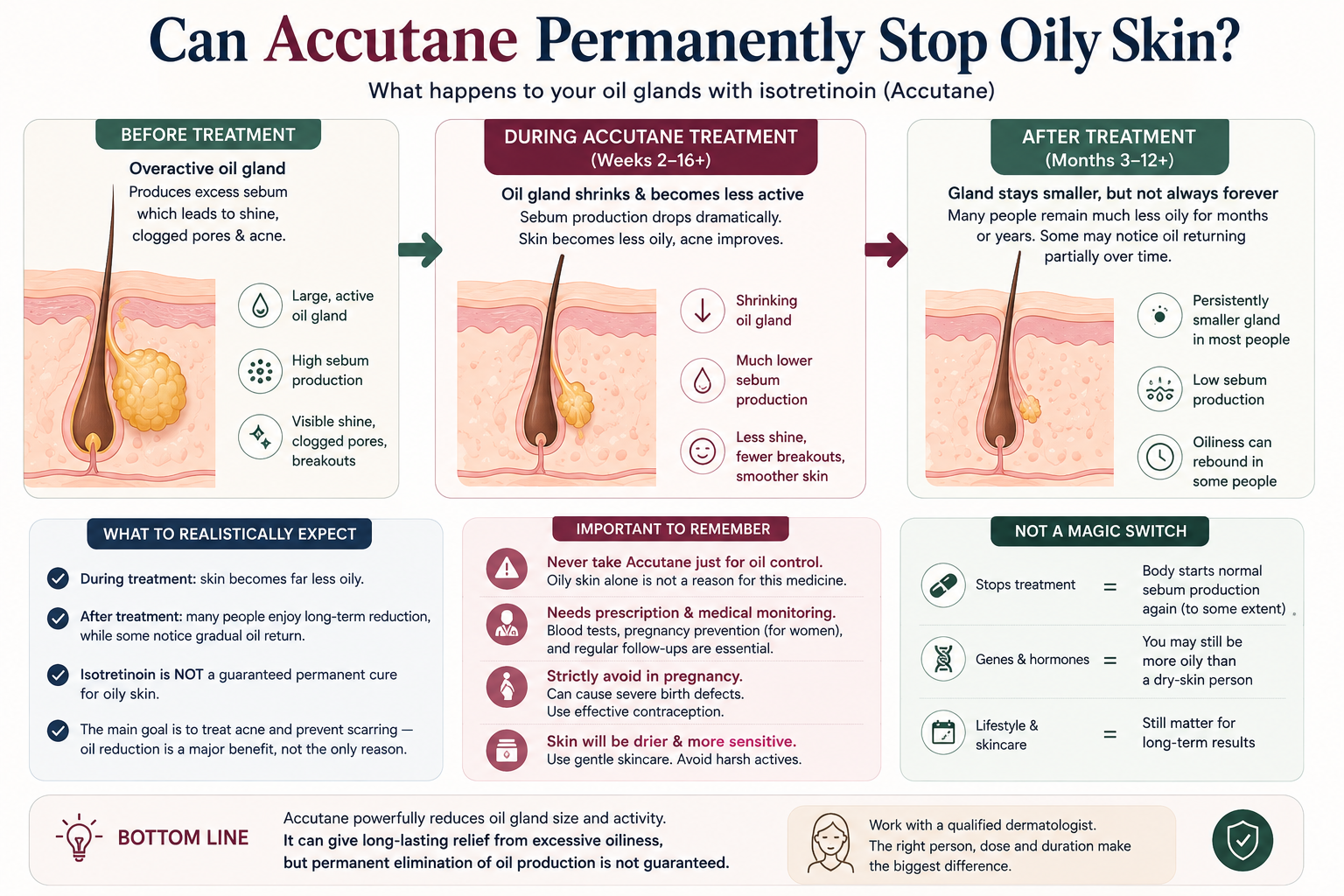
Will isotretinoin permanently cure oily skin?
Not reliably — and nobody should promise that it will.
During isotretinoin treatment, many people become dramatically less oily. After treatment, some continue to produce much less sebum for a long time. Others notice oiliness gradually returning.
Genetics, age, hormonal activity and the biology of your sebaceous glands have not disappeared. That means isotretinoin should not be sold as a guaranteed permanent switch that converts naturally oily skin into dry skin.
The appropriate question is therefore not simply “Will it stop my oil?” but “Do I have a medical reason to take isotretinoin?”
Some dermatologists use lower-dose approaches in selected patients, but dose, duration and treatment goals are medical decisions. This article intentionally does not provide a do-it-yourself isotretinoin dose or cumulative-dose plan.
Is isotretinoin available in Pakistan?
Yes. Oral isotretinoin is widely available through Pakistani pharmacies under multiple local and imported brand names, commonly in strengths such as 10 mg and 20 mg.
Prices vary enormously by brand and pack size.
Current Pakistani pharmacy listings show inexpensive local generics as well as much more expensive imported/original brands. Examples seen during our Pakistan market review included:
These are approximate market examples, not fixed retail prices. Pharmacy prices, stock and brands change. The total treatment cost also includes medical consultations and any laboratory monitoring your doctor considers appropriate.
Do not choose isotretinoin by brand or price alone.
Because isotretinoin is prescription medicine, the important questions are whether you actually need it, what dose and formulation your clinician chooses, whether the medicine is authentic, and how treatment will be monitored.
Women must know this before taking isotretinoin
Isotretinoin can cause severe harm to an unborn baby.
Oral isotretinoin must not be used during pregnancy. Women who could become pregnant require appropriate counselling and a pregnancy-prevention approach directed by their treating clinician.
If pregnancy occurs or is suspected while taking isotretinoin, contact the prescribing doctor urgently rather than waiting for the next routine visit.
Isotretinoin also requires medical supervision because treatment can affect other parts of the body. Depending on the person and local clinical practice, doctors may review medical history and consider monitoring such as pregnancy status, liver function and blood lipids.
Dry lips and dry skin are extremely common during treatment. Eyes and nasal passages may also become dry, and skincare normally has to become gentler rather than more aggressive.
What about peels, carbon laser and HydraFacial?
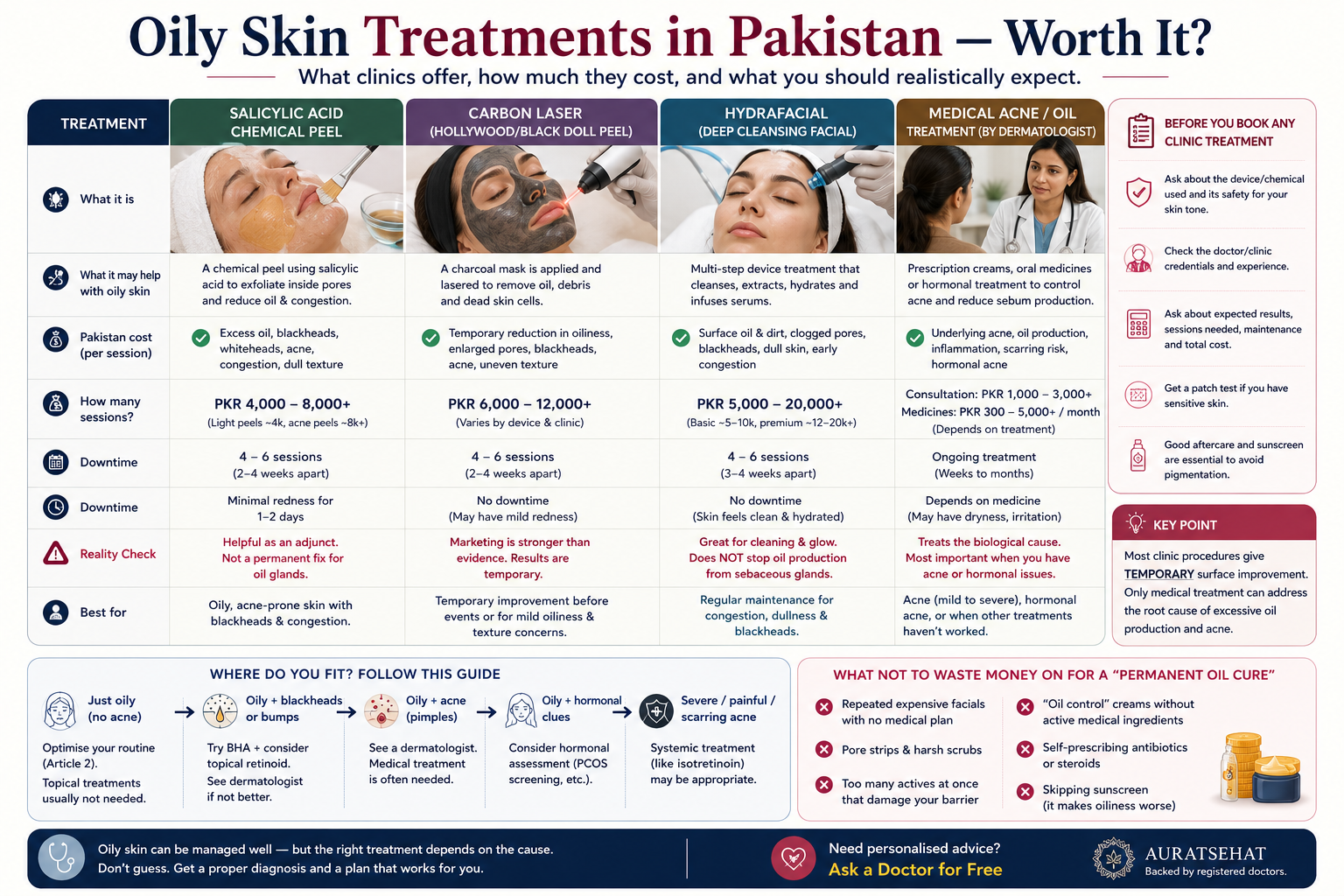
Pakistani aesthetic clinics advertise numerous treatments for oily skin, enlarged pores and blackheads. Some can genuinely improve congestion or how oily skin looks — but their marketing often sounds more permanent than the evidence justifies.
| Treatment | What it may help | Approx. Pakistan price | Reality check |
|---|---|---|---|
| Salicylic acid chemical peel | Congested oily skin, blackheads, comedonal acne and surface texture. | ~PKR 4,000–8,000+ | A useful adjunct in selected patients. It does not permanently shut down sebaceous glands. |
| Carbon laser / Hollywood peel | Temporary improvement in oiliness, congestion, visible pores and texture. | ~PKR 6,000–12,000+ | Popular in Pakistani clinics, but marketing claims are stronger than the evidence for permanent oil control. |
| HydraFacial | Surface cleansing, extraction, blackheads, debris and temporary smoother appearance. | ~PKR 5,000–20,000+ | Can make skin feel cleaner and fresher, but does not treat the biological cause of excessive sebum production. |
| Dermatologist-led medical treatment | Acne, comedones, hormonal acne and medically significant excessive sebaceous activity. | Varies | Targets the underlying condition when one exists rather than only removing oil from the surface. |
Prices are approximate examples from Pakistani clinic listings reviewed for this article and may differ substantially by city, clinic, doctor, device, treatment area and package.
1. Salicylic acid chemical peel
Salicylic acid is oil-soluble and commonly used for acne-prone and congested skin. A professionally selected superficial peel may temporarily improve blackheads, comedones, oiliness and texture.
It makes the most sense when oiliness is accompanied by clogged pores or acne, not as an expensive attempt to permanently change your natural skin type.
2. Carbon laser / Hollywood peel
Carbon laser treatments are heavily marketed by Pakistani aesthetic clinics for oily skin, visible pores, acne and “deep cleaning.” The procedure typically combines a carbon preparation with laser energy.
Some patients like the temporary change in texture, congestion and shine. However, it should not be presented as a proven permanent cure for excessive sebaceous-gland activity.
3. HydraFacial
HydraFacial and similar hydradermabrasion treatments can remove surface debris, extract some congestion and leave the skin temporarily cleaner and smoother.
That can be enjoyable and cosmetically useful. But removing oil is not the same as reducing the amount of oil your sebaceous glands biologically produce.
What not to waste money on for a “permanent oil cure”
Oily skin creates a particularly easy market for products that promise an instantly matte face, invisible pores or permanent sebum control. Before spending repeatedly, ask whether the treatment actually changes the underlying cause.
The aim is not to remove every molecule of sebum. Sebum is part of normal skin biology. The goal is to make excessive oiliness manageable and treat any associated acne, hormonal problem or follicular congestion appropriately.
Which oily-skin pathway sounds most like you?
There is treatment for very oily skin — but there is no one “oil cure.”
If your skin is naturally oily but otherwise healthy, the best strategy is usually a comfortable routine that controls surface oil without damaging your barrier.
If oiliness comes with blackheads or acne, treatments such as salicylic acid and topical retinoids become more relevant. If several hormonal clues occur together, hormonal assessment may be worthwhile. And when severe or resistant acne is present, isotretinoin can profoundly reduce sebum production as part of treating the underlying disease.
Clinic procedures such as salicylic peels, carbon laser and HydraFacial may improve congestion or temporarily reduce the appearance of oiliness, but they should not be sold as guaranteed permanent fixes for sebaceous glands.
Still not sure why your skin is so oily?
If your oiliness is severe, comes with acne or hormonal symptoms, or you are unsure whether a treatment is appropriate, you can ask AuratSehat for general medical guidance.
Sources & further reading
This article was developed using current acne guidance and Pakistan-specific pharmacy and clinic information. Prices are approximate and may change.