
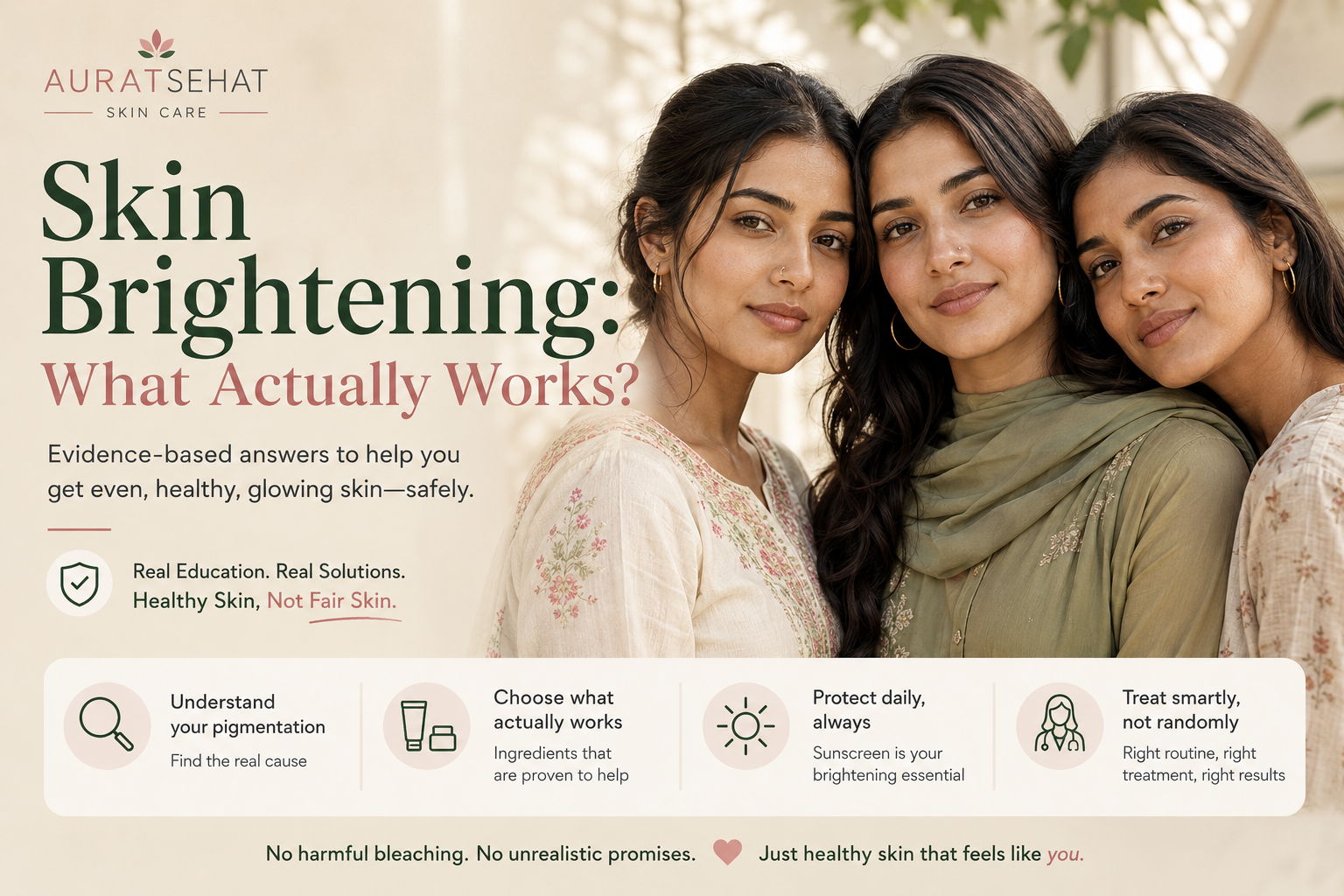
Skin Brightening — What Actually Works?
If your face looks darker, duller or more uneven than it used to, the answer is usually not to try every serum, facial and whitening cream you can find. First understand what has changed in your skin. Then choose treatment that matches the cause.
“I Want My Original Skin Tone Back.” What Does Brightening Really Mean?
This is one of the most common concerns women have about their skin: the face looks darker than the neck or body, old acne marks have accumulated, tanning has not faded, or the complexion simply looks more uneven than before.
The first thing to understand is that your natural skin colour and excess pigmentation are not the same thing.
Brightening
Treating excess pigmentation, tanning, dark marks and uneven tone so the skin looks closer to its natural healthy colour.
Bleaching / Whitening
Trying to make genetically brown skin several shades lighter than its natural colour, often using increasingly strong products.
The goal is not “fair skin.” The goal is healthy skin with less unwanted pigmentation, fewer dark marks and a more even appearance.
Why Does My Face Look Darker Than My Body?
Your face receives more sunlight, more skincare products, more acne, more makeup and often more irritation than most of your body. So it is not surprising that facial colour can gradually become different.
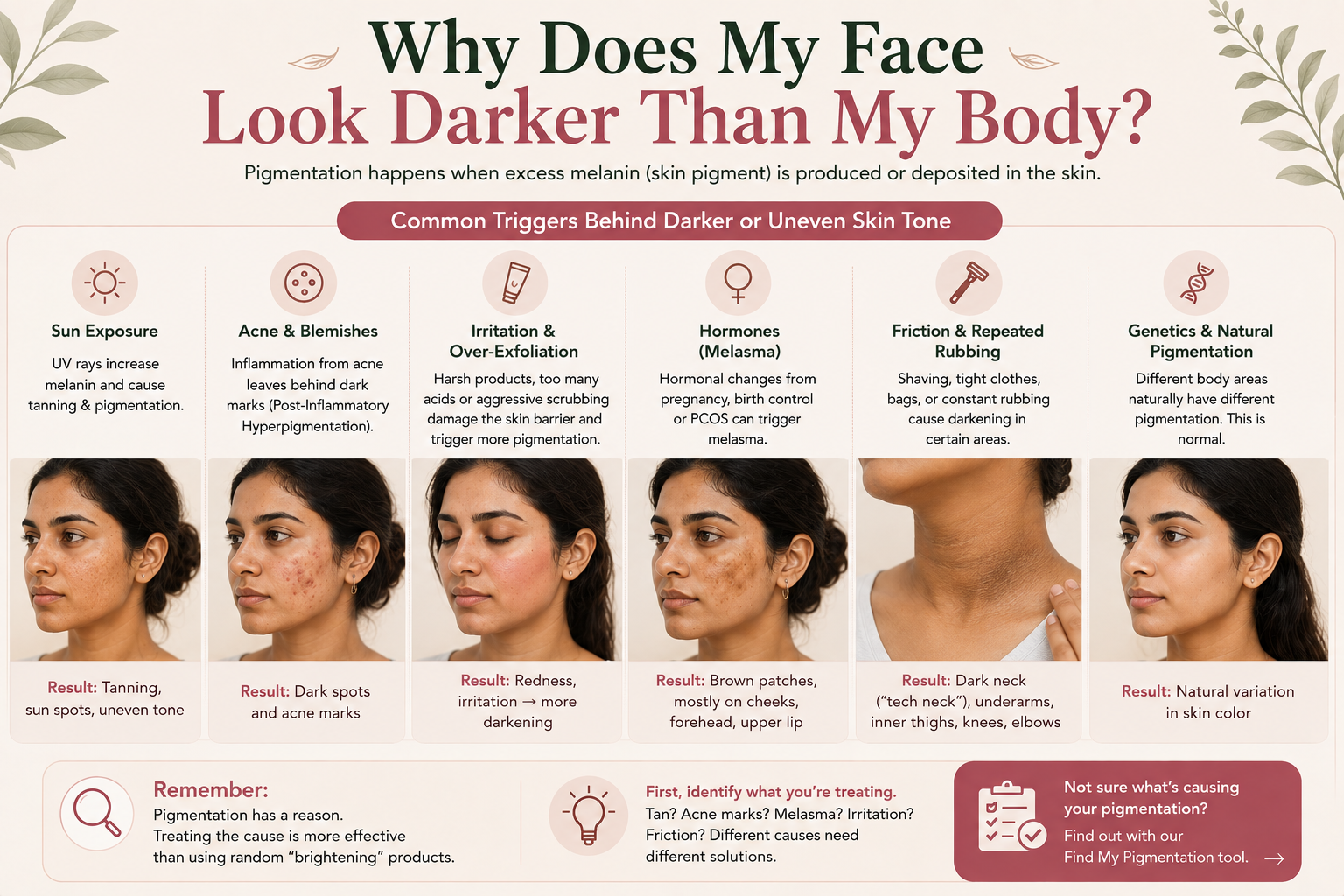
Common reasons include sunlight and tanning, post-acne pigmentation, melasma, irritation from strong skincare, repeated inflammation and normal differences in pigmentation between body areas.
Ask one question first: What am I actually treating? A tan, acne marks, melasma, irritation and natural skin colour are different problems and may need different solutions.
Is It Tanning, Dullness, Dark Spots or Melasma?
This distinction matters because a woman with dry, irritated skin may keep adding “brightening” acids when what her skin actually needs first is less irritation and better barrier care.
Can I Actually Change My Natural Skin Colour?
Your baseline skin colour is largely determined by genetics and the amount and behaviour of melanin in your skin.
Medicine can help reduce excess pigmentation, but naturally brown skin does not need to be medically “corrected.”
This is why a treatment that reduces tanning or melasma may make your face look noticeably brighter without turning you into a different natural skin tone.
The Most Boring Step May Be the Most Important: Sunscreen
You can spend thousands of rupees on brightening products while sunlight continues telling pigment-producing cells to make more melanin.
For pigmentation-prone skin, use a broad-spectrum sunscreen of at least SPF 30. If you have significant melasma or persistent pigmentation, a tinted sunscreen containing iron oxides may also help protect against visible light.
If you spend most of the day far from windows, exposure is lower. But if you commute, sit near bright windows, go outdoors or regularly receive daylight, sun protection still matters.
This is common on brown skin. Look for formulas designed to leave less white cast, or consider appropriately matched tinted sunscreens. The best sunscreen is one you can comfortably use consistently.
Choose a lighter gel, fluid or oil-control formulation rather than skipping sunscreen completely.
Which Brightening Ingredients Actually Work?
There is no single best ingredient for every woman. The right choice depends on the type of pigmentation, your skin sensitivity, pregnancy status, acne and what else you already use.
Azelaic Acid
Particularly useful when acne and pigmentation overlap. It can target both inflammation and post-inflammatory dark marks.
Vitamin C
An antioxidant commonly used to support brighter, more even-looking skin. Formulation and stability matter, and it is not a miracle cure.
Niacinamide
A useful supportive ingredient that is often easier to tolerate than stronger acids and can fit into many routines.
Retinoids
Can improve pigmentation, acne and texture in appropriate patients, but irritation can occur. Retinoid use also requires special consideration during pregnancy.
Glycolic Acid & Other AHAs
Can improve selected pigmentation and texture concerns, but frequent or aggressive exfoliation can cause irritation and worsen pigmentation.
Kojic Acid & Alpha Arbutin
Common pigmentation-targeting ingredients. They may be useful in selected routines but should not be expected to create overnight transformation.
Tranexamic Acid
Increasingly used for pigmentation, particularly melasma. Topical products are different from oral treatment, which requires medical assessment because of systemic risks.
Hydroquinone
An established treatment for selected pigmentation problems, but stronger does not mean safer. It should not be used indefinitely or hidden inside an unknown fairness mixture.
Can Too Much Skincare Make Your Face Darker?
Yes. This is one of the most important lessons for pigmentation-prone brown skin.
A woman notices dark spots and starts vitamin C, an acid toner, retinol, a brightening cream, a scrub and another serum. Her skin begins burning and peeling. Inflammation then triggers more pigmentation. Because the skin looks darker, she adds even more products.
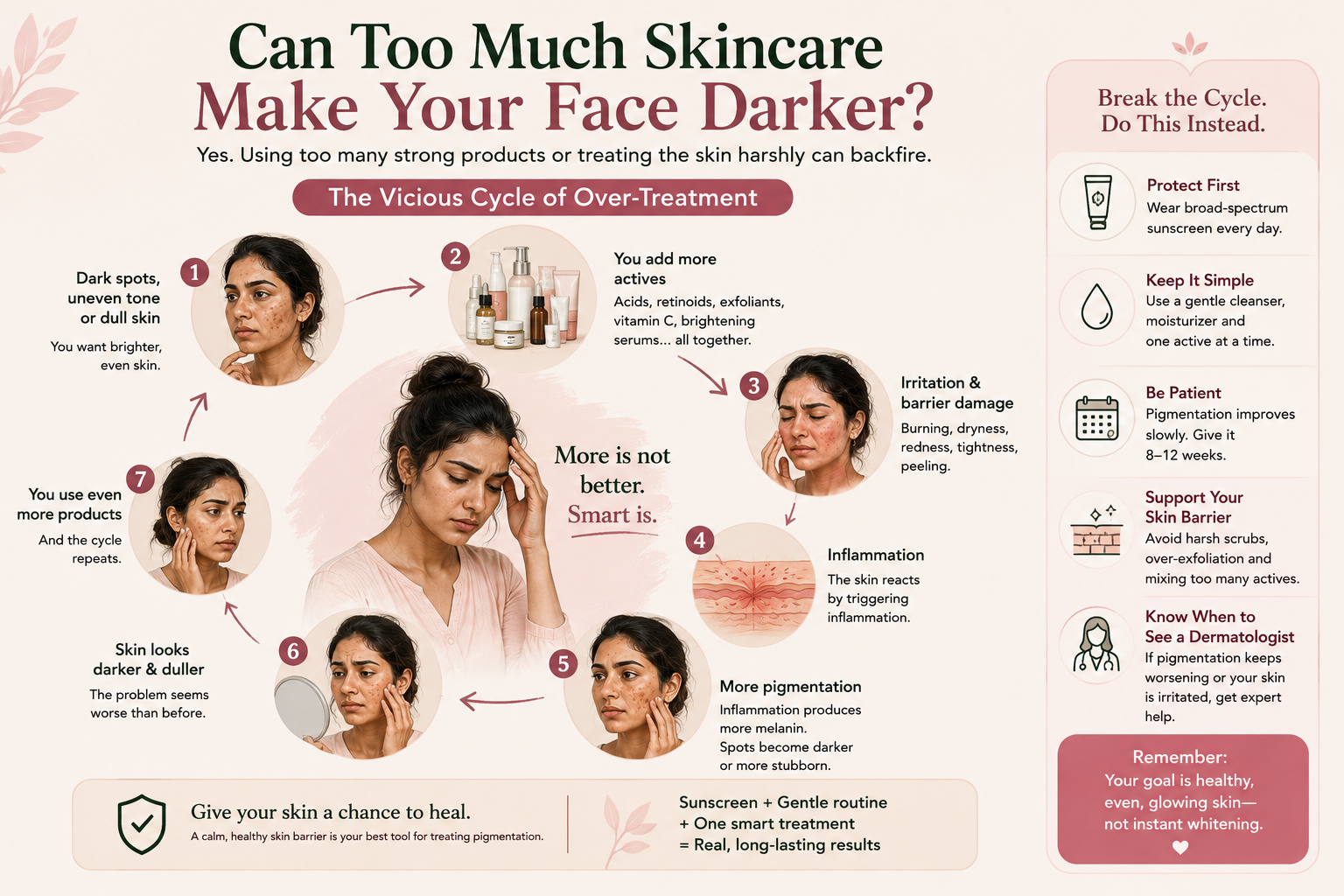
Burning, persistent redness, tightness, excessive peeling and new darkening are signs that your routine may be doing too much.
A simpler starting routine
Morning
- Gentle cleansing if needed.
- One suitable treatment or supportive serum.
- Moisturizer if needed.
- Broad-spectrum sunscreen.
Night
- Gentle cleanser.
- One main evidence-based treatment.
- Moisturizer.
- Give your skin time before adding more.
Multani Mitti, Aloe Vera, Besan, Haldi & Lemon — Do Home Remedies Brighten Skin?
Traditional skincare is part of everyday life in Pakistan. The right approach is neither to mock it nor to assume that everything natural must work.
The useful question is: what can this remedy realistically do?
Aloe Vera
Aloe may help soothe and moisturize irritated skin. Some compounds found in aloe are scientifically interesting, but ordinary aloe gel should not be presented as a reliable treatment for established melasma or significant hyperpigmentation.
Multani Mitti
Fuller’s earth can absorb oil and temporarily make oily skin feel cleaner and less greasy. That may make the face look fresher, but it does not mean excess melanin has been removed. Frequent use may dry or irritate some skin.
Besan
Gram flour is commonly used as a traditional cleanser or mask. Evidence that homemade besan masks treat significant pigmentation is limited.
Haldi / Turmeric
Turmeric contains biologically active compounds and is studied in skincare, but a homemade turmeric mask is not equivalent to a standardized treatment for melasma or hyperpigmentation.
Lemon Juice
Direct lemon juice is not a good pigmentation treatment. Its acidity can irritate skin, and citrus exposure combined with sunlight can sometimes produce phototoxic reactions.
Tomato, Potato & DIY Mixtures
These may feel refreshing, but there is not enough evidence to promise reliable treatment of hyperpigmentation.
A home remedy can be pleasant or supportive without being the main medical treatment for pigmentation.
What About the Facial I Get Every Month?
A regular facial may include cleansing, massage, hydration, masks, extraction or gentle exfoliation. It may make your skin temporarily feel smoother, softer and more radiant.
That is a perfectly reasonable cosmetic benefit.
But temporary glow is not the same as treating melasma or established hyperpigmentation.
What exactly are you putting on my skin?
Is it hydration and cleansing? Glycolic or another acid? A chemical peel? Microdermabrasion? A bleaching mixture? A strong exfoliant? The word “facial” alone tells you very little about the actual treatment.
HydraFacial, Chemical Peels, Microneedling, PRP, Mesotherapy & Lasers
Aesthetic procedures are not automatically bad, and some can be useful. The important question is whether the procedure actually matches the problem being treated.
HydraFacial-type Treatments
Usually focus on cleansing, exfoliation and hydration. They can improve temporary smoothness and radiance, but should not be sold as a guaranteed cure for melasma.
Chemical Peels
Selected superficial peels can help some pigmentation disorders, but peel type and strength matter. Excessive inflammation can cause further pigmentation in brown skin.
Microneedling
May be useful in selected cases and is also used for acne scarring. Pigmentation treatment requires correct technique and patient selection.
Lasers & Light Devices
Certain devices can help specific pigmentation conditions, but darker skin requires careful choice of device and settings because burns or inflammation can worsen pigmentation.
PRP
Platelet-rich plasma is marketed for several cosmetic indications. It should not be treated as a universal skin-brightening solution.
Mesotherapy
“Mesotherapy” may involve injecting different substances, so always ask exactly what is being injected, why, what evidence supports it and who is performing the procedure.
Choose a procedure because it matches your diagnosis, your skin type and your treatment goal.
What About Glutathione Tablets and Whitening Injections?
Glutathione is an antioxidant naturally involved in human biology. That fact alone does not prove that taking or injecting glutathione is a safe and effective way to whiten skin.
Oral supplements, intravenous injections and topical products are different interventions and should not be treated as interchangeable.
Injectable treatment deserves particular caution because the risk is no longer limited to the surface of your skin. Potential systemic reactions and the quality of the injected product also matter.
Before receiving any skin-lightening injection, ask what is being injected, what clinical evidence supports it, who is prescribing it and what the known risks are.
Fairness & Whitening Creams in Pakistan — What Should You Watch For?
Some women use a cream from a salon, friend, social-media seller or local shop without knowing exactly what it contains.
If your skin becomes dramatically lighter very quickly, that should make you more curious about the ingredients, not less.
- Is there a complete ingredient list?
- Is the manufacturer clearly identified?
- Does it promise dramatic whitening in a few days?
- Does your skin burn, peel or become unusually sensitive?
- Have you developed acne, facial hair or skin thinning?
- Does it contain a steroid or hydroquinone that you were never told about?
Unsupervised use of potent topical steroids and inappropriate use of strong depigmenting agents can damage the skin. Some unregulated skin-lightening products internationally have also been found to contain dangerous ingredients such as mercury.
What About Dark Underarms, Neck, Knees & Inner Thighs?
Do not automatically treat every darker body area like facial pigmentation.
Underarms may darken because of friction, shaving or irritation. Inner thighs commonly experience friction. Knees and elbows naturally have thicker skin and may look darker.
A dark neck or underarms that become thickened or velvety can sometimes represent acanthosis nigricans and may deserve medical evaluation rather than another bleaching cream.
How Quickly Can I Become Brighter?
Real pigmentation treatment usually takes time.
Some superficial pigmentation may begin improving within weeks, but persistent marks often take months. Melasma can be chronic and recurrent even after significant improvement.
The deeper the pigment and the longer it has been present, the more patience may be required.
Extremely rapid lightening does not necessarily mean effective medical treatment. It may sometimes indicate aggressive ingredients that are suppressing or damaging the skin rather than safely correcting the cause.
So What Actually Works?
Brightening treatment should usually move from the simplest and safest measures toward stronger treatment only when necessary.
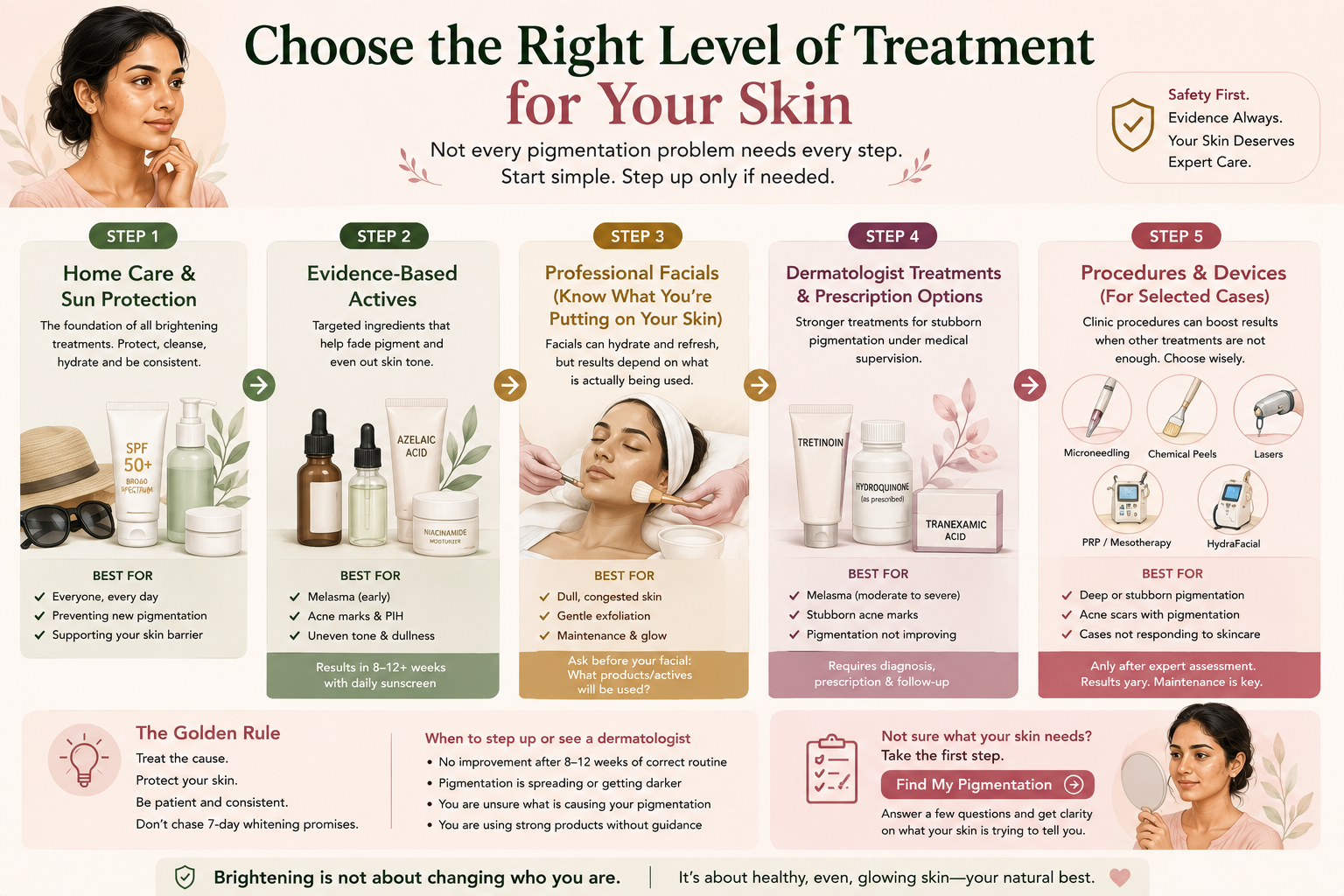
The AuratSehat Brightening Pathway
Identify What You’re Treating
Natural complexion, tan, acne marks, melasma, irritation and acanthosis nigricans are not the same problem.
Control the Trigger
Treat acne, stop irritating products, reduce friction and control whatever is continuing to produce new pigmentation.
Protect the Skin
Use appropriate daily sun protection and avoid unnecessary inflammation.
Treat Simply
Choose one or two evidence-based treatments appropriate to the actual problem instead of layering everything at once.
Give It Enough Time
Do not replace your whole routine every five days because you have not seen an immediate transformation.
Escalate When Appropriate
Dermatologist assessment, prescription treatment, chemical peels, lasers or other procedures can be considered when simpler treatment is not enough.
When Should I Stop Experimenting and See a Dermatologist?
Consider professional assessment if:
- pigmentation is rapidly worsening;
- you cannot work out what is causing it;
- it persists despite a sensible routine;
- your skin is repeatedly burning or becoming darker after treatment;
- you have thickened or velvety dark skin around the neck or underarms;
- the pigmentation is very unusual or strongly asymmetric;
- you are considering strong prescription creams, peels or lasers;
- you have been using an unknown fairness mixture and your skin now looks damaged.
Post-acne pigmentation has its own treatment strategy. Controlling new breakouts is just as important as fading old marks.
Still Not Sure What Is Making Your Skin Darker?
Start by identifying the pattern instead of buying another random product. AuratSehat can help guide you toward the most relevant pigmentation information.
Frequently Asked Questions
Can I get my original skin tone back after tanning?
Often, yes. If the darkening is mainly tanning or superficial pigmentation, reducing further sun exposure and using appropriate treatment may gradually allow the skin to move closer to its baseline tone.
Can vitamin C make my skin fair?
Vitamin C can support brighter and more even-looking skin, but it does not safely transform your genetically determined skin colour into a different one.
Is Multani mitti good for brightening?
Multani mitti can absorb oil and temporarily make oily skin feel cleaner, but it is not a proven treatment for significant melasma or excess pigmentation.
Does aloe vera remove pigmentation?
Aloe vera can be useful as a soothing or moisturizing ingredient, but ordinary aloe gel should not be relied upon as the main treatment for established hyperpigmentation.
Do facials permanently brighten skin?
A facial may temporarily improve hydration, smoothness and radiance. Whether it improves actual pigmentation depends on what treatment is being performed and what caused the pigmentation.
Can too many skincare products make pigmentation worse?
Yes. Excess acids, scrubbing, retinoids or other irritating products can damage the skin barrier and trigger inflammation, which can worsen post-inflammatory pigmentation.
Should I use hydroquinone for skin brightening?
Hydroquinone can be effective for selected pigmentation disorders, but it should not be used casually as an indefinite whitening cream. Correct diagnosis, strength, duration and follow-up matter.
Are glutathione whitening injections safe?
Injectable skin-lightening treatments require a much higher safety threshold than ordinary skincare. Do not assume that an injection is safe simply because glutathione is naturally present in the body. Discuss potential benefits and risks with an appropriately qualified clinician before considering it.
Continue Learning
Medical References
- American Academy of Dermatology — Melasma: diagnosis and treatment.
- American Academy of Dermatology — How to fade dark spots in darker skin tones.
- American Academy of Dermatology — Skin of color and sun protection.
- DermNet — Post-inflammatory hyperpigmentation.
- Dermatology literature on topical pigmentation treatments, chemical peels and procedure-related pigmentation risk in darker skin.