
Which Pigmentation Serum Should You Actually Buy?
Walk into a pharmacy or open an online skincare store in Pakistan and you will see vitamin C, niacinamide, azelaic acid, retinol, alpha arbutin, kojic acid and dozens of “brightening” serums.
So this guide answers the practical question: what should you use, what exact product can you ask for, and how much does it cost in Pakistan?

Tell Us Your Main Problem — Not Your Favourite Ingredient
You do not need to understand every skincare chemical before buying something. Start with what your skin is actually doing.
Pimples leave brown marks
Marks + oily or acne-prone skin
Skin looks dull and uneven
Dark marks plus rough texture
Most serums sting or irritate
Nothing seems to fade it
If you want the shortest possible answer…
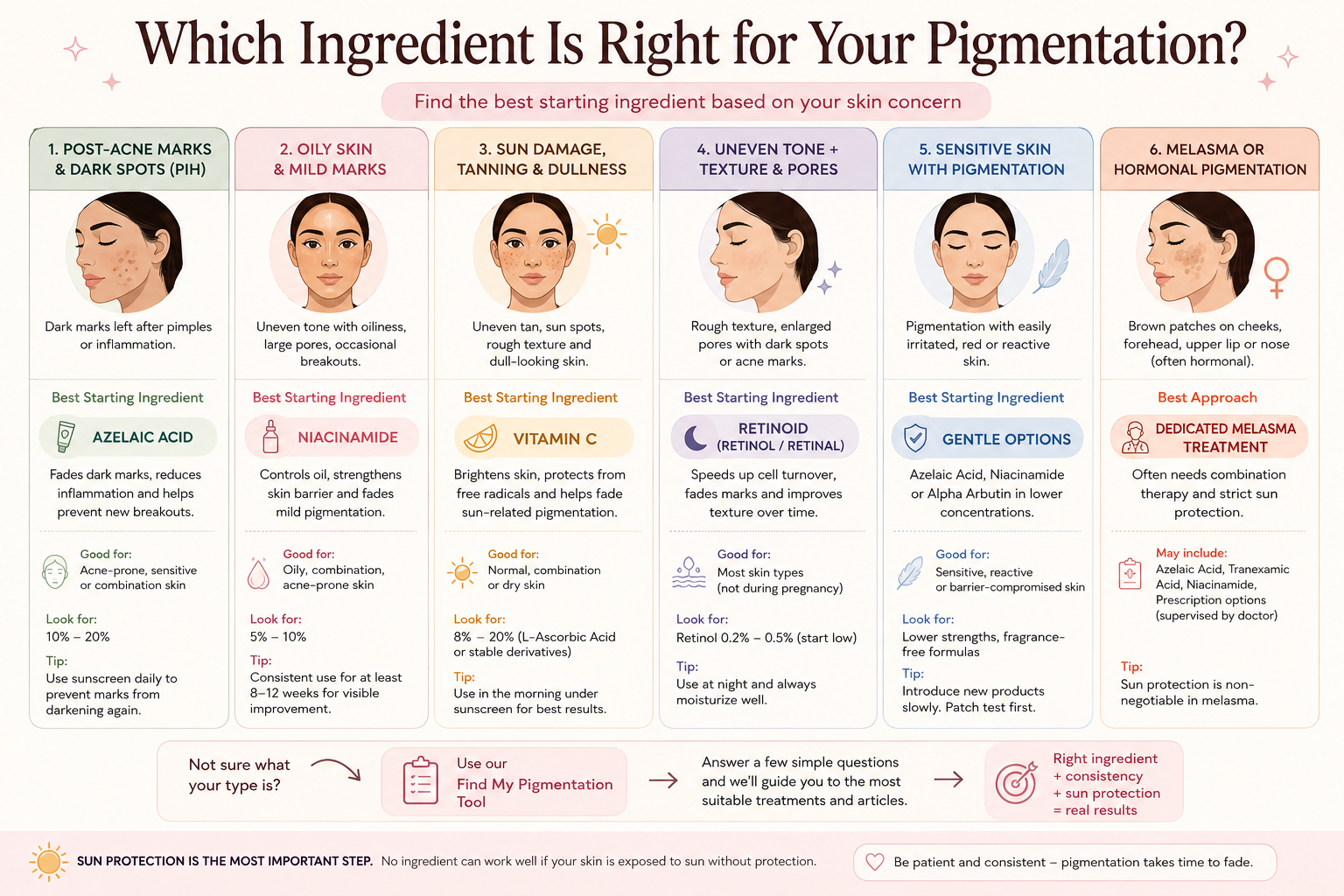
What Each Pigmentation Ingredient Is Actually Good For
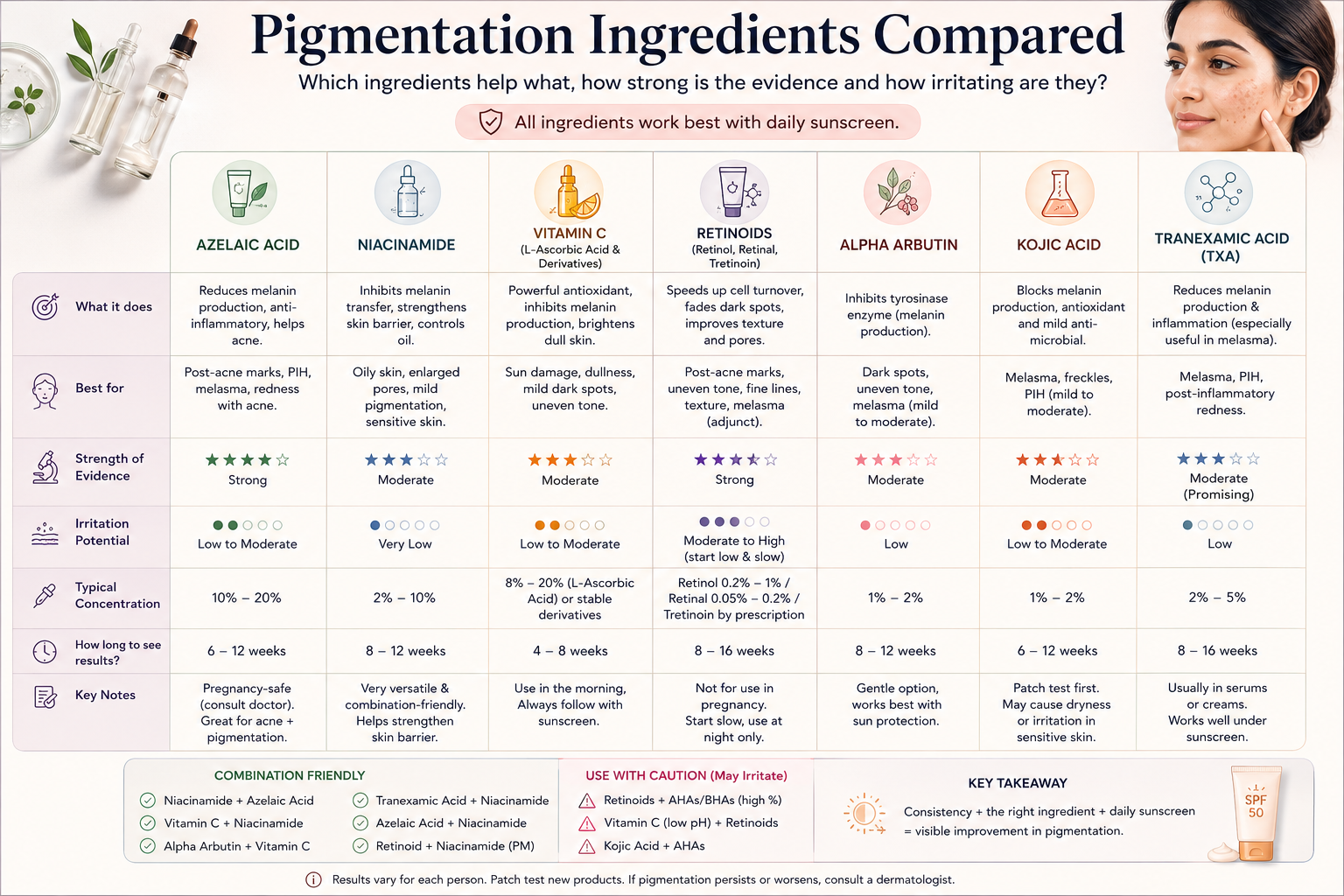
Marketing makes almost every brightening ingredient sound miraculous. In reality, they have different strengths, different uses and different irritation risks.
Azelaic Acid
One of the most useful choices when pigmentation and acne exist together.
Azelaic acid can help inflammation, acne and abnormal pigmentation. That combination makes it especially practical for brown marks left after pimples.
Mild tingling can happen initially. Burning, marked redness or persistent irritation means you should reduce use or stop and reassess.
Local example: Skinoren Cream 20%.
Imported example: The Ordinary Azelaic Acid Suspension 10%.
Niacinamide
Useful when pigmentation is mild and your skin is oily, sensitive or barrier-damaged.
Niacinamide is one of the easiest ingredients to fit into a routine. It can help mild uneven tone while supporting the skin barrier and controlling oiliness.
Remember: 10% is not automatically better than 5%. Sensitive skin may tolerate a lower concentration better.
Local example: Healers Pharma Niacinamide formulation.
Imported example: The Ordinary Niacinamide 10% + Zinc 1%.
Vitamin C
Excellent for antioxidant support, dullness and mild sun-related uneven tone.
Vitamin C is heavily marketed for pigmentation, but it is not automatically the strongest treatment for stubborn dark spots.
Think of it as a useful brightening and antioxidant ingredient — especially when combined with consistent sunscreen.
Local example: Jenpharm Maxdif Brightening Serum.
Imported example: CeraVe Skin Renewing Vitamin C Serum.
Retinol & Retinoids
Particularly useful where acne marks, clogged pores and uneven texture exist together.
Retinoids can improve acne, cell turnover, texture and post-acne pigmentation.
The problem is overuse. Red, peeling and irritated skin can create more pigmentation in brown skin.
Start gradually rather than trying to “speed up” results.
Imported example: CeraVe Resurfacing Retinol Serum.
Alpha Arbutin
A popular dark-spot ingredient that is generally easier to tolerate than stronger treatments.
Alpha arbutin can be reasonable for mild uneven pigmentation, but it should not be marketed as equivalent to stronger medical treatments for difficult melasma.
Local example: Jenpharm Maxdif Brightening Serum contains alpha arbutin alongside vitamin C.
Imported example: The Ordinary Alpha Arbutin 2% + HA.
Kojic Acid
Often found in pigmentation and melasma formulations.
Kojic acid can help inhibit melanin production but may cause irritation in some people.
A burning or rash-producing cream is not “working harder.” It may be damaging your barrier.
Tranexamic Acid
Increasingly used for melasma and persistent uneven pigmentation.
Tranexamic-acid serums can be useful, particularly in melasma-oriented routines.
But clear melasma still deserves a complete treatment strategy rather than dependence on one serum.
Local example: Healers Pharma 5% Tranexamic Acid + 4% Niacinamide Serum.
Glycolic & Mandelic Acid
Useful for surface pigmentation and texture — but not products to pile on carelessly.
Mandelic acid generally penetrates more slowly than glycolic acid and may be easier for some darker skin types to tolerate.
Local example: Jenpharm MandelAC Serum 20%.
Exact Local & Pharmacy Products You Can Ask For
This is where we want AuratSehat to be practical. Instead of telling you to “buy azelaic acid,” here are exact product names you can search or ask for.
| Exact product | What it contains | Size | Approx. Pakistan price | Best suited to |
|---|---|---|---|---|
| Skinoren Cream 20% (Bayer) | Azelaic acid 20% | 10 g | Rs 800–1,000 | Acne + post-acne marks and selected pigmentation |
| Healers Pharma 15% Azelaic Acid & Niacinamide Serum | Azelaic acid 15% + niacinamide | 50 ml | Rs 2,400–2,900 | Acne-prone skin with PIH and uneven tone |
| Healers Pharma 5% Tranexamic Acid + 4% Niacinamide Serum | Tranexamic acid 5% + niacinamide 4% | 30 ml | Rs 1,900–2,400 | Melasma-oriented and stubborn pigmentation routines |
| Jenpharm Maxdif Brightening Serum | Vitamin C 3% + alpha arbutin 2% | 30 ml | Rs 1,700–2,200 | Dullness, mild dark spots and uneven tone |
| Jenpharm MandelAC Serum | Mandelic acid 20% | 30 ml | Rs 1,300–1,800 | Acne-prone skin, texture and selected superficial pigmentation |
Imported Pigmentation Products — Exact Names & Price Ranges
If you prefer CeraVe, Cetaphil, The Ordinary, Eucerin or other international brands, use the exact product name. Saying “give me a CeraVe serum” is not enough because the same brand can have several completely different formulations.
The Ordinary Niacinamide 10% + Zinc 1% — 30 ml
Key active: Niacinamide 10% + zinc PCA 1%
Best for oily or blemish-prone skin with mild uneven tone.
The Ordinary Alpha Arbutin 2% + HA — 30 ml
Key active: Alpha arbutin 2% + hyaluronic acid
Best for mild dark spots and uneven pigmentation.
CeraVe Resurfacing Retinol Serum — 30 ml
Key ingredients: Encapsulated retinol + niacinamide + ceramides
Particularly useful for post-acne marks, pores and uneven texture.
Cetaphil Healthy Radiance Antioxidant-C Serum — 30 ml
Key ingredients: Niacinamide + vitamin-C-based antioxidant formulation
A gentler imported choice for sensitive skin and mild uneven tone.
Eucerin Anti-Pigment Dual Serum — 30 ml
Key ingredient: Thiamidol-based anti-pigment formulation
A premium product specifically designed around dark spots and hyperpigmentation.
CeraVe Skin Renewing Vitamin C Serum — 30 ml
Key ingredients: 10% pure vitamin C + ceramides + hyaluronic acid + vitamin B5
Best suited to dullness, antioxidant support and mild uneven tone.
Cetaphil Vitamin C Serum — 30 ml
Vitamin-C-based brightening formulation designed with sensitive skin in mind.
Useful for women who prefer a gentler imported formula rather than aggressive acids.
La Roche-Posay Mela B3 Serum — 30 ml
Key focus: Dark spots and persistent uneven pigmentation.
Premium imported formulation rather than a necessary first-line purchase.
Vichy Liftactiv Specialist B3 Anti-Dark Spot Serum — 30 ml
Niacinamide-based pigmentation formulation with additional brightening and exfoliating ingredients.
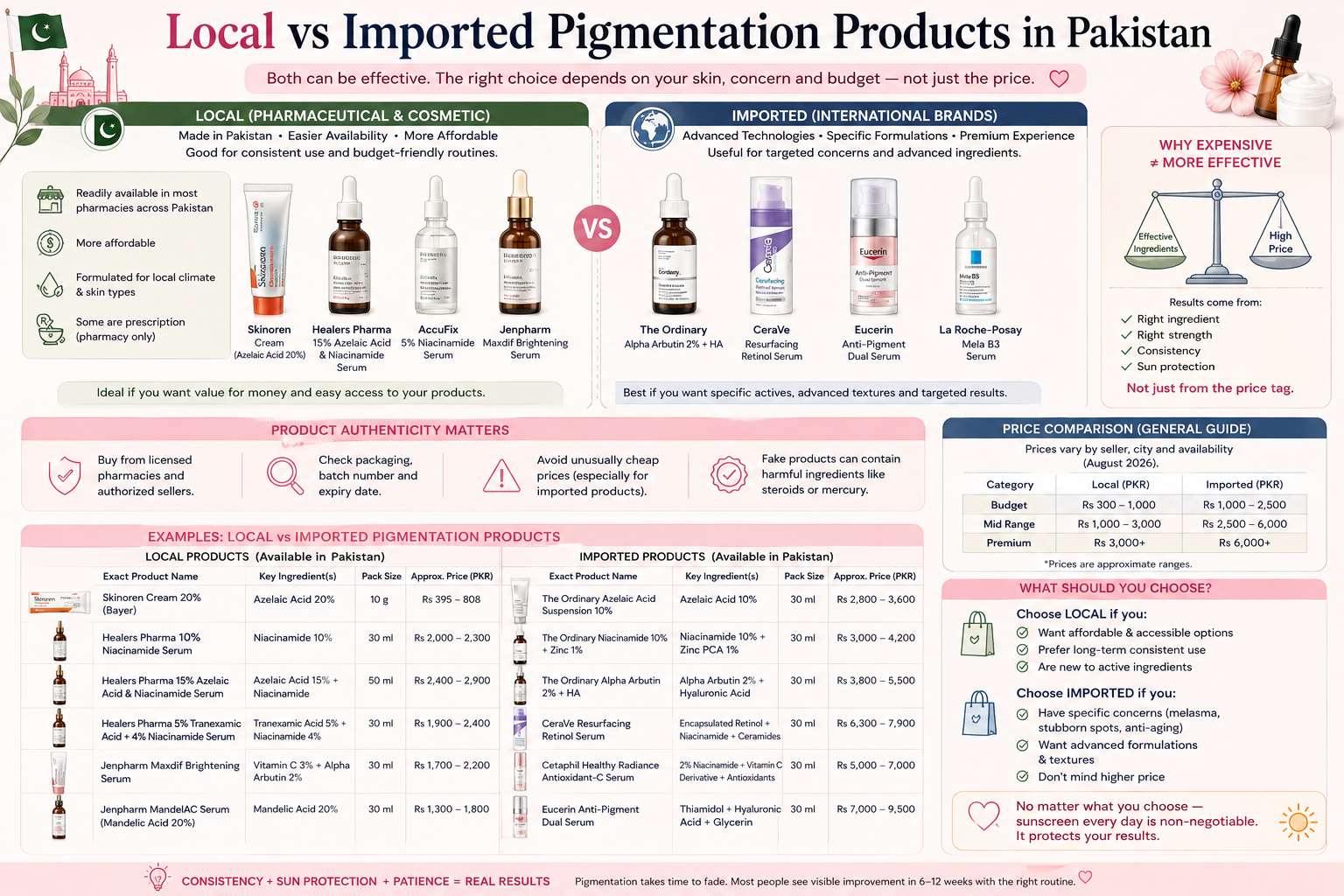
Local vs Imported Pigmentation Products
Local / Pharmacy
Often much cheaper and may contain exactly the active ingredient you need.
Pharmaceutical products can sometimes provide stronger evidence-based ingredients without premium cosmetic pricing.
Imported
May offer elegant textures, patented ingredients, combination formulas or better packaging.
Worth buying when the formulation provides something useful — not merely because the brand is foreign.
What Would Be the Most Sensible Starting Choice?
| Your situation | Ingredient direction | Example exact product |
|---|---|---|
| Acne + fresh brown marks | Azelaic acid | Skinoren Cream 20% |
| Acne-prone skin but want a cosmetic serum | Azelaic acid + niacinamide | Healers Pharma 15% Azelaic Acid & Niacinamide Serum |
| Oily skin + mild marks | Niacinamide | The Ordinary Niacinamide 10% + Zinc 1% |
| Dull skin + mild uneven tone | Vitamin C | CeraVe Skin Renewing Vitamin C Serum |
| Acne marks + rough texture | Retinol | CeraVe Resurfacing Retinol Serum |
| Sensitive skin + mild uneven tone | Gentler brightening formulation | Cetaphil Healthy Radiance Antioxidant-C Serum |
| Want targeted premium dark-spot product | Thiamidol-based treatment | Eucerin Anti-Pigment Dual Serum |
| Melasma / recurrent facial pigmentation | Do not rely on random serum switching | Build a proper melasma plan and escalate treatment if needed |
Can I Use These Serums Together?
Often yes. But the bigger problem is usually not a forbidden combination — it is starting too many active products at once and irritating the skin.
A sensible combination for acne-prone skin and post-acne marks.
These can generally be used in the same overall routine.
Niacinamide can support the skin barrier while using a retinoid.
Common cosmetic brightening combination.
Can become irritating, especially when started together.
More peeling does not mean faster pigment removal.
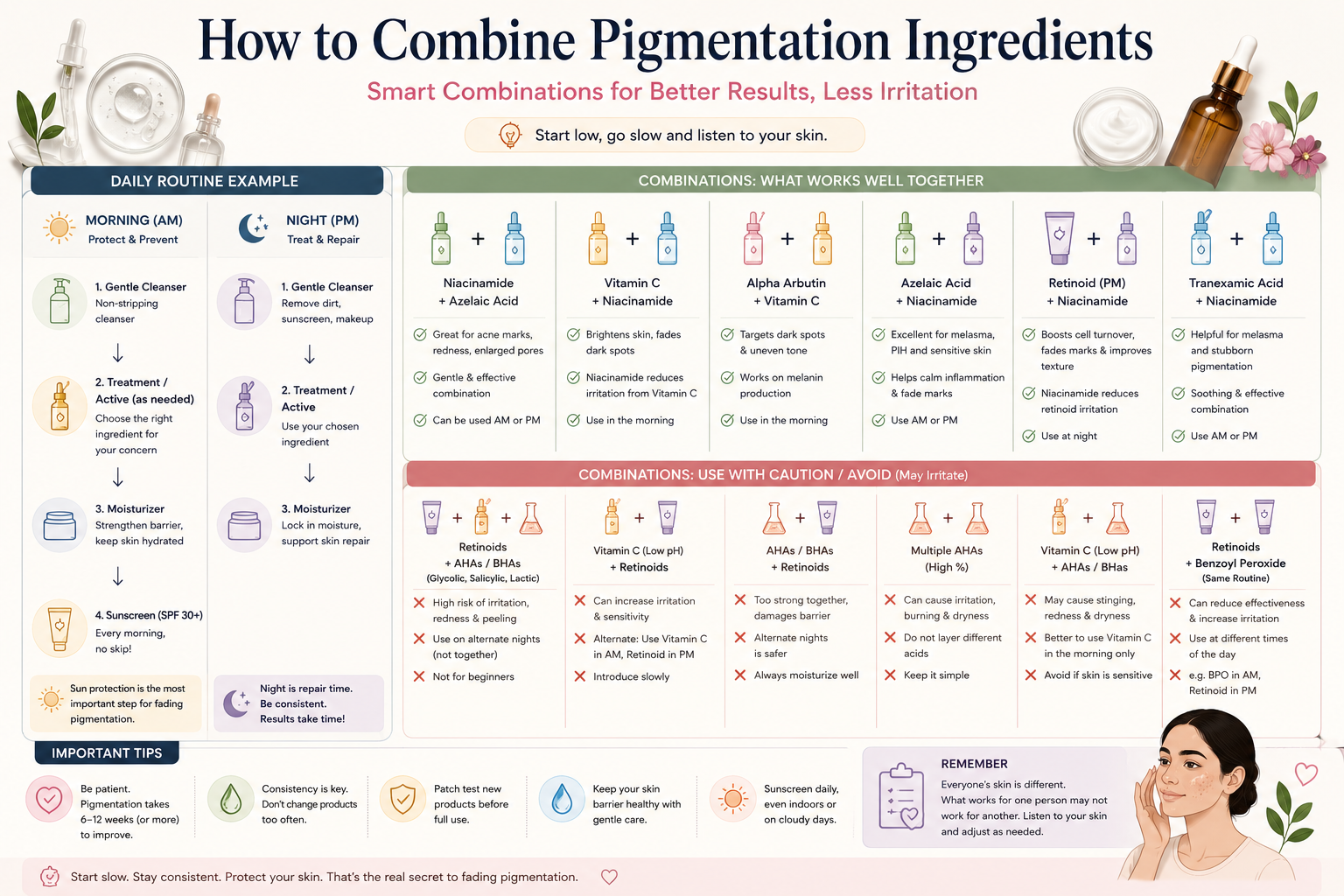
You Do Not Need Seven Serums
Choose the routine closest to your skin and keep it simple enough that you can actually follow it.
Simple Beginner Routine
Acne + Dark Marks
Sensitive-Skin Routine
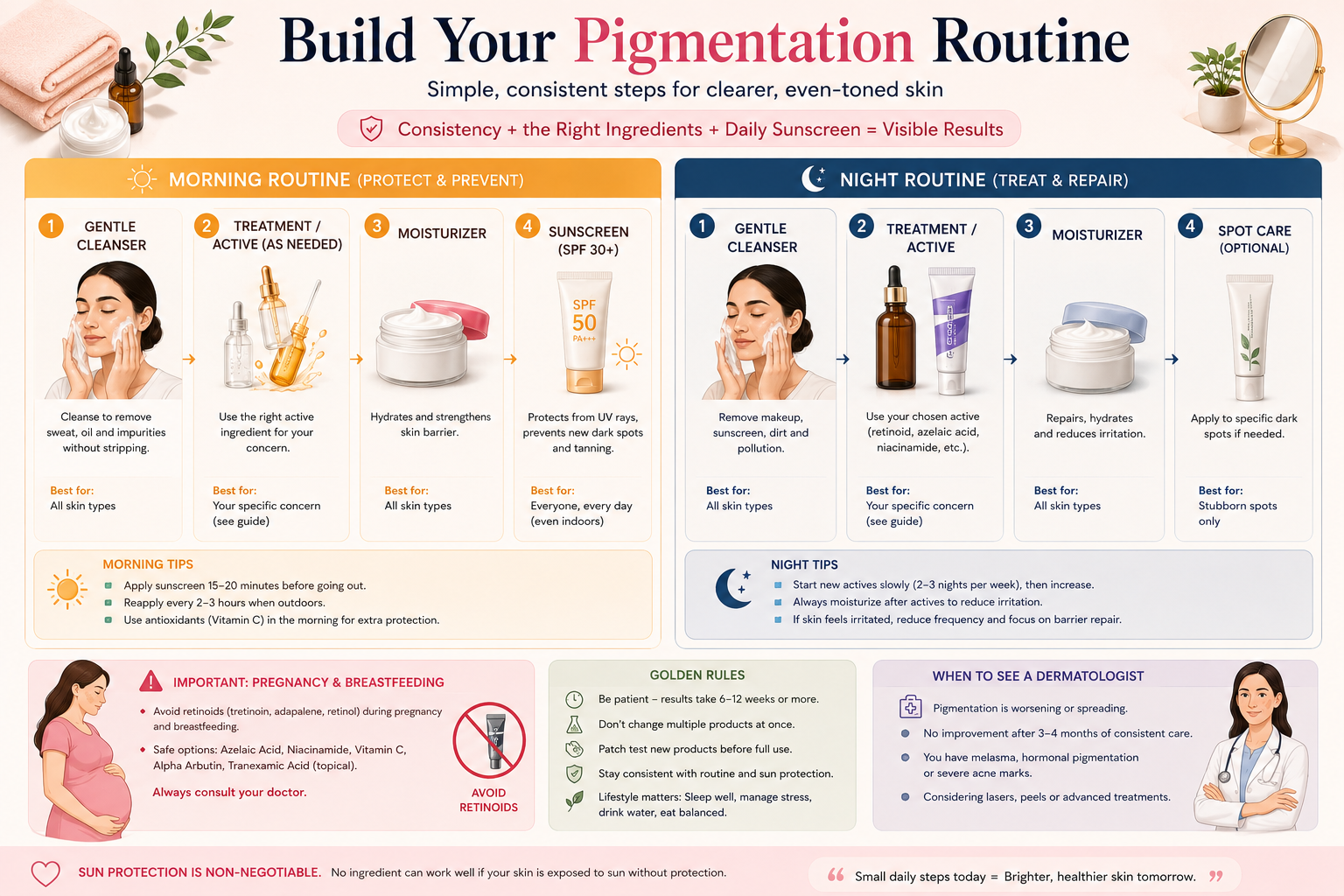
Before Buying Another Serum, Check This
Pregnant? Your Pigmentation Routine Changes
Azelaic acid is commonly used as a pregnancy-compatible option for acne and pigmentation. Niacinamide and vitamin C are also commonly used in ordinary topical skincare.
Hydroquinone is generally avoided during pregnancy.
If melasma becomes prominent during pregnancy, focus on sun protection and a pregnancy-appropriate treatment plan rather than experimenting with multiple strong products.
What About Hydroquinone?
Hydroquinone can be very effective for selected pigmentation problems, particularly melasma.
But it should not be treated like another ordinary cosmetic serum. Concentration, diagnosis, treatment duration and supervision matter.
The Questions People Actually Ask
“I only want ONE serum. Which one should I start with?”
If acne and post-acne marks are your main problem, azelaic acid is often one of the most useful starting options. If the pigmentation is mild and your skin is oily or sensitive, niacinamide may be easier to start with.
“My friend uses vitamin C. Should I buy the same one?”
Not necessarily. Vitamin C is useful for dullness and mild uneven tone, but someone with active acne and brown acne marks may benefit more from azelaic acid or a retinoid-based plan.
“Is a Rs 8,000 imported serum actually better?”
Not simply because it costs more. An inexpensive pharmaceutical product containing the right active can outperform an expensive cosmetic serum for the wrong problem.
“Why did my pigmentation get darker after starting skincare?”
Your routine may be irritating your skin. Strong acids, frequent exfoliation and aggressive retinoid use can trigger inflammation and worsen post-inflammatory pigmentation.
“Can I use vitamin C in the morning and retinol at night?”
Yes, many people can. But introduce treatments gradually so you know what your skin tolerates.
“How long should I wait before saying a serum failed?”
Pigmentation usually changes over weeks to months rather than days. If the treatment is appropriate and tolerable, give it enough time instead of changing products every week.
“My melasma keeps coming back. Am I using the wrong serum?”
Possibly — but the bigger issue may be that melasma is a recurring pigmentation disorder and often needs strict photoprotection plus a more targeted treatment plan than ordinary brightening serums.
“Can I use these products during pregnancy?”
Avoid retinoids during pregnancy. Azelaic acid is commonly used as a pregnancy-compatible option, while significant pigmentation or melasma should be managed with an appropriate pregnancy-safe plan.
Still Not Sure What You Have?
The right ingredient becomes much easier to choose once you know what type of pigmentation you are dealing with.
The Next Level of Pigmentation Treatment
Do Not Build Your Routine Around Hype
The best pigmentation product is not necessarily the strongest serum, the most expensive imported bottle or the product that worked for somebody on TikTok.
Choose an ingredient that matches your problem, use a strength your skin can tolerate, protect your skin from the sun and give the routine enough time to work.
Prices shown are approximate Pakistan market ranges and may change with retailer, city, availability and import costs. Always check the current product label, strength and ingredient list before purchase.
This article provides general skincare and health education and does not replace an individual diagnosis or prescription.