
Chemical Peels, Lasers & Skin Procedures in Pakistan — What Are They, Costs & What They Treat?
Chemical peels, microneedling, lasers and other clinic procedures can help with some types of pigmentation, acne scars and uneven skin texture. But they do very different things — and the procedure that works for one skin problem may be completely wrong for another.
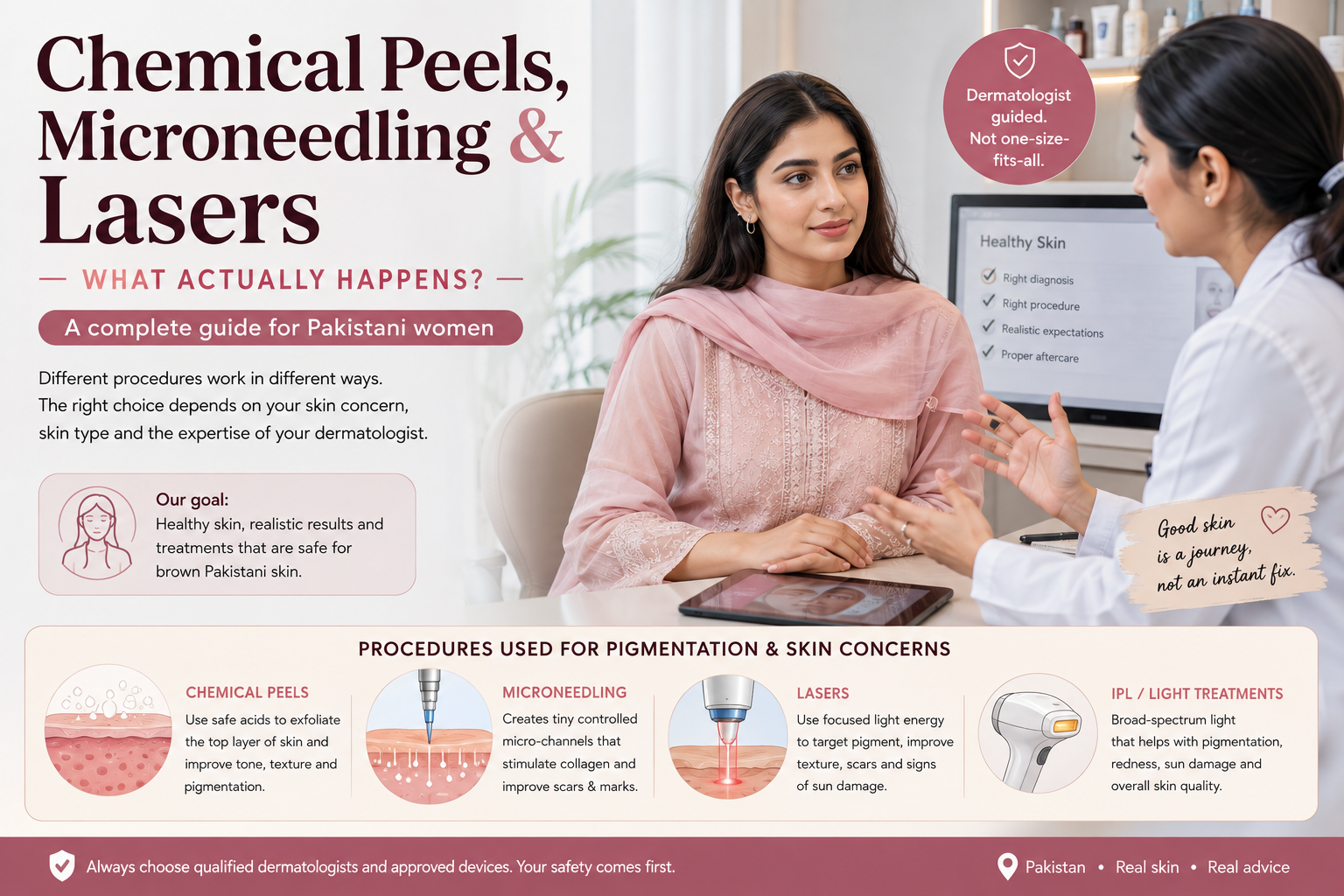
You do not choose a procedure simply because it is newer, more expensive or called a “laser.” The right treatment depends on what is actually causing your skin concern, how deep it is, your skin tone, and how your skin responds to inflammation.
First: what are you actually trying to treat?
Before comparing procedures, identify the problem. A flat brown mark left after a pimple is not the same thing as an acne scar. Melasma is not the same as a sun spot. And uneven texture requires a different approach from excess pigment.
If you are unsure what kind of pigmentation you have, start with our Pigmentation Finder or read our guide to hyperpigmentation and uneven skin tone.
If the area is flat but darker than the surrounding skin, it may be post-inflammatory pigmentation. If the skin itself is indented, raised or uneven, you may be dealing with an acne scar.
You can also read our dedicated guides to acne marks and dark spots and acne scars before considering a procedure.
What actually happens during these procedures?
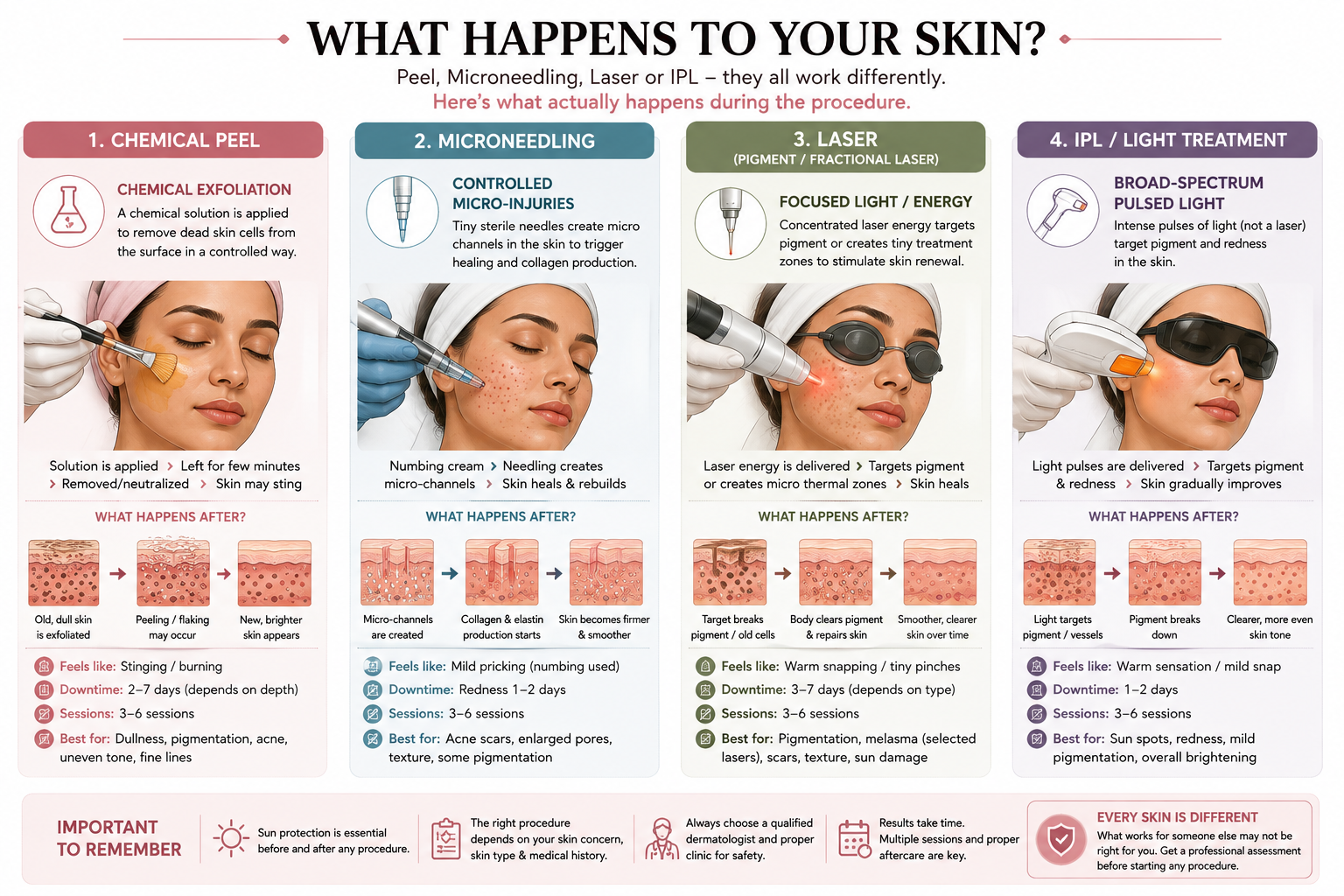
Controlled exfoliation
A chemical solution is applied to the skin to remove or loosen layers of damaged surface skin. As the skin renews, some superficial pigmentation and unevenness may improve.
Tiny controlled injuries
Very fine needles create microscopic channels in the skin. The healing response stimulates collagen remodelling, which is why microneedling is often considered for acne scars and texture.
Focused light energy
“Laser” is not one treatment. Different lasers use different wavelengths and settings to target pigment, water or deeper structures in the skin.
Broad-spectrum light
Intense Pulsed Light is technically not a laser. It delivers multiple wavelengths of light and may be used for selected pigment, redness or photodamage concerns.
Chemical peels
Chemical peels range from relatively superficial treatments to much deeper procedures. For pigmentation in brown skin, dermatologists generally need to be more cautious because excessive irritation can produce post-inflammatory hyperpigmentation (PIH) — meaning the treatment itself can leave the skin darker.
Superficial peels using ingredients such as glycolic acid, salicylic acid, lactic acid or other peeling agents may be used for selected cases of superficial pigmentation, acne and uneven texture.
A peel is not simply a stronger version of an exfoliating serum you use at home. The concentration, acidity, number of layers, contact time and your skin type all influence how deeply it affects the skin.
A deeper peel can create more injury. In Pakistani and other brown skin tones, unnecessary inflammation can increase the risk of prolonged darkening, burns and sometimes scarring.
Microneedling
Microneedling is particularly useful when the problem involves skin texture or certain acne scars. The needles create controlled microscopic injuries, encouraging the skin to remodel collagen during healing.
It can also be used as an additional treatment in selected pigmentation conditions, including melasma, but it should not automatically be assumed to be the best treatment for every brown patch.
Needle depth matters. Treating shallow facial pigmentation and treating deeper acne scars are not the same procedure.
What about microneedling with PRP?
You may see clinics advertising microneedling + PRP, sometimes called a “vampire facial.” PRP means platelet-rich plasma. A small amount of your own blood is processed to concentrate platelets, and the resulting plasma is used alongside the procedure.
PRP can increase the price considerably. Whether it provides enough additional benefit to justify the extra cost depends on what is being treated. Do not assume that adding PRP automatically makes microneedling dramatically better.
RF microneedling
Radiofrequency (RF) microneedling combines needles with radiofrequency energy delivered into the skin. It can produce deeper controlled heating and collagen remodelling than ordinary microneedling.
Clinics may use it for acne scars, enlarged pores, texture and skin tightening. It is usually considerably more expensive than conventional microneedling.
Because RF adds energy as well as needle injury, the device, settings, depth and operator experience matter.
Fractional CO₂ laser
Fractional CO₂ is a resurfacing laser. Instead of treating every millimetre of skin uniformly, it creates microscopic treatment columns while leaving intervening areas relatively intact.
It can be useful for acne scars and significant textural problems, but it also produces more inflammation and downtime than many lighter procedures.
That matters particularly for brown skin because inflammation can trigger PIH. Fractional CO₂ should therefore not be treated as a casual “facial” simply because a clinic is offering a package.
Q-switch and Pico lasers for pigmentation
Pigment-targeting lasers use very short pulses of energy to interact with pigment in the skin. You may hear terms such as Q-switched Nd:YAG, Pico or “laser toning.”
These devices can be useful for selected pigment problems, but the diagnosis is critical. A laser that helps one type of pigmentation can worsen another.
This is especially important with melasma, which behaves differently from an isolated sun spot. Melasma commonly requires long-term pigment control and strict sun protection rather than simply “removing” pigment once.
IPL — and why it isn’t actually a laser
IPL stands for Intense Pulsed Light. Unlike a laser, which uses a more specific wavelength, IPL delivers a broader spectrum of light.
It may be useful for selected superficial pigmentation, redness and sun-related changes, but darker skin contains more melanin, which can also absorb light energy. That makes careful patient selection and appropriate settings particularly important.
Which procedure is used for what?
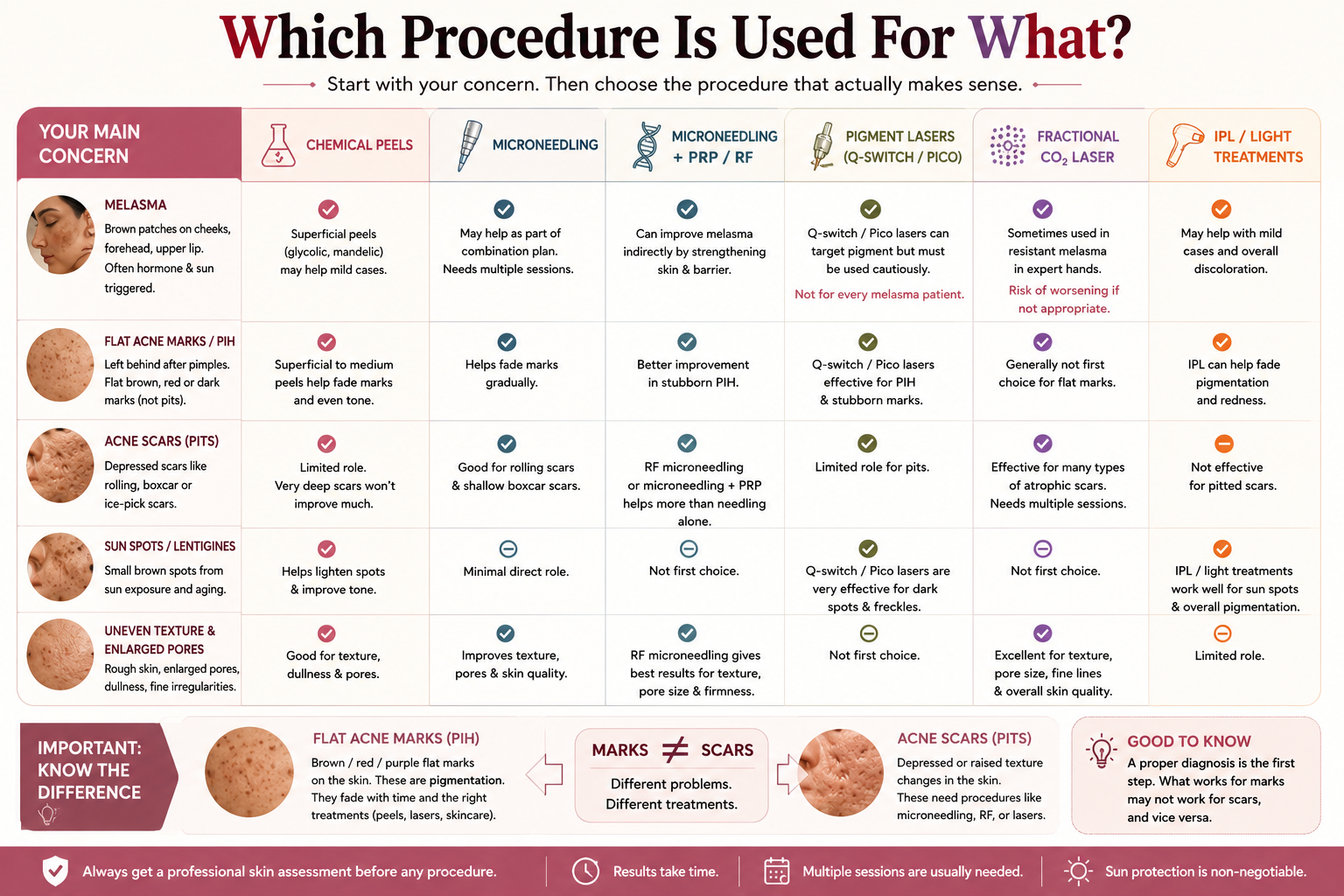
| Concern | Procedures that may be considered | Important point |
|---|---|---|
| Flat acne marks / PIH | Superficial peels; selected pigment procedures | Often start with topical treatment + sunscreen before procedures. |
| Indented acne scars | Microneedling, RF microneedling, fractional lasers and scar-specific procedures | Scar type matters. One procedure does not treat every scar equally. |
| Melasma | Selected superficial peels, microneedling or carefully chosen laser/light treatments as part of a wider plan | Melasma can relapse and may worsen after excessive heat or inflammation. |
| Sun spots | Selected pigment lasers, IPL or other targeted treatments | The spot should be correctly diagnosed before treating it cosmetically. |
| Uneven texture | Microneedling, RF microneedling, fractional resurfacing | The appropriate depth depends on the underlying problem. |
Brown Pakistani skin needs a different level of caution
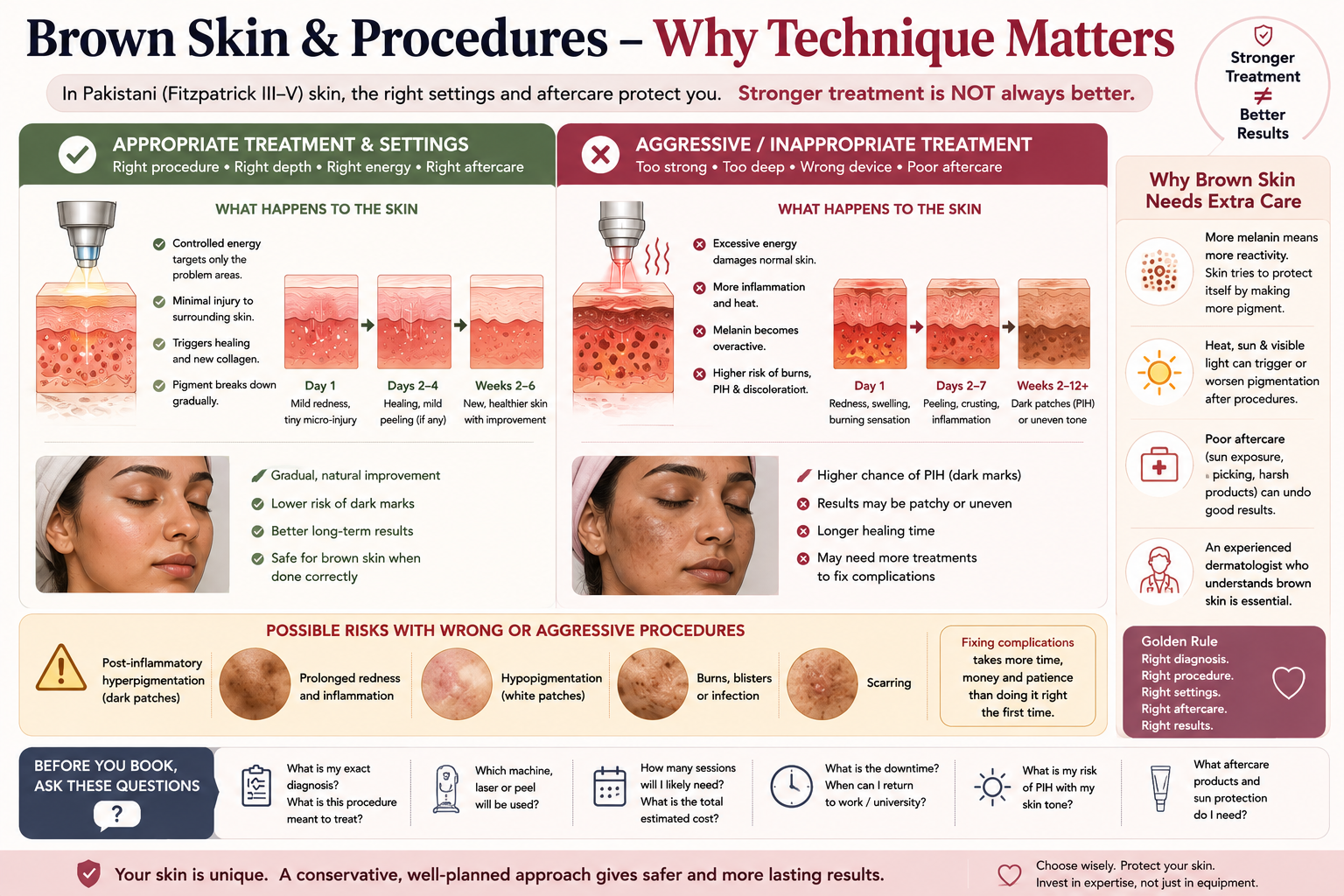
Melanin protects the skin, but it also changes how skin responds to some procedures. Brown and darker skin tones are more likely to develop post-inflammatory hyperpigmentation after significant irritation or injury.
That does not mean Pakistani women cannot have lasers, peels or microneedling. It means the procedure, device and settings need to be chosen with the person’s skin tone and diagnosis in mind.
More redness, more peeling and more pain do not necessarily mean better results. An unnecessarily aggressive treatment can leave brown skin with exactly the problem you were trying to remove: more pigmentation.
If pigmentation is your main concern, also read our guide to sunscreen for Pakistani skin. Procedures cannot compensate for ongoing UV exposure, especially when treating melasma and PIH.
How painful are these procedures?
Experience varies according to the procedure, intensity and treatment area.
Chemical peel
Often causes tingling, warmth or stinging during application. Stronger peels generally cause more discomfort and peeling afterwards.
Microneedling
A numbing cream is commonly used. You may still feel pressure, scratching or prickling, especially over bony areas.
RF microneedling
Usually requires topical anaesthesia and may feel hotter or more intense than standard microneedling.
Laser
Sensation varies enormously by device — from mild snapping or warmth to considerably stronger discomfort with resurfacing procedures.
How much downtime should you expect?
“No downtime” is often used loosely in clinic marketing. Even when you can return to normal activities quickly, your skin may still be red, sensitive, dry or temporarily darker.
A light superficial peel may produce little visible peeling, while fractional CO₂ can involve several days of obvious redness, swelling, crusting or peeling. Microneedling commonly causes temporary redness and sensitivity.
How many sessions will you need?
Many clinic procedures are not one-session treatments.
The number of sessions depends on the diagnosis, severity, procedure and how your skin responds. Acne scars, for example, commonly require a treatment course rather than a single microneedling or laser session.
This is why comparing clinics only by price per session can be misleading.
A PKR 8,000 treatment performed six times costs PKR 48,000 before skincare, medicines, follow-ups or maintenance. A more expensive treatment requiring fewer sessions may sometimes have a similar total cost.
Skin procedure prices in Pakistan
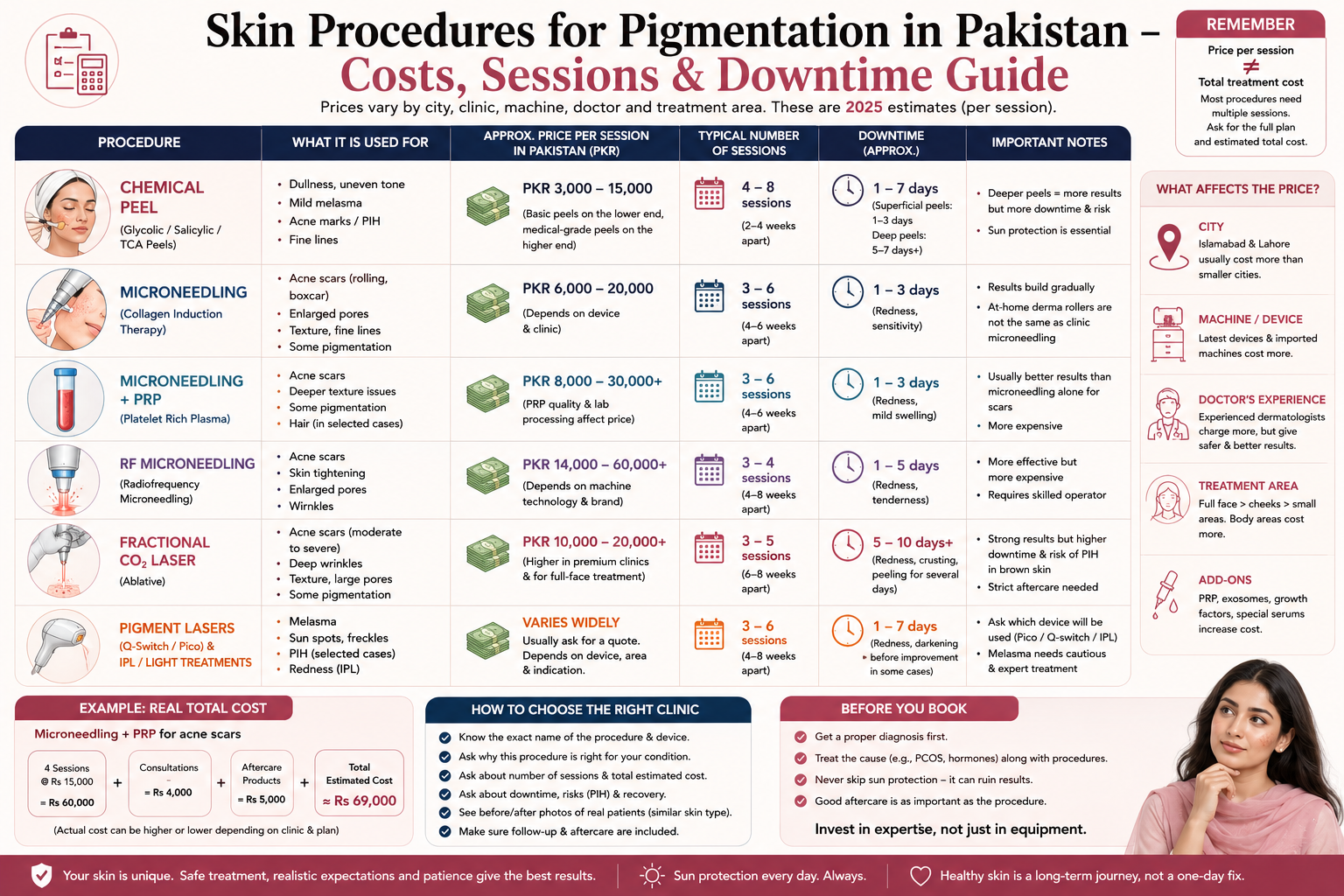
Prices vary significantly between Pakistani cities, clinics, dermatologists and devices. The following ranges are useful for understanding the general market rather than fixed prices.
| Procedure | Approximate Pakistan price | Common reason for treatment |
|---|---|---|
| Chemical peel | PKR 3,000–15,000 / session | Superficial pigmentation, acne, uneven tone or texture |
| Microneedling | PKR 6,000–20,000 / session | Acne scars, texture; selected pigmentation treatment |
| Microneedling + PRP | PKR 8,000–30,000+ / session | Scars, texture and rejuvenation |
| RF microneedling | PKR 14,000–60,000+ / session | Acne scars, texture, pores and tightening |
| Fractional CO₂ laser | PKR 10,000–20,000+ / session | Acne scars and significant texture problems |
| Pigment laser / Pico / Q-switch | Varies widely | Selected pigmentation depending on diagnosis and device |
| IPL | Varies widely | Selected pigmentation, redness and photodamage |
These are approximate consumer price ranges, not guaranteed clinic prices. Islamabad, Lahore and Karachi clinics may charge differently from smaller cities, and the exact device used can substantially affect price.
Don’t choose a clinic only because it is cheaper
A discounted procedure is not a bargain if it leaves you treating burns or pigmentation afterwards.
Before booking, ask:
- Who will actually perform the procedure?
- What is my diagnosis? Ask what they believe they are treating.
- What exact device or procedure will be used?
- Is this appropriate for my skin tone?
- What is the risk of PIH in my skin?
- How many sessions are realistically expected?
- What will the total treatment course probably cost?
- What downtime should I expect?
- What skincare or sun protection is required afterwards?
- What happens if I develop a burn or unexpected pigmentation?
Be careful with before-and-after photos
Before-and-after photographs can be useful, but they are not proof that you will get the same result.
Lighting, camera exposure, makeup, angle and editing can all change how pigmentation appears. More importantly, someone else’s skin type, diagnosis and scar pattern may be completely different from yours.
A clinic should be able to explain why a procedure suits your skin, not simply show you an impressive photograph.
What should you do before a procedure?
Preparation depends on the treatment. Your dermatologist may adjust active skincare before a peel, laser or microneedling session.
Tell the clinician about medicines and skincare you are using, previous reactions to procedures, tendency to develop dark marks or raised scars, active acne or infection, pregnancy, and any important medical conditions.
Do not hide the fact that you are using strong creams. This is especially important if you have been using an unknown fairness cream or a potent steroid-containing product.
Read our guide to fairness and whitening cream safety in Pakistan if you are unsure what may be present in a product you have been applying.
What about skincare after treatment?
Your skin barrier may temporarily be more vulnerable after a procedure. Follow the specific instructions given for your treatment.
In general, this is not the time to experiment with multiple new acids, scrubs, retinoids or viral DIY remedies. Gentle cleansing, appropriate moisturising and sun protection are commonly important while the skin heals.
Sun protection is particularly important when treating pigmentation. UV and visible-light exposure can contribute to persistent pigmentation and melasma recurrence.
When should you contact the clinic urgently?
Some redness, tenderness or peeling may be expected after certain procedures. But seek medical advice if you develop:
- Severe or increasing pain
- Significant blistering or a suspected burn
- Marked swelling that is worsening
- Pus, spreading redness or other signs of infection
- New crusting or wounds that are not healing normally
- Rapidly worsening dark or pale patches
- Any reaction that is substantially worse than what the clinician told you to expect
So, which procedure is “best”?
There isn’t one best skin procedure.
If you have flat acne marks, you may not need an expensive resurfacing laser at all. If you have indented acne scars, creams alone cannot remodel a deep scar in the same way a procedural treatment can. If you have melasma, aggressively trying to destroy the pigment can sometimes make the condition harder to control.
The best approach is therefore:
If your main concern is simply making your skin look brighter or more even, start with what actually works for skin brightening rather than assuming you need a clinic procedure.
Continue exploring Brightening & Pigmentation
Not sure which treatment fits your skin?
You don’t have to choose a peel, laser or procedure based on clinic advertising alone. Ask AuratSehat and understand your options first.
Ask a Doctor for FreeMedical references
American Academy of Dermatology (AAD). Melasma: Diagnosis and treatment. Includes dermatologist guidance on sun protection, chemical peels, microneedling, laser/light treatments and individualized treatment according to skin tone.
Elbuluk N, Eimpunth S, Udompataikul M, et al. Microneedling in skin of color: A review of uses and efficacy. Journal of the American Academy of Dermatology.
American Academy of Dermatology. Melasma in Skin of Colour — educational updates addressing chemical peels, microneedling and energy-based treatments in darker skin.
Prices in this article are approximate Pakistani market ranges collected for consumer education. Clinic prices vary by city, practitioner, device, treatment area and number of sessions.
AuratSehat Medical Team