
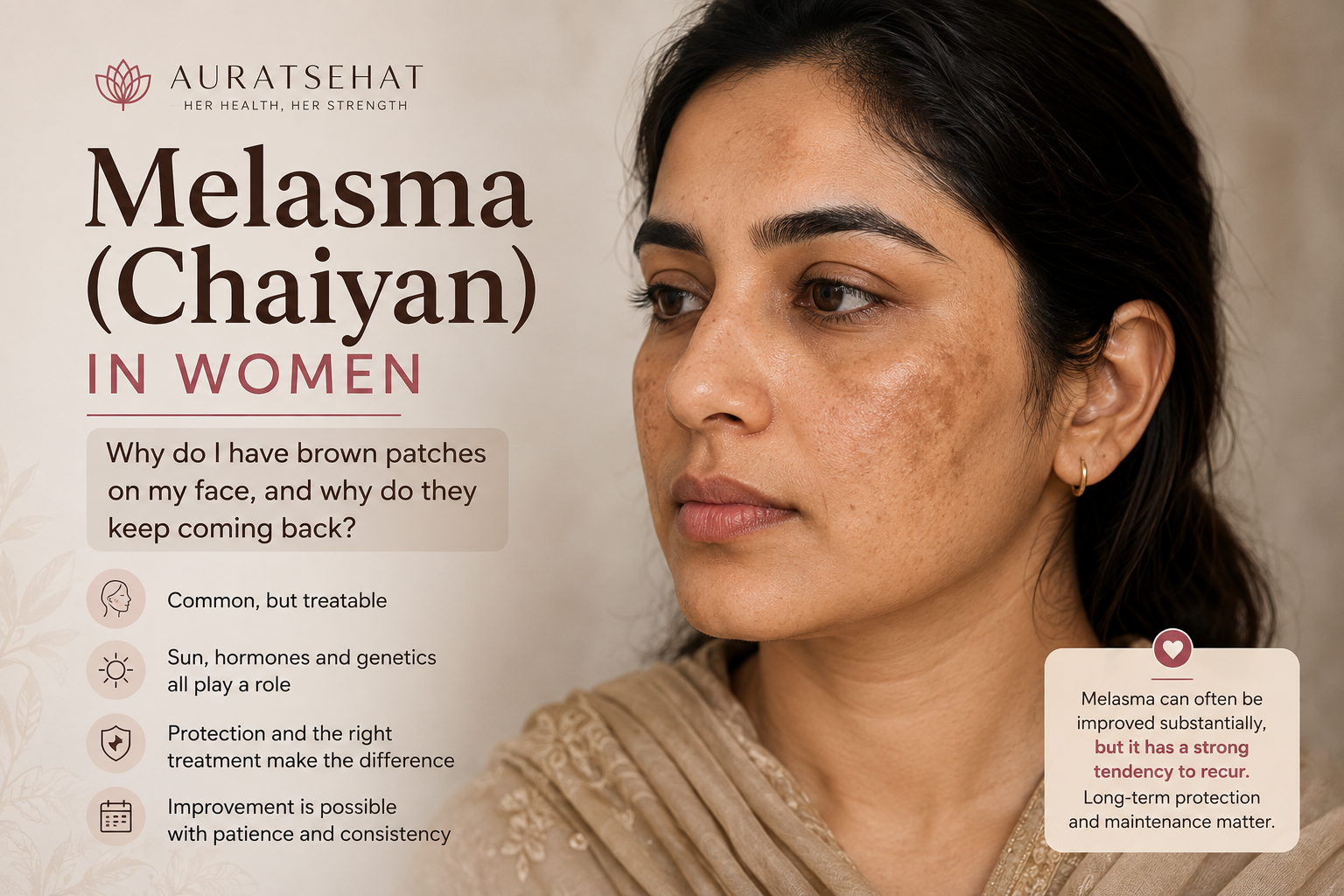
Melasma (Chehre Ki Chaiyan) in Women
Chehre ki chaiyan is a phrase many Pakistani women use for brown or grey-brown patches on the face. One of the most common causes is melasma — a long-term pigmentation condition that often appears symmetrically on the cheeks, forehead, upper lip, nose or chin.
Melasma is especially frustrating because it may seem to appear suddenly, fade slowly and then become darker again after sun exposure, pregnancy or stopping treatment.
It is not caused by dirty skin, poor hygiene or not washing your face properly. Melasma develops because pigment-producing cells in the skin become more active than usual.
What Exactly Is Melasma?
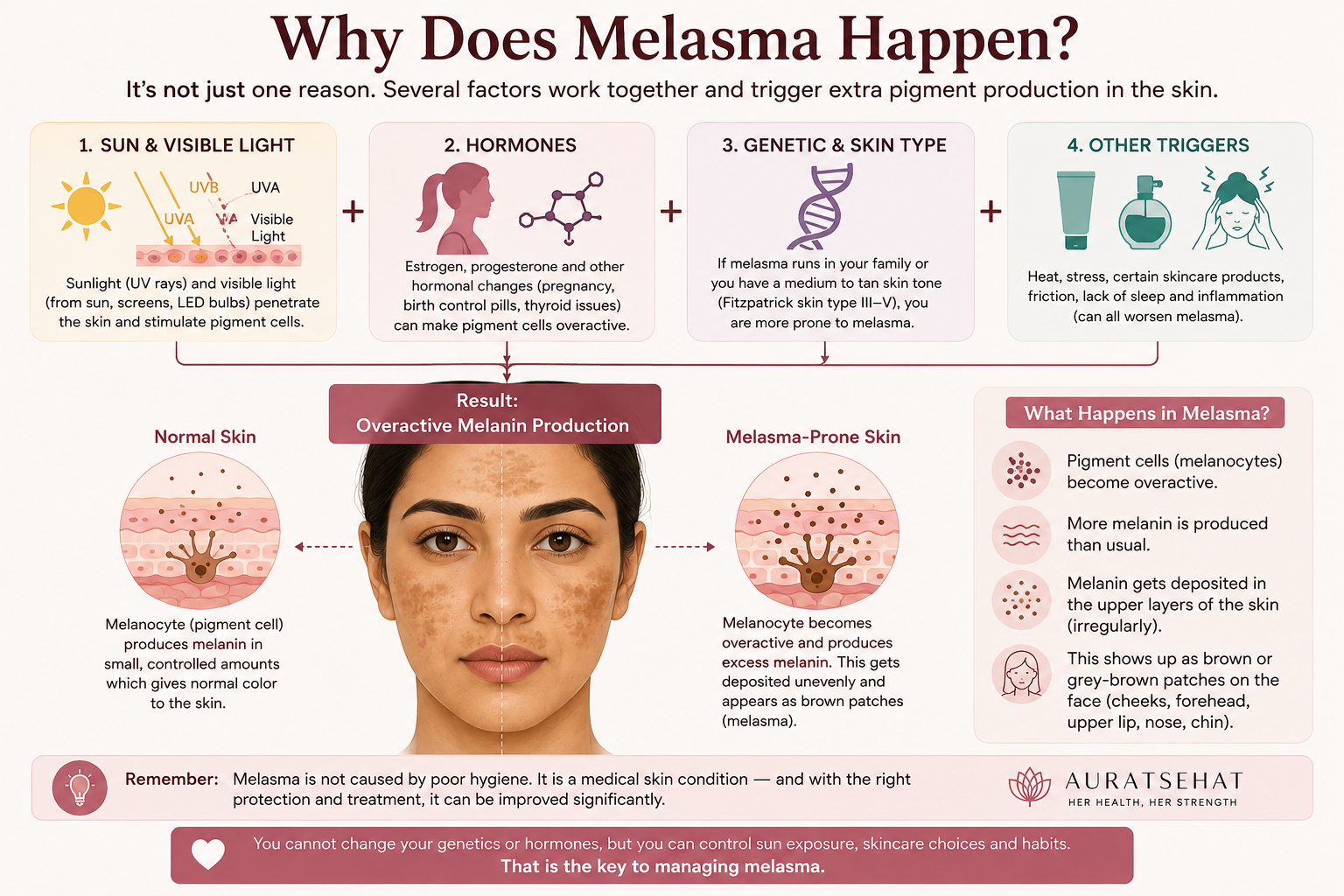
Your skin contains cells called melanocytes. These cells produce melanin — the pigment that gives skin its natural colour.
In melasma, these pigment cells become overactive. They produce and distribute more melanin in certain areas, creating patches that look tan, brown, grey-brown or sometimes slightly bluish-grey.
Melasma is most often seen on the face and is especially common in women and in people with medium-to-brown skin tones. It can last for months or years and commonly relapses after apparently successful treatment.
How Do I Know If My Chaiyan Are Melasma?
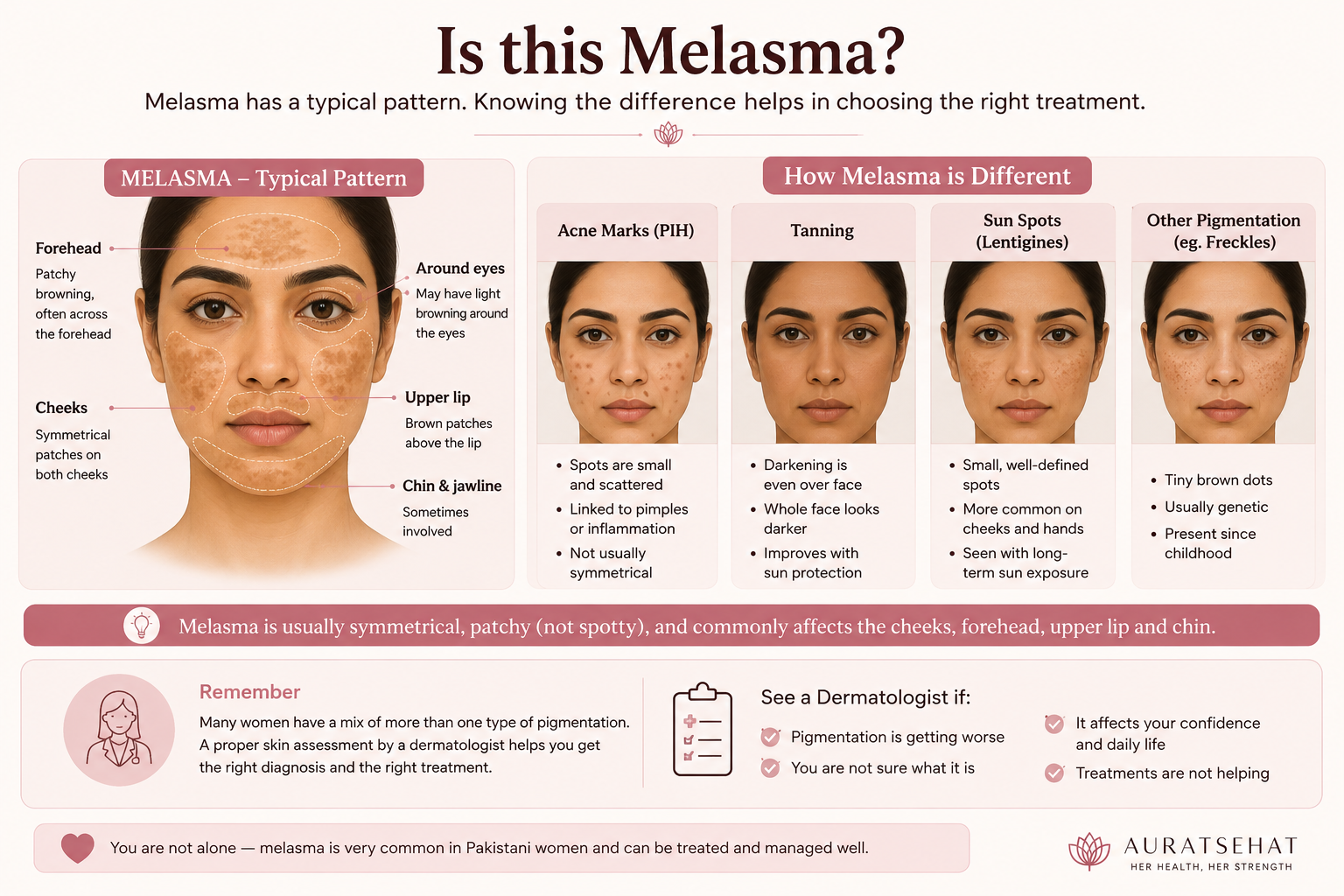
Melasma usually produces flat patches rather than individual pimples or scars. The colour is often similar on both sides of the face.
Cheeks
Brown patches over both cheeks are one of the most recognizable melasma patterns.
Forehead
Patchy pigmentation may extend across the centre or sides of the forehead.
Upper lip
Melasma above the upper lip can sometimes resemble a shadow or moustache-like pigmentation.
Chin & nose
Some women develop pigmentation over the chin, nose or central face as well.
Not every brown patch is melasma
Acne marks, tanning, post-inflammatory hyperpigmentation, freckles, sun spots and several other pigment disorders can resemble melasma. Some women have more than one type of pigmentation at the same time.
If the diagnosis is uncertain — especially if pigmentation is one-sided, unusually coloured, rapidly changing or not responding to treatment — a dermatologist should assess it.
Why Did I Get Melasma?
There is rarely one single cause. Melasma usually develops when a genetically or biologically susceptible skin is exposed to triggers that stimulate pigment production.
1. Sunlight
Sun exposure is one of the strongest triggers. Both ultraviolet radiation and visible light from sunlight can stimulate pigment production.
This is why melasma may become darker in summer, after travelling, during outdoor work or after spending more time in direct sunlight.
2. Visible light
Visible light from the sun can worsen hyperpigmentation, particularly in darker skin tones. For this reason, a tinted sunscreen containing iron oxides may provide additional protection for women with melasma.
What about mobile phones and laptops?
You may see claims online that phone or laptop screens are a major cause of melasma. Current evidence is much stronger for visible light from sunlight. You do not need to live in fear of your mobile screen.
3. Hormones
Hormonal changes are important in many women. Melasma commonly appears or worsens during pregnancy, and hormonal contraception can contribute in some people.
4. Genetics and skin type
Melasma often runs in families. People whose skin tans easily and those with naturally medium or brown skin are particularly susceptible.
5. Irritation
Harsh scrubs, aggressive facials, repeated peels, irritating creams and combining too many strong active ingredients can inflame the skin.
In pigmentation-prone skin, inflammation itself can produce additional darkening.
Melasma During Pregnancy
Melasma that appears during pregnancy is sometimes called the mask of pregnancy. Pregnancy hormones can make pigment-producing cells more active, especially when combined with sun exposure.
For some women, pregnancy-related melasma fades substantially after delivery. For others, some pigmentation remains or returns with future pregnancies or sun exposure.
If you are pregnant
Keep treatment simple and prioritize sun protection, gentle cleansing and moisturizing. Tell your obstetrician or dermatologist about every medicated or brightening product you use.
Do not use topical retinoids such as tretinoin or adapalene during pregnancy. Hydroquinone should also be avoided during pregnancy. Azelaic acid is generally considered an option that can be used during pregnancy, but it is still sensible to discuss your individual routine with your doctor.
Can Melasma Be Removed Permanently?
This is one of the most important expectations to understand.
Melasma can improve dramatically, but it is usually better thought of as a chronic tendency rather than a one-time stain.
Treatment can reduce the excess pigment that you currently see. It cannot always remove the underlying tendency of your pigment cells to become overactive again.
That is why maintenance treatment and daily photoprotection remain important even after your skin looks much better.
Does Sunscreen Really Help Melasma?
Yes. Sunscreen is not an optional extra in melasma treatment — it is the foundation.
A pigmentation cream cannot work well if the skin is repeatedly receiving signals from sunlight to make more pigment.
What sunscreen should I look for?
- Broad-spectrum protection.
- SPF 30 or higher; SPF 50+ is a practical choice for melasma.
- A product you can comfortably use every day.
- Consider a tinted sunscreen containing iron oxides for additional visible-light protection.
- Reapply during prolonged outdoor exposure, sweating or after the sunscreen is removed.
Hats, shade, sunglasses and covering the face from intense direct sun can provide additional protection.
What Is the Best Cream for Chehre Ki Chaiyan?
There is no single cream that is best for every woman. The right treatment depends on whether the pigmentation really is melasma, how severe it is, how sensitive your skin is, whether you are pregnant and what you have already tried.
Azelaic Acid for Melasma
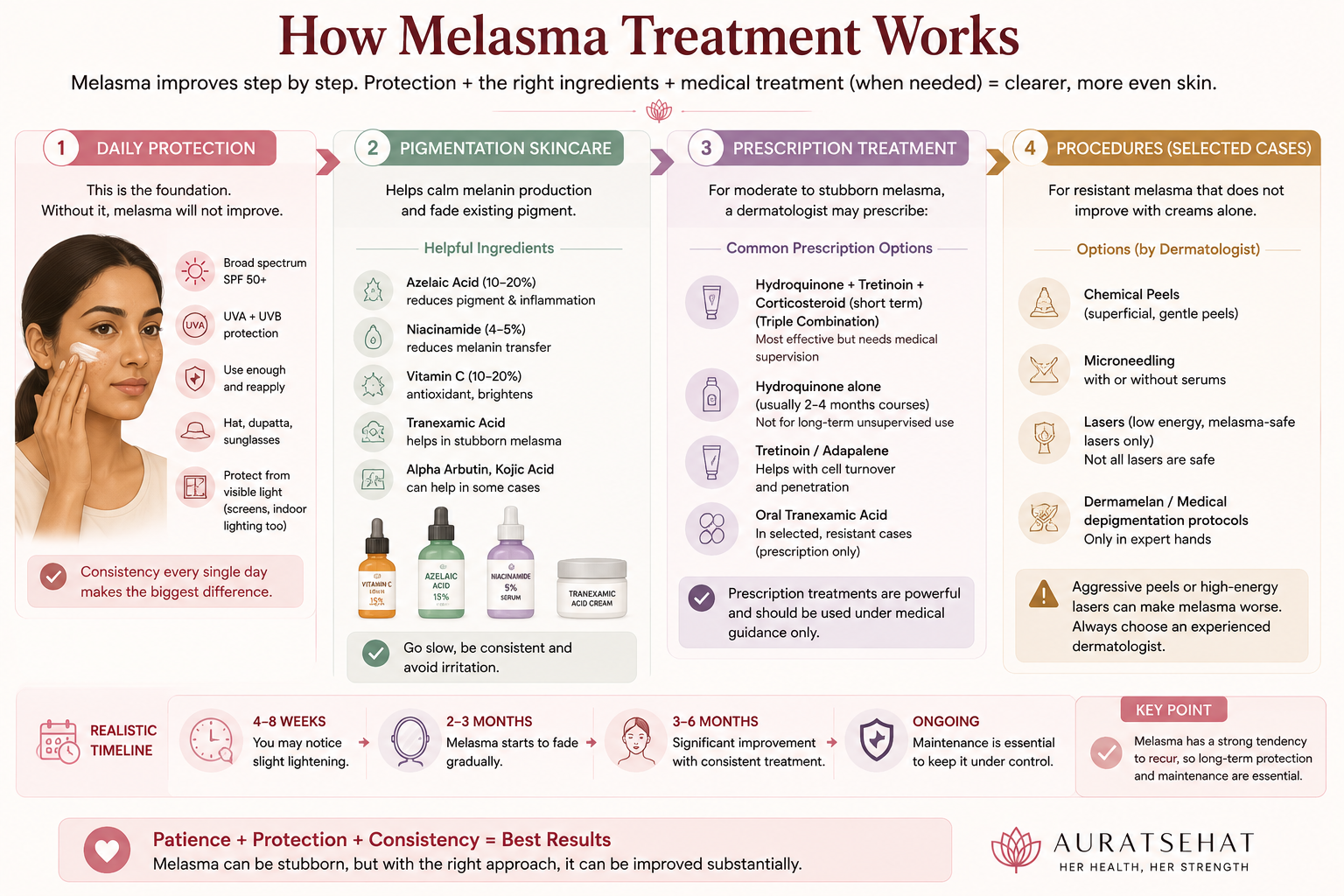
Azelaic acid can reduce abnormal pigment production and also has anti-inflammatory effects. It is frequently used for pigmentation and may be particularly useful when acne or post-inflammatory pigmentation exists alongside melasma.
It is not an overnight treatment. Pigmentation treatment generally requires consistent use for weeks to months.
Do Niacinamide, Vitamin C, Kojic Acid and Alpha-Arbutin Work?
These ingredients may help improve uneven pigmentation, although they generally do not have the same strength of evidence as dermatologist-prescribed hydroquinone-based combination treatment for established melasma.
Niacinamide
May help reduce transfer of pigment within the skin and is usually relatively gentle.
Vitamin C
An antioxidant that can support a pigmentation routine, but usually works best as part of a broader plan.
Kojic acid
Can reduce melanin production but may irritate sensitive skin.
Alpha-arbutin
Common in brightening products and may help mild pigmentation, but stubborn melasma often needs more.
Does Hydroquinone Remove Melasma?
Hydroquinone is one of the most effective topical medicines used for melasma. It reduces melanin production and may be prescribed alone or as part of a combination treatment.
A dermatologist may prescribe a triple-combination cream containing hydroquinone, tretinoin and a corticosteroid for appropriate patients.
Hydroquinone is not a lifelong fairness cream
It should not be used continuously for long periods without medical supervision. Irritation, rebound pigmentation and rare complications such as exogenous ochronosis are reasons to avoid uncontrolled long-term use.
If you have been using a hydroquinone or steroid-containing cream for months without supervision, show the product to a dermatologist.
Can Tretinoin Treat Melasma?
Tretinoin can help by increasing skin-cell turnover and improving the effectiveness of other pigmentation treatments. It is often used within prescription combination regimens.
However, using too much too quickly can cause irritation — and irritation can make pigmentation look worse.
Retinoids should not be used during pregnancy.
What About Tranexamic Acid?
Tranexamic acid is increasingly used in selected patients with difficult melasma. It may be used topically, and dermatologists sometimes prescribe it orally for resistant disease.
Oral tranexamic acid requires medical assessment
Oral tranexamic acid is not simply another pigmentation supplement. It can affect blood clotting, so doctors need to consider personal and family history of blood clots, cardiovascular risks and other medical factors before prescribing it.
Do not self-start oral tranexamic acid for melasma.
Home Remedies for Chehre Ki Chaiyan — Do They Work?
Pakistani women commonly try aloe vera, Multani mitti, turmeric, yogurt, milk, honey, rice water, rice flour and other home remedies before seeing a dermatologist.
There is nothing wrong with wanting a simple home approach, but it is important to separate gentle supportive skin care from claims that a kitchen ingredient can remove melasma permanently.
| Home remedy | What it may do | Cautious use |
|---|---|---|
| Aloe vera | May soothe or moisturize some skin. | Fine as a gentle soothing product if it does not sting or irritate you, but do not expect it to remove established melasma. |
| Turmeric | Has anti-inflammatory and antioxidant properties, but evidence for treating melasma is limited. | If you use it, keep mixtures gentle and stop if you develop burning, redness or a rash. |
| Yogurt or milk | Contain naturally occurring acids and may temporarily make skin feel smoother. | They are not substitutes for melasma treatment. Avoid if they sting or trigger irritation. |
| Honey | May act as a moisturizer. | Generally used for soothing rather than pigment removal. Avoid if you develop irritation or allergy. |
| Rice water / rice flour | Popular in DIY brightening routines, but evidence for treating melasma is insufficient. | Avoid vigorous rice-flour scrubbing. Friction can worsen pigmentation. |
| Multani mitti | Can absorb oil and temporarily make skin feel cleaner. | It does not remove melasma. Frequent use may dry or irritate the skin, especially when combined with lemon or scrubbing. |
| Lemon juice | Often promoted for “bleaching” dark skin. | Avoid. Lemon can irritate the skin and may contribute to inflammation and worsening pigmentation. |
| Vinegar | Sometimes promoted online as an acidic brightening treatment. | Avoid applying undiluted vinegar to the face. Chemical irritation can worsen pigmentation. |
| Scrubs / ubtan | May temporarily remove surface scale and make skin feel smoother. | Avoid aggressive rubbing. Physical irritation does not scrub melasma out of the skin and may make dark patches worse. |
If you still want to use a home remedy
- Use only one gentle remedy at a time.
- Patch-test it first.
- Do not scrub the skin.
- Stop if it burns, stings or causes persistent redness.
- Do not mix several acidic or irritating ingredients together.
- Keep sunscreen and evidence-based treatment as the main plan.
What About Fairness Creams and Chaiyan Creams?
Be careful with creams that promise very rapid whitening, especially products with unclear ingredient lists or mixtures prepared by salons, shops or unqualified sellers.
Some combination creams contain strong corticosteroids, hydroquinone or other medicines that should not be used casually. They may make the skin look temporarily lighter while causing thinning, acne-like eruptions, visible blood vessels, irritation or rebound pigmentation with prolonged misuse.
A quick-lightening result is not always a healthy result
If a cream makes your face dramatically lighter within days or weeks, do not assume that means the melasma has been safely treated. Check the ingredient list and, when uncertain, show the product to a dermatologist.
Do Chemical Peels Work for Melasma?
Superficial chemical peels can be used as an additional treatment in selected patients. They may help remove superficial pigment and improve the effect of topical treatment.
However, stronger is not necessarily better. An overly aggressive peel can produce inflammation and post-inflammatory hyperpigmentation, particularly in pigmentation-prone skin.
Does Microneedling Help?
Microneedling may be used as an adjunct in selected melasma patients and can help topical treatments penetrate more effectively. It is not necessary for everyone and should be performed carefully.
Which Laser Is Best for Melasma?
There is no universally “best laser” for melasma.
Lasers and light-based procedures can sometimes improve resistant melasma, but they can also trigger post-inflammatory hyperpigmentation or relapse. International expert guidance generally reserves lasers for carefully selected, refractory cases rather than treating them as the first step.
Can laser make melasma worse?
Yes. It can in some people. This is why procedure choice, energy settings, skin type, pre-treatment and aftercare matter. If you are considering a laser, choose a dermatologist experienced in treating pigmentation in brown skin.
How Long Does Melasma Treatment Take?
Melasma treatment should be measured in months rather than days.
First 4–8 weeks
You may notice early brightening or reduced contrast between the patches and surrounding skin.
2–3 months
More visible improvement may develop if treatment and photoprotection are consistent.
3–6 months
Stubborn melasma may continue to improve gradually, although complete clearance is not guaranteed.
After improvement
Maintenance becomes the priority because melasma has a strong tendency to return.
I Have Tried Everything. Why Are My Chaiyan Not Going Away?
This is a very common frustration. Lack of improvement does not always mean that you simply need a stronger cream.
The diagnosis may be wrong
Not every facial pigmentation problem is melasma.
Sun protection may be incomplete
Repeated light exposure can keep stimulating new pigment even while treatment is trying to remove old pigment.
The routine may be too irritating
Too many acids, retinoids, scrubs or procedures can create inflammation and worsen darkening.
The treatment may be inconsistent
Constantly changing products makes it difficult for any one treatment to work.
Your melasma may be resistant
Some cases need prescription treatment or dermatologist-directed combinations.
Your expectations may be too fast
Melasma usually improves slowly and recurrence can occur even after good results.
Sometimes doing less gives better results
If your face is burning, peeling, red or sensitive from multiple pigmentation treatments, your first step may be to simplify the routine and repair the skin barrier rather than adding another active ingredient.
Why Does Melasma Keep Coming Back?
Treating visible pigmentation does not permanently remove the skin’s tendency to form melasma. Sunlight, hormonal changes, irritation and stopping maintenance can reactivate pigment production.
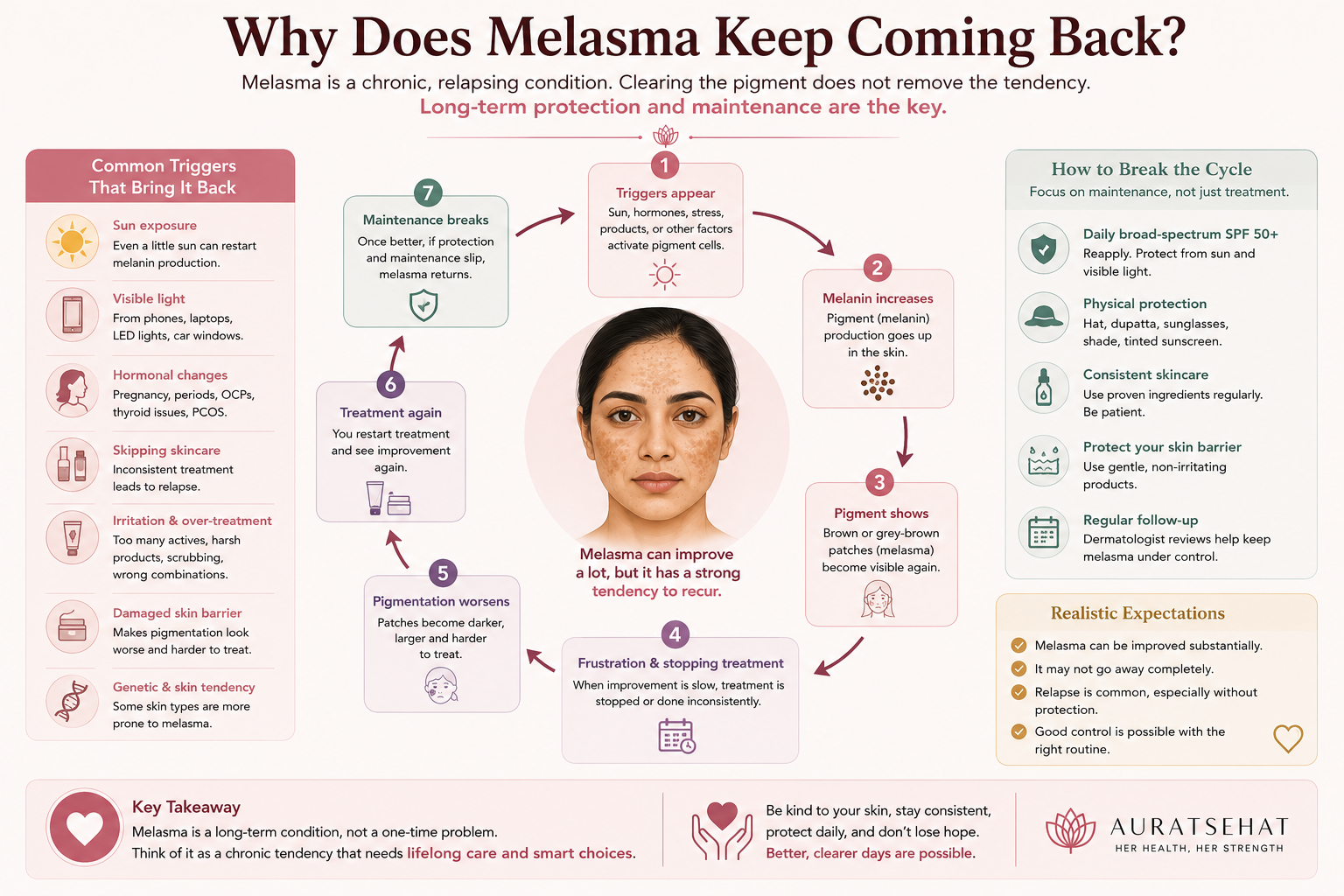
How Do I Stop Melasma From Coming Back?
- Use sunscreen consistently, not only when you are actively treating the pigmentation.
- Consider tinted iron-oxide sunscreen if suitable for you.
- Use hats, shade and other physical protection during strong sun exposure.
- Continue the maintenance plan recommended by your dermatologist.
- Avoid repeated irritation and unnecessary aggressive procedures.
- Do not restart prescription creams indefinitely without medical guidance.
- Expect some fluctuation rather than assuming every recurrence means treatment has failed.
A Simple Melasma Routine
Morning
Gentle cleanser → suitable pigmentation treatment if prescribed → moisturizer if needed → broad-spectrum sunscreen, ideally with visible-light protection when appropriate.
Evening
Gentle cleanser → your selected treatment → moisturizer. Avoid adding multiple strong actives simply because progress feels slow.
When Should I See a Dermatologist?
Consider a dermatologist assessment if:
- You are not sure whether the pigmentation is actually melasma.
- Your pigmentation is rapidly worsening.
- The pigmentation is very uneven or mainly on one side.
- Your current treatment causes burning, redness or persistent peeling.
- You have used multiple products for several months without improvement.
- You are considering hydroquinone, oral tranexamic acid, strong peels or laser treatment.
- You are pregnant and are unsure which products are safe.
- The pigmentation is significantly affecting your confidence or daily life.
Frequently Asked Questions About Melasma & Chaiyan
Chehre ki chaiyan kaise khatam karein?
First make sure the pigmentation is really melasma. Then focus on daily sun protection, an evidence-based pigmentation treatment and long-term maintenance. Stronger treatment is not always better.
Can melasma disappear completely?
Some people achieve very substantial clearing, and pregnancy-related melasma may fade after delivery. However, melasma commonly returns, so long-term control is a more realistic goal than guaranteeing a permanent cure.
Does melasma mean I have a hormonal problem?
Not necessarily. Hormones can influence melasma, but many women with melasma do not have an underlying hormonal disease.
Can PCOS cause melasma?
PCOS itself is not considered a direct universal cause of melasma. Women with PCOS can certainly have melasma, but darkening around the neck or body folds may instead suggest acanthosis nigricans, which is a different condition.
Does washing the face more often remove chaiyan?
No. Melasma pigment is produced within the skin. Scrubbing harder or washing repeatedly will not remove it and may cause irritation.
Can aloe vera remove melasma?
Aloe vera may soothe the skin, but it should not be expected to clear established melasma on its own.
Does Multani mitti remove chaiyan?
Multani mitti may absorb oil and temporarily change how the skin feels, but it does not treat the biological process causing melasma. Overuse can also dry or irritate some skin.
Can I use lemon for melasma?
We would not recommend it. Lemon juice can irritate facial skin, and inflammation may worsen pigmentation rather than improve it.
Which sunscreen is best for melasma?
Choose a broad-spectrum sunscreen with SPF 30 or higher that you can use consistently. For melasma, tinted sunscreen containing iron oxides can provide additional protection from visible light.
Can melasma return in another pregnancy?
Yes. If pregnancy triggered melasma once, hormonal changes in a future pregnancy may trigger or worsen it again. Consistent photoprotection remains important.
Why did my melasma get worse after skincare?
The routine may have irritated your skin. Acids, retinoids, scrubs, bleaching products and strong treatments can worsen pigmentation when they cause inflammation.
The AuratSehat takeaway
Melasma is manageable, but patience matters. The goal is not to bleach your natural skin colour. The goal is to reduce abnormal excess pigmentation, protect the skin from triggers and maintain a healthier, more even skin tone.
If your chaiyan keep returning, that does not automatically mean treatment has failed. Melasma is a condition that often needs long-term management.
Not Sure If Your Pigmentation Is Melasma?
If you have brown patches, chaiyan or facial pigmentation and are confused about what it might be, use AuratSehat’s pigmentation guidance or ask a doctor.
Ask a Doctor for FreeRelated AuratSehat Guides
Hyperpigmentation & Uneven Skin Tone
Understand why skin becomes darker and how different types of pigmentation are treated.
Skin Brightening — What Actually Works?
Learn the difference between healthy brightening and unsafe skin whitening.
Medical References
American Academy of Dermatology.
Melasma: Overview, treatment and self-care guidance.
American Academy of Dermatology
American Academy of Dermatology.
Melasma self-care and visible-light protection.
Melasma Self-Care
DermNet.
Melasma — causes, diagnosis and treatment.
DermNet Melasma
Sarkar R, Desai SR, et al. Delphi consensus on melasma management by international experts and the Pigmentary Disorders Society. Journal of the European Academy of Dermatology and Venereology. 2026.
American Academy of Dermatology.
Dermatologist-approved pregnancy skin care.
Pregnancy Skin Care
Dr Hayat
Dr Sadia — Dermatologist