
Hyperpigmentation & Uneven Skin Tone — Why Is My Skin Getting Darker?
Is your face darker than your body? Are old acne marks refusing to fade? Or have you developed darker patches around your mouth, cheeks, forehead or neck? The first step is not finding a stronger brightening cream. It is understanding why your skin has become darker.
Why is my skin becoming darker?
Your skin gets its colour mainly from a pigment called melanin. When certain areas produce or retain more melanin, they can look darker than the surrounding skin. This is called hyperpigmentation.
Sun exposure, acne, eczema, burns, irritation, friction, hormonal changes and some medical conditions can all contribute. In brown and darker skin tones, inflammation can leave particularly noticeable pigmentation that may remain long after the original rash or pimple has healed.
That is why the most useful question is often not “Which brightening product should I buy?” but “What is causing my pigmentation?”
My face is darker than my body — why?
This is one of the most common pigmentation concerns. Your face receives much more sunlight than areas normally covered by clothing, so some difference between exposed and covered skin can be completely normal.
But if the difference has become much more noticeable, several things may be contributing.
Tanning and repeated sunlight
Daily sunlight can gradually increase melanin production. This can happen even when you are not deliberately sitting in the sun.
Melasma
Melasma commonly causes symmetrical brown or grey-brown patches, especially over the cheeks, forehead and upper lip.
Acne, rashes or irritation
Repeated inflammation can leave extra pigment behind even after the original skin problem settles.
Too many strong skincare products
Burning, peeling and chronic irritation from excessive actives can worsen uneven pigmentation rather than improve it.
The goal is not to change your natural skin colour
If your skin has become darker because of tanning, inflammation or another treatable cause, it may become considerably more even again. But safe treatment should aim to reduce excess pigmentation and restore a healthier, more even appearance — not promise to turn genetically brown skin several shades lighter.
First identify what your pigmentation looks like
“Pigmentation” is not one diagnosis. Two women may both say their face has become darker while having completely different underlying problems. Those problems may need different treatment.
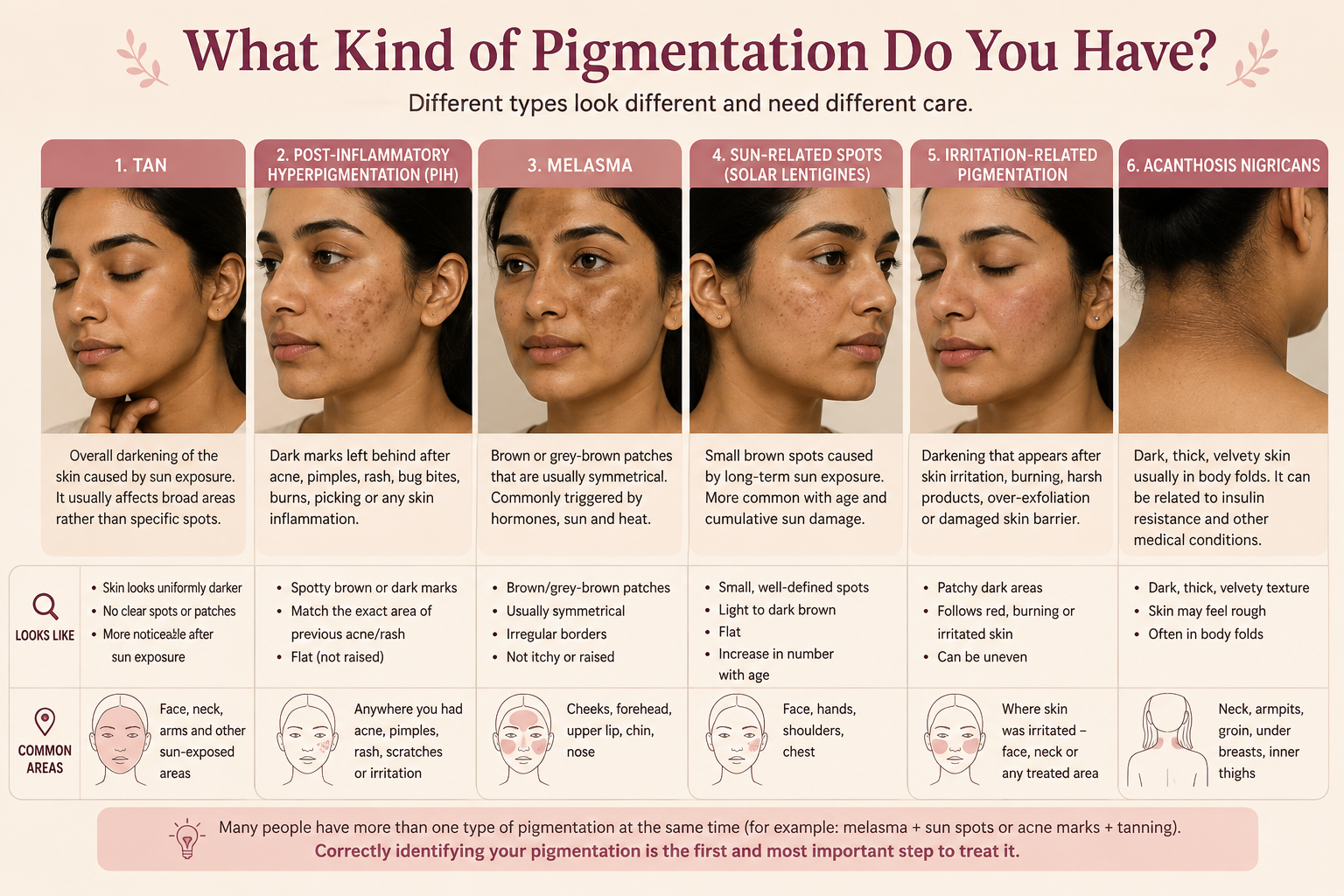
1. Tanning
A tan usually produces broader, relatively even darkening over areas exposed to sunlight rather than isolated individual marks. The face, neck, arms and hands may look darker than areas usually covered by clothing.
2. Post-inflammatory hyperpigmentation (PIH)
PIH appears after the skin has been inflamed or injured. Acne, eczema, scratching, burns, insect bites, picking and irritating skincare can all leave brown or dark marks behind.
A useful clue is that the pigmentation often appears in the same places where the original inflammation occurred.
3. Melasma
Melasma usually appears as brown or grey-brown patches, often on both sides of the face. Common areas include the cheeks, forehead, bridge of the nose and upper lip.
Sunlight is an important trigger. Hormonal factors such as pregnancy can also contribute, and melasma often has a tendency to return even after successful treatment.
4. Sun-related spots
Years of cumulative sun exposure can contribute to more localised brown spots on exposed areas. These are different from the broader symmetrical patches typically seen with melasma.
5. Irritation-related pigmentation
If your skin started looking darker after burning, redness, peeling, aggressive scrubbing or a new skincare routine, inflammation itself may be part of the problem.
6. Acanthosis nigricans
Acanthosis nigricans usually causes skin to become darker, thicker and more velvety, particularly around the neck and body folds such as the underarms.
It can be associated with insulin resistance and other medical factors, so it should not simply be treated as ordinary tanning.
Why is the area around my mouth darker?
Darkening around the mouth does not have one universal cause. Natural pigmentation can contribute, but so can irritation, inflammation, repeated rubbing, sun exposure, previous rashes and some pigmentation disorders including melasma.
Don’t automatically reach for a stronger acid
If the skin around your mouth is already dry, irritated, burning or peeling, repeatedly adding glycolic acid, scrubs, retinoids or other strong products may make the inflammation — and therefore the pigmentation — worse.
Persistent or unexplained pigmentation around the mouth is worth having properly assessed, especially if it is spreading or accompanied by other skin changes.
Why do acne marks stay dark for months?
When an acne lesion becomes inflamed, pigment-producing cells can respond by producing extra melanin. The pimple eventually disappears, but the pigment can remain.
This is one reason a woman can have very little active acne but still feel that her complexion looks uneven.
Acne mark or acne scar?
A flat brown or dark mark after acne is usually different from a true acne scar, which changes the texture or contour of the skin. Read our dedicated Acne guides for detailed help with acne marks and scarring.
Why does pigmentation sometimes keep getting darker?
Pigmentation is often the visible end result of a process happening underneath the surface.
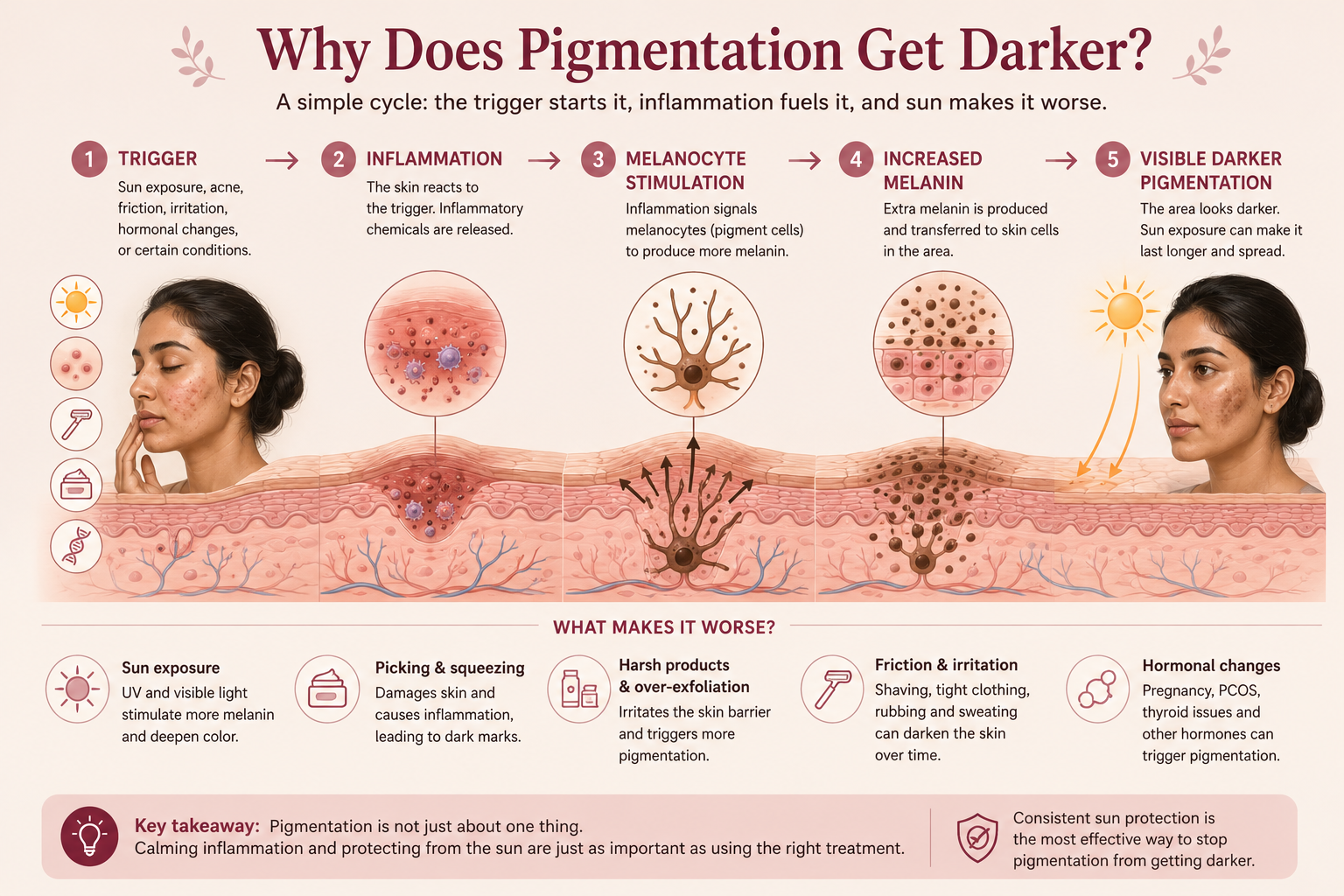
A trigger such as acne, irritation or friction can produce inflammation. That inflammation can stimulate melanocytes — the cells responsible for producing melanin — and the affected area becomes darker.
Continued sunlight can then make the pigmentation more noticeable or slower to fade.
Can skincare actually make pigmentation worse?
Yes — particularly when skincare repeatedly irritates the skin.
The over-treatment cycle
Too many actives → irritated skin barrier → inflammation → increased pigmentation → stronger products → more irritation.
This does not mean ingredients such as tretinoin, azelaic acid, vitamin C, hydroquinone or exfoliating acids are inherently bad. Many have legitimate roles in pigmentation treatment.
Problems arise when several irritating products are combined, introduced too quickly, used too frequently, or continued despite significant burning, redness and peeling.
Brown skin can develop post-inflammatory pigmentation after irritation, so “stronger” is not automatically “better.”
Can I get my original skin tone back?
It depends on why your skin became darker.
If the change is largely due to a recent tan or superficial post-inflammatory pigmentation, the skin may become substantially more even once the trigger is controlled and the pigment gradually fades.
Melasma behaves differently. It can improve significantly, but it often needs long-term control because sunlight, hormones and other triggers can cause it to return.
Deeper or longstanding pigmentation can also take much longer to improve.
A realistic goal
Aim for your healthier, more even natural complexion. No responsible treatment can guarantee that naturally brown skin will permanently become several shades lighter.
What should I actually do first?
You usually do not need a shelf full of products. A better approach is to work through the problem in the right order.
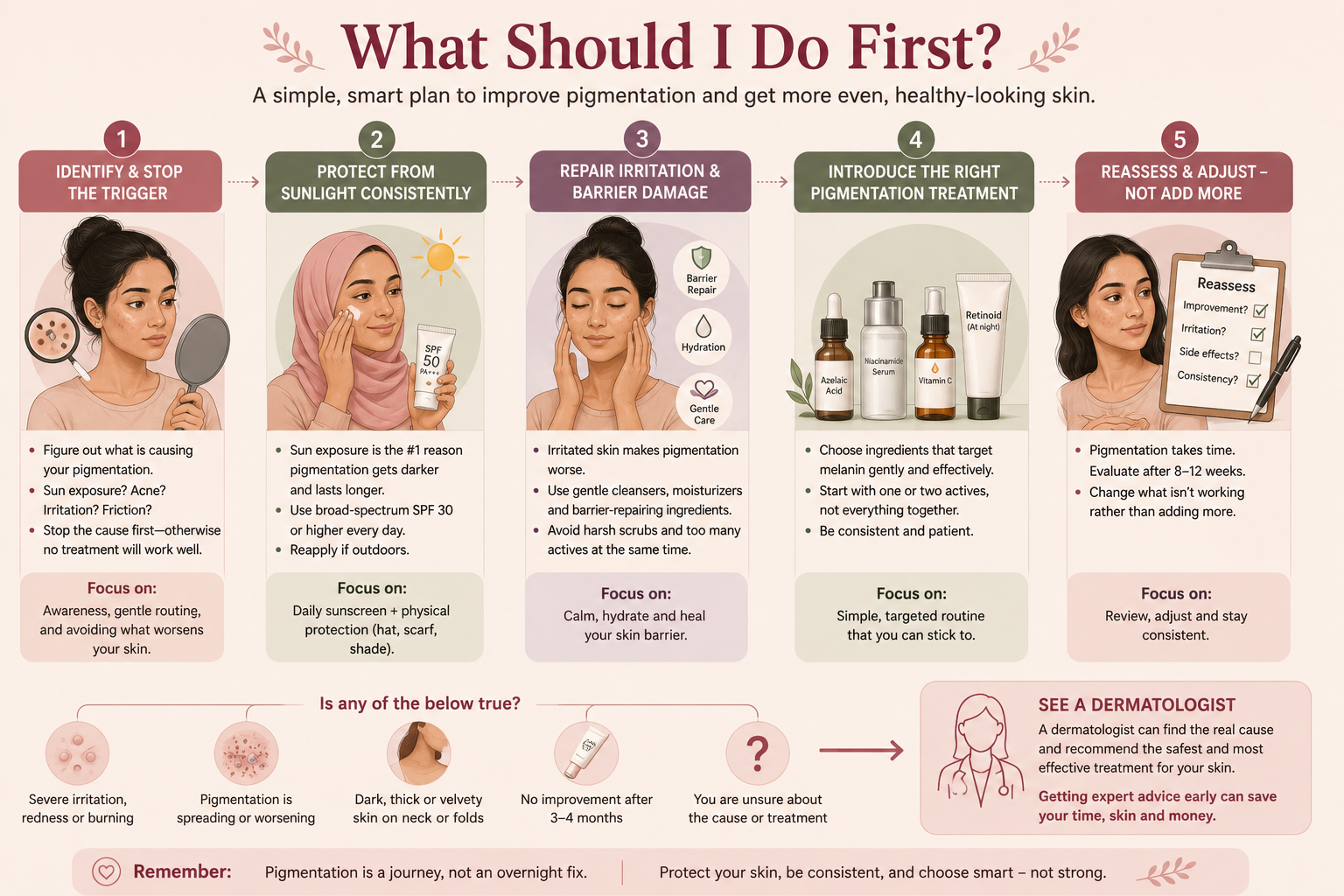
Identify and stop the trigger
Look for ongoing acne, irritation, scratching, friction, excessive exfoliation or repeated sun exposure.
Protect your skin from sunlight
Use broad-spectrum sunscreen consistently and combine it with shade, hats and other physical protection when practical.
Repair irritation first
If your face is burning, peeling or persistently red, simplify the routine and focus on gentle cleansing and moisturising before escalating pigmentation treatment.
Introduce appropriate treatment
Choose treatment based on the likely cause rather than combining every brightening ingredient at once.
Reassess instead of continually adding products
Pigmentation treatment takes time. Review whether the diagnosis, routine and triggers make sense before assuming you need something stronger.
Is sunscreen really that important for pigmentation?
Yes. Sunlight can stimulate pigment production and make existing pigmentation darker or more persistent.
For everyday pigmentation care, choose a broad-spectrum sunscreen with SPF 30 or higher and use it consistently on exposed skin. Reapplication becomes particularly important when you are spending prolonged time outdoors, sweating or swimming.
Melasma deserves extra attention
Visible light can also contribute to melasma, particularly in darker skin tones. A dermatologist may therefore recommend a tinted sunscreen containing iron oxides in addition to standard broad-spectrum UV protection.
Sunscreen is not a bleaching treatment. Think of it as helping prevent your skin from repeatedly receiving the signal to produce more pigment while other treatments are trying to reduce it.
Which ingredients actually help pigmentation?
The best ingredient depends on the type of pigmentation, your skin sensitivity and what else you are already using.
| Ingredient | Where it may help | Important point |
|---|---|---|
| Azelaic acid | PIH, acne-related pigmentation and melasma | Can be useful when acne and pigmentation occur together. |
| Niacinamide | Uneven tone and supportive skincare | Generally easier to incorporate into a gentle routine. |
| Vitamin C | Uneven pigmentation and antioxidant support | Formulation and tolerance matter. |
| Retinoids | Acne, cell turnover and some pigmentation | Can irritate if introduced too aggressively. |
| Alpha-arbutin / kojic acid | Selected superficial pigmentation | Useful options, but not a substitute for identifying the cause. |
| Hydroquinone | Selected hyperpigmentation and melasma | Potent treatment that should not become indefinite unsupervised skincare. |
We cover these treatments in much more detail in our dedicated Best Ingredients for Pigmentation and Hydroquinone & Prescription Treatments guides.
“I’ve tried everything and nothing works.”
This is frustrating, but it does not necessarily mean your pigmentation is untreatable.
Common reasons include:
- the pigmentation has been misidentified;
- the trigger is still active;
- sun exposure is continuing;
- acne, eczema or another inflammatory condition is still occurring;
- the skincare routine itself is causing irritation;
- treatment is being changed too frequently;
- the pigment is deeper or more longstanding;
- melasma is recurring;
- or an underlying medical or skin condition has not been recognised.
More products are not always the answer
If you have already tried multiple acids, serums, retinoids, hydroquinone or procedures without improvement, getting the diagnosis reviewed may be more useful than buying another brightening product.
How long does hyperpigmentation take to fade?
There is no single timeline.
Recent superficial pigmentation may begin showing visible improvement over several weeks, but noticeable clearing often requires months. Dark marks that are only a few shades deeper than the natural skin tone can sometimes take around 6–12 months to fade without treatment.
Deeper pigmentation can persist considerably longer. Melasma may improve but then recur when its triggers return.
This is why changing your entire routine every two weeks makes it very difficult to know whether a sensible treatment is actually working.
What about facials, chemical peels, lasers, microneedling, PRP or mesotherapy?
Procedures can have a role in selected pigmentation problems, but they are not interchangeable and they are not automatically better than topical treatment.
Chemical peels and certain laser or light-based treatments may help some superficial pigmentation. However, any procedure that significantly irritates or injures the skin can potentially trigger post-inflammatory hyperpigmentation, which is especially relevant in brown and darker skin tones.
PRP, microneedling and mesotherapy are also marketed for pigmentation, but whether they are appropriate depends on the diagnosis and treatment goal.
Don’t choose a procedure only because it sounds stronger
The correct procedure, settings and patient selection matter. Pigmentation treatment in South Asian skin should balance improvement against the risk of causing further inflammation and pigmentation.
What about dark neck, underarms, inner thighs, knees and elbows?
Body pigmentation should not automatically be treated as though it is facial hyperpigmentation.
Friction, shaving, sweating, previous irritation and natural differences in pigmentation can all contribute to darker body areas.
But a dark, thick or velvety neck or darkened body folds can suggest acanthosis nigricans. In that situation, repeatedly applying whitening products without considering the underlying cause may miss an important clue.
Coming in this Brightening & Pigmentation series
We have dedicated guides for Dark Underarms, Dark Neck & Acanthosis Nigricans, and Dark Inner Thighs, Knees & Elbows so each problem can be approached properly rather than treating every dark area the same way.
When should I see a dermatologist?
Consider a dermatologist assessment if:
- you are not sure what type of pigmentation you have;
- the pigmentation is spreading or becoming noticeably darker;
- your skin is repeatedly burning, peeling or becoming inflamed;
- you have dark, thick or velvety skin around the neck or folds;
- pigmentation appeared suddenly or has an unusual pattern;
- months of sensible treatment have produced little improvement;
- you are considering prescription-strength hydroquinone or combination creams;
- or you are considering peels, lasers or other procedures.
A dermatologist can distinguish between conditions that can look very similar and choose treatment appropriate for your skin type.
Not sure what kind of pigmentation you have?
Start with the AuratSehat Brightening & Pigmentation guides, or ask a doctor if your pigmentation is persistent, unusual or difficult to understand.
Ask a Doctor for Free