

Dark inner thighs, a darker bikini line, or darker knees and elbows are extremely common. These areas do not have to be exactly the same colour as your face, tummy or legs.
Sometimes the colour is simply part of your natural skin tone. In other women, repeated rubbing, sweating, shaving, waxing, ingrown hairs, previous rashes or inflammation leave the skin darker.
The most important question is therefore not “Which whitening cream should I buy?” It is:
“Why is this particular area dark, and what is safe to use here?”
Why Are My Inner Thighs Dark?
The upper inner thighs are warm, moist and frequently exposed to skin-on-skin friction. That combination makes them particularly prone to irritation and post-inflammatory hyperpigmentation (PIH) — dark marks that remain after the skin has been inflamed or injured.
Common reasons include:
- thighs repeatedly rubbing together while walking or exercising;
- chafing and sweating in hot weather;
- tight trousers, leggings or clothing that repeatedly rubs the area;
- shaving or waxing irritation;
- razor bumps, folliculitis or ingrown hairs;
- scratching or picking bumps;
- a previous rash or fungal infection;
- eczema or contact irritation;
- normal naturally darker skin in the area;
- and, in some women, acanthosis nigricans.
You cannot successfully fade friction-related pigmentation while the same skin is being irritated every day. Controlling the trigger comes before adding more brightening products.
Which Area Is Actually Dark?
This matters more than many women realise. The words “inner thighs,” “groin,” “bikini line” and “private area” are often used as if they mean the same thing. They do not.
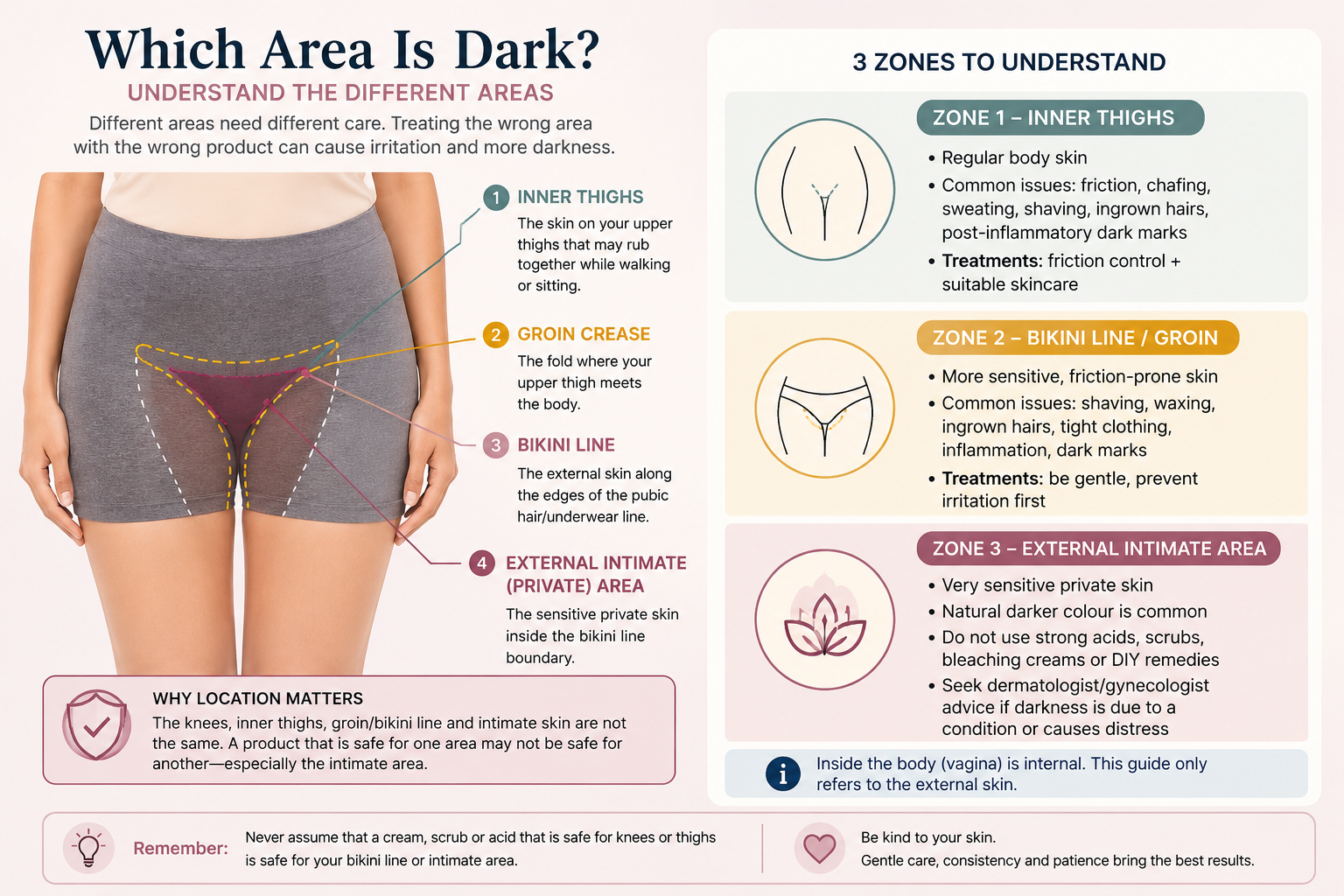
Inner thighs
Ordinary external body skin on the upper thighs. Friction, sweat, chafing and post-inflammatory pigmentation are common here.
Bikini line / groin
External skin around the underwear and pubic-hair line. It is more sensitive and commonly irritated by shaving, waxing and friction.
External intimate skin
Sensitive external genital skin. Natural darker pigmentation is very common, and aggressive whitening routines should not be copied here.
Women commonly search for a “dark vagina” when they actually mean the visible skin outside the body. The vagina is internal. This article is mainly discussing pigmentation of external skin.
Why Did My Inner Thighs or Bikini Line Become Darker?
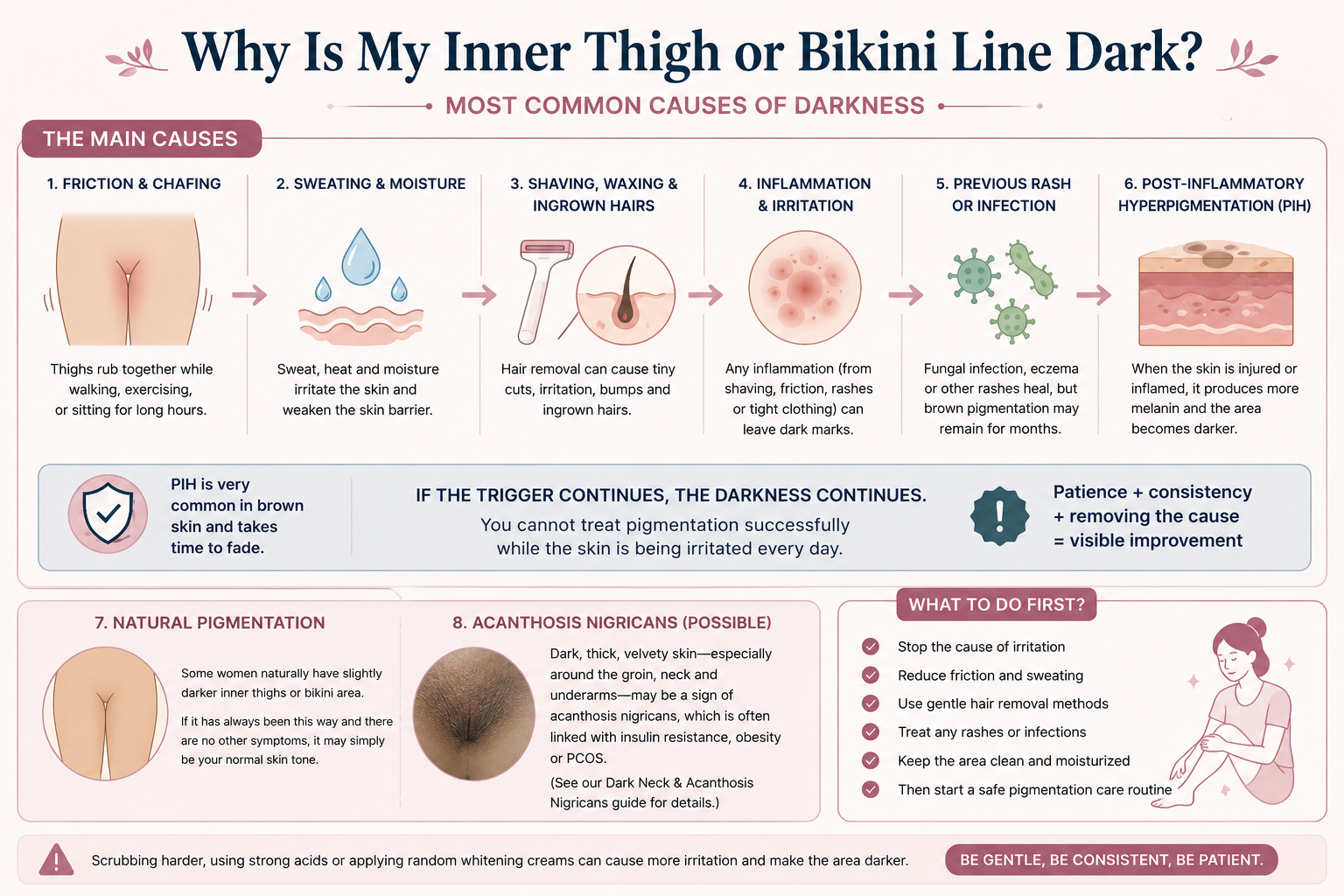
1. Friction and chafing
If your thighs rub together, repeated friction can irritate the skin. This may be more noticeable in women whose thighs naturally touch, but it can happen at any body size.
Heat and sweating can make the friction worse. Over time, repeated irritation may leave the skin darker and sometimes slightly rougher.
2. Shaving and waxing
Shaving does not directly “turn the skin black.” The problem is often the cycle around shaving:
shaving → razor irritation → bumps or ingrown hairs → inflammation → dark marks.
Waxing can cause the same problem when the skin becomes repeatedly inflamed.
3. Previous rash or fungal infection
If you previously had an itchy, irritated or scaly rash between the thighs, brown pigmentation can remain after the active rash improves.
Do not focus only on whitening the mark. An active rash needs to be identified and treated first. Pigmentation treatment comes later.
4. Post-inflammatory hyperpigmentation
Brown skin commonly produces noticeable pigment after inflammation. The original irritation may disappear quickly, while the pigmentation can take weeks to months to fade.
If you also have facial pigmentation or uneven tone, see our Hyperpigmentation & Uneven Skin Tone guide.
Why Is My Private or Intimate Area Dark?
First: darker intimate skin does not mean that you are dirty or unhygienic.
External genital skin can naturally be darker than the thighs, tummy or surrounding skin. Colour varies considerably between women and can also change with hormones, age and pregnancy.
If the colour has always been present, is reasonably symmetrical and there are no symptoms such as itching, burning, sores or a new changing lesion, it may simply represent your natural pigmentation.
There is no medical requirement for intimate skin to be light, pink or the same colour as the rest of your body.
Why Is My Bikini Line Dark?
The bikini line is different from deeper intimate skin. This external area is commonly affected by:
- repeated shaving;
- waxing;
- razor bumps and ingrown hairs;
- folliculitis;
- tight underwear or clothing;
- friction;
- sweating;
- previous rashes;
- and post-inflammatory pigmentation.
If the darkening started after hair removal and you repeatedly get bumps, reducing that irritation may be more important than adding a stronger pigmentation product.
Can I Lighten My Private Area?
The answer depends on what is dark and why it is dark.
If the darkness developed after friction, chafing or inflammation, reducing the trigger and using appropriate body-skin pigmentation care may gradually help.
If shaving, waxing, ingrown hairs or irritation caused the darkening, gentler hair removal and carefully selected products may improve it.
If this skin is naturally darker, aggressive “whitening” is neither medically required nor reliably safe. Significant acquired pigmentation is better assessed by a dermatologist.
These areas should not be treated with cosmetic whitening acids, scrubs or bleaching products.
What Can I Safely Use Where?
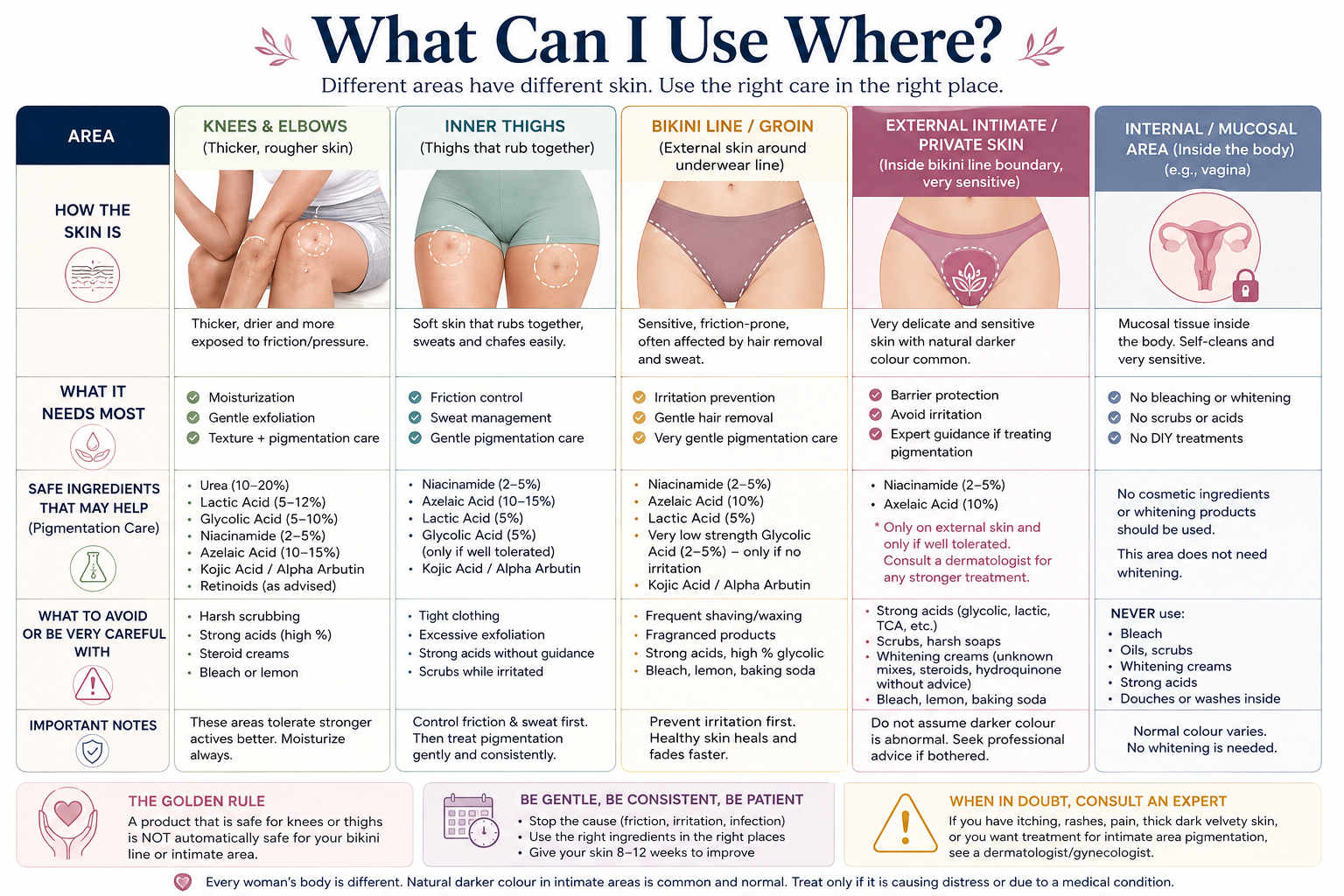
| Area | Main goal | Reasonable approach | Extra caution |
|---|---|---|---|
| Knees & elbows | Roughness + pigmentation | Moisturizer, urea/lactic acid and appropriate pigment care | Avoid harsh scrubbing and over-exfoliation |
| Inner thighs | Reduce friction + PIH | Friction control, moisturizer and gentle pigment ingredients | Do not apply acids to irritated or freshly shaved skin |
| Bikini line / groin | Prevent inflammation | Gentle hair removal and cautious external-skin care | Much easier to irritate than knees/elbows |
| External intimate skin | Protect the skin barrier | Gentle care; medical assessment if acquired pigmentation is concerning | Do not copy strong body-lightening routines |
| Internal/mucosal area | No cosmetic whitening needed | Normal hygiene only | No cosmetic acids, bleach or whitening products |
Can I Use Glycolic Acid on Dark Inner Thighs or the Bikini Line?
Glycolic acid is an exfoliating alpha-hydroxy acid. It can help some forms of superficial pigmentation and roughness, but stronger is not always better.
On ordinary inner-thigh skin, a carefully introduced glycolic-acid product may be reasonable for some people if the skin is healthy and not irritated.
The bikini/groin region is more sensitive. Products that are tolerated on the legs, knees or elbows can sting or inflame this area.
And do not apply ordinary glycolic-acid toners to internal genital or mucosal surfaces. If an acid repeatedly burns or irritates your skin, the inflammation can leave you with more pigmentation.
Shaving, Waxing or Laser — Which Is Better for Pigmentation?
Shaving
Shaving can be perfectly acceptable, but poor technique or repeated razor burn may produce bumps and PIH.
Use a clean razor, enough lubrication, avoid repeatedly passing over the same irritated area and do not aggressively exfoliate immediately afterward.
Waxing
Waxing removes hair for longer, but it can still cause inflammation. If your skin repeatedly becomes red, sore or develops bumps after waxing, it may be contributing to the pigmentation.
Laser hair removal
Laser hair removal is primarily a hair-reduction treatment, not a bikini-line whitening treatment.
However, if repeated shaving and ingrown hairs are continuously causing inflammation, reducing the hair may indirectly reduce one of the triggers for pigmentation.
Women with brown skin should choose a qualified practitioner experienced in treating darker skin tones because burns and pigment changes can occur after inappropriate laser settings.
Intimate-Area Bleaching or Whitening — Pros & Cons
“Intimate whitening,” “private-parts bleaching” and “pinkening” are increasingly marketed as beauty treatments. Before considering them, it is important to separate acquired hyperpigmentation from the completely normal colour of genital skin.
Possible benefits
- Selected acquired pigmentation on appropriate external skin may improve.
- Reducing a genuine pigment concern may improve confidence for some women.
- A dermatologist can first determine whether there is actually something treatable.
Possible downsides
- burning and irritation;
- contact dermatitis;
- chemical burns;
- post-inflammatory hyperpigmentation — making the area darker;
- patchy or excessive lightening;
- infection if the skin barrier is damaged;
- possible scarring after significant injury;
- and recurrence if the original cause continues.
Never apply household bleach or cleaning chemicals to the groin, bikini line or genital skin.
Salon treatment vs dermatologist treatment
The phrase “intimate whitening” does not tell you what is actually being applied. A salon cream, peel or mixture may contain ingredients that are poorly labelled or inappropriate for sensitive genital skin.
If pigmentation of the external intimate area is genuinely distressing, a dermatologist can first determine whether it represents normal colour, PIH, dermatitis, acanthosis or another condition before discussing treatment.
Should I Bleach My Intimate Area Before Marriage?
This is a concern many women may feel uncomfortable asking openly.
There is no medical requirement for genital skin to be light or pink before marriage. Normal intimate skin is often darker than nearby skin.
If you still want treatment for a genuine acquired pigment concern, do not experiment with a strong acid, unknown whitening cream, bleach or aggressive salon procedure just before your wedding.
A reaction can leave the area sore, inflamed or even darker. If treatment is important to you, assessment well beforehand is safer than last-minute experimentation.
Why Are My Knees and Elbows Dark?
Knees and elbows are different from the bikini line. Their skin is naturally thicker and commonly experiences pressure, rubbing and dryness.
Common contributors include:
- naturally thicker skin;
- dryness;
- repeated kneeling;
- leaning on the elbows;
- friction from clothing or surfaces;
- eczema or previous inflammation;
- and repeated aggressive scrubbing.
Pigmentation is not dirt. Scrubbing harder cannot wash melanin away. Repeated irritation may actually contribute to further darkening.
What Actually Works for Dark Inner Thighs, Knees and Elbows?
Reduce friction, chafing, repeated razor irritation, scratching and unnecessary scrubbing.
If there is an itchy rash, folliculitis, eczema or another skin problem, manage that before trying to fade the pigment left behind.
Regular moisturization is especially important for rough knees and elbows.
Choose ingredients suitable for the location rather than combining several strong products at once.
Pigmentation usually changes much more slowly than irritation or dryness.
Which Ingredients Can Help?
Niacinamide
A generally gentle skincare ingredient that may help uneven pigmentation. It can be a reasonable option for external body skin when tolerated.
Azelaic acid
Can help post-inflammatory pigmentation and is useful in several pigment-prone skin conditions. Sensitive locations still need caution.
Lactic acid
Useful when pigmentation occurs together with dry, rough or thickened skin, particularly on knees and elbows.
Glycolic acid
Can exfoliate and improve superficial pigmentation, but excessive use may irritate the skin and worsen PIH.
Urea
Especially useful for rough, dry knees and elbows. It helps soften thickened skin rather than acting as an aggressive “whitener.”
Kojic acid & alpha arbutin
May be included in pigment-targeting products, but location and irritation potential matter more than the marketing claim on the bottle.
Retinoids
Can help selected forms of hyperpigmentation but may also cause irritation. They are not something to casually copy from a facial routine onto intimate skin.
Hydroquinone
A potent treatment used for selected hyperpigmentation. Avoid turning it into a DIY “private whitening” treatment; appropriate diagnosis and medical supervision are preferable.
If you want a broader explanation of evidence-based brightening ingredients, read Skin Brightening — What Actually Works?.
What About Pakistani Home Remedies?
Home remedies are extremely popular for dark thighs, knees, elbows and bikini lines, but “natural” does not automatically mean safe.
Acidic and potentially irritating. Do not use lemon on the bikini line or intimate skin. Irritation can leave pigmentation worse.
Not a good pigmentation treatment and may disrupt or irritate the skin barrier.
Scrubbing repeatedly adds friction — exactly what many dark inner thighs and knees do not need.
It does not bleach pigmentation, but it can help reduce dryness and friction on appropriate external skin.
May feel soothing, but it should not be expected to erase established pigmentation.
Popular culturally, but they are not reliable treatments for established hyperpigmentation. Avoid aggressive rubbing.
What About Private-Parts Whitening Creams?
Products marketed with phrases such as “intimate whitening,” “private-parts whitening,” “pinkening,” “instant fairness” or “7-day results” deserve caution.
The label “intimate” does not prove that a product has been medically tested for every area women may call their private parts.
Be particularly cautious with:
- unlabelled mixtures;
- products that do not clearly list their ingredients;
- strong steroid-containing combinations used without medical advice;
- aggressive peels;
- unknown imported bleaching creams;
- and products promising dramatic whitening within a few days.
If friction or inflammation made your skin darker, treating the cause and fading the acquired pigmentation is reasonable. Natural genital colour does not need to be “corrected.”
Dark Thighs + Dark Neck + Dark Underarms — Could It Be Acanthosis Nigricans?
Not every dark inner thigh is caused by insulin resistance.
But if the skin is not simply flat and brown and instead becomes dark, thick and velvety, particularly across several body folds such as the neck, underarms and groin, acanthosis nigricans should be considered.
Read our detailed guide: Dark Neck & Acanthosis Nigricans — Is It Just Pigmentation or Insulin Resistance?
If the underarms are also a major concern, see Dark Underarms — Causes & What Actually Helps.
Look at the overall pattern, texture and other symptoms rather than assuming every area of pigmentation is hormonal.
Why Isn’t the Darkness Going Away?
Common reasons include:
- the thighs are still rubbing every day;
- shaving continues to cause inflammation;
- you are repeatedly picking ingrown hairs;
- an active rash has not been treated;
- you are exfoliating too often;
- the “whitening” product itself is irritating the skin;
- you are using several acids together;
- the pigmentation is actually acanthosis nigricans;
- the colour is partly your normal anatomy;
- or you simply have not given PIH enough time to fade.
How Long Does It Take to Improve?
Be suspicious of products promising to permanently remove established pigmentation in a few days.
And remember: if some of the colour is your natural skin tone, the goal is not to force that area to match another part of your body.
Why Is This Area Dark? — Decision Map
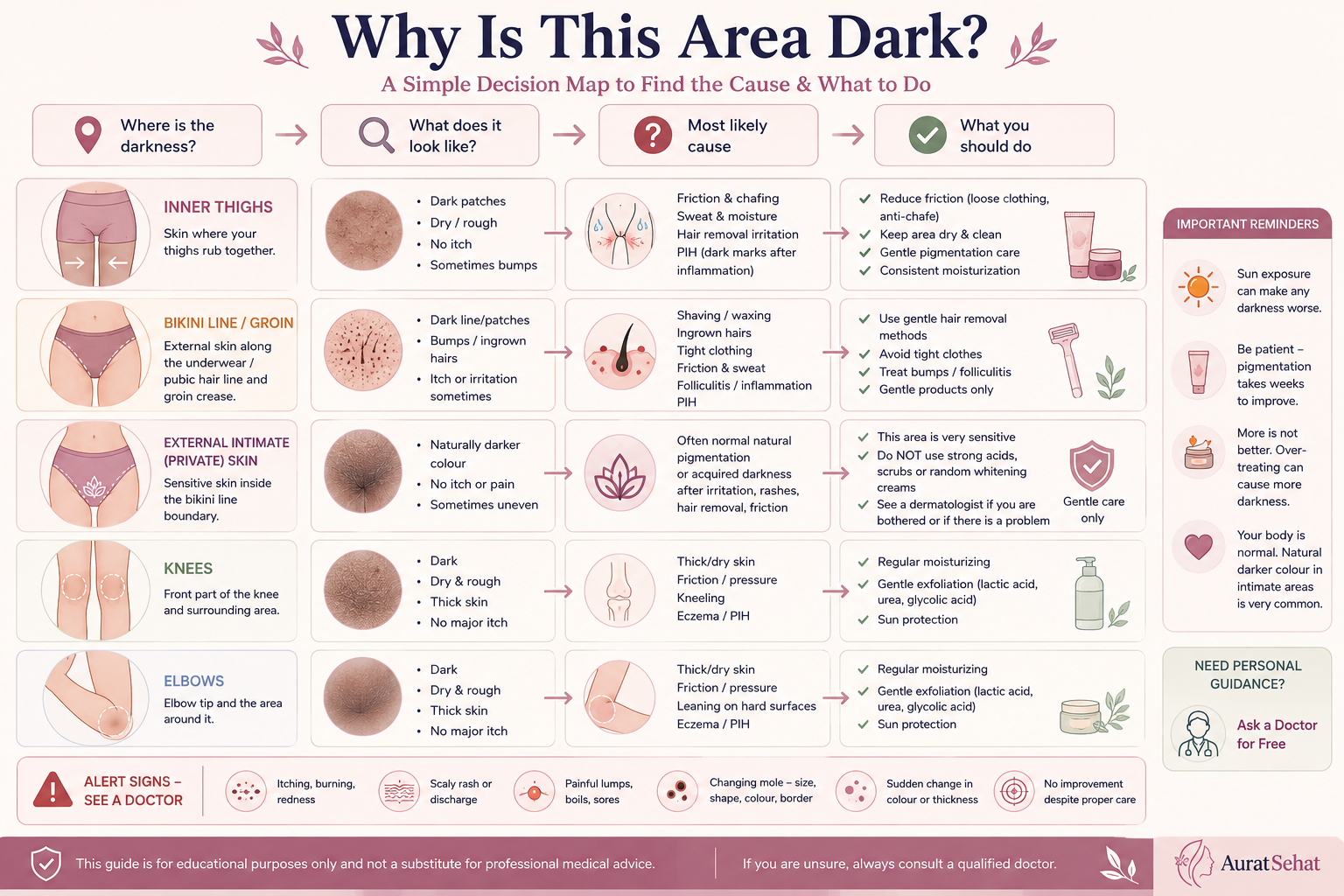
When Should I See a Doctor?
Darkness alone is often harmless, but arrange medical assessment if you notice:
- persistent itching or burning;
- a red or scaly rash that is not improving;
- pain;
- open sores or ulcers;
- recurrent painful lumps, boils or drainage;
- a new pigmented spot that changes in size, shape or colour;
- sudden or unusual pigmentation;
- dark skin that becomes distinctly thick and velvety;
- similar thick pigmentation on the neck and underarms;
- or burns and significant irritation after a whitening product, peel or laser procedure.
The American Academy of Dermatology also explains why treating the cause of dark spots and avoiding irritating products are important, particularly in darker skin tones.
Read the American Academy of Dermatology guide on fading dark spots →
Continue Your Pigmentation Guide
Frequently Asked Questions
Why are my inner thighs dark?
Friction, sweating, chafing, shaving, waxing, ingrown hairs, previous rashes and post-inflammatory pigmentation are common reasons. Some women also naturally have darker skin there.
Is it normal for private parts to be darker?
Yes. External intimate skin is commonly darker than surrounding body skin. A darker colour by itself does not mean poor hygiene or disease.
Can I lighten my private area?
Acquired pigmentation on appropriate external skin may sometimes improve, especially when caused by friction or inflammation. Natural genital pigmentation does not medically need whitening, and aggressive DIY treatment should be avoided.
Does shaving make the bikini area darker?
Shaving does not directly create melanin, but repeated razor burn, folliculitis and ingrown hairs can cause inflammation followed by dark marks.
Can I use glycolic acid on my bikini line?
The bikini line is more sensitive than ordinary body skin. Low-strength products may be tolerated by some people on appropriate external skin, but glycolic acid should not be used on irritated, freshly shaved, broken or internal genital skin.
Can glycolic acid lighten dark inner thighs?
It can help some superficial pigmentation, but controlling friction and inflammation remains essential. Overuse may irritate the skin and worsen PIH.
Can I use kojic acid on my private area?
Do not assume that a product suitable for the face or thighs is safe for external genital skin. If the pigmentation involves truly intimate skin rather than the bikini line, professional assessment is safer than experimenting with strong lightening ingredients.
Does laser hair removal lighten the bikini line?
Laser hair removal is designed to reduce hair, not whiten skin. If shaving and ingrown hairs are repeatedly causing inflammation, reducing hair may indirectly remove one trigger for pigmentation.
Are dark inner thighs a sign of PCOS?
Dark inner thighs alone do not diagnose PCOS. Thick, velvety pigmentation affecting several folds may suggest acanthosis nigricans, which can be associated with insulin resistance and sometimes coexist with PCOS.
Can lemon remove dark inner thighs?
Lemon is not recommended. It can irritate the skin, and inflammation may leave brown skin with even more pigmentation.
Why are my knees and elbows darker than the rest of my body?
These areas naturally have thicker skin and experience more pressure, dryness and friction. That combination can make them look darker and rougher.
How long does dark inner-thigh pigmentation take to fade?
There is no fixed timeline. Irritation can improve relatively quickly, but established PIH commonly takes many weeks or months to fade, especially if friction continues.
Not Sure Why Your Skin Is Dark?
Darkness after shaving, an itchy groin rash, thick velvety skin, intimate-area pigmentation or a product that has caused burning can require very different advice. Ask an AuratSehat doctor about your concern.
Ask a Doctor for Free →