
Dark Underarms — Why Are My Underarms Dark?
Dark underarms are extremely common, and they are not always caused by the same thing. Sometimes the darkness is simply natural pigmentation or visible hair beneath the skin. In other women it develops after shaving, waxing, friction, deodorant irritation or inflammation. Less commonly, thick velvety pigmentation can be a clue to a condition such as acanthosis nigricans.
That is why the first step is not buying the strongest whitening cream. It is understanding why your underarms are dark.
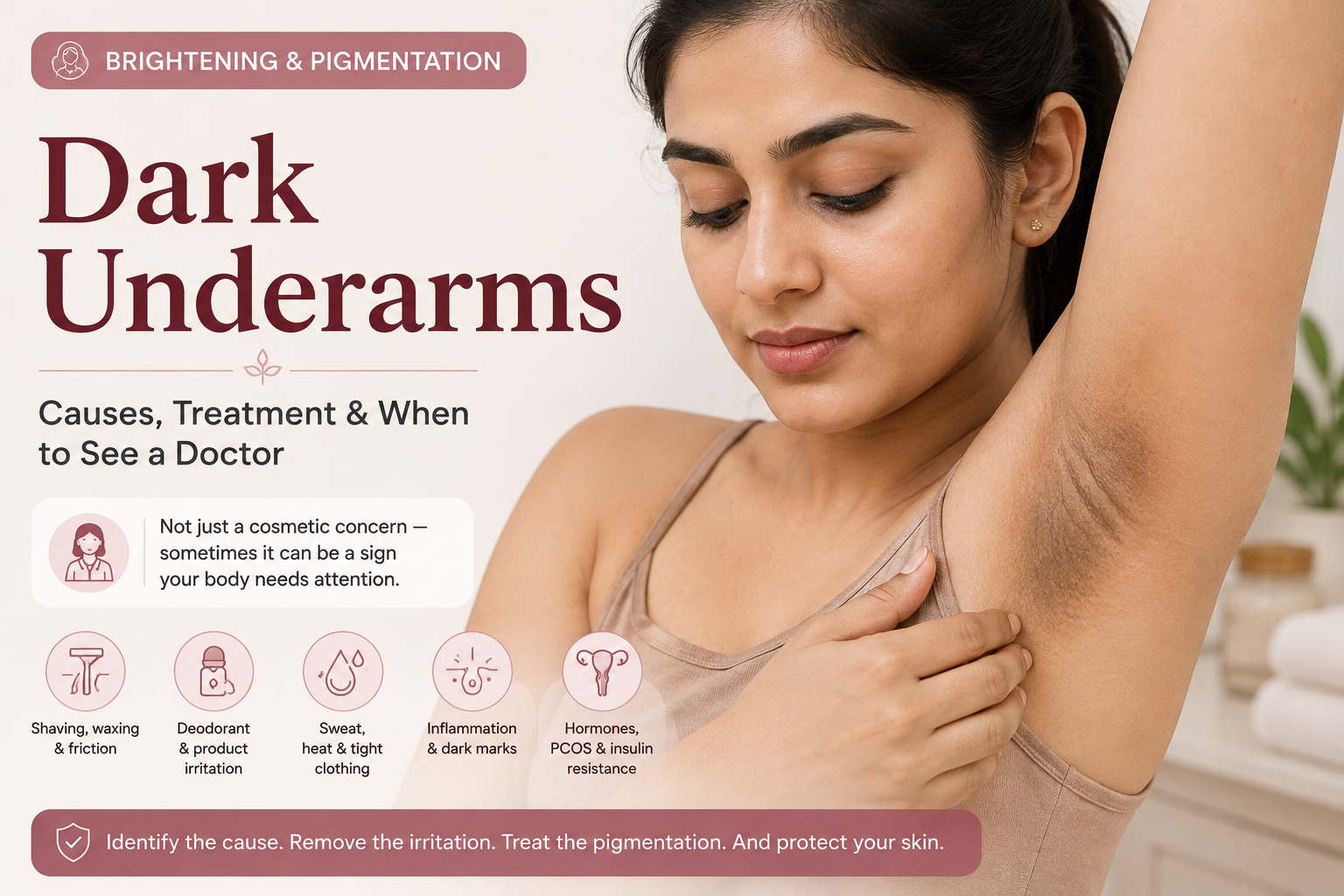
Find out why your underarms are dark. Hair shadow, irritation, post-inflammatory pigmentation and acanthosis nigricans do not need exactly the same treatment.
Are darker underarms normal?
Yes. The skin in body folds does not always have exactly the same colour as the surrounding skin. Genetics, natural skin tone, hair density, friction and previous inflammation can all affect how the underarms look.
Some women naturally have slightly darker underarms without any disease. This is especially important to understand because healthy skin does not need to be the same colour everywhere.
Pigmentation usually cannot simply be scrubbed away. Aggressive scrubbing may actually create more inflammation and make the area look darker.
What does your underarm pigmentation look like?
Before choosing treatment, look at the texture, colour, symptoms and timing. The visual below shows the most useful patterns.
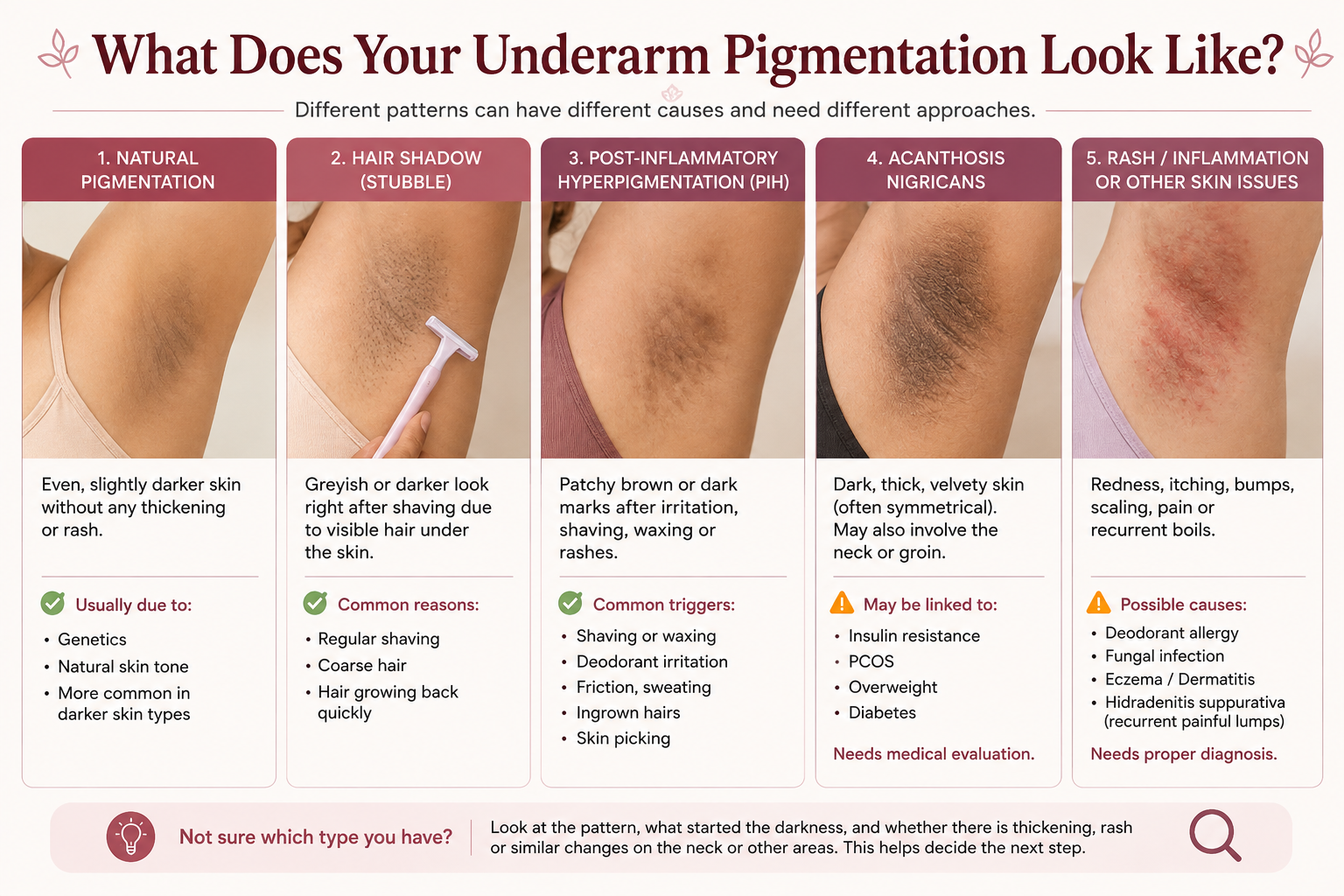
Slightly darker but otherwise normal skin
The skin is flat and comfortable without itching, redness, scaling or thickening. The colour may simply reflect your natural pigmentation.
Grey or dark appearance after shaving
Hair beneath the skin can remain visible even after a close shave. A brightening cream cannot completely remove a shadow that is actually caused by hair.
Flat brown marks after irritation
Shaving, waxing, ingrown hairs, rubbing, deodorant reactions or scratching can leave post-inflammatory hyperpigmentation behind.
Dark, thick or velvety skin
This pattern deserves more attention, particularly when similar changes are present on the neck or groin. It can occur with insulin resistance and other medical conditions.
Why do underarms become dark?
Several different pathways can lead to darker underarms. In many cases, repeated irritation causes inflammation, and the skin responds by producing additional pigment.
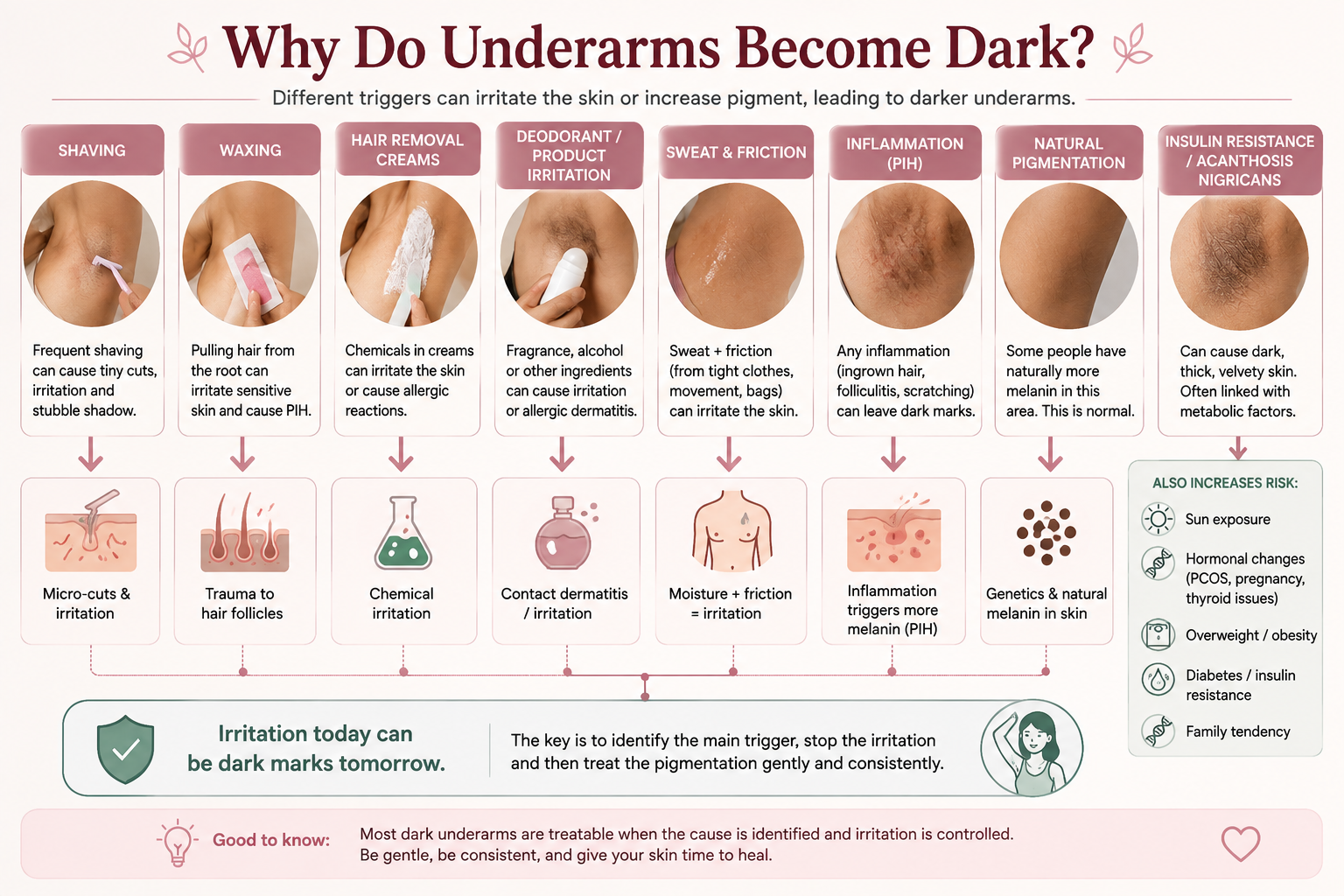
Common causes include:
- Natural pigmentation
- Visible hair or shaving shadow
- Repeated shaving irritation
- Waxing irritation
- Hair-removal creams causing irritation
- Ingrown hairs or folliculitis
- Friction from clothing or skin rubbing
- Sweat and moisture contributing to friction
- Irritant or allergic reactions to deodorants or fragrances
- Post-inflammatory hyperpigmentation after rash or injury
- Acanthosis nigricans
- Less commonly, another skin disorder
Does shaving make underarms dark?
Shaving does not automatically permanently darken everyone’s underarms. But it can make the area look darker in two different ways.
1. Hair shadow
Shaving cuts hair near the surface rather than removing it from the root. Dark, coarse hair beneath the skin may therefore create a greyish shadow.
2. Irritation and post-inflammatory pigmentation
Frequent shaving, dry shaving, blunt blades, repeated passes or shaving against the direction of growth can irritate the skin. If inflammation occurs repeatedly, pigment may remain afterward.
Use a clean sharp razor, soften the hair first, use lubrication, avoid repeatedly scraping the same area and moisturise afterward. If shaving consistently causes bumps or irritation, consider changing your hair-removal method.
Shaving vs waxing vs laser — which is better for dark underarms?
There is no universally perfect hair-removal method. The best choice is the one your skin tolerates without repeated inflammation.
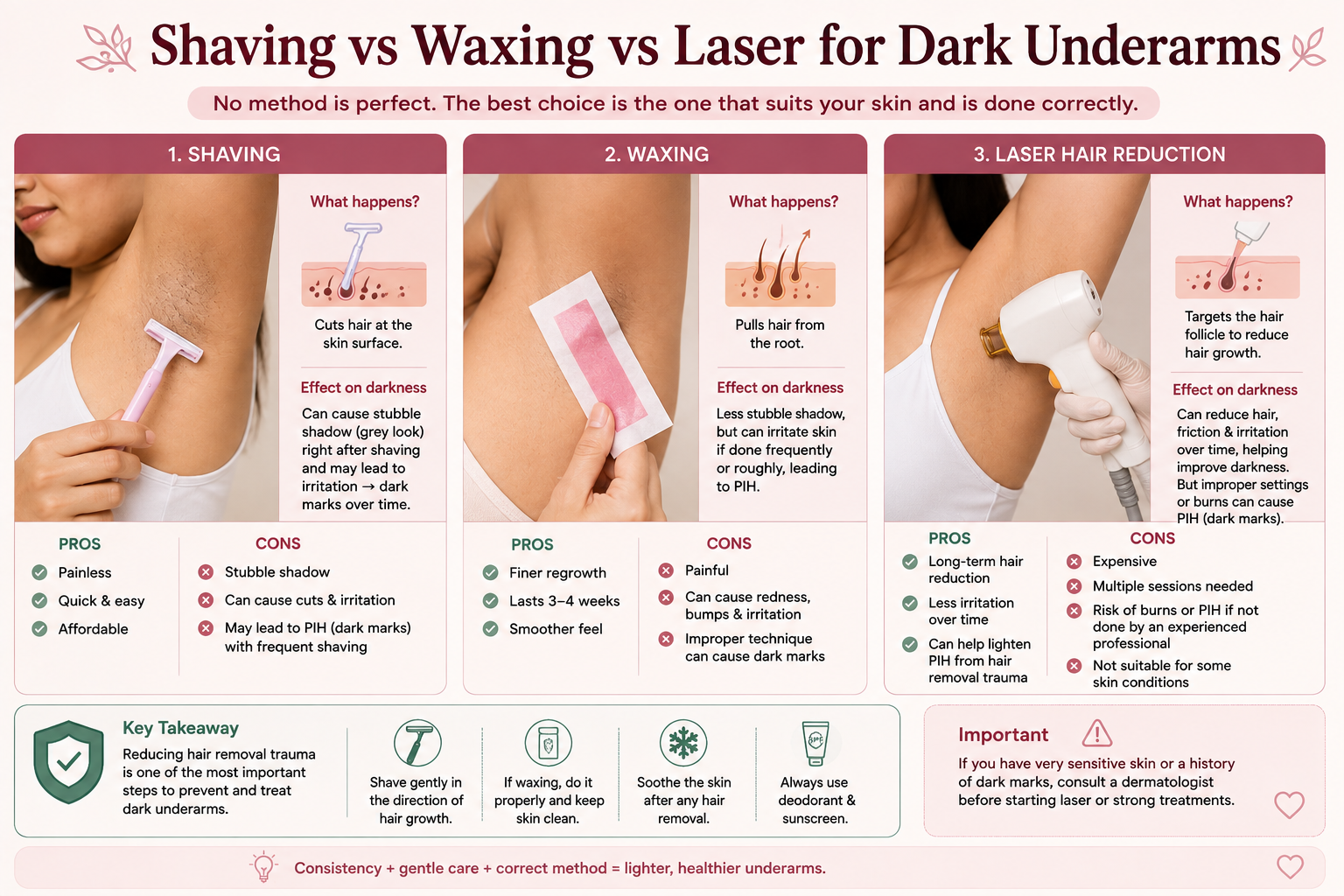
| Method | Advantages | Possible problem |
|---|---|---|
| Shaving | Quick, inexpensive and convenient | Hair shadow, cuts, bumps or irritation in some women |
| Waxing | Removes hair from the root and reduces visible stubble temporarily | Can inflame sensitive skin and cause PIH if repeated trauma occurs |
| Hair-removal creams | Painless and convenient | Chemical irritation or dermatitis in susceptible skin |
| Laser hair reduction | Can reduce long-term hair growth and repeated hair-removal trauma | Incorrect settings or burns may cause PIH, especially in darker skin |
What should I do after shaving or waxing?
Freshly shaved or waxed skin is easier to irritate. This is not the ideal moment to apply every brightening active you own.
Avoid vigorous scrubbing immediately after hair removal.
Supporting the skin barrier can reduce irritation.
Glycolic acid, strong exfoliants and other irritating products may sting freshly treated skin.
Repeated follicular inflammation can keep creating new pigment.
Does deodorant make underarms dark?
Not automatically. Many women use deodorants or antiperspirants without developing pigmentation.
The more important issue is whether a specific product irritates your skin. Fragrance, preservatives or other ingredients can occasionally trigger irritant or allergic contact dermatitis. Inflammation can then leave pigmentation behind.
You develop burning, itching, redness, scaling or a rash soon after using it. Stop the suspected product rather than applying stronger brightening products on top of irritated skin.
Switching to another product may help if irritation is the problem. There is no medical rule that every woman with dark underarms needs to stop antiperspirants or use alum/phitkari instead.
Does sweating make underarms darker?
Sweat itself does not simply dye the skin dark. But sweating creates a moist environment, and moisture combined with rubbing, tight clothing or repeated irritation can contribute to inflammation.
Heavy sweating can also make women use more deodorant or repeatedly clean the area, both of which may add irritation if the skin is sensitive.
Do dark underarms mean PCOS or insulin resistance?
Dark underarms alone do not diagnose PCOS, insulin resistance or diabetes. This is an important distinction because social-media discussions often jump directly from pigmentation to a metabolic diagnosis.
The pattern that matters more is acanthosis nigricans: skin that becomes darker and also feels thicker or velvety. It commonly occurs in body folds such as the underarms, neck and groin.
Acanthosis nigricans can be associated with insulin resistance, excess weight, diabetes and some hormonal conditions. It may also occur for other reasons. A clinician can decide whether metabolic evaluation is appropriate.
Do not assume every woman with dark underarms has PCOS. PCOS is diagnosed using the overall clinical picture — including menstrual, androgen and ovarian features — not underarm colour alone.
What if my underarms and neck are both dark?
Darkening of both areas is more important when the skin is also thickened or velvety. This pattern increases suspicion for acanthosis nigricans and may justify assessment for insulin resistance or other metabolic factors.
Our upcoming Dark Neck & Acanthosis Nigricans guide will explore this in more detail.
If the underlying cause is metabolic, aggressive exfoliation will not solve it and may simply irritate the skin further.
How can I actually lighten dark underarms?
Treatment depends on what you identified above. The same cream cannot fix hair shadow, dermatitis, acanthosis nigricans and PIH equally well.
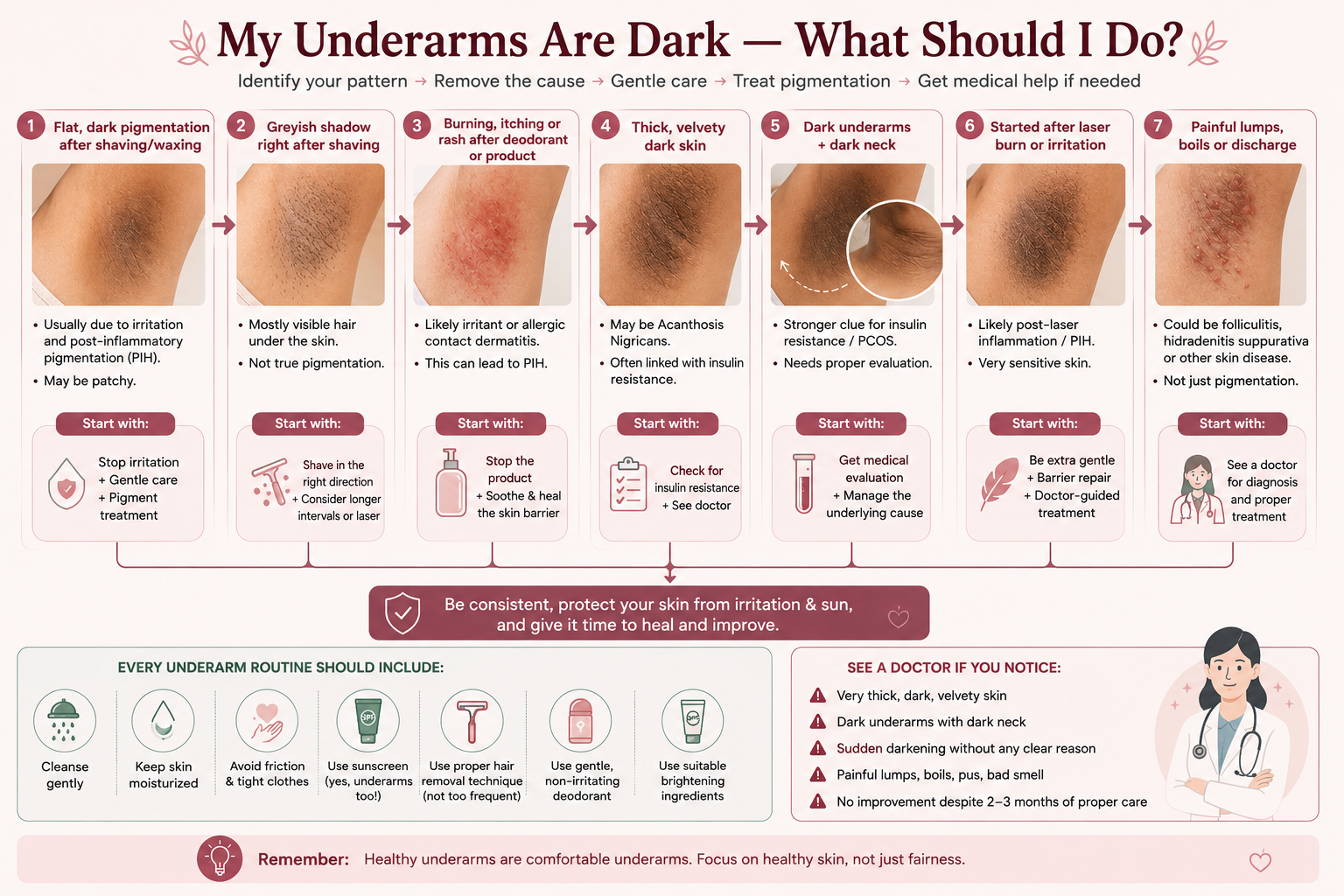
| If your underarms look like… | First priority | Next step |
|---|---|---|
| Flat dark marks after shaving or waxing | Reduce irritation | Gentle pigment treatment once the skin is calm |
| Grey shadow after shaving | Recognise visible hair | Changing hair-removal method may help more than brightening cream |
| Burning or itchy rash after deodorant | Stop suspected irritant | Allow inflammation to settle before treating pigment |
| Thick, velvety dark skin | Consider acanthosis nigricans | Medical evaluation may be appropriate |
| Dark underarms + dark velvety neck | Consider metabolic association | Discuss whether evaluation for insulin resistance is needed |
| Darkness after a laser burn | Heal the skin barrier | Gentle PIH treatment; avoid further aggressive procedures initially |
| Painful recurrent lumps, boils or drainage | Do not treat as cosmetic pigmentation | See a doctor to evaluate folliculitis, infection, hidradenitis or another cause |
Does glycolic acid work for dark underarms?
Glycolic acid is one of the most commonly recommended social-media treatments for dark underarms. It is an alpha-hydroxy acid that exfoliates the outer layers of skin and may help some superficial pigmentation.
But glycolic acid is not the right answer for every dark underarm. It will not remove visible hair shadow, fix acanthosis nigricans by itself or cure dermatitis.
If the concentration or frequency is too irritating — especially when combined with frequent shaving, waxing, deodorant and friction — inflammation can occur. In pigmentation-prone skin, that inflammation can produce more PIH.
How to use it more safely
- Do not start with daily use if your skin is sensitive.
- Avoid applying it immediately after shaving or waxing.
- Do not combine several strong exfoliating products at the same time.
- Stop if persistent burning, redness, peeling or itching develops.
- Use moisturiser if the area becomes dry or irritated.
Which ingredients may help dark underarms?
There is no need to use all of these together. Choose treatment according to your skin tolerance and the likely cause of the pigmentation.
Underarm skin is exposed to friction, hair removal, sweat and deodorant already. Adding multiple strong acids or brightening products at once increases the risk of irritation.
A simple routine for dark underarms
Basic routine
- Clean gently.
- Keep the skin dry and comfortable.
- Use a moisturiser if the area is dry or irritated.
- Use one suitable pigmentation ingredient.
- Avoid unnecessary rubbing or scrubbing.
If your underarms are sensitive
- Stop acids and strong brightening products initially.
- Use a gentle cleanser.
- Moisturise and allow the barrier to recover.
- Identify the irritating hair-removal or deodorant trigger.
- Introduce only one gentle active later.
Can laser hair removal lighten dark underarms?
Laser hair reduction does not directly “whiten” the skin. However, reducing dark hair can reduce shaving shadow, and reducing repeated shaving or waxing may decrease ongoing irritation. For some women, the underarms therefore look more even over time.
But laser is not risk-free. Darker skin contains more melanin, so choosing an appropriately experienced clinician and suitable laser parameters matters. Burns or excessive inflammation can cause new post-inflammatory pigmentation.
Do not immediately attack the area with stronger acids or whitening products. First allow the injury and inflammation to heal. Persistent post-laser pigmentation is better assessed by a dermatologist.
Lemon, baking soda, potato and other home remedies — do they work?
Pakistani social media is full of underarm-lightening totkay. Natural does not automatically mean safe or effective.
| Home remedy | What to know |
|---|---|
| Lemon | Acidic and irritating. Repeated irritation may worsen PIH. Not recommended as an underarm treatment. |
| Baking soda | Can disrupt and irritate the skin barrier. Avoid using it as a bleaching scrub. |
| Potato / potato juice | Popular online, but reliable clinical evidence for significant pigmentation treatment is lacking. |
| Besan | May be used as part of traditional skincare, but scrubbing aggressively can increase friction and irritation. |
| Turmeric | Has anti-inflammatory properties in some contexts, but homemade mixtures are not a predictable treatment for established underarm pigmentation. |
| Aloe vera | May soothe some irritated skin but should not be expected to remove established pigmentation by itself. |
What about underarm whitening creams?
Many products in Pakistan are marketed specifically as underarm whitening creams, serums or roll-ons. The label “whitening” tells you very little about whether the product is appropriate for your skin.
Check the actual ingredients. Avoid unknown mixtures promising dramatic whitening within days, particularly products with unclear ingredient lists.
Strong steroid-containing or inappropriate bleaching mixtures can damage the skin and should not be used casually in the underarms.
The realistic goal is comfortable, healthy skin with less excess pigmentation — not changing your natural skin colour.
Can a dermatologist treat stubborn dark underarms?
Yes, when appropriate. A dermatologist first determines whether the problem is PIH, acanthosis nigricans, dermatitis, folliculitis, infection or another skin condition.
Depending on the diagnosis, treatment may involve prescription creams, controlled chemical peels, treatment of dermatitis or folliculitis, laser hair reduction or management of an underlying medical condition.
Procedures must be used carefully in darker skin because excessive irritation can itself produce post-inflammatory pigmentation.
How long does it take to lighten dark underarms?
Underarm pigmentation usually improves gradually, not in seven days. If the darkness is caused by repeated inflammation, the trigger must first be controlled. Existing pigment then needs time to fade.
Some women may notice early improvement over several weeks, while more established pigmentation can require several months. Acanthosis nigricans may remain difficult to improve if the associated underlying factor is not addressed.
Very rapid lightening is not the normal course of safe pigmentation treatment. Do not sacrifice skin health for short-term cosmetic change.
Why are my underarms not getting lighter?
- You are still irritating the skin every few days.
- You are treating hair shadow as though it were pigmentation.
- You use glycolic acid or several actives too frequently.
- Your deodorant is causing dermatitis.
- You are scrubbing aggressively.
- You have recurrent ingrown hairs or folliculitis.
- The pigmentation is actually acanthosis nigricans.
- The underlying trigger has not been addressed.
- The treatment simply has not been used consistently for long enough.
If several months of sensible care produces no improvement, reconsider the diagnosis rather than simply buying a stronger cream.
What if I have painful lumps, boils or drainage in my underarms?
This is an important distinction: painful recurrent lumps are not simply a pigmentation problem.
Possible causes include folliculitis, bacterial infection, abscesses and hidradenitis suppurativa (HS). HS commonly affects areas where skin touches skin, including the underarms, and can cause recurrent deep painful lumps, drainage and scarring.
Especially if they are painful, keep returning, drain fluid or pus, leave scars or occur in both underarms or the groin. Treating only the leftover dark marks misses the underlying disease.
When should dark underarms be medically assessed?
Consider medical or dermatology assessment if you notice:
- Thick, velvety dark skin
- Similar dark thickening on the neck or groin
- Rapid or unexplained new pigmentation
- Persistent itching, burning, scaling or rash
- Painful lumps, boils, pus or drainage
- Significant pigmentation after a burn or laser procedure
- No improvement despite several months of appropriate gentle care
- Concern about insulin resistance, diabetes or another underlying condition
Common questions about dark underarms
Can dark underarms become completely normal again?
It depends on the cause. PIH from irritation can often improve substantially once the trigger is controlled. Natural pigmentation or acanthosis nigricans may not disappear completely.
Does shaving always darken underarms?
No. Shaving can create visible hair shadow and may irritate susceptible skin, but many women shave without developing significant pigmentation.
Is waxing better than shaving for dark underarms?
Not automatically. Waxing removes hair from the root but can also irritate sensitive skin. Choose the method that causes the least inflammation for you.
Can glycolic acid lighten underarms?
It may help some superficial pigmentation, but excessive or frequent use can irritate the area and potentially worsen PIH.
Does PCOS cause dark underarms?
PCOS can coexist with insulin resistance, and insulin resistance can be associated with acanthosis nigricans. But dark underarms alone do not diagnose PCOS.
Does deodorant cause dark underarms?
Deodorant itself does not necessarily darken skin. If a product causes irritant or allergic dermatitis, the resulting inflammation can leave pigmentation.
Can lemon remove dark underarms?
Lemon is irritating and is not recommended as a pigmentation treatment. Irritation can worsen post-inflammatory pigmentation.
Can laser hair removal improve dark underarms?
It may improve the appearance by reducing visible hair and repeated hair-removal trauma. It must be performed appropriately because burns can cause new pigmentation.
Dark underarms are a symptom, not one single diagnosis.
Identify whether you are seeing natural pigmentation, hair shadow, irritation-related PIH, acanthosis nigricans or another skin problem. Then remove the trigger, protect the skin barrier and treat excess pigmentation gently.
Healthy, comfortable underarm skin matters more than chasing fairness.
Trusted dermatology resources
American Academy of Dermatology — Acanthosis Nigricans
DermNet — Post-inflammatory Hyperpigmentation
American Academy of Dermatology — Hidradenitis Suppurativa
AuratSehat provides patient education and does not replace personalised assessment or treatment from your own doctor.