
Open Pores, Blackheads & Sebaceous Filaments
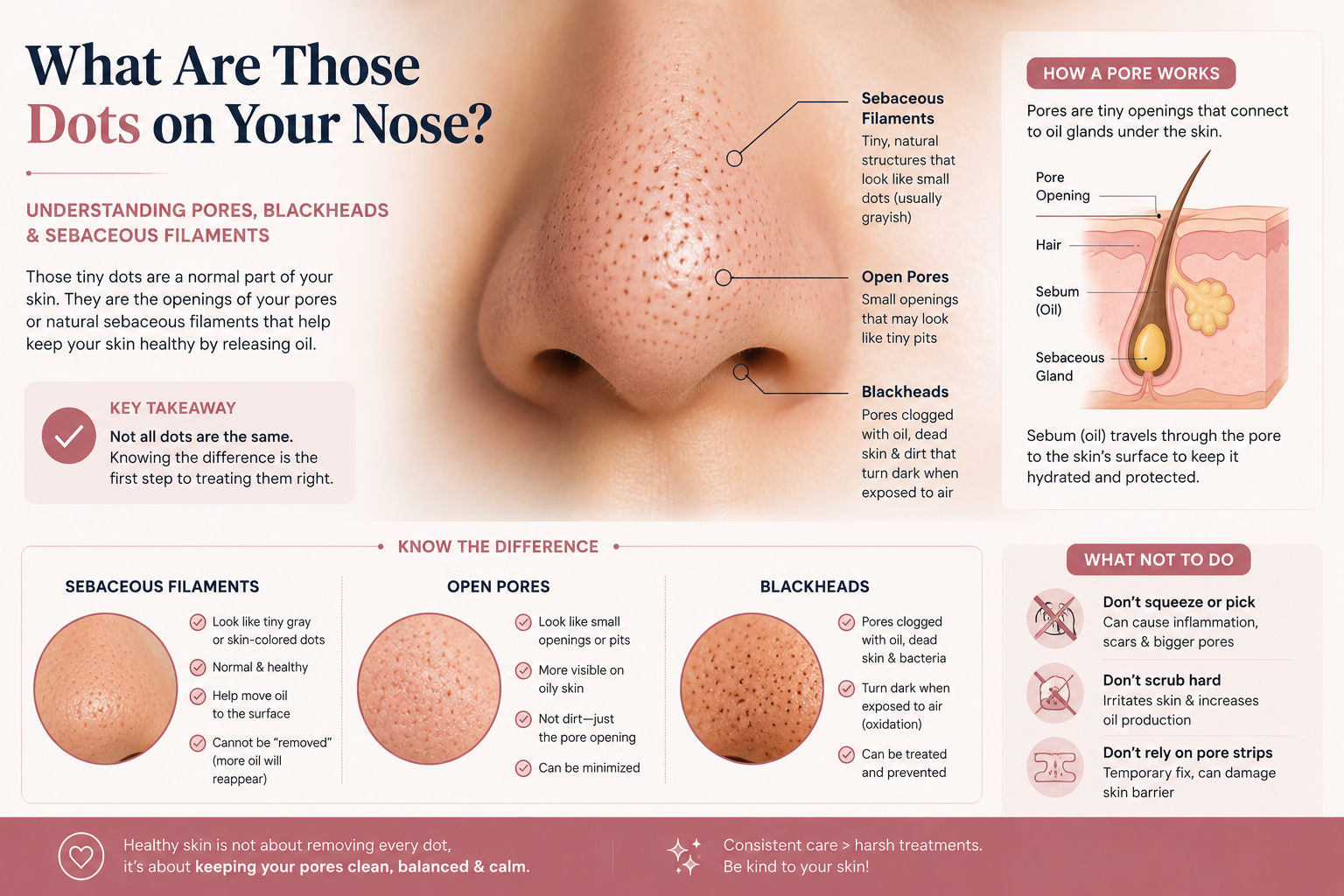
Look closely at your nose and you may see dozens of tiny grey, brown or black dots. It is tempting to call all of them blackheads — but many are completely normal sebaceous filaments, while others are simply visible pore openings.
The difference matters because they do not all need the same treatment — and some cannot, and do not need to, be permanently removed.
Sebaceous filaments are normal. Blackheads are clogged follicles. Pores are normal openings in your skin — and they do not literally open and close like doors. The realistic goal is cleaner, less clogged and less noticeable-looking pores, not perfectly poreless skin.
What are those dots on your nose?
The nose and central face contain many oil-producing follicles, so several normal and acne-related structures become especially visible there.
Sebaceous filaments
Normal structures inside oil-producing follicles. They help guide sebum toward the surface and often appear as many small, fairly uniform grey, beige or skin-coloured dots.
Blackheads
Blackheads are open comedones. Oil and dead skin cells accumulate inside the follicle and the exposed material darkens at the surface.
Whiteheads
Whiteheads are closed comedones. The follicular material is trapped beneath a closed surface, creating a small flesh-coloured or whitish bump.
Visible pores
These are simply follicular openings that look more noticeable because of genetics, oil, clogging, skin structure, age or sun-related changes.
Why are blackheads black?
It is one of the most persistent skincare myths:
A blackhead develops when material such as sebum and shed skin cells accumulates within a follicle while the opening remains exposed to the air. Chemical changes, including oxidation of material at the surface, produce the characteristic darker colour.
That is why scrubbing harder does not solve the underlying problem. You are dealing with follicular clogging, not simply a dirty face.
If blackheads and whiteheads are appearing across your face alongside other breakouts, your main concern may be comedonal acne. In that case, use the AuratSehat Acne Hub rather than treating every spot as a “pore problem.”
Why do sebaceous filaments keep coming back?
Because your skin is still doing its job.
Sebaceous glands continue producing sebum. That sebum moves through the follicle toward the surface, and normal cellular material continues to be shed.
If you extract a sebaceous filament or pull some of its surface material out with a pore strip, the follicle has not disappeared. Over time it fills again.
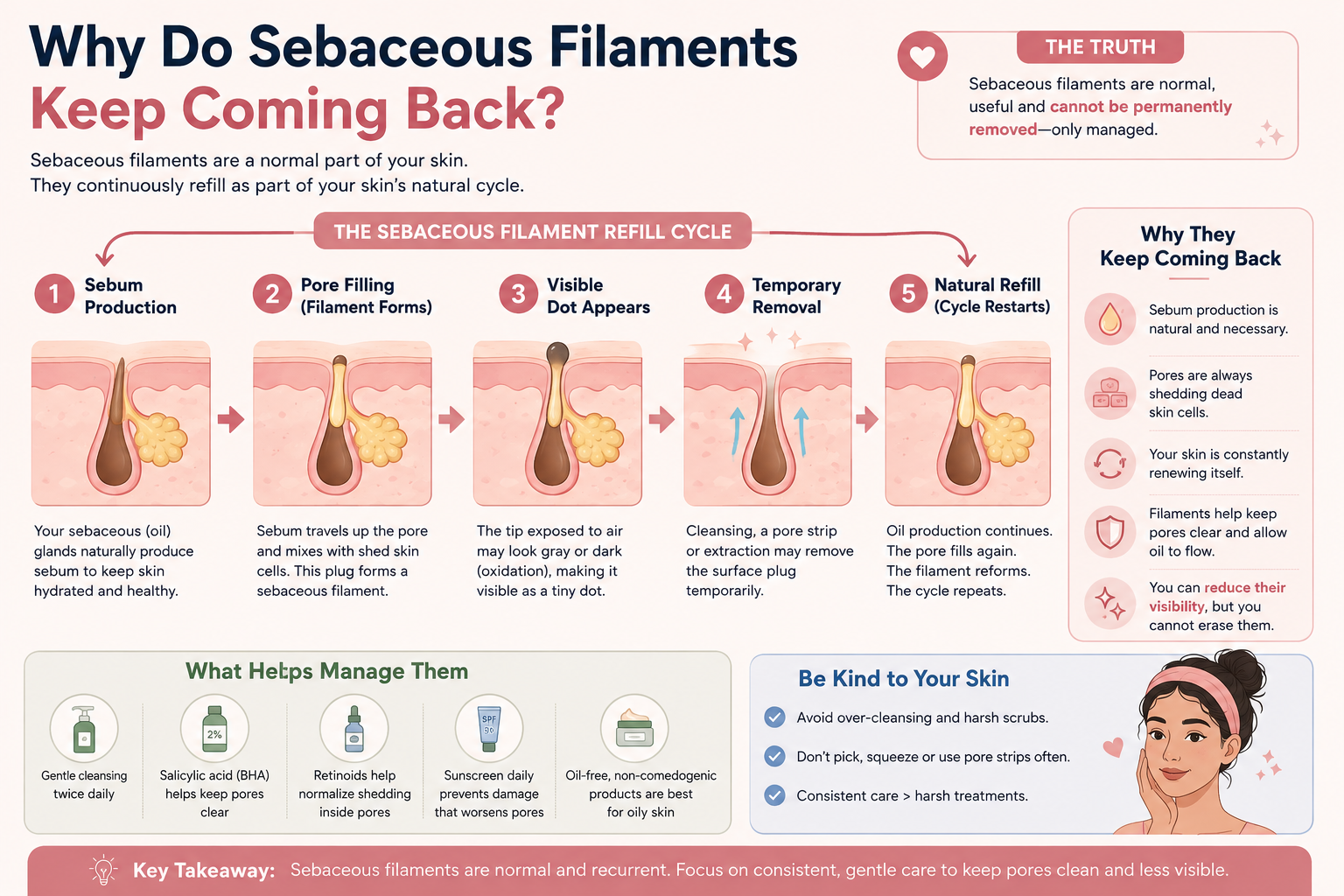
Skincare can sometimes reduce how obvious these filaments look by limiting excess surface oil and keeping follicular material moving more normally. But promising to permanently remove every sebaceous filament is unrealistic.
Pores are not doors.
They do not swing open when you steam your face and snap shut when you rub ice over it.

So why can pores look larger on some days?
Their appearance can change according to what is happening around and inside the follicle. Oil, accumulated material, skin elasticity, lighting, makeup and sun-related skin changes can all affect how obvious a pore looks.
Why are pores and filaments more obvious on oily skin?
If your sebaceous glands produce plenty of oil, follicular contents can simply become more noticeable. This is one reason the nose and central face may look textured or dotted even when the skin is perfectly clean.
But oily skin does not automatically mean acne. You can have oily skin with prominent sebaceous filaments and very few actual blackheads.
If your bigger issue is facial shine, greasiness or understanding why your oil keeps returning, start with Oily Skin Explained — Why Is My Face So Oily?.
What actually helps?
You do not need to attack your nose from five different directions. Start with a sensible routine and choose treatment according to what you are actually seeing.

Clean gently
Remove sweat, sunscreen, makeup and excess surface oil without repeatedly scrubbing or washing your skin every time it becomes shiny.
Consider salicylic acid for clogging
Salicylic acid is oil-soluble and can help with clogged pores and blackheads. You do not need to use it simply because your skin is oily; it is most useful when follicular clogging is actually part of the problem.
Retinoids can help comedonal acne
Retinoids such as adapalene or prescription tretinoin can help normalise follicular cell turnover and prevent new comedones. They are particularly relevant when you have repeated blackheads and whiteheads rather than only normal sebaceous filaments.
Niacinamide is optional — not a pore-closing miracle
Niacinamide may support the skin barrier and can be a useful ingredient in an oily-skin routine, but it does not physically close pores. You do not need to add it if your current routine already works well.
Use a suitable moisturiser when needed
If your skin feels tight, dehydrated or irritated, a lightweight gel-cream or lotion may be more comfortable than repeatedly drying the skin out.
Protect your skin every morning
Daily broad-spectrum sunscreen helps protect against UV damage and post-inflammatory pigmentation. If sunscreen feels greasy in Pakistani heat, look for lighter fluid, gel or matte-feeling formulas rather than skipping protection completely.
For a complete morning and evening routine — including Pakistani and imported product options — see our Best Skincare Routine for Oily Skin in Pakistan.
What about pore strips?
Pore strips can physically pull some material from the surface of follicles. That can make the nose look temporarily cleaner and can be satisfying to see.
What they cannot do is remove the follicle, permanently stop sebum production or prevent normal sebaceous filaments from filling again.
Should I squeeze the dots out?
Repeated squeezing is one of the easiest ways to turn a small cosmetic concern into an inflamed one.
Better approach
- Use gentle cleansing
- Treat actual clogging consistently
- Give skincare time to work
- Use professional extraction when appropriate
Avoid
- Squeezing every visible dot
- Digging with fingernails or tools
- Repeated harsh scrubbing
- Trying to make the nose completely poreless
Picking can increase inflammation and increases the chance of persistent dark marks or scarring — an especially frustrating trade-off when the original sebaceous filament was harmless.
Does oil cleansing remove sebaceous filaments?
Oil cleansers can be useful for dissolving sunscreen, makeup and oil-soluble residue before your regular cleanser. Some people also notice temporary surface material being loosened during massage.
But there is no need to treat oil cleansing as a special method that permanently “pulls every sebaceous filament out.”
Multani mitti, steam, ice, baking soda & scrubs?
🪨 Multani mitti
Clay can absorb surface oil and make skin feel temporarily less greasy. It does not permanently shrink pores or eliminate sebaceous filaments.
♨️ Steam
Warmth can soften surface material, which is why it may be used before some professional extractions. It does not mechanically “open” a pore.
🧊 Ice
Cooling can temporarily affect redness or the appearance of skin. It does not permanently close or shrink pores.
🧂 Baking soda & harsh scrubs
Aggressive DIY exfoliation can irritate the skin barrier without correcting the process occurring inside a clogged follicle.
When home care is not enough
Most visible pores and sebaceous filaments do not require a procedure. But clinic treatment may be useful when you have substantial blackheads, comedonal acne, persistent congestion or additional texture concerns.
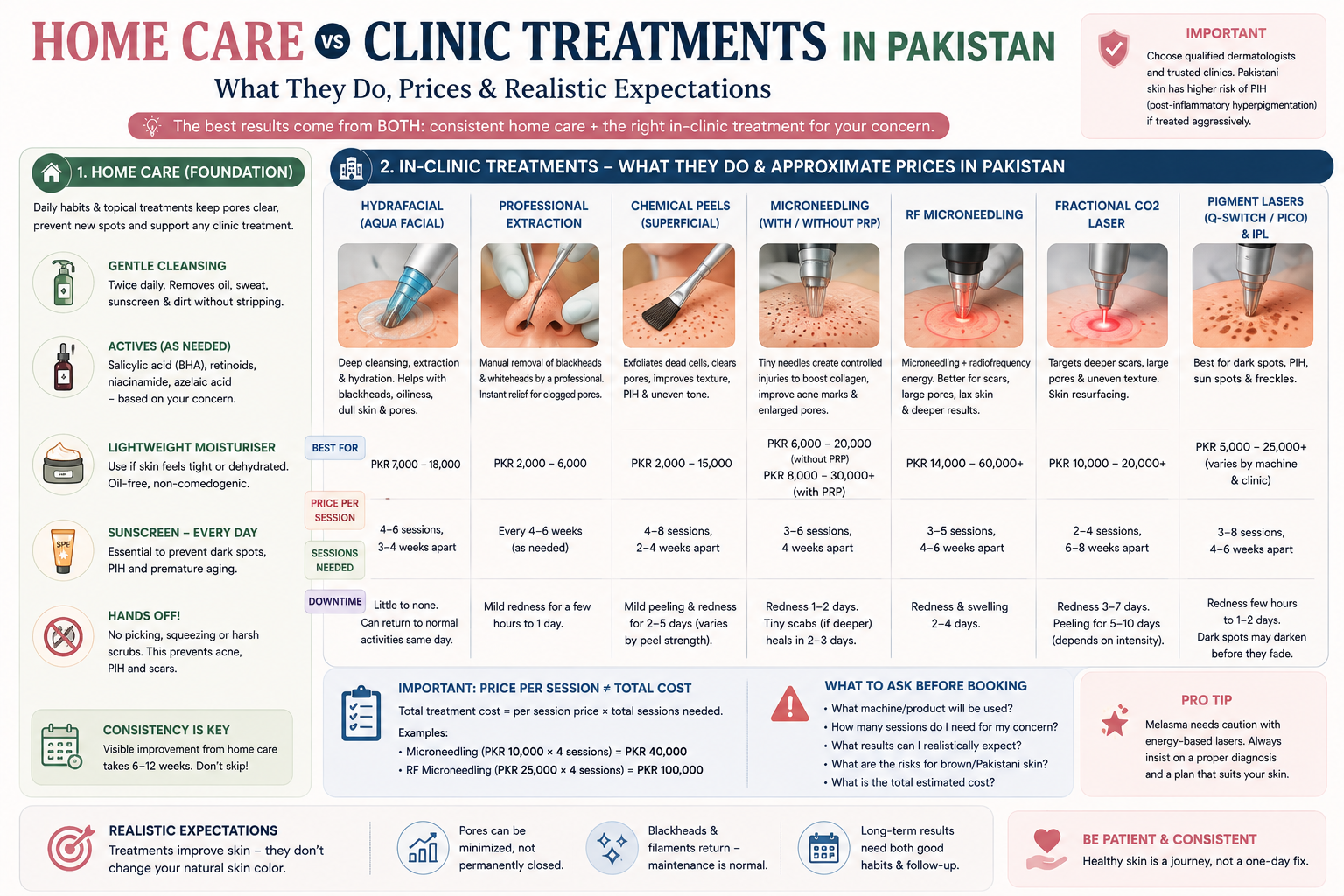
Professional extraction
A trained professional can physically remove selected blackheads and comedones under controlled conditions. The result is immediate, but new clogging can occur later.
Approx. PKR 2,000–6,000+HydraFacial / hydradermabrasion
These treatments combine cleansing, exfoliation and suction-based extraction. They can temporarily make congested skin look cleaner and smoother, but they do not permanently remove pores or filaments.
Approx. PKR 7,000–18,000+Superficial chemical peels
Depending on the peeling agent, superficial peels may help comedonal acne, surface texture and some pigmentation concerns. They should be selected according to your skin and diagnosis.
Approx. PKR 3,000–15,000+Do I need microneedling or laser just for blackheads?
Usually not. Procedures such as microneedling, RF microneedling and fractional lasers may be used for problems such as acne scars, texture or other specific indications, but they are not the ordinary first-line solution for a few sebaceous filaments or blackheads.
A clinic should first identify what problem you actually have before selling you a machine-based treatment.
Why do my pores look huge after foundation?
Makeup can settle around texture, mix with surface oil or become more obvious as the day becomes hotter and more humid. Repeatedly layering thick foundation and powder can sometimes make texture stand out rather than hide it.
For oily Pakistani skin, the easier approach is often:
See the full product and layering strategy in our Oily Skin Routine for Pakistan.
You are treating visibility — not trying to erase normal skin.
✓ Fewer blackheads
A consistent comedonal-acne routine can reduce existing clogging and help prevent new comedones.
✓ Cleaner-looking pores
Less surface oil and less retained material can make follicular openings look smoother and less obvious.
✓ Less obvious filaments
Sebaceous filaments may become less noticeable — but they will continue to exist and naturally refill.
Frequently asked questions
Are all black dots on my nose blackheads?
No. Many tiny, uniform dots on the nose are normal sebaceous filaments. Blackheads are open comedones caused by follicular clogging.
Can I permanently remove sebaceous filaments?
No. They are normal structures associated with sebaceous follicles and naturally refill. Their visibility can often be reduced, but permanent removal is not a realistic goal.
Does salicylic acid remove pores?
No. Salicylic acid can help reduce follicular clogging and blackheads, which may make pores look cleaner or less obvious. The pore itself remains.
Does steam open pores?
No. Steam and warmth may soften surface material, but pores do not open and close mechanically like doors.
Does ice close pores?
No. Cold can temporarily alter redness or the appearance and sensation of the skin, but it does not permanently close pores.
Are pore strips bad?
Occasional use is not automatically harmful for everyone, but their effect is temporary. They should not replace a proper routine, and frequent aggressive use can irritate some skin.
Should I squeeze blackheads?
Repeated squeezing can traumatise the skin and increase inflammation, pigmentation and scarring. Persistent comedones are better treated appropriately or extracted professionally.
What is your main problem?
Pores, oiliness and acne often overlap — but the right next guide depends on what is actually bothering you.
Still not sure whether those dots are blackheads?
Skin concerns can look very similar in photographs and mirrors. If your pores, breakouts or skin texture are persistent or you are unsure what treatment is appropriate, you can ask AuratSehat for general medical guidance.
Ask a Doctor for Free →Medical references
- American Academy of Dermatology — Acne signs, symptoms and formation of blackheads and whiteheads.
- American Academy of Dermatology — Acne treatment guidance, including topical retinoids for comedonal acne.
- American Academy of Dermatology — Acne care in darker skin tones, including salicylic acid, retinoids and avoidance of picking.