
Periods Explained — Is My Menstrual Cycle Normal?
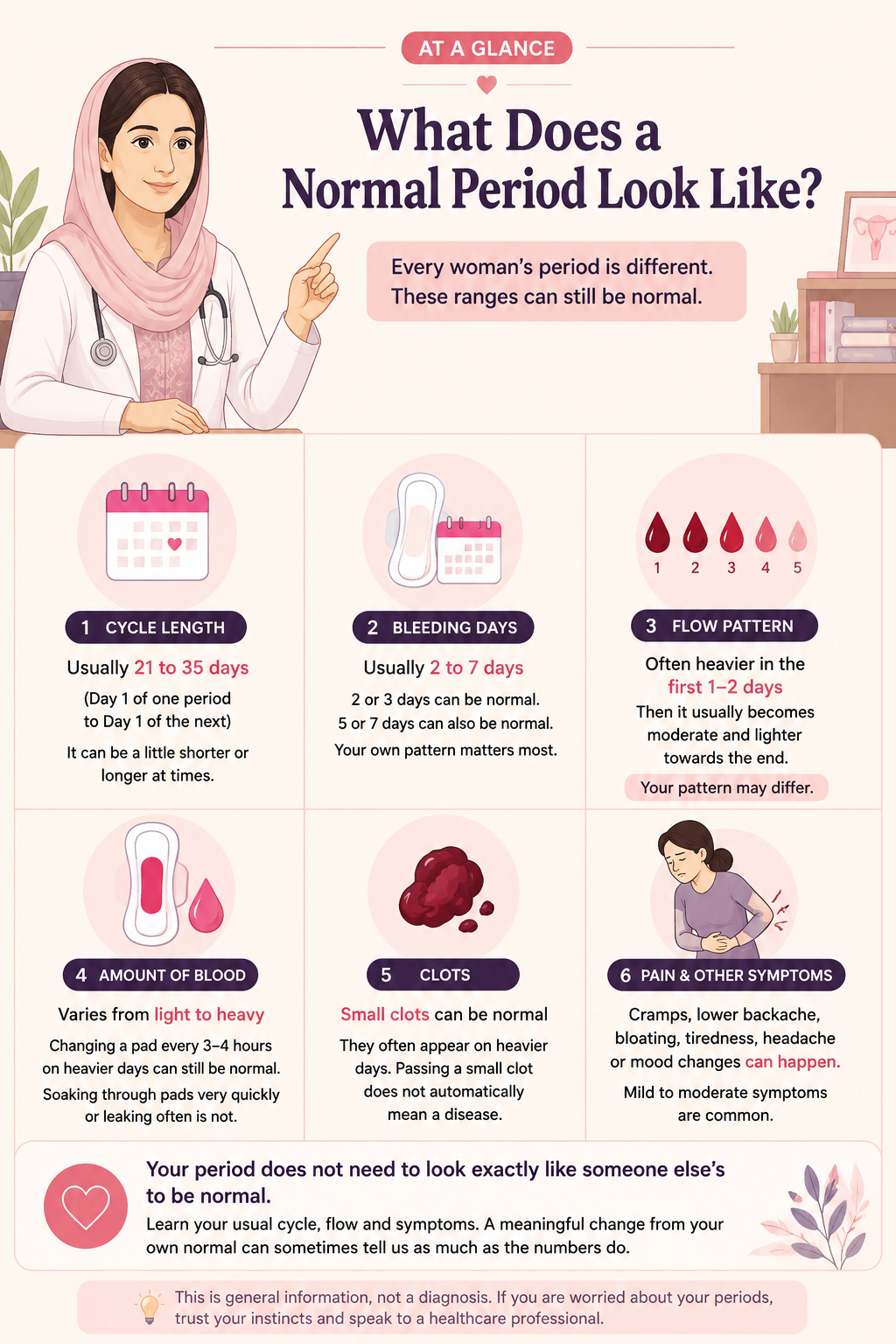
Periods do not look exactly the same for every woman. Your bleeding may be heavier on the second day, your blood may turn brown, you may see a small clot, or your period may last only a few days. Many of these changes can be completely normal.
First, what actually is a period?
During the menstrual cycle, the uterus prepares a soft inner lining in case pregnancy occurs.
If pregnancy does not happen, hormone levels change and the uterus sheds this lining. That is your period.
Your period is not just blood
Menstrual flow contains a mixture of blood, cells from the uterine lining, mucus and other natural secretions.
This is why period blood may sometimes look thick, stringy, jelly-like or different from blood from a cut on your skin.
Period days and cycle days are not the same thing
This is one of the most common sources of confusion.
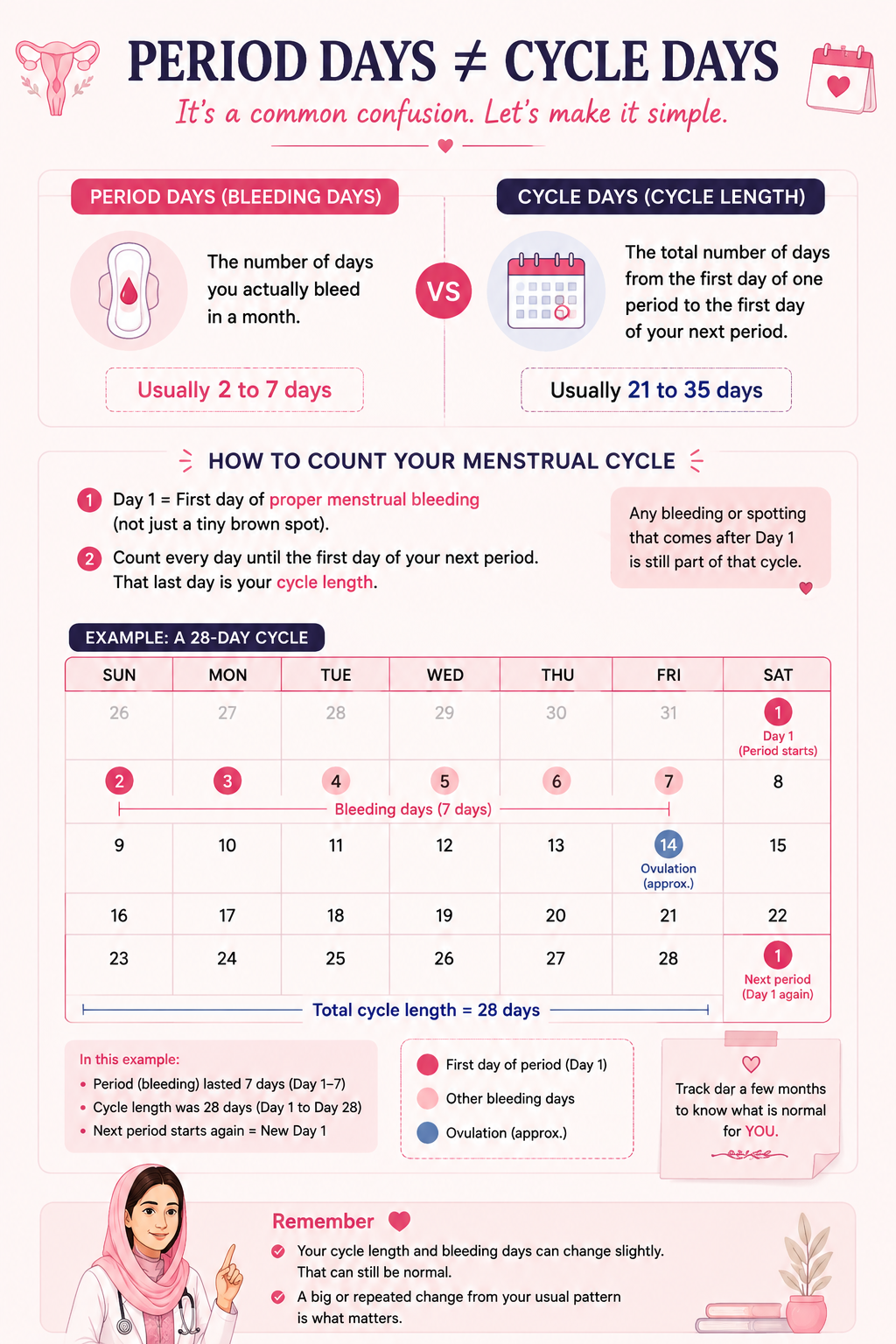
Cycle length means the number of days from the first day of one period until the next period begins.
Day 1 of your menstrual cycle is the first day of proper menstrual bleeding — not necessarily one tiny brown spot that appears before your flow begins.
How many days should a normal period last?
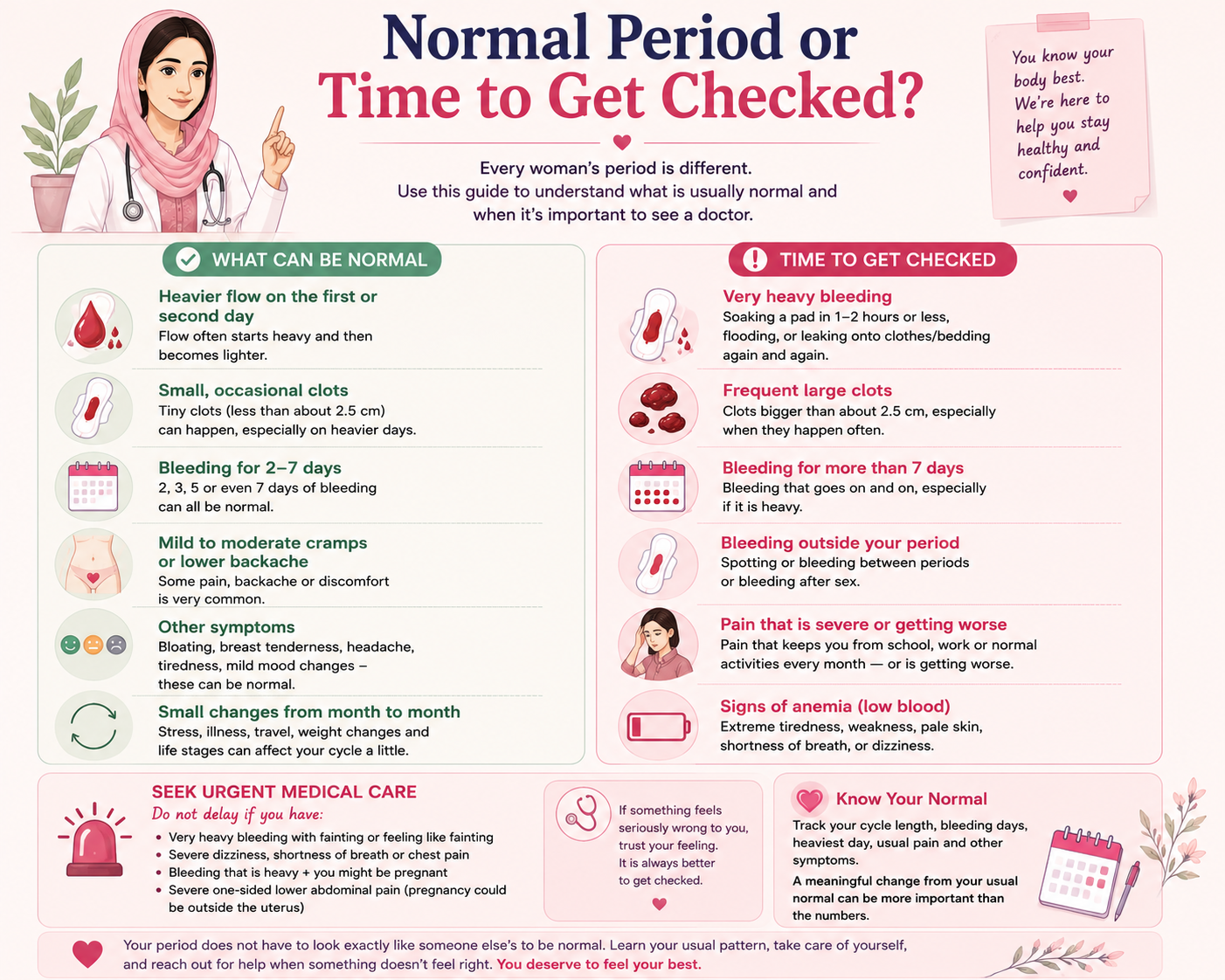
For many women, menstrual bleeding lasts around 2 to 7 days.
That means a period lasting three days is not automatically too short, and a period lasting six or seven days is not automatically too long.
If your periods have usually lasted four days for years, that can simply be your normal. We become more interested when the pattern changes significantly, becomes very heavy, or keeps lasting longer than expected.
Bleeding that repeatedly continues for more than about seven days, particularly when it is heavy, deserves medical evaluation.
How long should my menstrual cycle be?
In adults, menstrual cycles commonly fall around 21 to 35 days.
Your period does not have to arrive on exactly Day 28 every month. A small amount of variation can happen naturally.
But if your cycles repeatedly become very unpredictable, frequently disappear, or change considerably from your previous pattern, the reason deserves attention.
Understand PCOS and irregular periodsWhy is my second day so heavy?
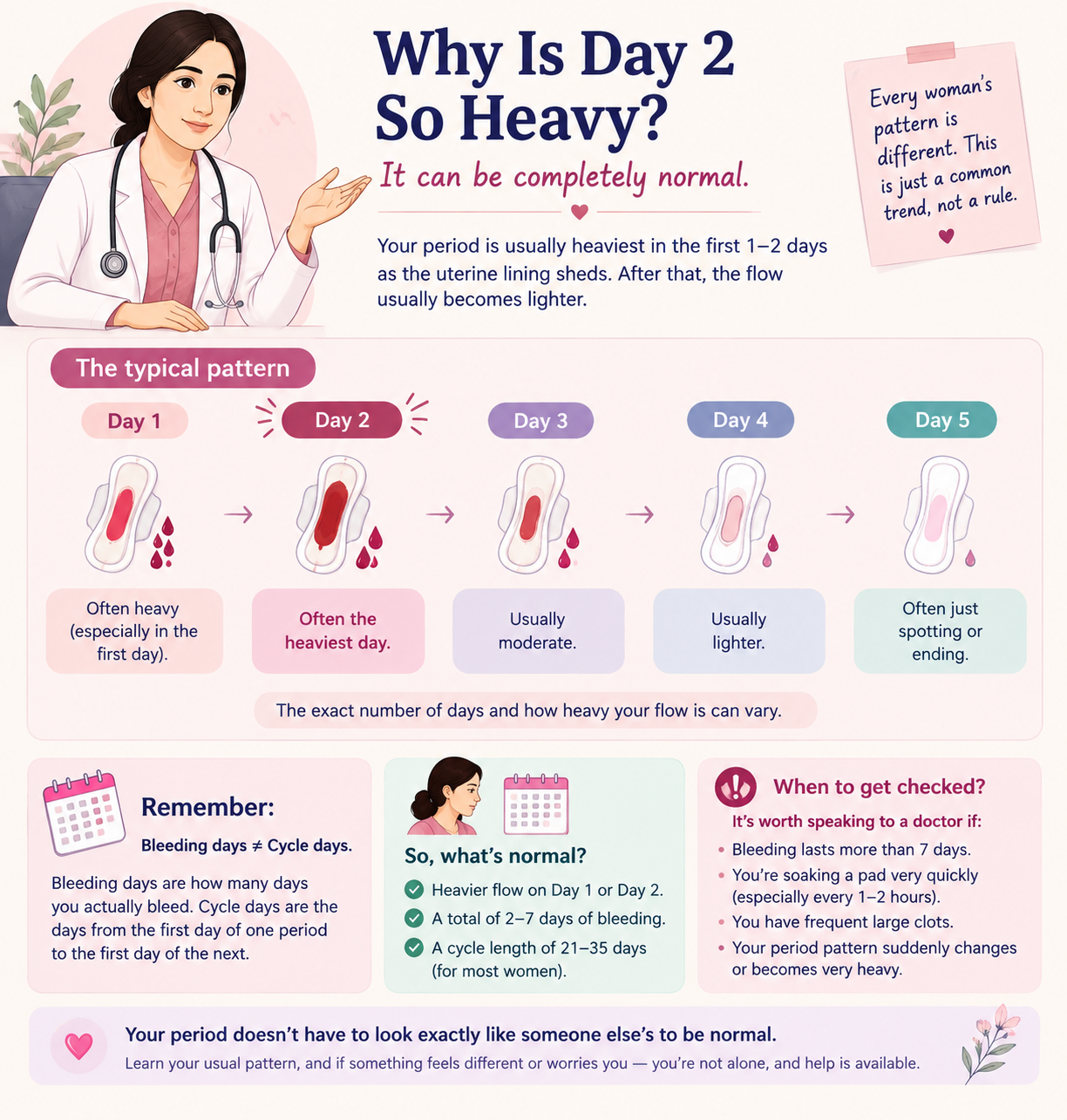
This worries many women, but the answer is often reassuring: the first or second day of a period can naturally be the heaviest.
During the early part of menstruation, more of the uterine lining and blood may be passing out at once. The flow then often becomes progressively lighter.
Your period does not have to follow this exact pattern. Some women are heaviest on Day 1, some on Day 2, and others have a more even flow.
How much menstrual blood is normal?
Medical textbooks sometimes describe menstrual blood loss in millilitres. In real life, almost nobody measures her period that way.
What tells us much more is how quickly you are soaking pads, whether blood is leaking through your clothes or bedding, how long the heavy bleeding lasts, and whether you are developing symptoms such as weakness or dizziness.
A heavier first or second day can still be normal. What becomes more concerning is repeated flooding, very frequent pad changes because the pad is completely soaked, prolonged heavy bleeding, or heavy flow that repeatedly disrupts normal life.
Read about heavy periods and blood clotsAre blood clots during a period normal?
Yes — small occasional clots can happen during a normal period, particularly on a heavier-flow day.
When blood leaves the uterus relatively quickly, some of it may collect and clot before it leaves the body.
A small clot is not automatically a warning sign
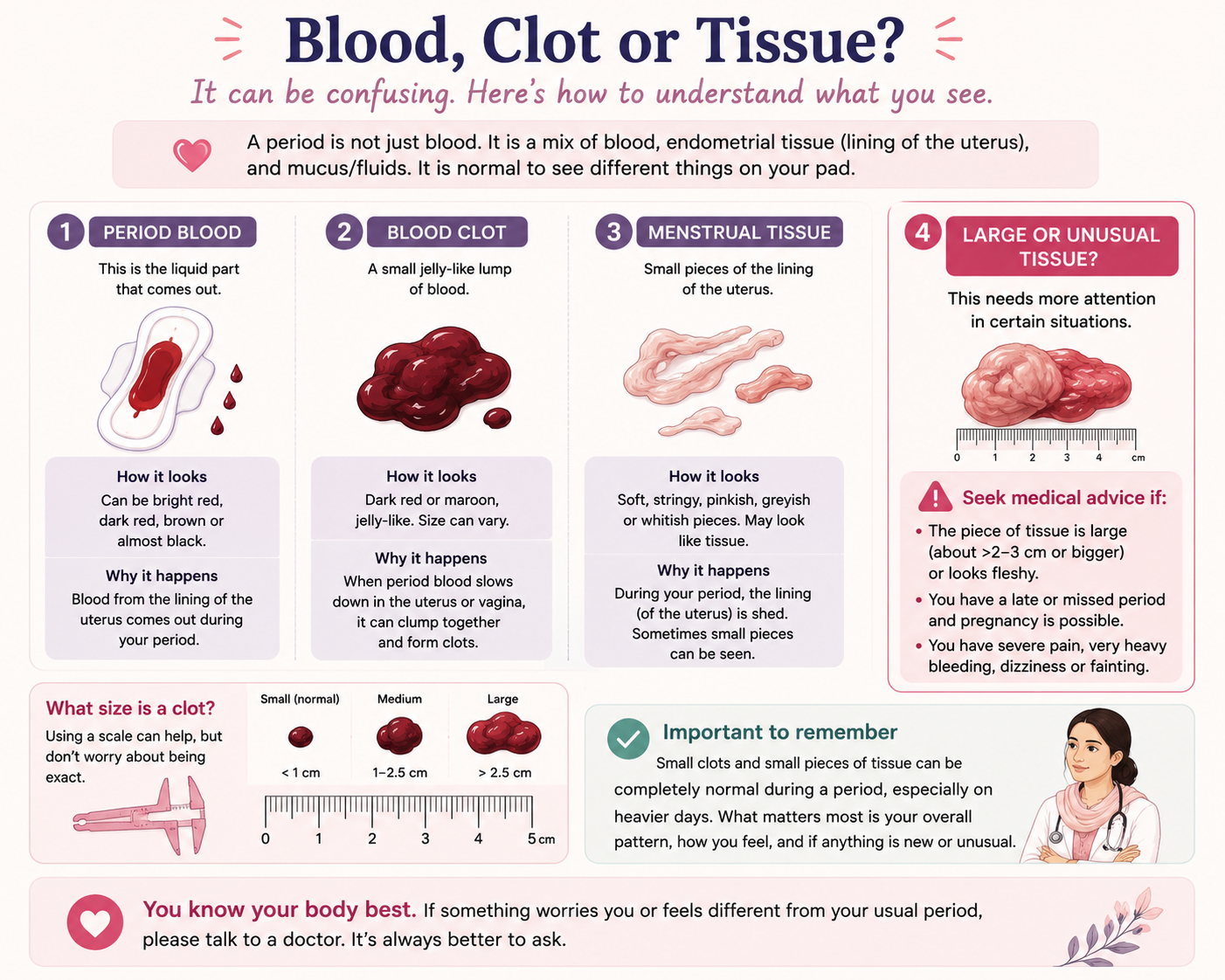
Seeing one small dark-red or jelly-like clot on your heaviest day does not, by itself, mean something is wrong. We become more concerned when clots are large, frequent or accompanied by very heavy bleeding.
As a practical visual reference, clots around 2.5 cm or larger — particularly when they happen repeatedly — are worth discussing with a healthcare professional in the context of your overall bleeding.
“I saw something that looked like tissue.”
Remember that menstruation involves shedding the lining of the uterus. So menstrual flow can occasionally contain soft, stringy or tissue-like material.
A blood clot tends to look dark red, maroon or jelly-like. Menstrual tissue may look softer, more irregular or different in texture.
When tissue deserves more attention
If your period was late or missed, pregnancy is possible, and you pass unusually large or fleshy tissue — especially together with severe pain, heavy bleeding, dizziness or fainting — do not simply assume it is an ordinary period. Pregnancy-related bleeding should be assessed appropriately.
If pregnancy might be possible, AuratSehat’s early pregnancy guide can help you understand what to look for.
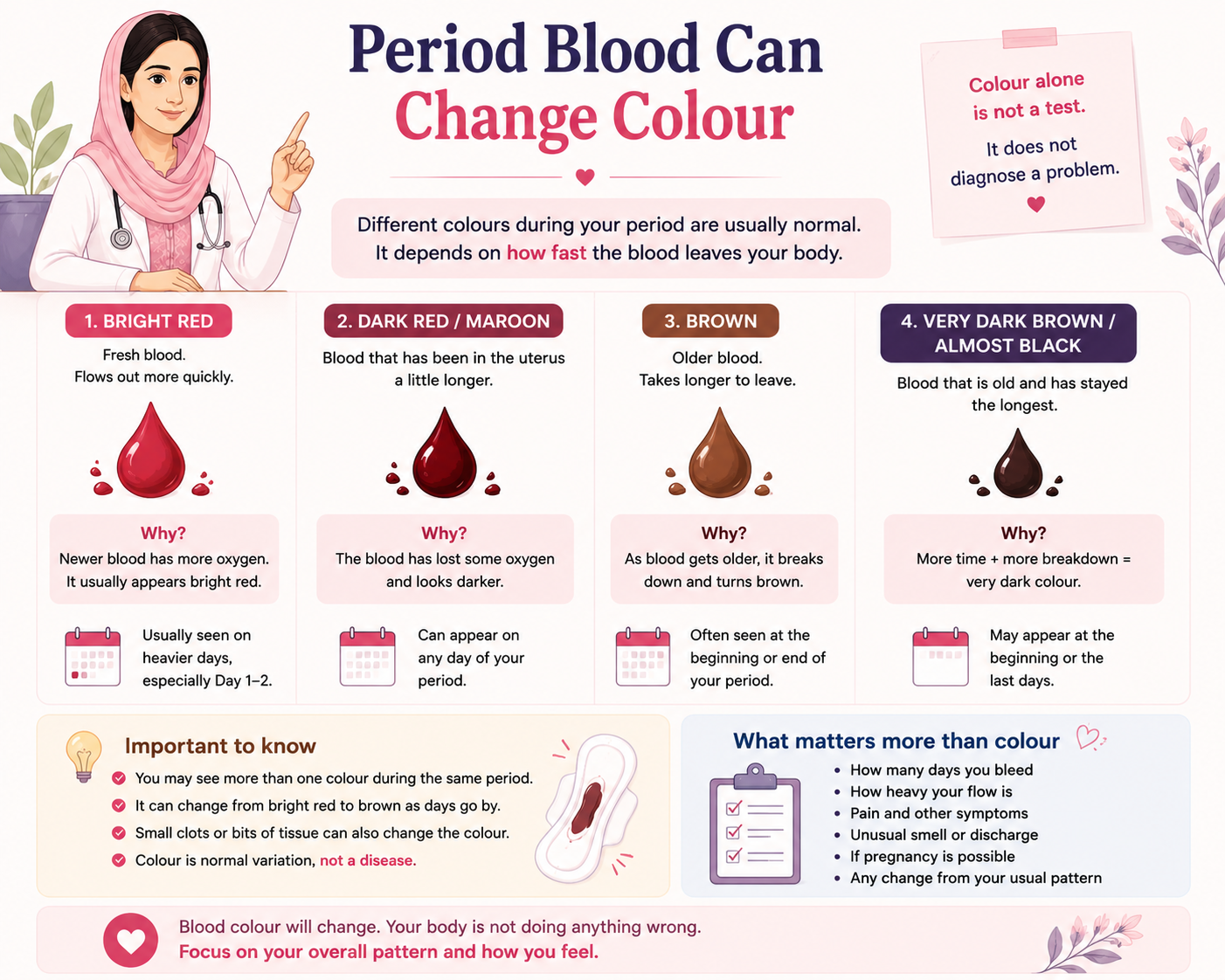
What colour should period blood be?
Period blood does not have to stay the same colour throughout your period.
You may see:
The colour matters much less than the whole picture: your bleeding amount, smell, pain, discharge, timing, pregnancy possibility and whether something has changed from your usual pattern.
Are period cramps normal?
Mild to moderate cramping around the beginning of a period is common.
During menstruation, natural chemicals called prostaglandins help the uterus contract. Those contractions help the uterine lining leave the body, but they can also cause cramping.
You do not have to spend one or two days every month unable to stand, study, work or sleep simply because you have been told “periods mein dard hota hi hai.”
Pain that is severe, getting worse, suddenly different, or repeatedly interfering with normal life deserves proper evaluation.
Understand painful periodsWhy does my lower back hurt during my period?
Period discomfort is not always felt only in the centre of the lower abdomen.
Cramping may also be felt in the lower back, hips or upper thighs. This can happen because pain from the pelvic organs can be felt in nearby areas.
Mild lower-back aching along with ordinary menstrual cramps can therefore be part of a typical period.
Your period can affect more than your uterus
Around menstruation, some women also notice:
Bloating • breast tenderness • tiredness • headache • mild nausea • looser stools or bowel changes • mood changes • lower-back discomfort
Having one or more of these symptoms does not automatically mean something is wrong. The intensity and effect on your daily life matter.
Your period does not have to be identical every month
A menstrual cycle is biological, not a clock.
An occasional change can happen with stress, illness, travel, major changes in sleep, changes in body weight, adolescence, approaching menopause, or other temporary influences.
If irregularity becomes a recurring problem — especially alongside acne, increased facial hair, weight or metabolic changes — PCOS may be one possibility, although it is not the only cause.
Learn why PCOS can make periods unpredictableThings you may have been told about periods
You can bathe during menstruation. Keeping yourself clean is healthy.
Washing your hair does not stop menstrual bleeding.
Menstrual blood does not become trapped inside your uterus because you drank or used cold water.
Ordinary nutritious foods do not need to be avoided simply because you are menstruating.
Menstrual blood is not “dirty blood,” and appropriate pain treatment does not trap it inside the body.
So what is not a normal period pattern?
Normal periods vary, but some changes deserve medical attention rather than simply being accepted month after month.
Repeatedly soaking through pads very quickly, flooding or leaking through clothing or bedding.
Menstrual bleeding repeatedly continuing beyond about seven days.
Especially when they occur together with heavy bleeding.
Cycles repeatedly becoming markedly early, late, missed or unpredictable.
Recurrent bleeding or spotting when you are not expecting your period.
This should not simply be assumed to be part of your period.
Especially pain that regularly prevents school, university, work, sleep or normal activity.
Marked tiredness, dizziness, weakness, breathlessness or looking unusually pale.
Some bleeding should not wait
Seek prompt medical assessment if you have very heavy ongoing bleeding together with fainting, severe dizziness, marked weakness, shortness of breath or feeling seriously unwell.
If pregnancy may be possible and you have heavy bleeding, severe abdominal or pelvic pain, one-sided pain, dizziness or fainting, urgent assessment is particularly important.
Learn your normal
Your period does not need to look exactly like your sister’s, your friend’s or another woman’s period to be normal.
It is useful to know:
your usual cycle length • how many days you bleed • which day is heaviest • whether you normally have clots • how much pain you usually experience
A meaningful change from your own usual pattern can sometimes tell us as much as the numbers do. Tracking your periods for a few months can make these changes much easier to notice.
Still wondering whether your period is normal?
If your bleeding, clots, pain, cycle timing or another period symptom is worrying you, you can send your question to AuratSehat for general medical guidance.
Ask a Doctor for Free →This article is for general health education and does not replace individual medical assessment, diagnosis or treatment. Severe bleeding, severe pain, fainting or pregnancy-related warning symptoms should be assessed promptly by an appropriate healthcare professional.