
Irregular Periods — Why Does My Cycle Keep Changing?
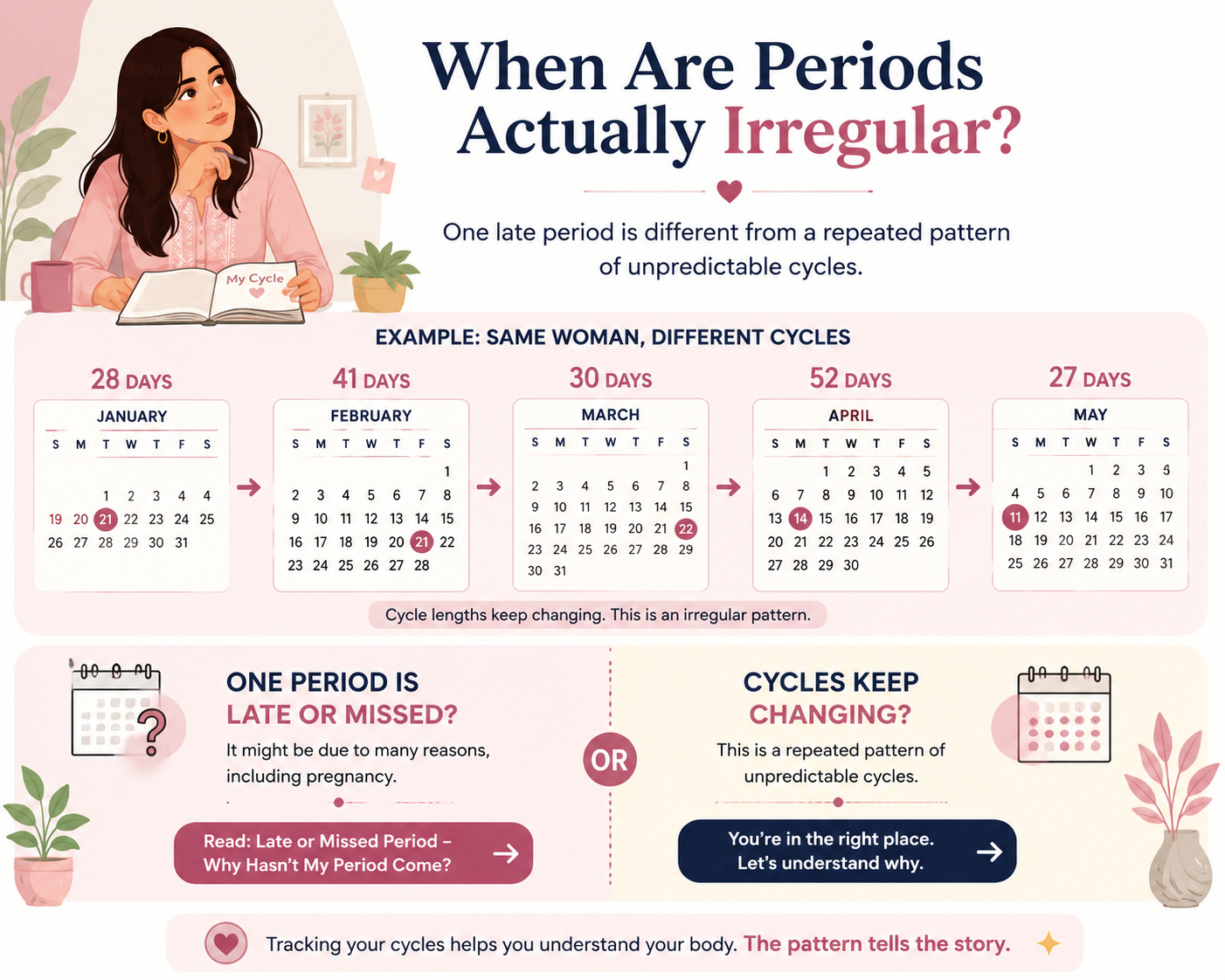
If your period came after 28 days one month, 42 days the next, then you skipped a month completely, you may be dealing with an irregular cycle pattern. One unusual cycle can happen to almost anyone. Irregular periods usually mean the unpredictability keeps happening across several cycles.
Is this only one late or missed period? That is a slightly different problem. Start with our Late or Missed Period guide instead.
What Do We Mean by Irregular Periods?
A menstrual cycle is counted from the first day of one period to the first day of the next. Some variation from month to month is normal. Your body is not a machine, and your cycle does not need to arrive on exactly the same date every month.
The concern is when the pattern becomes repeatedly unpredictable. Your cycles may keep becoming much longer, much shorter, or you may occasionally skip periods completely.
A single unusually late cycle does not automatically mean you have chronic irregular periods. The important question is whether your cycle lengths keep changing substantially over several months.
For many adult women, menstrual cycles commonly fall roughly within a range of about 24 to 38 days. But regularity is also about how much your own cycle varies from one month to another. Age, breastfeeding, contraception and other circumstances can change what is expected.
If you are unsure what a normal menstrual cycle can look like, start with Periods Explained — Is My Menstrual Cycle Normal?.
What Can an Irregular Pattern Look Like?
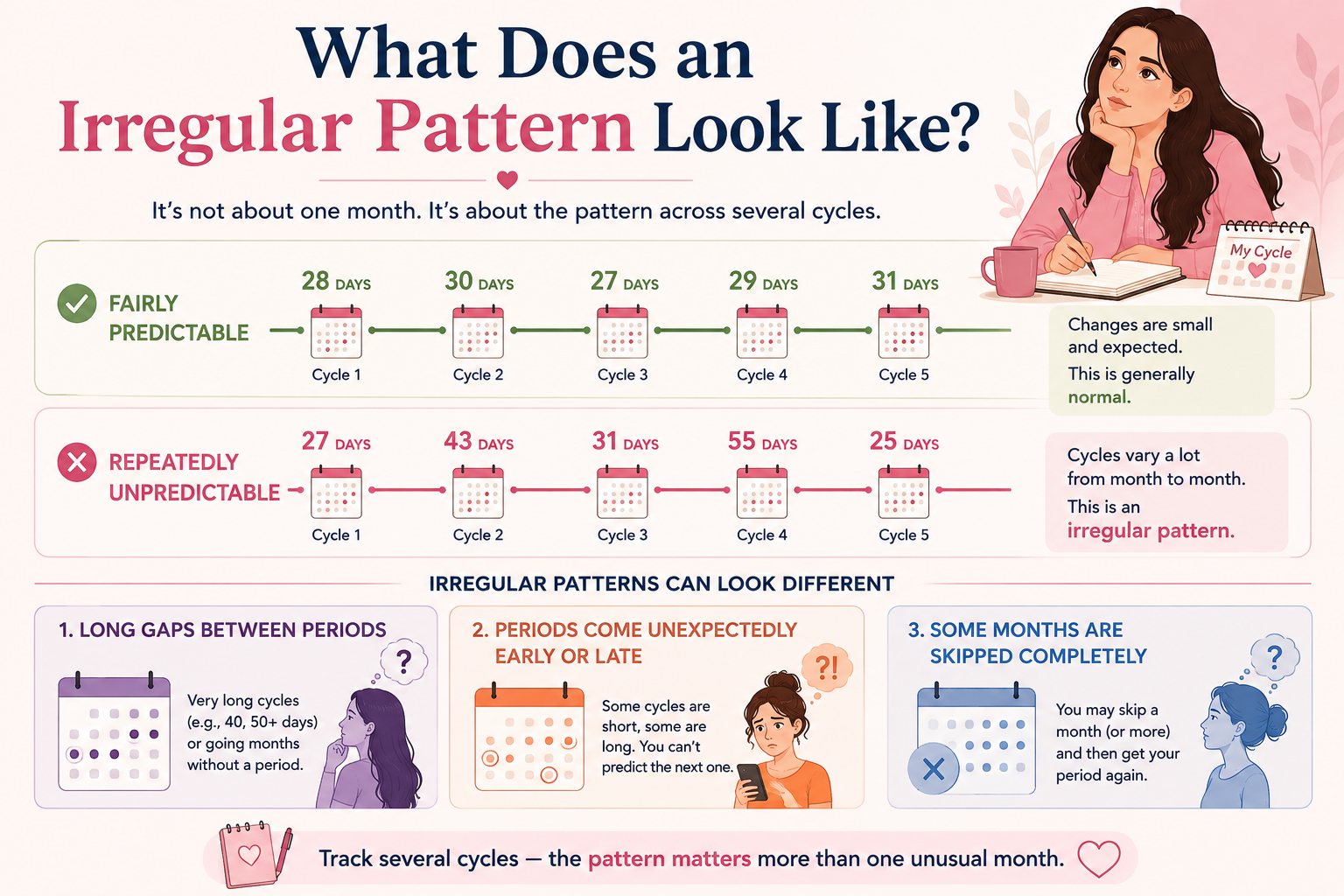
Women use the words irregular periods to describe many different experiences. These are some of the patterns that more strongly suggest repeated cycle irregularity:
- Your periods repeatedly come much earlier or later than you expect.
- Your cycle length changes considerably from one month to another.
- You regularly have long gaps between periods.
- You occasionally skip one or more months and then start bleeding again.
- You can no longer reasonably predict when your next true period will arrive.
Irregular bleeding is not always the same as irregular periods. Spotting between periods, bleeding after sex or prolonged bleeding can have different causes and may need a different evaluation.
Why Do Periods Become Irregular?
Most menstrual cycles depend on the ovaries releasing an egg in a reasonably coordinated way. This is called ovulation. When ovulation becomes delayed, inconsistent or temporarily stops, the timing of periods can become unpredictable.
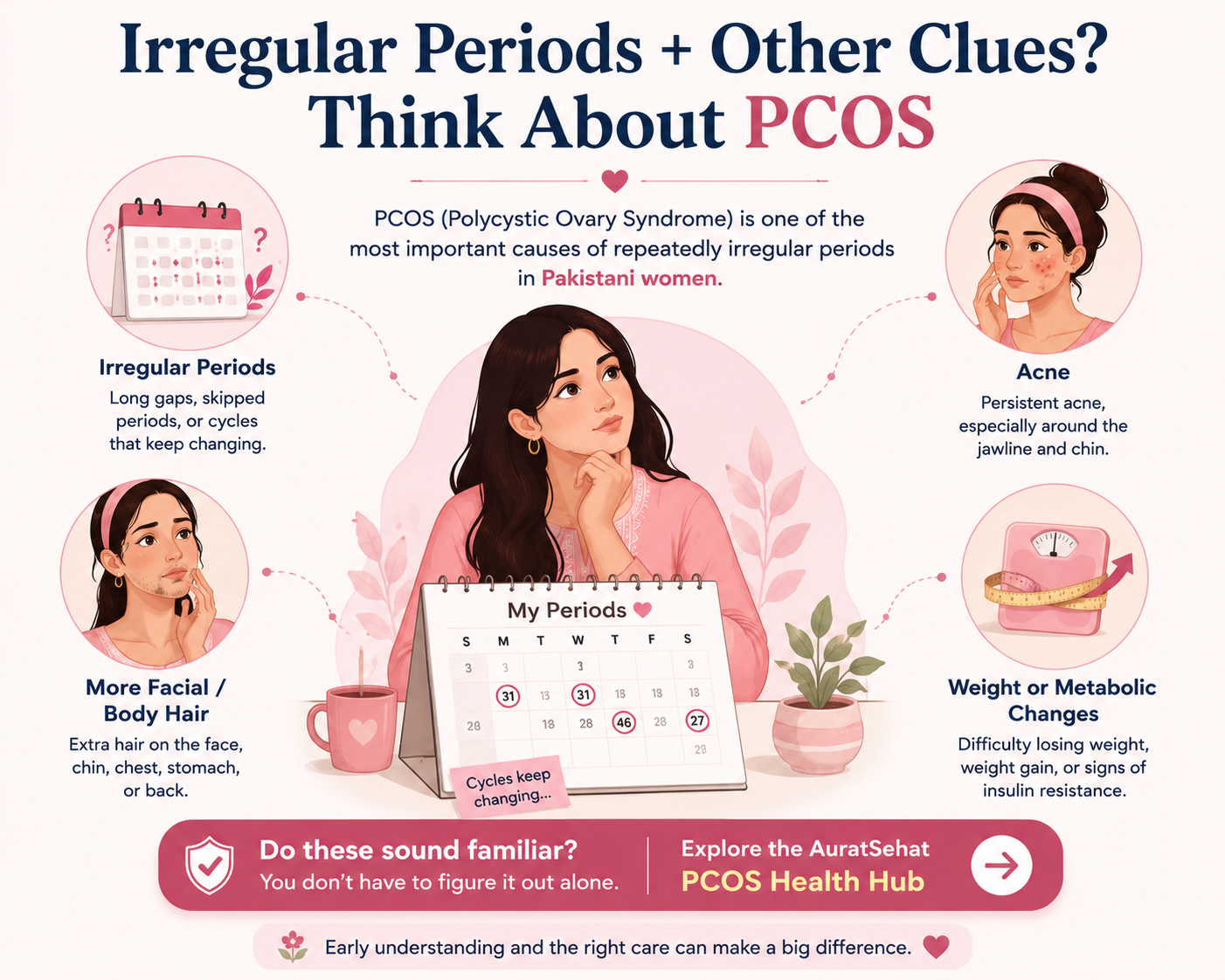
There is no single cause. In Pakistani women, PCOS is one of the most important conditions to think about, but it is not the only explanation.
1. PCOS — An Important Cause of Repeated Irregular Periods
Polycystic ovary syndrome (PCOS) commonly affects ovulation. Instead of an egg being released regularly, ovulation may happen late, unpredictably or not at all during some cycles.
That can lead to long cycles, skipped periods or a pattern where your cycle length keeps changing.
PCOS becomes particularly worth considering when irregular periods occur together with other clues such as:
- Persistent acne
- More facial or body hair than usual
- Difficulty with weight or signs of insulin resistance
- Difficulty predicting ovulation
- Problems becoming pregnant because ovulation is irregular
But irregular periods alone do not diagnose PCOS. Other conditions can produce a similar menstrual pattern.
Other Common Reasons Your Cycle May Change
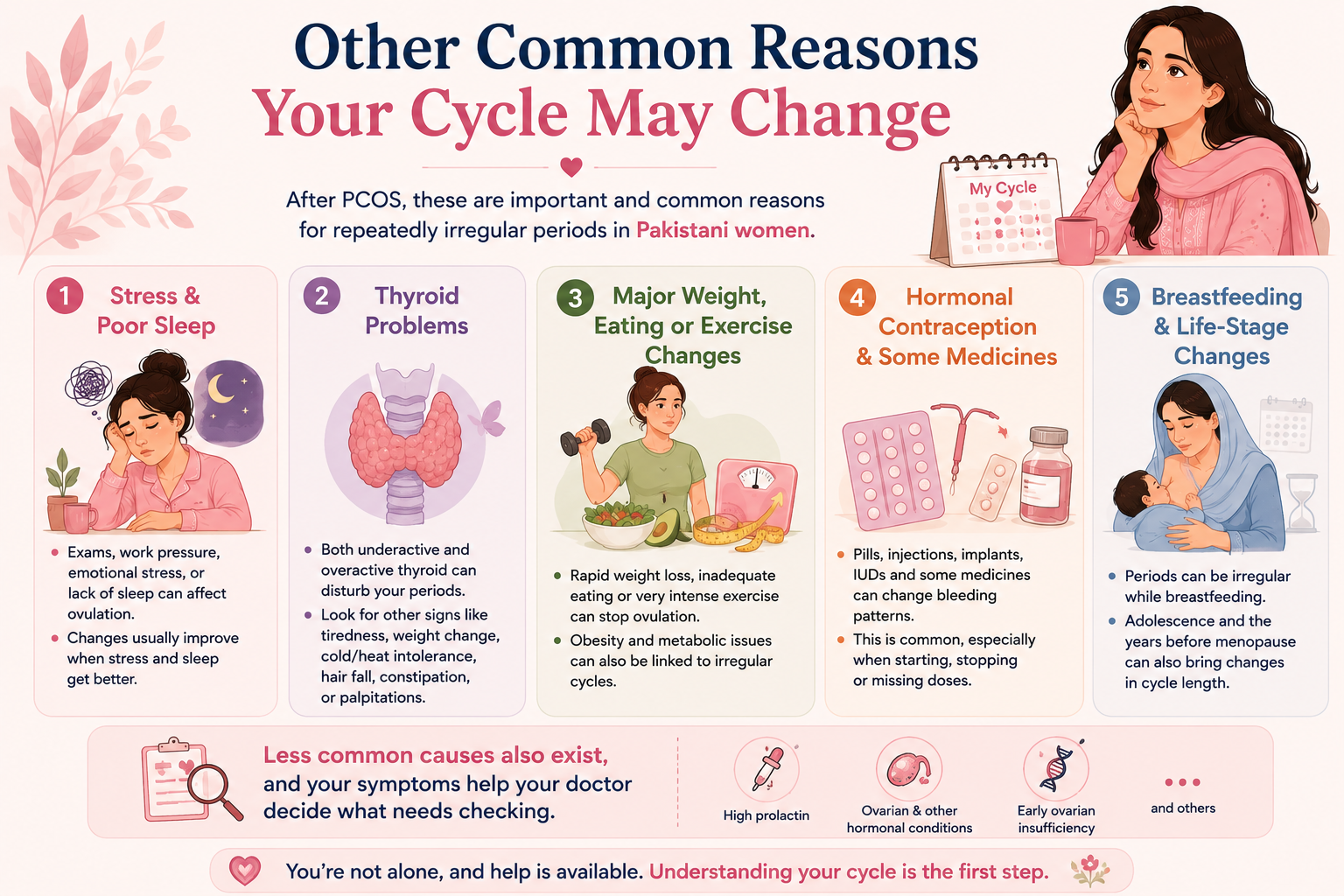
Once PCOS has been considered, there are several other explanations that matter in everyday practice. The right cause depends on your age, symptoms, medicines, lifestyle and what your cycles were like before.
2 Stress, Poor Sleep & Major Routine Changes
Significant emotional stress, physical stress, illness, exam pressure, night shifts and disrupted sleep can interfere with the brain signals that help control ovulation.
This can temporarily lengthen cycles or make them less predictable.
3 Thyroid Problems
Both an underactive thyroid and an overactive thyroid can disturb menstrual timing. Thyroid disease can affect ovulation and may sometimes change bleeding as well.
Your doctor may think more strongly about thyroid testing if irregular periods occur with symptoms such as:
- Unusual tiredness
- Feeling unusually cold or hot
- Constipation or bowel changes
- Palpitations or tremor
- Unexplained weight change
- Hair or skin changes
These symptoms are not specific to thyroid disease, so they should be interpreted together rather than used for self-diagnosis.
4 Major Changes in Weight, Eating or Exercise
Your reproductive system responds to the amount of energy available to your body. Significant weight loss, restrictive eating, inadequate calorie intake or very intense exercise can suppress the hormone signals needed for normal ovulation.
Significant weight gain and metabolic changes can also be associated with irregular cycles, particularly when PCOS or insulin resistance is present.
5 Hormonal Contraception & Some Medicines
Birth-control pills, injections, implants and hormonal intrauterine devices can change bleeding patterns. Starting, stopping or missing hormonal contraception may also make bleeding less predictable for a time.
Some other medicines can affect prolactin or reproductive hormones and indirectly change the menstrual cycle.
6 Breastfeeding & the Months After Pregnancy
After childbirth, periods may take time to return. Breastfeeding often keeps prolactin levels higher, which can suppress or delay ovulation.
When periods begin returning, the first few cycles may be less predictable.
Your Age Can Change What an Irregular Cycle Means
Teenage Years
Cycles can be less predictable during the first few years after periods begin because the hormonal system controlling ovulation is still maturing.
But very long gaps, persistent irregularity, excessive hair growth, severe acne or other concerning symptoms should not simply be dismissed as “teenage hormones.”
Perimenopause
As women move toward menopause, usually during the 40s, ovarian hormone production becomes less predictable. Cycle length may shorten, lengthen or become irregular.
New heavy bleeding, bleeding after sex or other unusual bleeding still deserves proper assessment rather than automatically being blamed on age.
High Prolactin
Prolactin is the hormone that helps produce breast milk. When prolactin becomes abnormally high outside pregnancy or breastfeeding, it can interfere with ovulation and cause irregular or absent periods.
One useful clue is milky nipple discharge when you are not pregnant or breastfeeding. However, high prolactin does not always cause visible breast discharge.
Certain medicines and several medical conditions can raise prolactin, so testing is usually interpreted in context rather than on its own.
Less Common — but Important — Causes
Less commonly, irregular periods can be related to other ovarian, pituitary or hormonal disorders. One example is primary ovarian insufficiency, where ovarian function becomes reduced before age 40.
Symptoms such as irregular or absent periods together with hot flushes, night sweats or vaginal dryness at a younger age deserve medical assessment.
Rare conditions do not need to be your first assumption. Your age, cycle pattern and other symptoms usually help your doctor decide whether they need to be considered.
Can I Still Get Pregnant If My Periods Are Irregular?
Yes. Irregular periods often mean ovulation is unpredictable, not necessarily that it never happens.
That means pregnancy is still possible, but predicting fertile days can become more difficult.
If you are sexually active and one expected period has not arrived, pregnancy should still be considered even if your cycles are usually irregular.
Track the Pattern Before You Forget It
You do not need an expensive app. A phone calendar, notebook or menstrual-tracking app can all work. The important part is recording enough information to see the pattern.
Try to keep track of:
Cycle timing
Write down the first day of every true period and calculate the number of days until the next one begins.
Bleeding
Note whether your flow is light, moderate or unusually heavy, and whether you are passing large clots.
Hormonal clues
Acne, new facial hair, hair thinning, nipple discharge, hot flushes and other symptoms can help identify the pattern.
Life changes
Record major stress, illness, weight changes, new medicines, contraception changes, breastfeeding or major changes in exercise.
A few months of cycle history can be much more useful than saying “my periods are irregular.” It gives your doctor something concrete to work with.
What Might a Doctor Check?
There is no single “irregular periods test.” The evaluation should be chosen according to your history, symptoms, age and whether pregnancy is possible.
Your doctor may start by asking about your usual cycle, when the irregularity began, pregnancy possibility, medications, contraception, weight changes, exercise, stress, breastfeeding and symptoms suggesting PCOS, thyroid disease or another hormonal problem.
| Possible check | Why it may be considered |
|---|---|
| Pregnancy test | If pregnancy is possible and a period is late or missing. |
| Thyroid testing | If thyroid disease could be contributing to menstrual irregularity. |
| Prolactin | If periods are absent/irregular or there are suggestive symptoms such as unexpected milk discharge. |
| Androgen or other hormone tests | When PCOS or another hormonal disorder is being considered. |
| Ultrasound | When your history or examination suggests that imaging would add useful information. |
You do not automatically need every hormone test or an ultrasound. Testing should answer a clinical question, not simply generate a long laboratory report.
When Should You See a Doctor?
One unusual cycle may settle by itself. Repeated changes deserve more attention, particularly when the pattern is persistent or occurs with other symptoms.
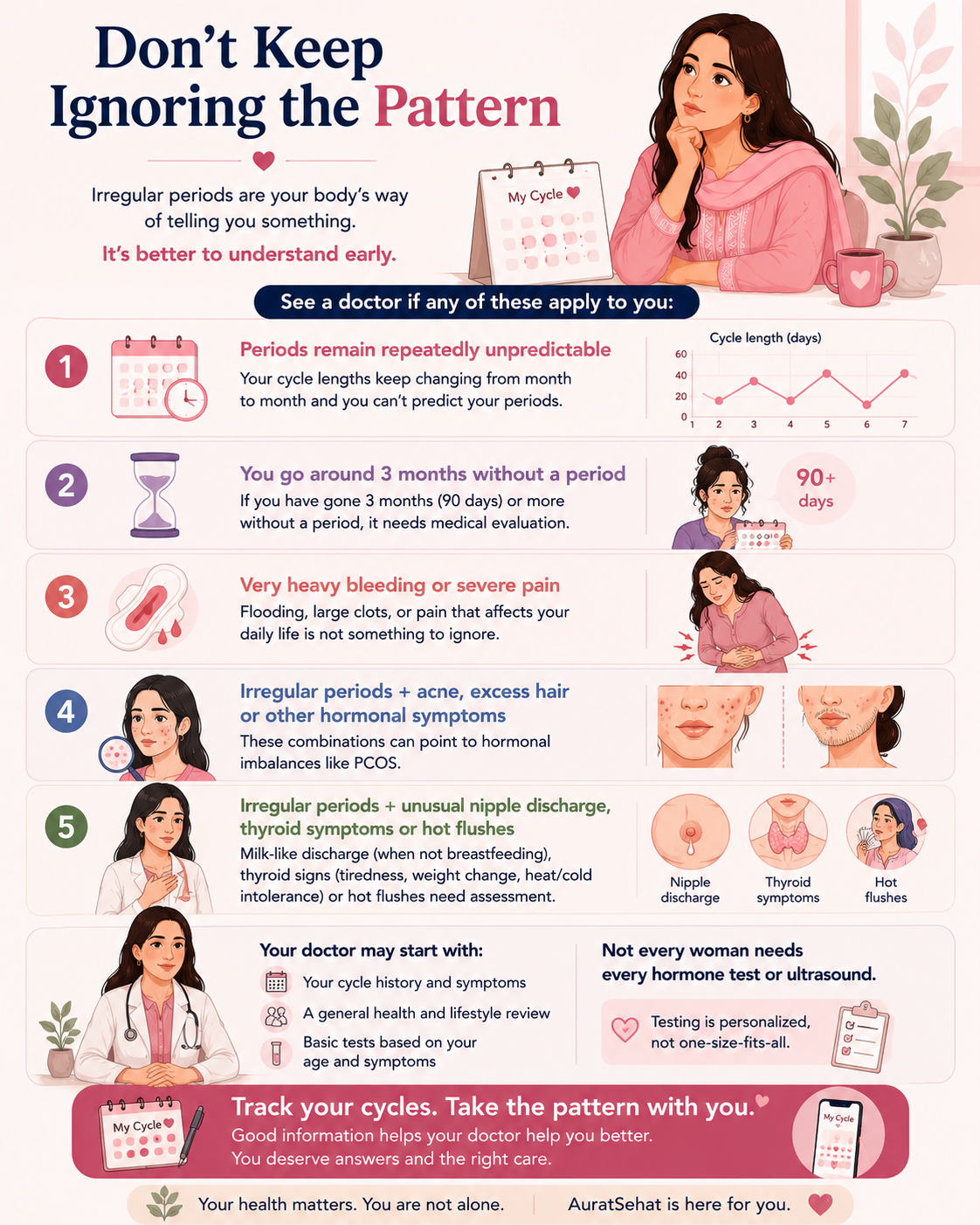
Arrange medical assessment if:
- Your periods remain repeatedly unpredictable over several cycles.
- You go around 3 months without a period and are not pregnant.
- Your bleeding becomes very heavy or prolonged.
- You develop severe or worsening pelvic/period pain.
- Irregular periods occur with significant acne or increased facial/body hair.
- You have unexpected milky nipple discharge.
- You develop symptoms suggesting thyroid disease.
- You have irregular/absent periods together with hot flushes before age 40.
- You are trying to become pregnant and your cycles make ovulation difficult to predict.
Frequently Asked Questions
Does one late period mean my periods are irregular?
Not necessarily. One cycle can be unusually late because of pregnancy, illness, stress, travel, hormonal changes or sometimes no obvious reason at all. We usually become more concerned about an irregular pattern when substantial unpredictability keeps happening across several cycles.
If your main problem is one period that has not arrived, read our Late or Missed Period guide.
What is the most common reason for irregular periods?
There is no single cause for every woman. PCOS is one of the most important and common causes of persistent irregular ovulation in reproductive-age women, but stress, sleep disruption, thyroid disease, major nutrition or weight changes, contraception, breastfeeding and life-stage changes can also affect cycle timing.
Do irregular periods always mean PCOS?
No. PCOS is important, especially when irregular periods occur with acne, increased facial/body hair or metabolic problems, but irregular periods have many other possible causes.
Can stress really make periods irregular?
Yes. Significant emotional or physical stress can affect the hormonal signals controlling ovulation. Poor sleep and major routine disruption may contribute as well. But persistent irregularity should not automatically be blamed on stress without considering other explanations.
How many months should I track before seeing a doctor?
You do not need to wait a fixed number of months if something is concerning. If cycles are repeatedly unpredictable, you are going long periods without menstruation, bleeding is very heavy, or you have other hormonal symptoms, medical advice can be useful earlier.
Can I get pregnant with irregular periods?
Yes. Irregular periods may mean ovulation is happening unpredictably rather than not happening at all. Pregnancy can therefore still occur, although identifying fertile days may be more difficult.
Do I need an ultrasound for irregular periods?
Not always. Ultrasound can be useful in selected situations, but an irregular cycle is not automatically an indication for scanning. Your doctor should decide whether imaging would help based on your history, symptoms and examination.
Should I take medicine to make my period come every month?
Do not repeatedly self-medicate simply to produce bleeding without understanding why your cycles are irregular. In some situations doctors prescribe hormonal treatment to regulate bleeding or protect the uterine lining, but the correct treatment depends on the cause and your individual circumstances.
The Takeaway
One late period and repeatedly irregular periods are not the same problem.
If your cycles keep becoming early, late, very long or occasionally absent, start by looking at the pattern. PCOS is an important cause, but stress and sleep disruption, thyroid disease, major changes in nutrition or weight, contraception, breastfeeding and other hormonal changes can also affect ovulation.
Track your cycle, notice any accompanying symptoms, and seek medical assessment when the pattern persists or something does not feel right.
Still Not Sure Why Your Periods Are Irregular?
If your cycle keeps changing and you are unsure whether PCOS, thyroid problems, stress, contraception or another cause could be involved, you can send your question to AuratSehat for general medical guidance.
Ask a Doctor for Free