
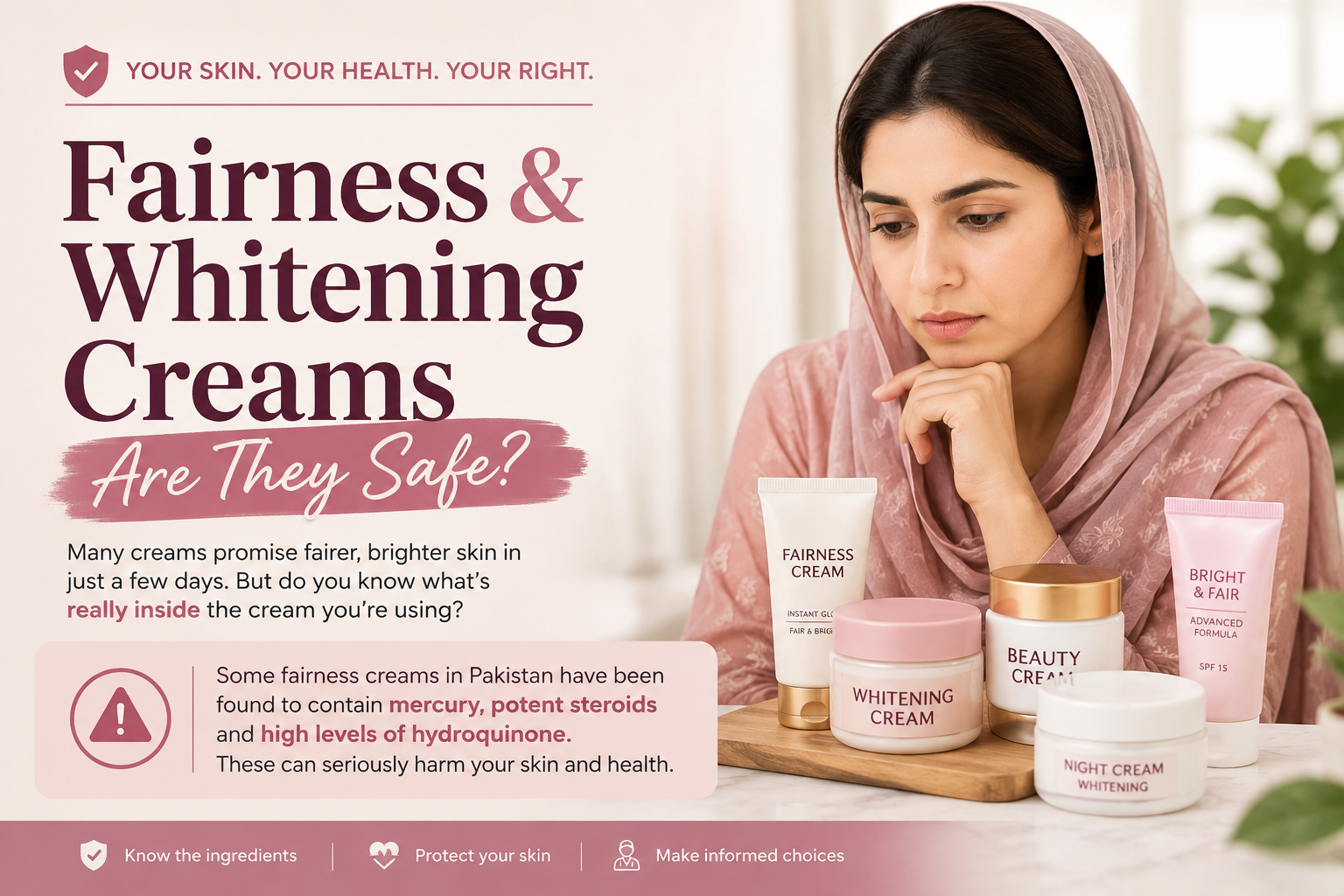
Fairness & Whitening Creams in Pakistan — Are They Safe?
A fairness cream that makes your skin lighter very quickly is not necessarily a good cream. Sometimes, the speed itself can be a warning sign.
Are fairness creams dangerous?
Not every product marketed for brighter or more even-looking skin is dangerous. Many ordinary skincare products contain well-known ingredients such as vitamin C, niacinamide or azelaic acid.
The concern is mainly with unclear, poorly regulated, unlabelled or unusually powerful whitening products, especially when you do not really know what is inside the cream or how strong the ingredients are.
If your main issue is tanning, melasma, acne marks or uneven pigmentation, it is usually better to treat the actual cause. See our Brightening & Pigmentation guide for safer treatment options.
Three ingredients you should know about
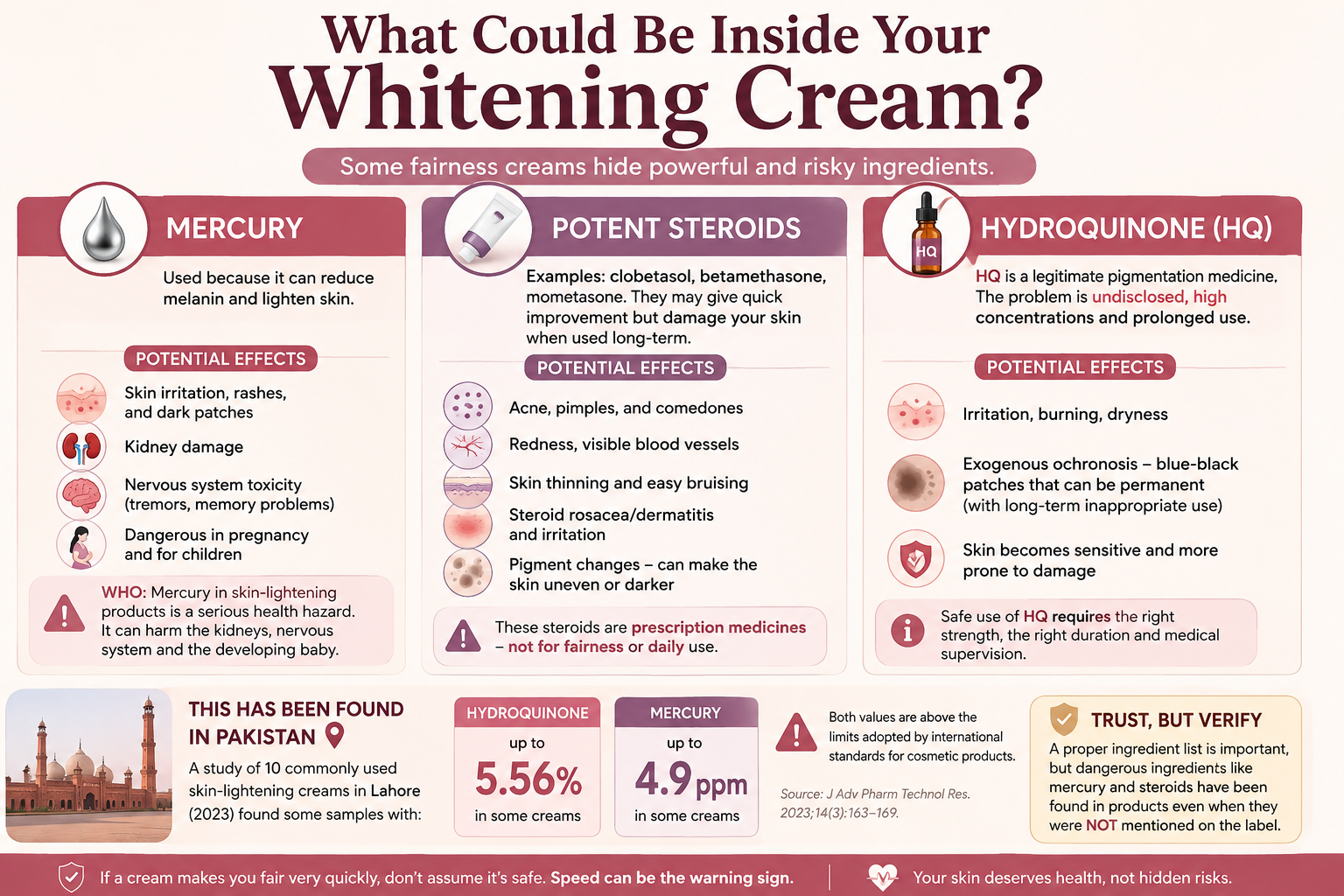
Mercury
Mercury can suppress melanin formation and make skin appear lighter. But exposure can cause skin irritation and discoloration and, with sufficient exposure, can affect the kidneys and nervous system.
Clobetasol, betamethasone, mometasone
Strong topical steroids may initially make skin look smoother or lighter, but prolonged inappropriate facial use can lead to acne, redness, visible blood vessels, skin thinning, steroid dermatitis and pigment changes.
Hydroquinone (HQ)
Hydroquinone is a legitimate pigmentation medicine. The concern is undisclosed, excessive or prolonged unsupervised use. Misuse can cause irritation and, in some cases, exogenous ochronosis — a difficult-to-treat blue-black discoloration.
This is not only a theoretical problem
Researchers studying 10 commonly used skin-lightening creams in Lahore found some products containing substantial amounts of hydroquinone and detectable mercury.
What the Lahore study found
The important point for consumers is simple: you cannot assume that every cream sold for whitening is a mild cosmetic product.
Is your fairness cream damaging your skin?
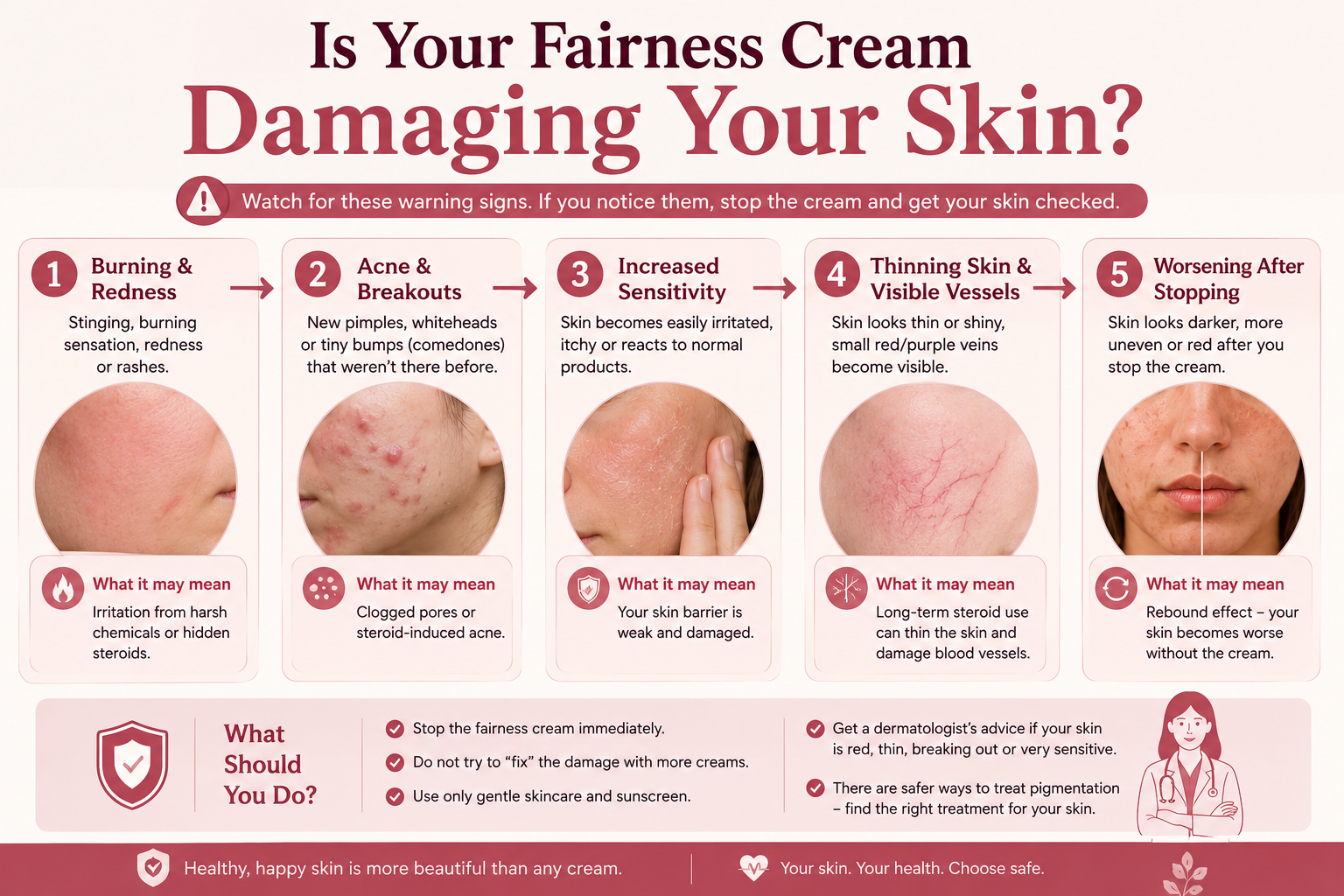
Pay attention if your skin starts changing in ways that go beyond simple brightening.
- burning, stinging or persistent redness;
- new acne, whiteheads or small bumps;
- skin becoming unusually sensitive;
- skin looking thin or shiny;
- small red or purple blood vessels becoming visible;
- skin becoming darker, redder or more uneven after stopping the cream.
Do not interpret damage as proof that the cream is “working.”
Burning, severe peeling, persistent redness or rapid changes in skin texture are reasons to question the product — not reasons to apply more.
If you are already using a questionable cream
Keep it simple.
- Avoid loose, unlabelled or homemade whitening mixtures.
- Do not deliberately use potent steroid creams as fairness products.
- Do not keep layering additional whitening creams onto irritated skin.
- Use gentle skincare and daily sunscreen.
- If your skin is red, thin, acne-prone or very sensitive, consider a dermatologist assessment.
If your concern is a specific pigmentation problem rather than your natural skin tone, targeted treatment is usually more sensible.
You can read our Glutathione for Skin Whitening guide if you are considering tablets or IV drips, or return to the Brightening & Pigmentation hub to find the correct treatment for melasma, acne marks, tanning or uneven pigmentation.