
Daily Skincare Routine — Keep It Simple
You do not need ten products, multiple serums or a complicated morning ritual to take good care of your skin. A useful daily routine starts with a few basics, then adds treatment only when your skin actually has a specific problem.

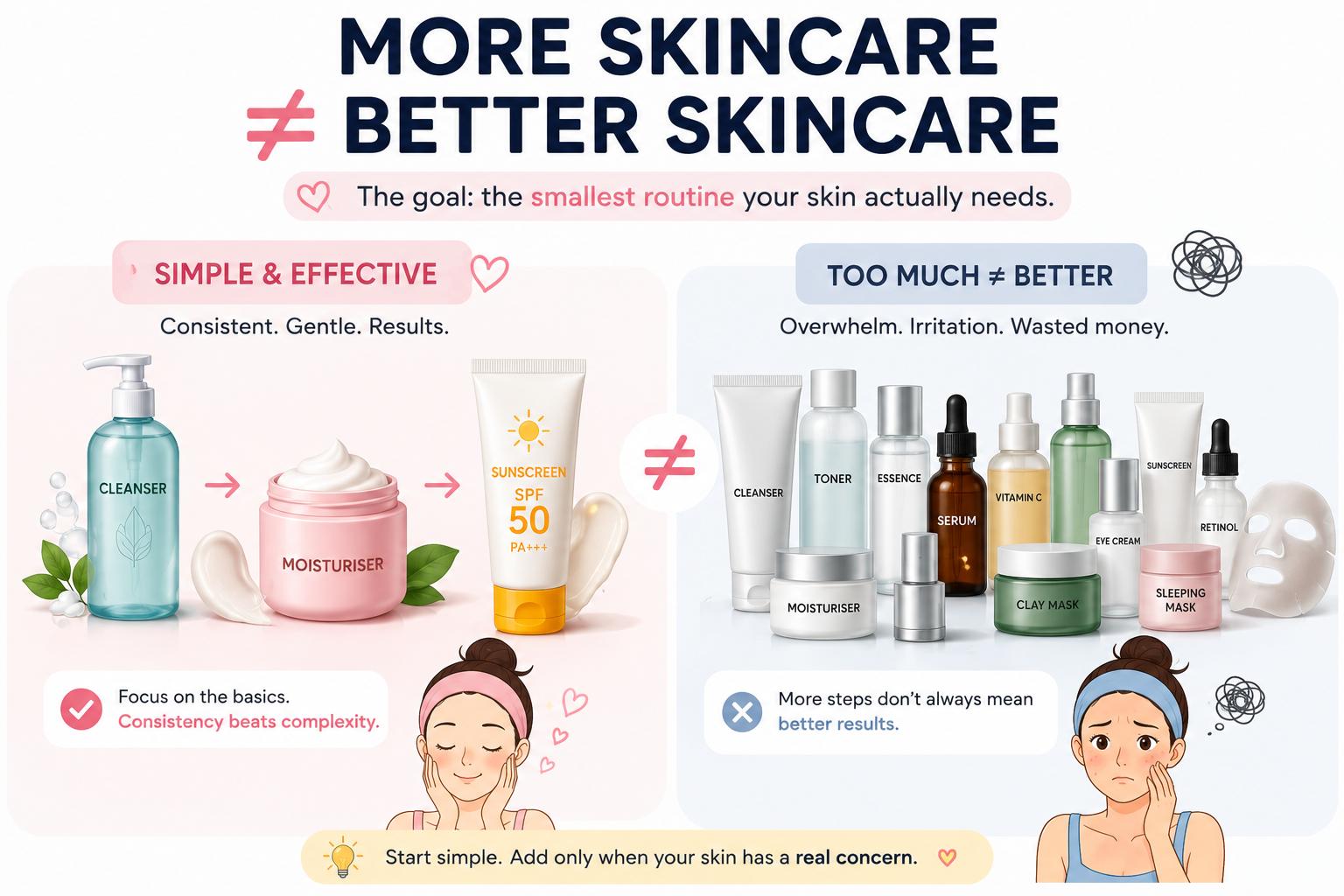
Your skin does not need a shelf full of products
Skincare can become confusing very quickly. One person tells you to use vitamin C. Another recommends niacinamide. Social media adds toner, essence, eye cream, exfoliating acids, sheet masks and retinol. Before long, a simple routine can feel like a chemistry project.
For most beginners, the foundation is much simpler: cleanse, moisturise and protect from the sun. Everything beyond that should have a reason.
The AuratSehat approach: build the smallest routine your skin actually needs. If you later identify a real concern such as acne, pigmentation or excessive oiliness, add targeted treatment rather than adding products randomly.
The Daily 3
Simple enough to follow consistently.
1. Cleanse
Remove sweat, excess oil, dirt, makeup and sunscreen without aggressively stripping the skin.2. Moisturise
Support the skin barrier with a texture that feels comfortable for your skin type and climate.3. Protect
Use sunscreen during the day to reduce UV-related skin damage, tanning and worsening pigmentation.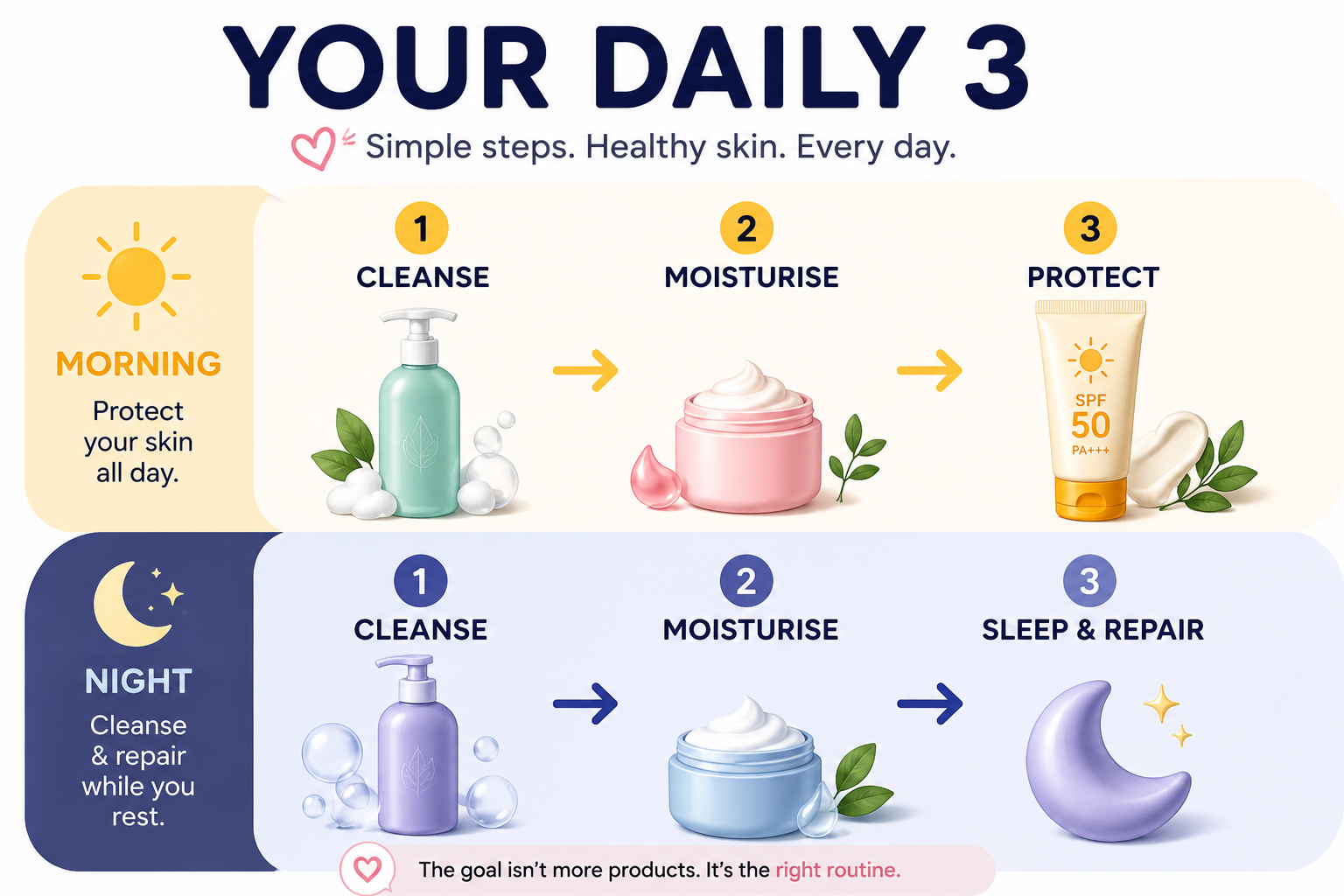
What should I actually do every day?
Think of morning skincare as preparation and protection, while your evening routine is mainly about removing the day from your skin and supporting it overnight.
Morning
If your face feels comfortable when you wake up, some people do not need an aggressive morning cleanse. A gentle wash — or sometimes simply rinsing — may be enough depending on your skin and what you applied the night before.
Moisturiser can then be adjusted to your skin. Dry skin may need a richer layer, while very oily skin may prefer a light gel or gel-cream. If your sunscreen already feels sufficiently moisturising, you may not always need a separate heavy moisturiser underneath.
Night
At night, cleansing becomes more useful because sunscreen, makeup, sweat, oil and environmental residue may have accumulated during the day.
If you use an acne or pigmentation treatment, this is often where it fits into the routine. But a treatment step is not compulsory. Someone with comfortable, healthy skin and no specific concern may simply cleanse and moisturise.
First ask: what does my skin actually feel like?
Product labels can be confusing, but your own skin gives useful clues. You do not need to diagnose yourself perfectly. Start by noticing how your face behaves when you are not constantly changing products.
Oily skin
Your face becomes noticeably shiny or greasy, often within a few hours. Pores and blackheads may also appear more noticeable.
Dry skin
Skin may feel tight, rough or flaky, particularly after washing or during cooler and drier weather.
Combination skin
Some areas — often the forehead, nose and chin — become oily while the cheeks remain normal or dry.
Sensitive or reactive skin
Products may frequently sting, burn or trigger redness and irritation. In this situation, simplicity becomes especially important.
Skin type and skin concern are different. You can have oily skin with pigmentation, dry skin with acne, or sensitive skin that also develops breakouts. Treat the concern without forgetting the needs of the underlying skin.
How to choose the three basics
Choose a cleanser that leaves your skin comfortable
The purpose of cleansing is to remove material sitting on the skin — not to make your face feel painfully tight or “squeaky clean.”
If your skin feels dry, stretched or irritated immediately after washing, the cleanser may be too harsh, you may be cleansing too frequently, or your overall routine may already be irritating the skin barrier.
Oily skin does not necessarily need the strongest foaming cleanser available. Removing too much surface oil does not permanently stop the sebaceous glands from producing oil.
Choose moisturiser by texture, not marketing
A moisturiser does not need to feel thick to be useful. Different textures suit different people and different weather.
Gel and gel-cream textures may feel more comfortable on oily skin or in humid weather, while lotions and creams may suit skin that feels dry, tight or flaky.
Someone with combination skin may even use a lighter amount on the T-zone and more on drier areas rather than forcing the whole face into one category.
Make sunscreen your daytime protection step
Sun protection matters not only for long-term UV damage but also for concerns common in South Asian skin, including tanning, melasma and post-inflammatory dark marks.
For everyday use, look for a broad-spectrum sunscreen of at least SPF 30. The best formula is one you can apply comfortably and consistently.
If sunscreen makes your face greasy, do not assume sunscreen itself is the problem. You may simply need a lighter fluid, gel or dry-touch formulation. If it leaves a grey or white cast on brown skin, look for formulas designed to blend more transparently or an appropriately matched tinted option.
Want to understand tanning, uneven tone or dark marks in more detail? Visit the Brightening & Pigmentation Hub .
Do I need to double cleanse?
Not everyone needs two cleansers every night.
Double cleansing can be useful when you are wearing significant makeup, heavy or water-resistant sunscreen, or products that are difficult to remove with your usual cleanser. An oil cleanser, cleansing balm or micellar product may be used first, followed by a gentle water-based cleanser.
But if one gentle cleanser removes your sunscreen and makeup comfortably, there is no prize for adding another step.
Do you actually need a serum?
Sometimes. But a serum is not a compulsory category of skincare. Think of active ingredients as tools for specific problems.
Acne or clogged pores
Ingredients such as salicylic acid or specific acne medicines may be useful when chosen for the right type of acne.
Dark marks or pigmentation
Ingredients such as azelaic acid, vitamin C, niacinamide or other targeted pigmentation treatments may have a role depending on the problem.
No specific skin concern
If your skin is healthy and comfortable, you do not need to invent a problem just so that you can use a serum.
If your main concern is pigmentation, do not keep rotating through random “brightening” products. Start by identifying what you are treating through the AuratSehat Brightening & Pigmentation section .
What about toner, essence, eye cream and all the extra steps?
They can be pleasant or useful for some people, but they are not requirements for healthy skin.
The functional foundation
Cleanser + moisturiser + sunscreen. These are the core categories around which a basic routine can be built.
Toner
Optional. Some toners hydrate or deliver active ingredients, but your skin does not biologically require a toner simply because social media routines include one.
Essence
Optional. It can add hydration or specific ingredients, but it is not a compulsory step between toner and serum.
Eye cream
Often optional. Some people enjoy a dedicated eye product, but many ordinary moisturisers can be used carefully around the eye area if they are well tolerated and suitable for that purpose.
Face mist, sheet mask or sleeping mask
These may feel refreshing or temporarily hydrating, but they do not automatically make a routine medically better.
Which skincare product goes first?
Do not make layering more complicated than it needs to be.
Simple morning order
Simple night order
Exact layering can vary according to the medicine or formulation you are using. If a dermatologist has prescribed a treatment, follow the instructions for that product rather than forcing it into a generic social-media layering rule.
Do not start everything at once
Salicylic acid, glycolic acid, vitamin C, niacinamide, azelaic acid and retinoids can all be useful in appropriate situations. The mistake is assuming that useful ingredients become even better when you start several of them together.
If you develop burning, persistent stinging, redness, unusual sensitivity or worsening dryness after adding several new products, simplify the routine and consider whether irritation is driving the problem.
Pregnancy note: retinoids require special pregnancy considerations and should not simply be started as an ordinary cosmetic anti-ageing step during pregnancy. If you are pregnant, trying to conceive, or unsure about a medicine, ask a qualified healthcare professional.
Your routine may need to change with the weather
The product that feels perfect in one city or season may feel too heavy or too light somewhere else. Your skin can change with humidity, heat, air-conditioning and winter dryness.
☀️ Hot or humid weather
Heavy creams may feel sticky, makeup can break down faster and sunscreen may feel greasy. Lighter gels, fluids and gel-creams can be easier to tolerate.
❄️ Cooler or drier weather
Skin that normally feels oily may become tighter or flaky. You may need a gentler cleanser, a more supportive moisturiser or simply more moisturiser than you use during summer.
Do not become trapped by a permanent label such as “I have oily skin, so I can never use cream.” Choose according to how your skin behaves now.
Skincare habits that can make things harder
Physical irritation does not scrub acne, pigmentation or pores out of the skin.
Constant switching makes it difficult to know what is helping or irritating you.
More exfoliation can mean more irritation, not faster results.
DIY ingredients can irritate the skin and may worsen inflammation or pigmentation.
Try a different texture rather than abandoning sun protection completely.
A well-formulated affordable product can suit your skin better than a fashionable imported one.
What is your main skin concern?
Daily Face Care gives you the foundation. If something specific is bothering you, continue into the AuratSehat guide that matches the problem.
Consider medical advice when the problem is persistent
Skincare is useful, but not every skin condition should be managed by buying another cosmetic product.
Consider professional assessment if you have persistent or painful acne, significant scarring, a spreading or unexplained rash, repeated swelling, severe irritation, sudden major skin changes, pigmentation that is difficult to identify, or a problem that keeps worsening despite sensible care.
If acne is your main concern, start with the AuratSehat Acne Hub rather than trying random acne products.
Your routine does not need to impress anyone
Good skincare is not measured by how many bottles are on your shelf. Start with gentle cleansing, enough moisturising for your skin, and consistent sun protection. Add something else only when you can answer one question: What exactly am I trying to treat?
Still not sure what your skin needs?
If you have persistent acne, irritation, pigmentation or another skin concern and are unsure where to start, you can send your question to AuratSehat for general medical guidance.
Ask a Doctor for Free