
Damaged Skin Barrier — Signs, Causes & How to Repair It
Does your face suddenly sting when you apply products that never bothered you before? Does it feel tight after washing, look flaky or red, or somehow feel oily and dehydrated at the same time? Your skin barrier may be irritated.
The simple answer:
An irritated skin barrier usually does not need a complicated “repair routine.” It often needs fewer irritating products, gentle cleansing, proper moisturization, daily sun protection and time to recover.
The phrase “damaged skin barrier” is everywhere in skincare now. Ceramide creams, barrier serums, recovery ampoules and “skin rescue kits” are heavily marketed, including in Pakistan.
But before buying another product, it helps to understand what the skin barrier actually is, why it becomes disrupted and what genuinely supports recovery.
If your skin has always been easily reactive rather than suddenly becoming irritated, first read our guide to Sensitive Skin Explained.
What Is the Skin Barrier?
The outermost layer of your skin is called the stratum corneum. It acts as an important protective barrier between your body and the outside environment.
A useful way to picture it is as a brick wall.
The lipids between the skin cells include substances such as ceramides, cholesterol and fatty acids. Together, this structure helps keep water inside the skin while limiting penetration of irritants and environmental substances.
When this barrier becomes disrupted, the skin can lose water more easily. This is commonly described as increased transepidermal water loss, or TEWL.
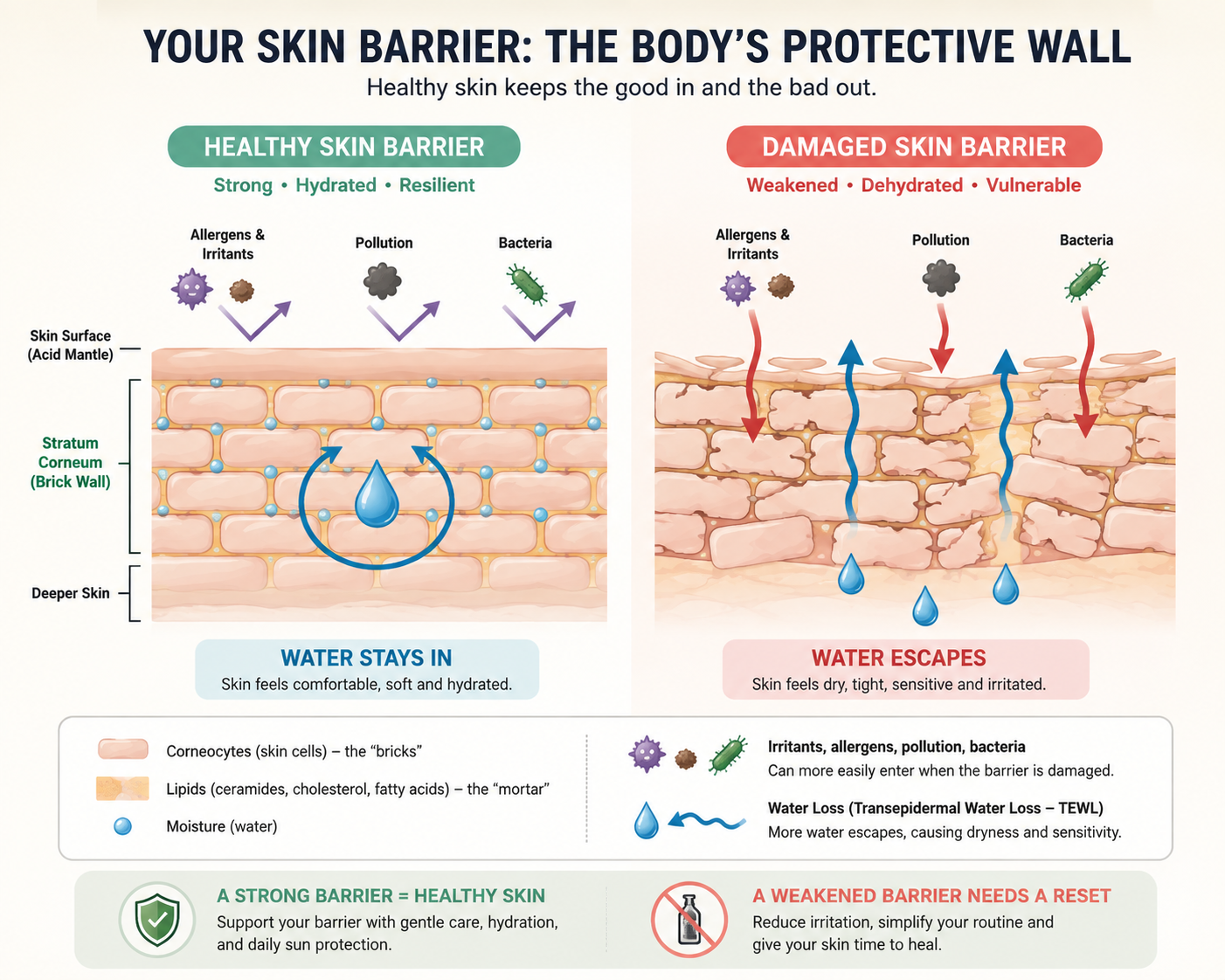
This helps explain why damaged or irritated skin may become dry, tight, burning, flaky or unusually sensitive.
How Do I Know If My Skin Barrier Is Damaged?
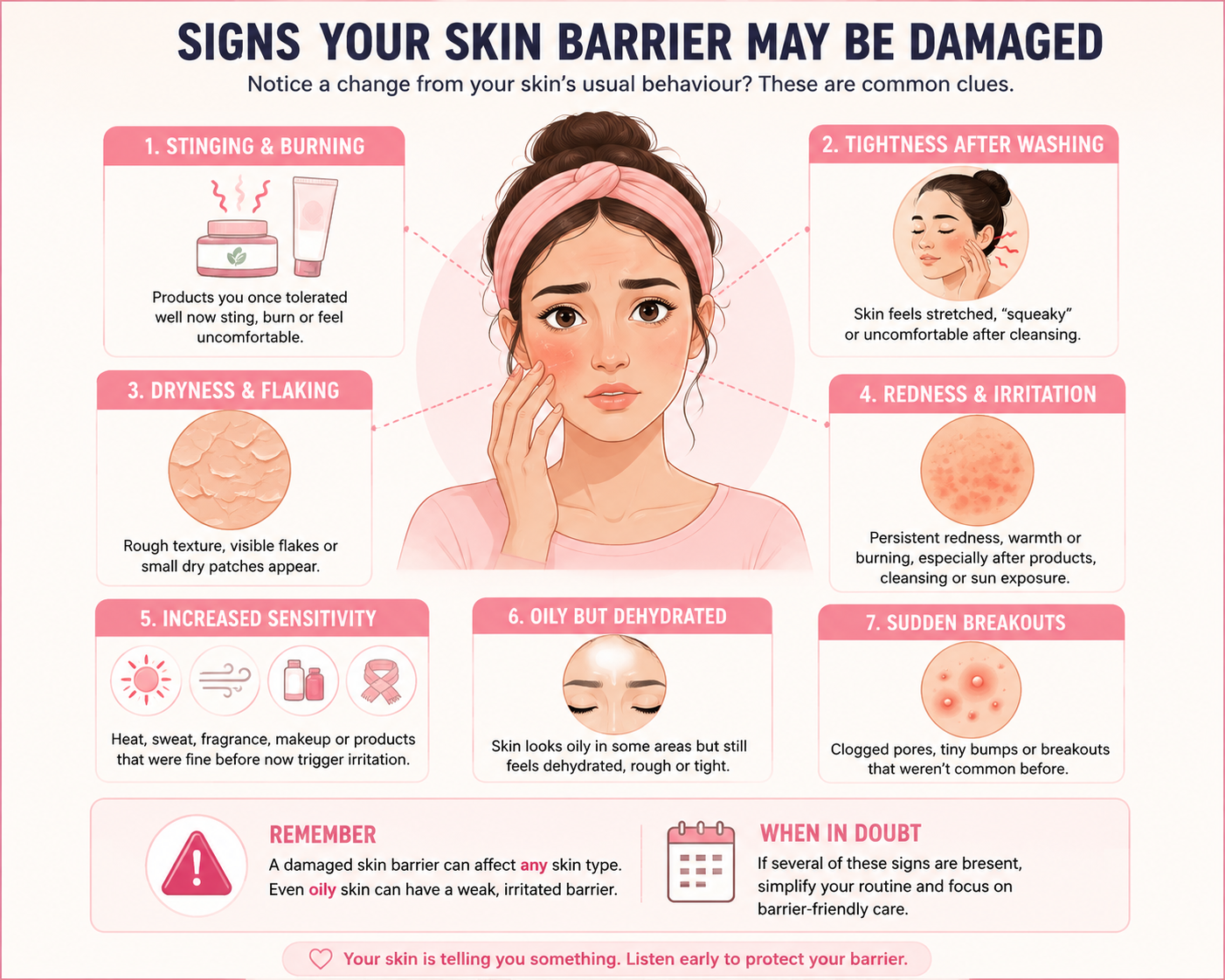
There is no simple home test that proves your barrier is damaged. What matters more is noticing a change from your skin’s normal behaviour.
Products suddenly sting
Moisturizer, sunscreen or serums that previously felt comfortable may suddenly burn or sting when applied.
Tightness after washing
Your face may feel stretched, dry or “squeaky clean” immediately after cleansing.
Dryness & flaking
You may notice rough texture, small flakes or patches that seem unusually dehydrated.
Redness or burning
Heat, cleansing, skincare or sun exposure may suddenly trigger visible redness or discomfort.
Can Oily Skin Have a Damaged Barrier?
Yes.
One of the most common misconceptions is:
Oiliness does not automatically mean that your skin barrier is healthy.
Sebum production and hydration of the outer skin layer are not the same thing. Skin can produce plenty of oil while still feeling dehydrated, irritated or tight.
This can create a frustrating cycle:
If oiliness is your main concern, our Oily Skin Explained guide can help you understand why your face produces excess oil without automatically stripping it harder.
What Damages the Skin Barrier?
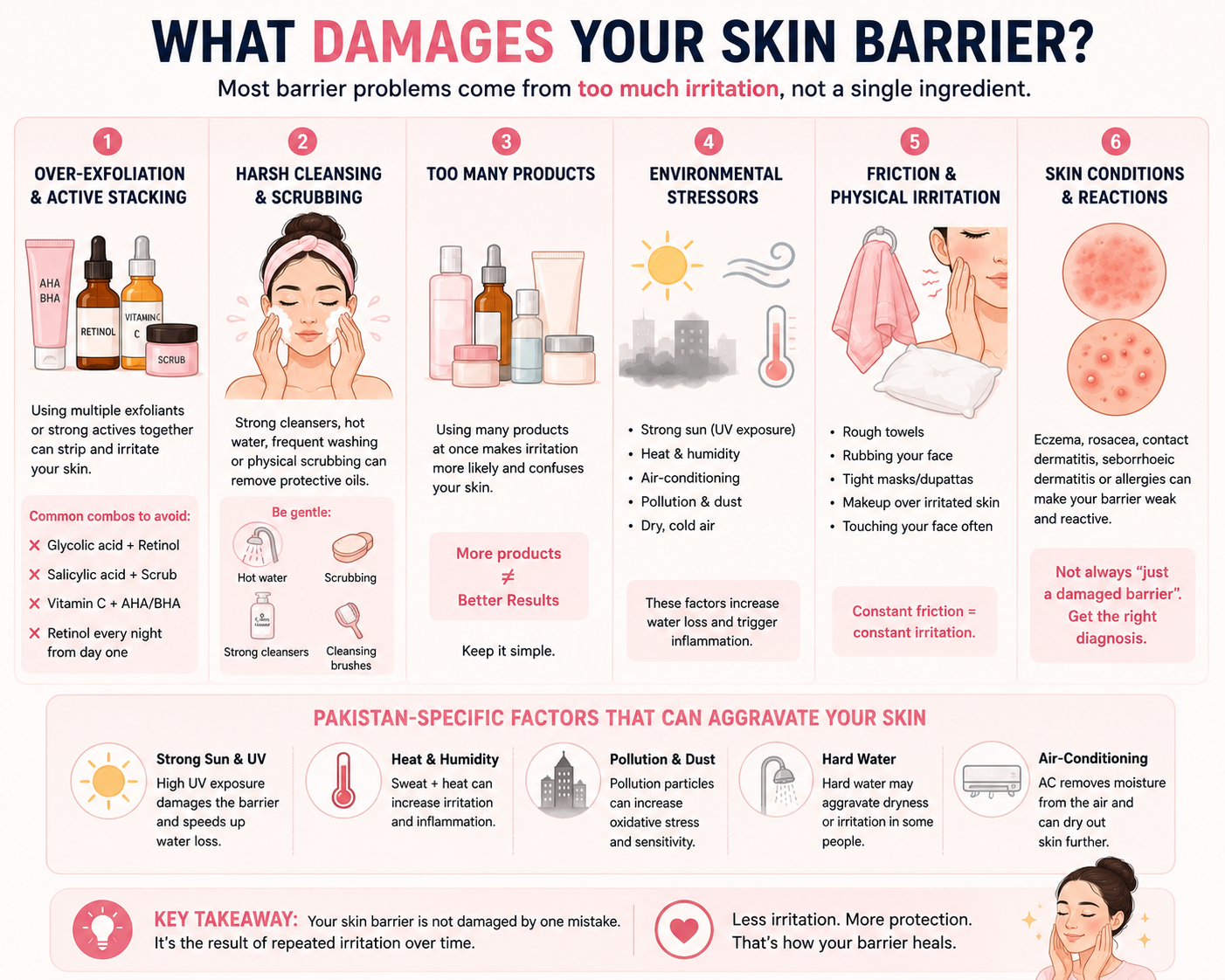
Usually there is not one dramatic event. Barrier irritation is often the result of repeated stress over time.
1. Over-exfoliation & active stacking
This is one of the easiest ways to irritate the skin.
For example:
Each ingredient may have a legitimate purpose. The problem is that your skin may not tolerate all of them together.
2. Starting strong actives too quickly
Retinoids, AHAs, BHAs and acne treatments can all be useful. But starting several at once—or immediately using them every day—can cause significant irritation.
3. Harsh cleansing
Frequent washing, very strong cleansers, hot water and repeated scrubbing can aggravate already-sensitive skin.
Your skin does not need to feel “squeaky clean” for your cleanser to have worked.
4. Too many products
Sometimes no single product is disastrous. The routine itself is simply overloaded.
If your morning and night routine contain multiple serums, acids, toners, masks and treatment products, it becomes difficult to know what is helping and what is irritating you.
5. Friction & physical irritation
Rough towels, scrubs, cleansing brushes, repeated rubbing, scratching and tight face coverings can all aggravate already-irritated skin.
Skin Barrier Problems in Pakistan
Pakistani skin is not biologically different in some special way, but our environment and skincare habits can change how irritation shows up.
Strong sun & heat
High UV exposure and heat can worsen redness, inflammation and pigmentation, especially when the skin is already irritated.
Pollution & dust
Urban environmental exposure can contribute to oxidative stress and irritation, particularly in already-sensitive skin.
Air-conditioning
Long periods in dry, air-conditioned environments may make some people feel drier or tighter.
Hard water
Hard water may aggravate dryness or irritation in some individuals, but it should not automatically be blamed for every skin-barrier problem.
In practice, however, one of the biggest preventable problems is often much simpler: too many skincare actives used at the same time.
How to Repair an Irritated Skin Barrier
The first step is often not to add another treatment.
It is to remove unnecessary irritation.
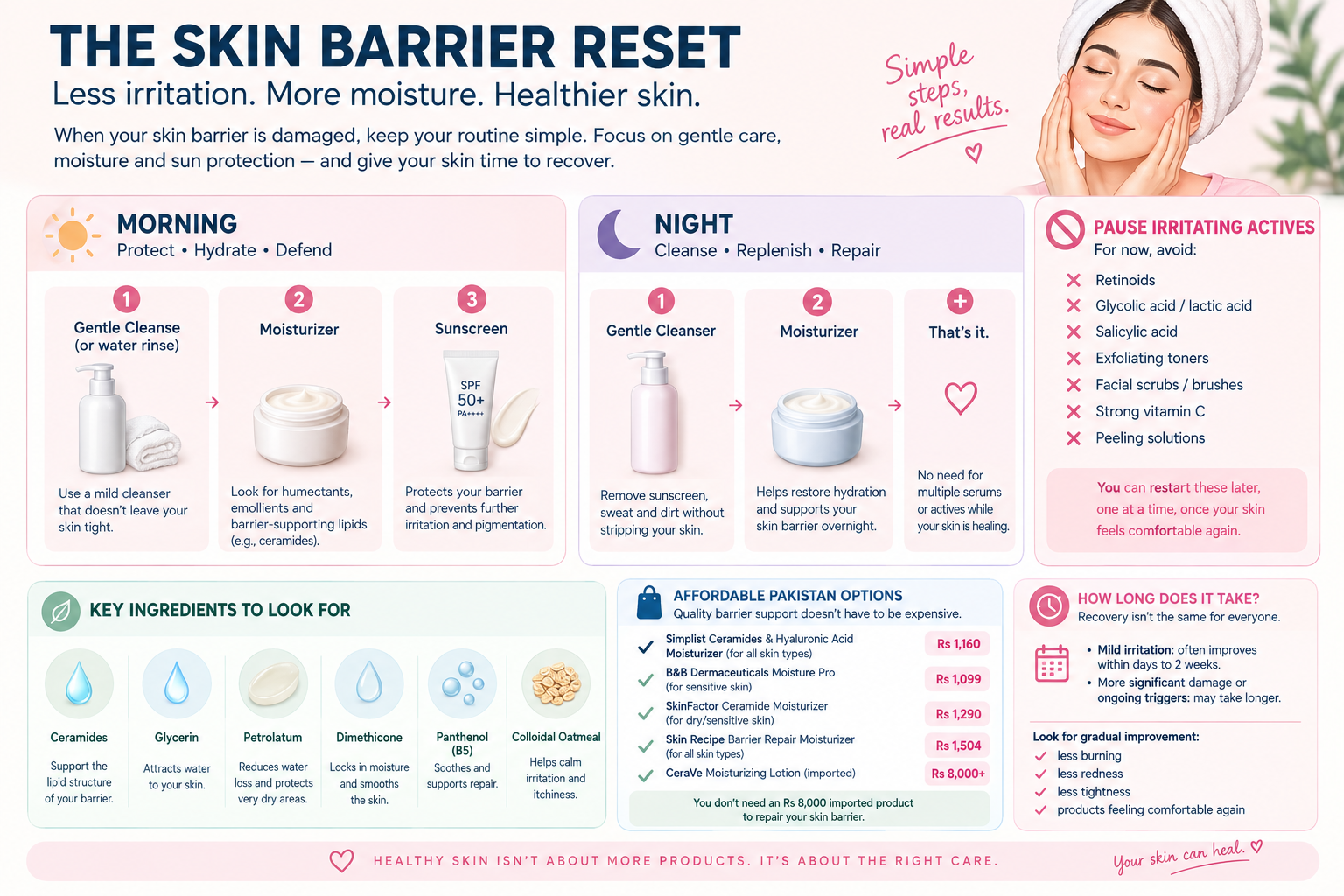
Pause irritating actives
If your face is burning, peeling or significantly irritated, temporarily stop products such as:
- retinoids
- glycolic acid
- lactic acid
- salicylic acid
- exfoliating toners
- facial scrubs
- peeling solutions
- strong vitamin C formulations if they sting
This does not mean these ingredients are “bad.” It means irritated skin may need a break.
Cleanse gently
Choose a mild cleanser that removes sunscreen, sweat and dirt without leaving your face extremely tight.
If your skin is very dry or reactive, some people can simply rinse with water in the morning and cleanse properly at night.
Moisturize properly
A good moisturizer helps improve hydration and reduce water loss. You do not necessarily need several “barrier serums” underneath it.
Protect your skin from the sun
UV exposure can worsen inflammation and pigmentation. Continue using a sunscreen your skin can comfortably tolerate.
The Simple Barrier Reset Routine
Morning
1. Gentle cleanse or water rinse
↓
2. Moisturizer
↓
3. Sunscreen
Night
1. Gentle cleanser
↓
2. Moisturizer
↓
Stop there.
If irritation appears related to over-treatment, a temporary simplified routine for roughly one to two weeks can be a useful period of reassessment.
This is not a promise that every damaged barrier heals in 14 days. Mild irritation may improve quickly, while dermatitis or more significant inflammation can take much longer.
Ingredients That Can Support the Skin Barrier
You do not need every ingredient below in one product. Instead, understand what different parts of a moisturizer do.
Humectants
Help attract water into the outer skin.
Examples: glycerin, hyaluronic acid, urea.
Emollients
Help smooth and soften the spaces between skin cells.
Examples: fatty alcohols, squalane and various oils.
Occlusives
Help reduce water loss from the skin.
Examples: petrolatum and dimethicone.
Barrier lipids
Ceramides, cholesterol and fatty acids are natural components of the stratum corneum.
Ceramides
Ceramides are naturally present in the skin barrier and are commonly included in moisturizers marketed for dry or sensitive skin.
They can be useful—but do not choose a moisturizer simply because the bottle has the largest ceramide percentage written on the front.
Glycerin
Glycerin is one of the most established humectants used in skincare. It helps increase hydration in the outer skin.
Petrolatum
Petrolatum is an effective occlusive that helps reduce water loss. A thin layer over moisturizer can be helpful on particularly dry or flaky areas.
Dimethicone
Dimethicone is a silicone-based ingredient commonly used in moisturizers to help reduce water loss and improve skin feel.
Panthenol
Panthenol, also called provitamin B5, is frequently included in soothing and moisturizing formulations.
Colloidal oatmeal
Colloidal oatmeal can be useful in formulations designed for dry, itchy or eczema-prone skin.
What About Niacinamide?
Niacinamide can support normal skin-barrier function and is included in many moisturizers.
But this is where skincare advice often becomes too simplistic.
A well-formulated moisturizer containing niacinamide may be enough, and some people find high-strength niacinamide serums irritating.
Affordable Barrier-Friendly Moisturizers in Pakistan
Pakistan now has many local moisturizers marketed around ceramides, hydration and barrier support.
You do not need to buy the most expensive imported moisturizer to care for your skin. Look at the whole formulation, texture, ingredients and how your skin tolerates it.
Prices in Pakistan change frequently and can vary by seller, city and availability. Product inclusion here is for formulation education, not because everyone needs to buy one.
Barrier-Repair Marketing: What You Do Not Need
Not necessarily. A label such as “10% ceramide complex” may refer to a blend or raw-material complex rather than 10% pure ceramides. Percentages are also not automatically comparable between different formulations.
Price and country of manufacture do not determine whether a formulation suits your skin. A well-formulated affordable moisturizer can be perfectly reasonable.
You usually do not. If your skin is irritated, adding more layers can make it harder to identify the actual trigger.
A moisturizer does not need the word “BARRIER” printed across the bottle to moisturize your skin properly.
Should You Use Vaseline on a Damaged Skin Barrier?
Plain petrolatum can help reduce water loss and protect very dry areas.
You can apply a thin layer over moisturizer, particularly on dry patches.
You do not necessarily need to cover your entire face in a thick layer. If you are acne-prone, dislike heavy textures or live in hot and humid weather, targeted application may be more comfortable.
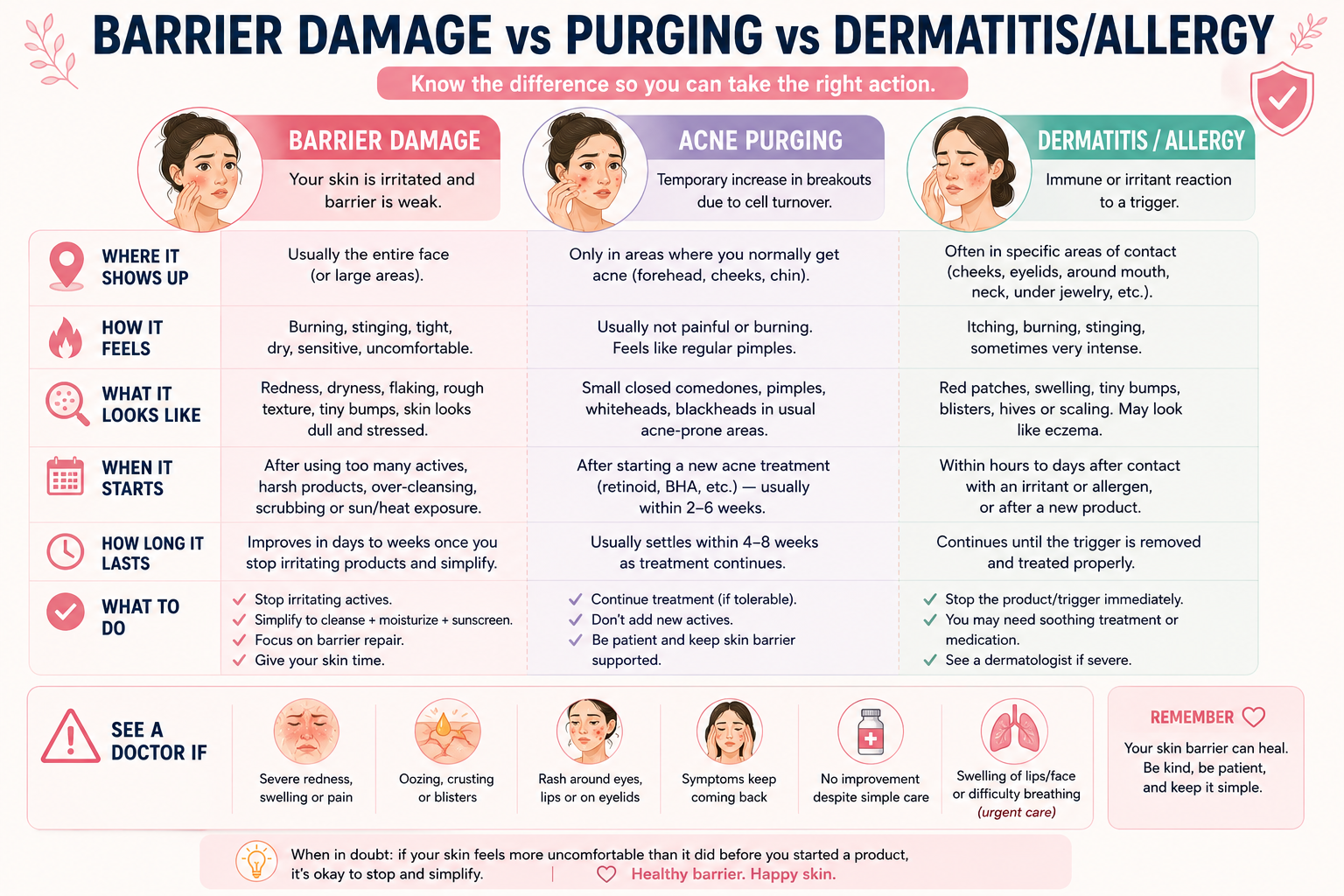
Damaged Skin Barrier or Purging?
These are frequently confused.
Barrier irritation
More likely to cause:
- burning
- stinging
- tightness
- redness
- flaking
- tenderness
Purging
Usually refers to a temporary increase in acne after starting certain treatments that increase skin-cell turnover.
It generally appears in areas where you already tend to develop acne.
If your entire face feels raw after starting several new active ingredients, repeatedly calling it “purging” and continuing aggressively can make irritation worse.
For help with acne treatment choices, visit our Acne Hub.
Sometimes It Is Not “Just a Damaged Barrier”
Persistent redness, burning, itching or scaling can sometimes be caused by an actual skin condition.
Possibilities include:
- irritant contact dermatitis
- allergic contact dermatitis
- eczema
- rosacea
- seborrhoeic dermatitis
- other inflammatory skin conditions
This distinction matters because persistent dermatitis may require proper diagnosis and medical treatment—not just another moisturizer.
How Long Does a Damaged Skin Barrier Take to Heal?
There is no universal number.
Mild irritation may begin improving within days to a couple of weeks once the trigger is removed.
More significant dermatitis, repeated exposure to an irritant or an underlying skin condition may take much longer.
Signs of improvement include:
- less burning
- less redness
- less tightness
- less flaking
- your usual moisturizer becoming comfortable again
When Can You Restart Retinol, Acids or Vitamin C?
Do not restart products simply because a certain number of days has passed.
Wait until your skin is again:
- comfortable after cleansing
- no longer significantly peeling
- not persistently red
- able to tolerate moisturizer without burning
Then reintroduce one active at a time.
If you’re unsure how to rebuild your daily routine, see our Best Skincare Routine for Sensitive Skin .
What Not to Do While Your Skin Is Recovering
- Do not scrub away flakes.
- Do not keep exfoliating because you think the roughness is “dead skin.”
- Do not add several new soothing products at once.
- Do not use lemon or baking soda DIY remedies.
- Do not repeatedly increase retinoid strength.
- Do not combine multiple exfoliating acids while your skin is irritated.
When your skin is burning, this is not the time for a skincare challenge.
When Should You See a Dermatologist?
Seek medical assessment if you develop:
- severe or persistent redness
- significant swelling
- intense itching
- oozing or crusting
- painful cracks
- blistering
- rash around the eyes
- symptoms that repeatedly return
- no improvement despite simplifying your routine
Sudden swelling of the lips or face, wheezing, throat tightness or difficulty breathing requires urgent medical attention.
The Bottom Line
An irritated skin barrier does not usually need an elaborate rescue routine.
Ceramides, glycerin, petrolatum, dimethicone, panthenol and similar ingredients can all be useful.
But the goal is not to collect every ingredient marketed for “barrier repair.”
The real goal is simpler: reduce irritation, maintain moisture and allow your skin to recover.
Written by Dr Melina
Reviewed by Dr Sadia — Dermatologist
Still Unsure What Is Irritating Your Skin?
If your skin is persistently red, burning, itchy or reacting to products, professional evaluation can help distinguish simple irritation from dermatitis, eczema, rosacea or another skin condition.
Ask a Doctor for Free