
Best Skincare Routine for Sensitive Skin
Sensitive skin usually does not need more products. It needs fewer unnecessary triggers, the right textures and a routine you can actually tolerate consistently. Before buying another serum, learn what your cleanser, moisturiser and sunscreen are supposed to do.
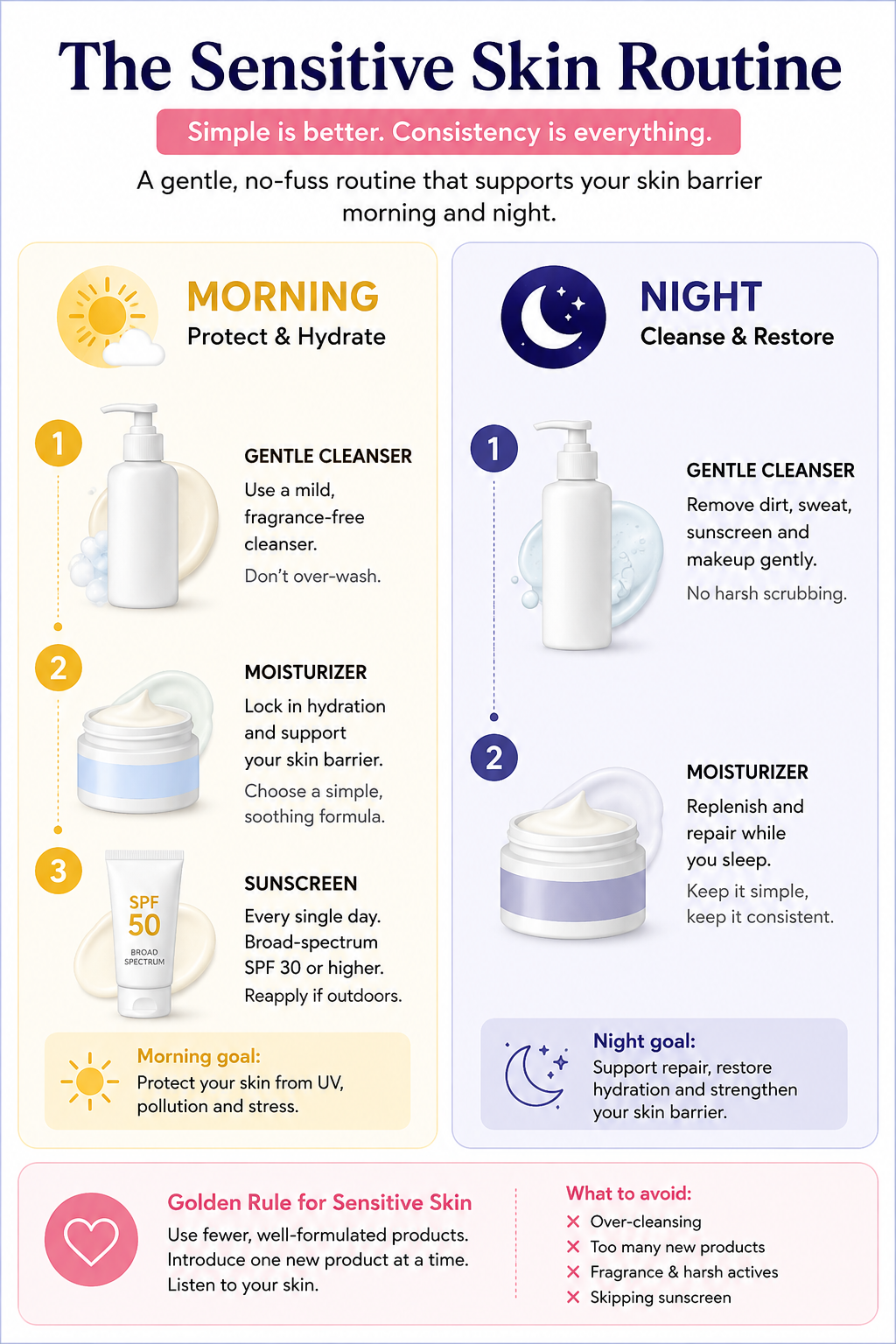
The Routine Can Be Surprisingly Simple
For many people with sensitive skin, the basic routine is:
Morning
Night
Your irritated face may have other plans.
Toner, essence, facial oil, eye cream, sleeping mask and three separate serums are not mandatory steps for sensitive skin. Add a targeted treatment only when there is a clear reason for it.
First, Learn What Your Cleanser Is Supposed to Do
A cleanser has a fairly ordinary job: remove sweat, excess oil, dirt, sunscreen and makeup. It does not need to make your face feel squeaky clean.
For sensitive skin, look for a cleanser that removes what needs to come off without leaving your face tight, hot, itchy or uncomfortable afterwards.
- Choose fragrance-free products when possible.
- Look for a mild formulation rather than chasing words such as “deep cleansing.”
- Creamy or lotion cleansers can suit dry sensitive skin.
- A mild gel cleanser may feel better on oily sensitive skin.
- Avoid aggressively scrubbing your face or repeatedly cleansing without a reason.
If your face feels stretched or uncomfortable immediately after washing, your cleanser may be too stripping for you.
Also, do not treat “sulfate-free” as a magic quality stamp. How irritating a cleanser feels depends on the entire formulation, the surfactant system, how often you use it and your individual skin.
Then Learn Your Moisturiser
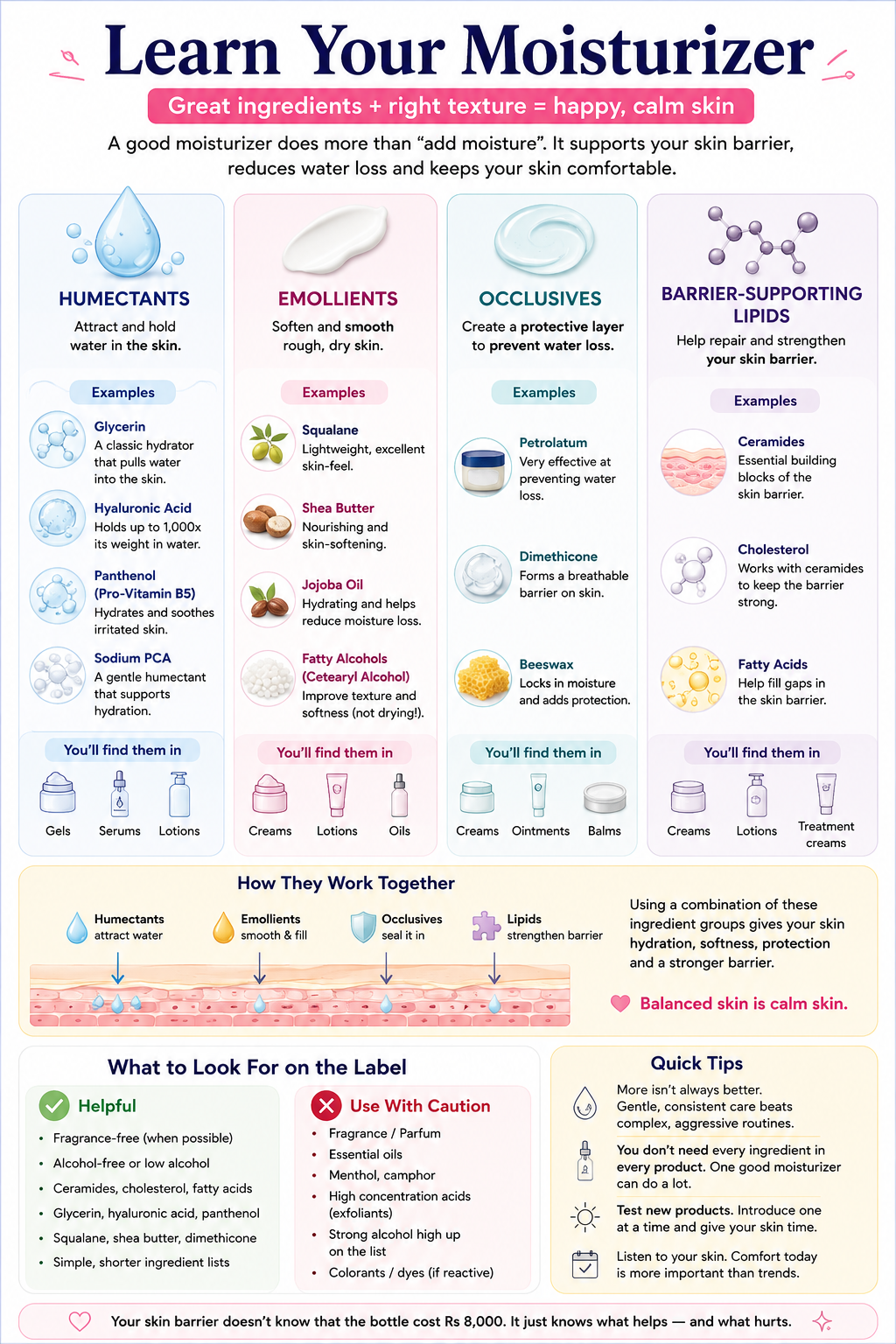
A moisturiser is not just “cream in a jar.” Different ingredients perform different jobs. Once you understand those jobs, product labels become much easier to evaluate.
Humectants
Help attract and hold water.
Examples: glycerin, hyaluronic acid, panthenol.
Emollients
Help smooth and soften dry or rough skin.
Examples: fatty alcohols, squalane and various oils or lipids.
Occlusives
Reduce water loss by forming a protective layer.
Examples: petrolatum and dimethicone.
Skin Lipids
Can support a dry or compromised skin barrier.
Examples: ceramides, cholesterol and fatty acids.
You do not need all of these ingredients listed prominently on the front of the bottle. A good moisturiser often combines several functions within one formulation.
Sensitive skin does not automatically mean your moisturiser must contain ceramides. What matters is whether the complete product keeps your skin comfortable and supports your needs.
What About Niacinamide?
Niacinamide is everywhere in modern skincare. It can support skin-barrier function and may be useful in many formulations, but more is not automatically better.
If your cleanser, moisturiser and sunscreen already contain niacinamide, you may not need to add a separate high-strength niacinamide serum just because social media says it is “essential.”
A sensitive face does not need every useful ingredient in a separate bottle. One well-formulated moisturiser may already be doing several jobs.
Fragrance-Free Usually Makes More Sense
For reactive skin, particularly when someone has eczema or possible contact dermatitis, fragrance-free products are often the safer starting point.
Do not confuse “unscented” with fragrance-free. A product can smell neutral while still containing ingredients used to mask another odour.
And “natural” is not a guarantee of gentleness. Essential oils and botanical extracts can still irritate skin or trigger allergic contact dermatitis in susceptible people.
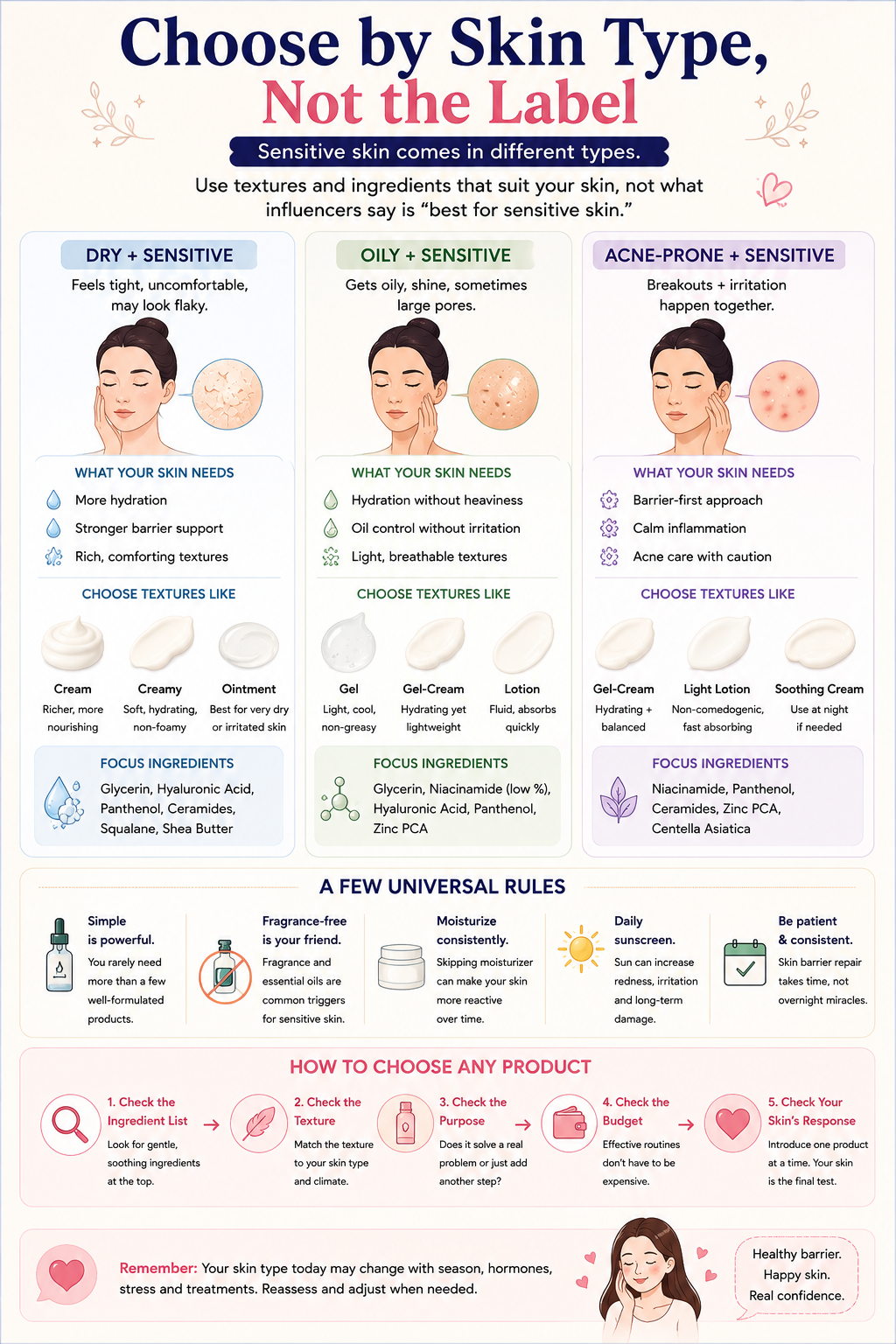
Choose Your Moisturiser by Skin Type — Not by the Word “Sensitive”
Dry + Sensitive
Richer lotion or cream textures may feel more comfortable. Glycerin, ceramides, petrolatum, dimethicone or other barrier-supporting ingredients can be useful.
Oily + Sensitive
Look for lighter lotions, gel-creams or fluid moisturisers that hydrate without feeling excessively greasy.
Acne-Prone + Sensitive
Keep the base routine gentle and introduce acne treatments carefully rather than drying the entire face aggressively.
Pakistan’s climate also matters. A rich cream that feels wonderful during a dry winter may feel heavy during hot, humid weather. Texture is part of product selection — not an afterthought.
If oiliness is your main concern, you can also read our Skin Care hub and explore the Oily Skin section from there.
What Sunscreen Is Best for Sensitive Skin?
There is no universal rule that every sensitive face must use a mineral sunscreen. Some people tolerate zinc oxide or titanium dioxide very well. Others prefer modern organic UV filters because the formulation feels lighter and easier to wear.
The priorities are:
- Broad-spectrum protection
- SPF 30 or higher
- A texture you can apply generously
- A formulation that does not repeatedly sting or irritate your skin
- Daily use, not just occasional use
It is the one that gives adequate protection and that you can actually tolerate and use consistently.
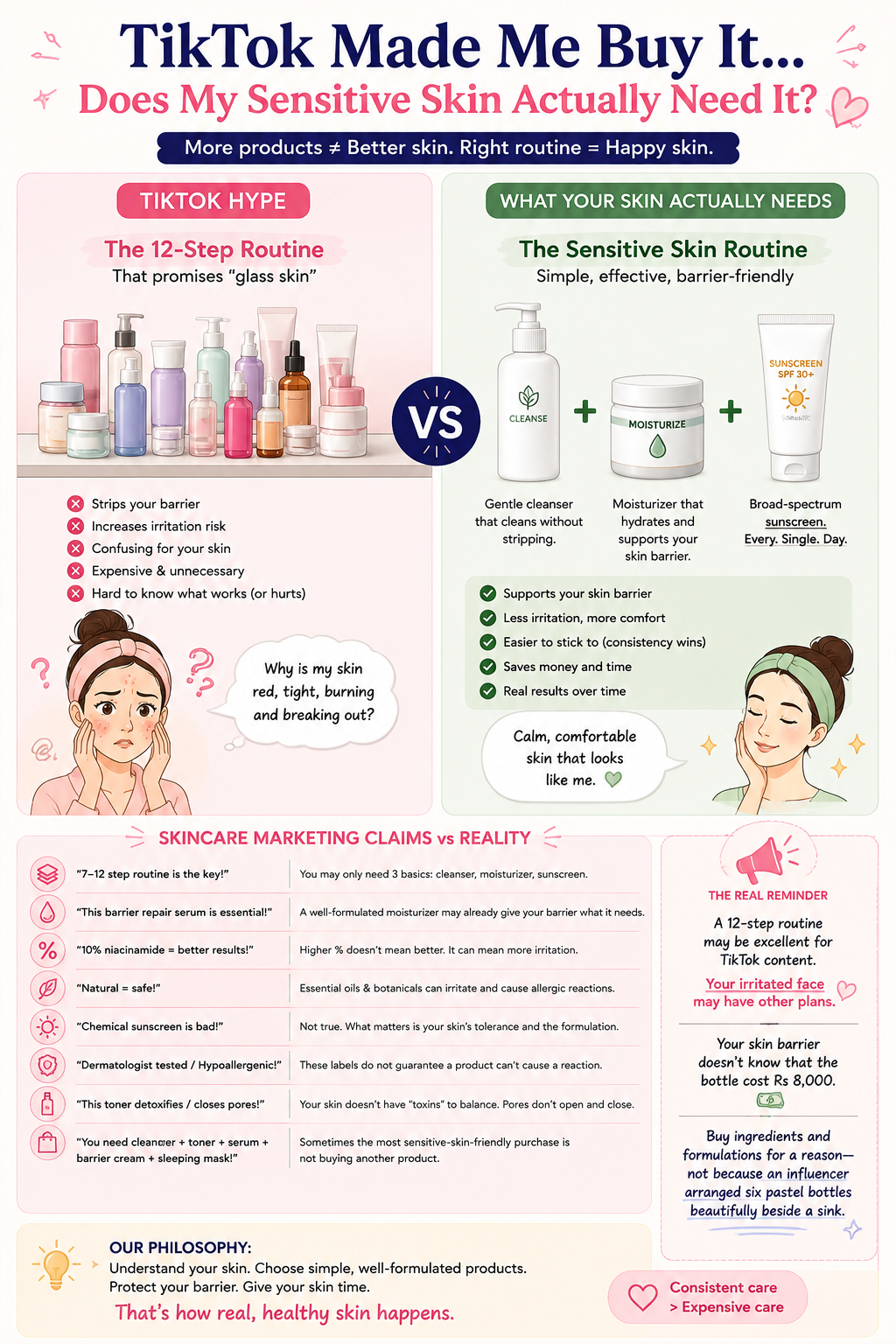
TikTok Made Me Buy It… Does Your Skin Actually Need It?
Sensitive skin marketing has become its own industry. Once your skin becomes reactive, every second bottle suddenly promises to “repair,” “calm,” “detox,” “restore,” “reset” or “save” your barrier.
Expensive products can be excellent. Affordable products can also be excellent. The price of a cleanser or moisturiser is not a measure of how intelligently it was selected for your skin.
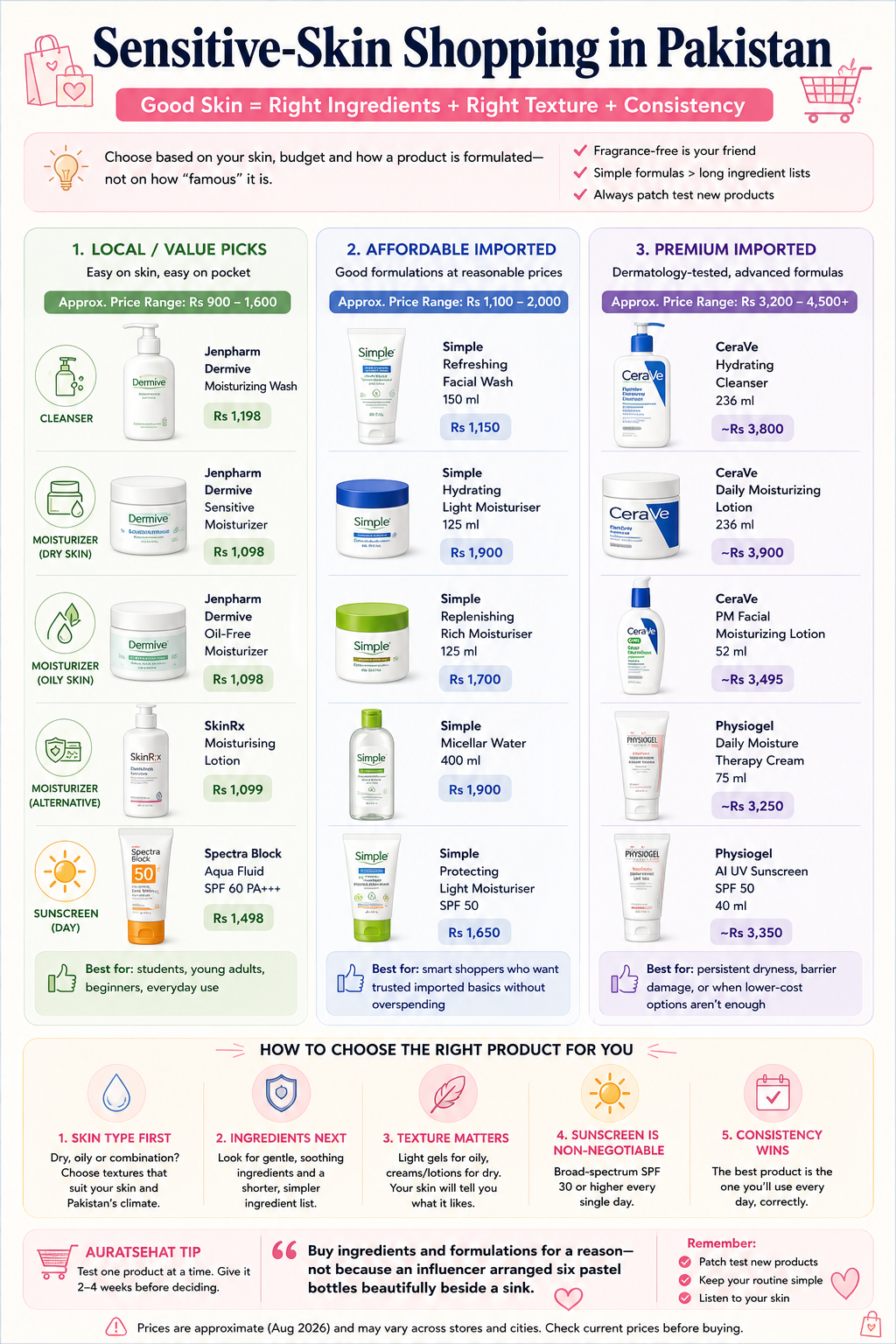
Sensitive-Skin Products Available in Pakistan
Now that you understand what you are looking for, product names become much less intimidating. The examples below are not “the best products in Pakistan.” They are simply examples of different price points and formulations currently available in the Pakistani market.
Prices can change quickly because of promotions, import costs, retailer stock and pack size. Use these figures as approximate August 2026 reference prices rather than permanent prices.
| Product | Type | Approx. Price | Who Might Consider It |
|---|---|---|---|
| Jenpharm Dermive Moisturizing Wash | Local / cleanser | About Rs 1,200 | Someone looking for an affordable gentle cleanser. |
| Jenpharm Dermive Sensitive Moisturizer | Local / moisturiser | Rs 1,098 | Dry or sensitive skin wanting a richer local moisturiser. |
| Jenpharm Dermive Oil Free Moisturizer | Local / moisturiser | Rs 1,098 | Oily or acne-prone skin wanting a lighter moisturiser. |
| SkinRx Moisturising Lotion | Local / moisturiser | About Rs 1,100 | Another lower-cost moisturising option to compare by formulation and texture. |
| Simple Refreshing Facial Wash | Affordable imported / cleanser | About Rs 1,150 | Someone who wants a simple imported cleanser without moving into premium pricing. |
| Simple Hydrating Light Moisturiser | Affordable imported / moisturiser | About Rs 1,900 | Normal, combination or sensitive skin preferring a lighter texture. |
| Simple Replenishing Rich Moisturiser | Affordable imported / moisturiser | About Rs 1,700 | Dry sensitive skin preferring a richer texture. |
| Physiogel Daily Moisture Therapy Cream | Imported / rich moisturiser | Rs 3,250 | Dry sensitive skin or people who prefer a richer barrier-supporting cream. |
| CeraVe Daily Moisturizing Lotion | Imported / moisturiser | About Rs 3,000–4,200 | Normal-to-dry skin wanting a lightweight fragrance-free ceramide lotion. |
| Physiogel Dermo-Cleanser | Imported / cleanser | Rs 1,600 | Dry or sensitive skin preferring a mild soap-free cleanser. |
So Which Products Should You Actually Buy?
Instead of choosing by fame, ask five questions:
- What is my skin type? Dry, oily, combination or acne-prone?
- What is this product supposed to do? Cleanse, moisturise, protect or treat a specific problem?
- Does the texture suit me? A beautiful ingredient list is useless if you hate wearing the product.
- Does my skin tolerate it? Your own response matters more than an influencer review.
- Can I afford to use it consistently? A routine should be sustainable.
A Rs 1,100 moisturiser that keeps your skin comfortable is a better choice for you than a Rs 8,000 moisturiser that stings, feels miserable or empties your budget every month.
How Should You Introduce a New Product?
Sensitive skin becomes much harder to understand when five products are started simultaneously. Introduce one new product at a time.
For a cautious home-use test, apply a small amount to a limited area according to how the product is normally used. If you repeatedly develop redness, itching, swelling or significant burning, stop using it.
Remember: home testing of a skincare product is not the same as formal dermatology patch testing for allergic contact dermatitis.
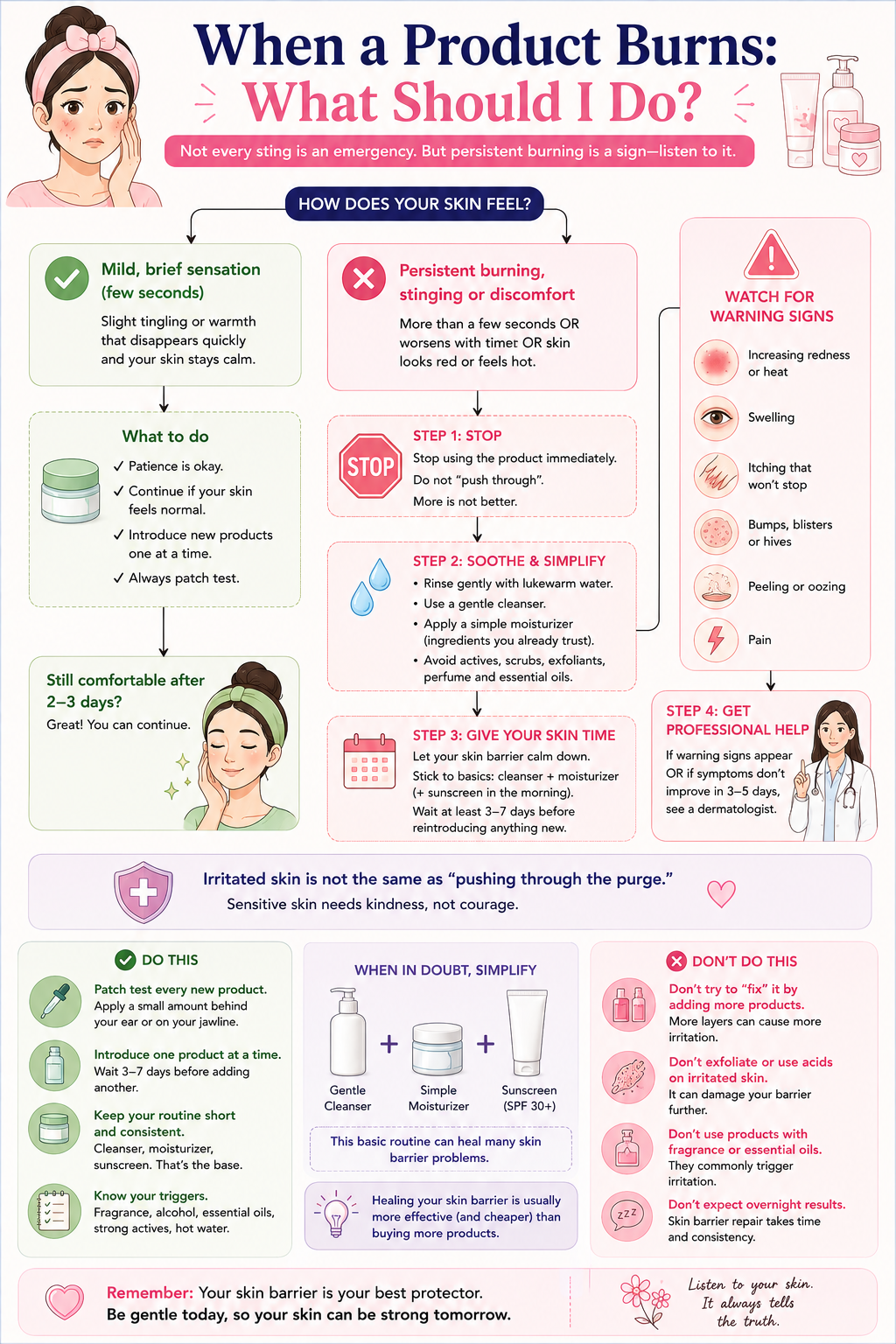
What If a Product Burns?
A tiny brief sensation can occasionally occur with some active products. But persistent burning, worsening stinging, visible redness, swelling or pain is not something you need to “push through.”
Mild & Brief
If the sensation is minimal, disappears quickly and the skin remains comfortable, observe carefully and avoid adding another new product at the same time.
Persistent or Worsening
Stop the suspected product. Gently rinse the skin if appropriate and return to a simple, familiar routine while the irritation settles.
Watch for warning signs
- Increasing redness or heat
- Marked swelling
- Blisters, hives or oozing
- Significant pain
- Eye or lip involvement
- Symptoms that are persistent or worsening rather than settling
If these occur, or if you keep reacting to multiple products, a dermatologist can help distinguish simple irritation from eczema, rosacea, allergic contact dermatitis or another skin condition.
If your skin suddenly started reacting after acids, retinoids, scrubs or excessive cleansing, our upcoming Damaged Skin Barrier guide is the more relevant next step.
If You Have Sensitive + Acne-Prone Skin
Do not respond by avoiding all acne treatment forever. The goal is to maintain a gentle base routine and introduce evidence-based acne treatment carefully.
If acne is an important part of your problem, visit our Acne Hub to understand what type of breakouts you are dealing with before adding random acids or spot treatments.
The Sensitive-Skin Rule That Matters Most
Calm skin usually comes from consistency, not constant experimentation.
Use a gentle cleanser when needed, a moisturiser suited to your skin type and daily sunscreen. Add treatments only when they solve a real problem.
Skincare should become easier as you understand your skin better. If your bathroom shelf keeps getting larger while your face keeps becoming more irritated, the answer may not be another bottle.
Continue the Sensitive Skin Series
Still Reacting to Everything?
If your skin is persistently red, painful, itchy or reacting to multiple products, you may need more than another skincare recommendation.
Ask a Doctor for Free