
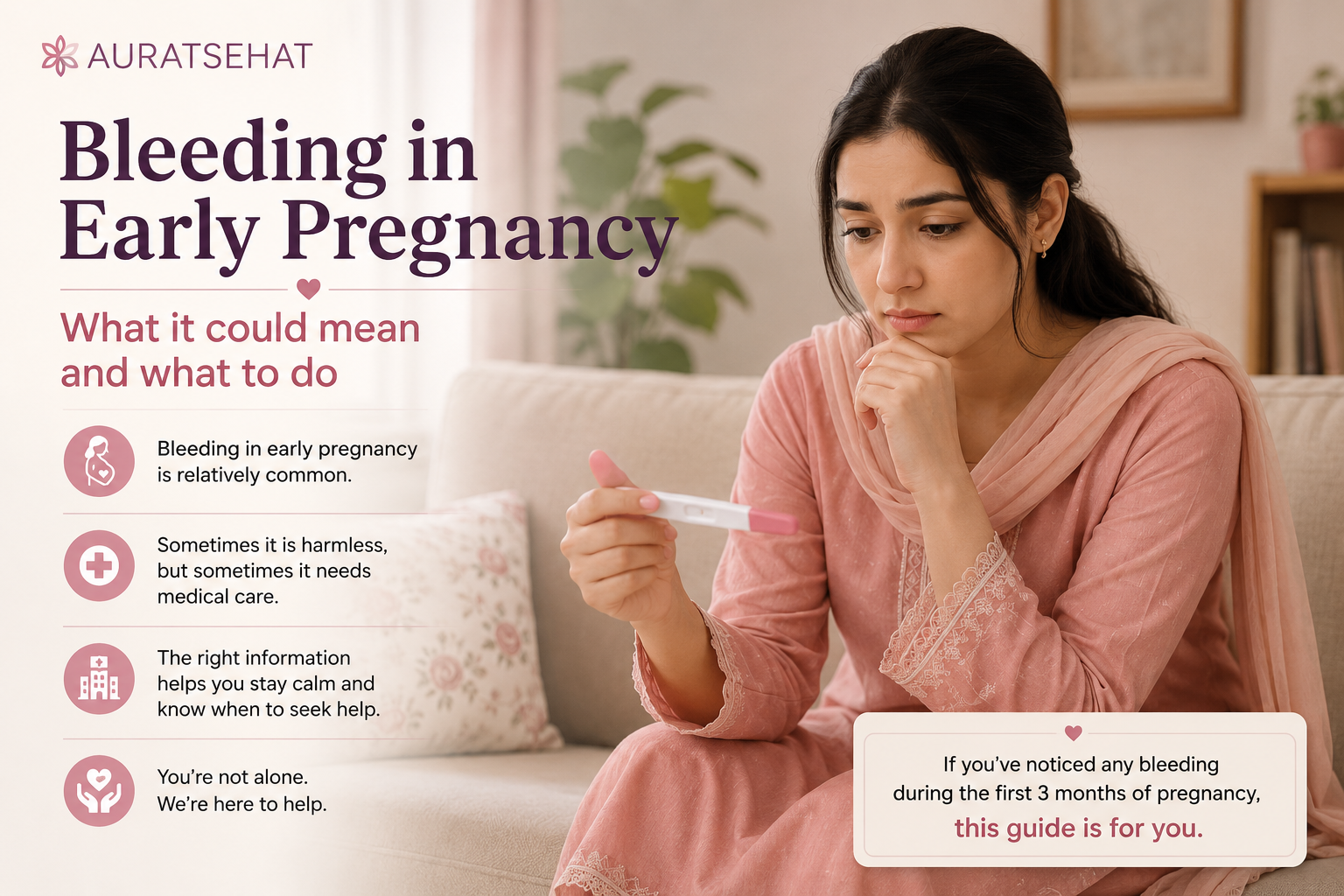
Bleeding in Early Pregnancy: What It Could Mean and What to Do
Seeing blood during the first 3 months of pregnancy can be frightening. Your first thought may be miscarriage. But bleeding does not always mean that you are losing the pregnancy.
No — bleeding in early pregnancy does not automatically mean miscarriage. Around 15–25 out of every 100 pregnancies have some bleeding during the first trimester. But because bleeding can sometimes be caused by miscarriage, ectopic pregnancy or another problem, you should tell your maternity doctor or clinician about it.
Does bleeding mean I am having a miscarriage?
This is usually the first worry when a woman sees blood during pregnancy. The answer is not necessarily.
have some bleeding during the first 3 months of pregnancy. Many women who bleed in early pregnancy do not miscarry.
A miscarriage can cause bleeding, but bleeding can also happen for several other reasons. The amount of bleeding, whether you have pain and what your ultrasound shows are much more useful than simply looking at the colour of the blood.
Signs that can be more concerning for miscarriage
- Bleeding that becomes heavier or keeps increasing
- Strong period-like cramps or worsening tummy/pelvic pain
- Passing larger clots
- Passing tissue or pregnancy-like material
But even these symptoms do not confirm a miscarriage on their own. A doctor usually needs an ultrasound to find out what is happening.
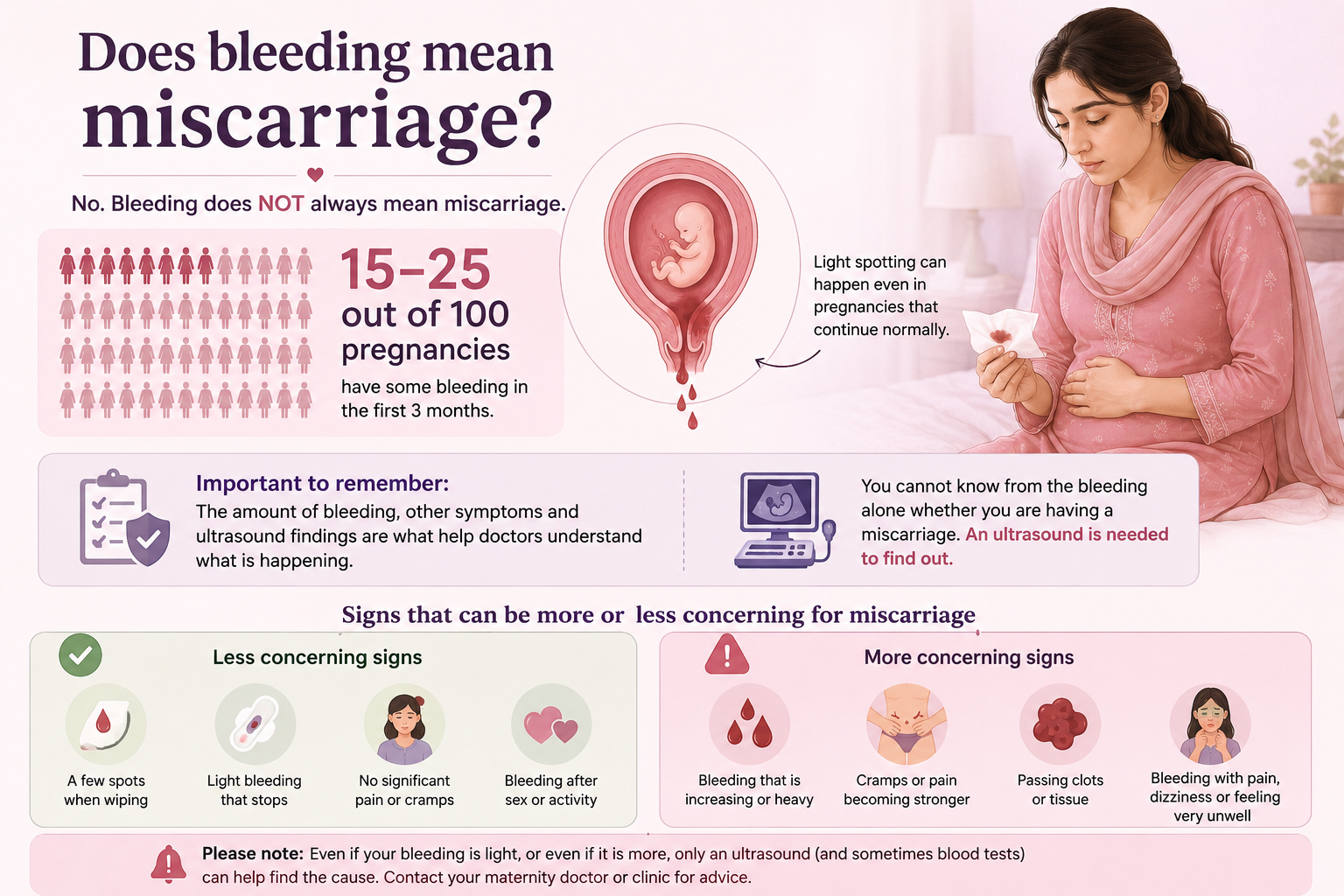
If an ultrasound shows the pregnancy inside the womb and the baby’s heartbeat (fetal cardiac activity) is seen when expected, this is a very reassuring sign.
Could it be an ectopic pregnancy?
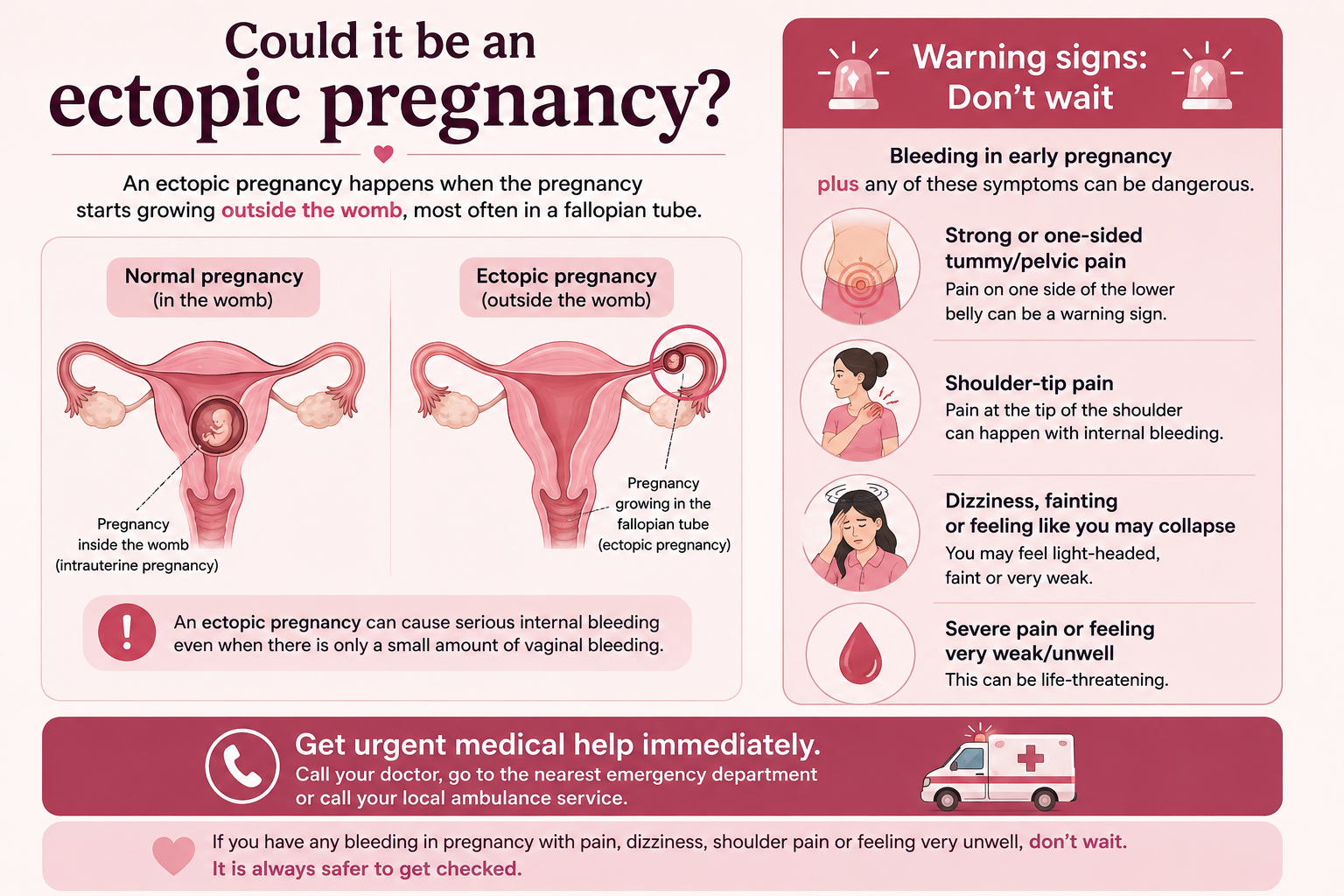
An ectopic pregnancy means the pregnancy has started growing outside the womb, most commonly inside one of the fallopian tubes.
Ectopic pregnancy is much less common than miscarriage, but it is important because the tube can rupture and cause dangerous bleeding inside the tummy.
Bleeding together with strong or one-sided tummy pain, shoulder-tip pain, dizziness, fainting or feeling very weak needs urgent medical assessment.
One important thing to understand is that the amount of blood you see from the vagina does not tell you how much bleeding may be happening inside the body. A woman with an ectopic pregnancy may have only a small amount of vaginal bleeding.
If it is not miscarriage or ectopic pregnancy, what else can cause bleeding?
There are several other reasons you may see blood during early pregnancy. Some are related to the pregnancy itself, while others come from the cervix or vagina.
A small collection of blood beside the pregnancy
Sometimes blood collects between the pregnancy sac and the wall of the womb. Doctors call this a subchorionic hematoma. It may cause light spotting or sometimes more noticeable bleeding. It can often be seen on ultrasound.
Bleeding from the cervix
During pregnancy, more blood flows through the cervix and it can bleed more easily. Some women notice light spotting after sex or after an examination.
Very early pregnancy spotting
A small amount of spotting can happen very early in pregnancy, including around the time a woman may have expected her period. You cannot tell the exact cause simply from the colour or timing of the blood.
Infection or irritation
Infection or inflammation of the vagina or cervix can sometimes cause spotting or bleeding. You may also notice unusual discharge, smell, irritation, burning or discomfort.
Less common pregnancy problems
Rarely, bleeding can happen with other early pregnancy problems such as a molar pregnancy. These conditions cannot usually be diagnosed from bleeding alone. Ultrasound and other tests help your doctor find the cause.
Brown, pink or bright-red blood does not give the diagnosis. Brown blood is often older blood and bright-red blood is fresher blood, but the amount of bleeding, pain and ultrasound findings matter more.
I have bleeding. Should I see a doctor?
Yes. Tell your maternity doctor or clinician about bleeding during pregnancy, even if it seems light.
If you are feeling well and have only a few spots, this may not require an emergency visit, but your doctor can tell you whether you need an examination, ultrasound or follow-up.
Before you go, it can help to notice:
- When the bleeding started
- Whether it is just spotting, light bleeding or heavy bleeding
- Whether it is increasing or stopping
- Whether you have passed clots or tissue
- Whether you have tummy or pelvic pain
- Whether the pain is mainly on one side
- Whether you feel dizzy, faint or very weak
- About how many weeks pregnant you are
What will the doctor do?
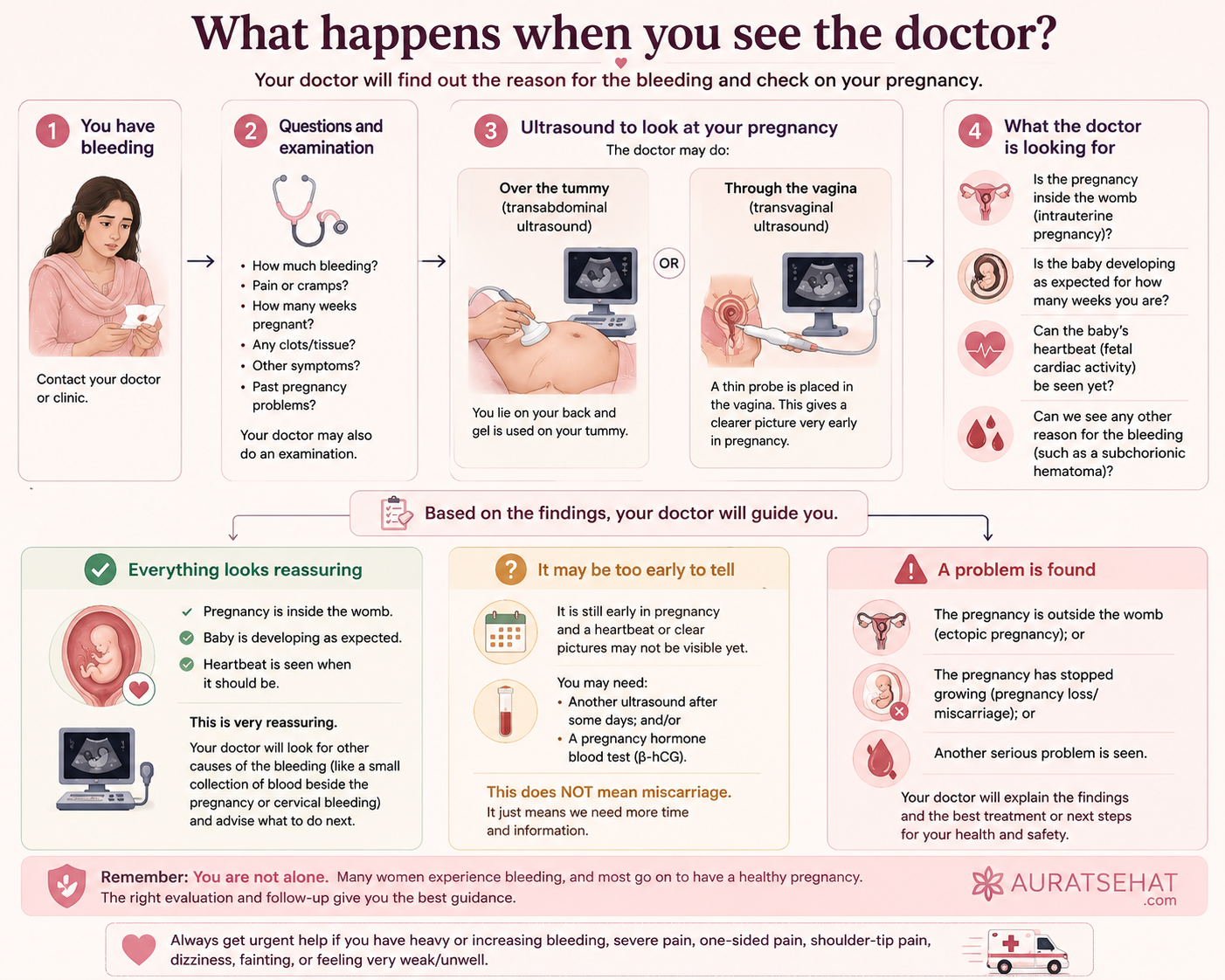
The aim is to find out where the bleeding is coming from and how the pregnancy is doing.
Ask about your bleeding and symptoms
Your doctor may ask how much you are bleeding, whether you have pain, your last period, how many weeks pregnant you may be and whether you have had previous pregnancy problems.
Examine you if needed
Your tummy may be examined. Sometimes the doctor may also examine the vagina and cervix to look for another source of bleeding.
Do an ultrasound
This may be an ultrasound over your tummy (transabdominal ultrasound) or an ultrasound through the vagina (transvaginal ultrasound). Very early in pregnancy, a transvaginal ultrasound often gives a clearer picture.
Look at the pregnancy
The doctor checks whether the pregnancy is inside the womb (intrauterine pregnancy), whether the baby is developing as expected and whether the baby’s heartbeat (fetal cardiac activity) can be seen yet.
What if the baby’s heartbeat is seen?
If the scan shows that the pregnancy is inside the womb, the baby is developing as expected and the baby’s heartbeat (fetal cardiac activity) can be seen, this is very reassuring.
Doctors may call bleeding with an otherwise normally developing pregnancy a threatened miscarriage. The name can sound frightening, but it does not mean that a miscarriage will definitely happen.
Your doctor may also look for another reason for the bleeding, such as a small collection of blood beside the pregnancy (subchorionic hematoma) or bleeding from the cervix.
What if a heartbeat cannot be seen yet?
It may simply be too early. Not seeing a heartbeat on a very early ultrasound does not automatically mean miscarriage.
Pregnancy develops quickly during these early weeks. If your dates are uncertain, you may be earlier in pregnancy than you thought.
Your doctor may recommend another ultrasound after an appropriate interval and sometimes a pregnancy hormone blood test (β-hCG).
Looking at how β-hCG changes over time can help your doctor understand what is happening, but one blood test on its own usually cannot give the whole answer.
What if the pregnancy cannot be seen on the scan?
If your pregnancy test is positive but the pregnancy cannot yet be seen clearly inside or outside the womb, doctors may call this a pregnancy of unknown location (PUL).
This can happen because:
- the pregnancy is simply too early to see
- a very early miscarriage has happened
- or the pregnancy may be outside the womb (ectopic pregnancy)
Your doctor may arrange repeat β-hCG blood tests and another ultrasound until the location and progress of the pregnancy become clear.
Tell your doctor if your blood group is RhD negative
If you know your blood group is negative — for example O−, A−, B− or AB− — tell your doctor that you have had pregnancy bleeding.
The letter A, B, AB or O is your main blood group. The minus sign means you are RhD negative.
Whether you need Anti-D immunoglobulin (RhoGAM injection) depends on how many weeks pregnant you are, what has happened and the clinical situation. Your maternity doctor will advise you according to the appropriate protocol.
Get urgent medical help if you have:
- Heavy or rapidly increasing bleeding
- Severe tummy or pelvic pain
- Strong pain mainly on one side
- Shoulder-tip pain
- Dizziness or feeling like you may faint
- Fainting or collapse
- Feeling extremely weak or very unwell
These symptoms can occur with significant bleeding or an ectopic pregnancy and need urgent assessment.
Common questions about bleeding in early pregnancy
Can I have bleeding and still have a healthy pregnancy?
Yes. Bleeding happens in 15–25 out of every 100 pregnancies during the first trimester, and many of these pregnancies continue normally. Your symptoms and ultrasound findings help determine what the bleeding means.
Is brown spotting safer than red bleeding?
Brown blood is usually older blood and bright-red blood is fresher blood, but colour alone cannot tell you whether the pregnancy is healthy. The amount of bleeding, pain and ultrasound findings matter more.
Does passing a clot mean I miscarried?
Not always. Clots can occur with bleeding, but you cannot confirm a miscarriage from the appearance of the blood or clot alone. Medical assessment and ultrasound may be needed.
Is a transvaginal ultrasound safe in early pregnancy?
Yes. An ultrasound through the vagina (transvaginal ultrasound) does not increase your risk of miscarriage and often gives a clearer picture very early in pregnancy.
What if my scan says it is too early to tell?
This does not automatically mean something is wrong. You may simply be earlier in pregnancy than expected. Your doctor may arrange another scan and/or a pregnancy hormone blood test (β-hCG).
Can ectopic pregnancy cause only light bleeding?
Yes. Vaginal bleeding may be light even when an ectopic pregnancy is causing bleeding inside the body. Severe or one-sided tummy pain, shoulder-tip pain, dizziness or fainting should therefore never be ignored.
My Pregnancy
Build your personalized AuratSehat pregnancy journey and see the important stages and milestones ahead.
Open My PregnancyHave a pregnancy question?
Ask your women’s health question through AuratSehat’s free doctor service.
Ask a Doctor for FreeMedical references
- American College of Obstetricians and Gynecologists (ACOG). Bleeding During Pregnancy. ACOG patient guidance.
- Royal College of Obstetricians and Gynaecologists (RCOG). Bleeding and/or Pain in Early Pregnancy. Patient information reviewed August 2025.
- Royal College of Obstetricians and Gynaecologists (RCOG). Early Miscarriage.
- Royal College of Obstetricians and Gynaecologists (RCOG). Ectopic Pregnancy.
- American College of Obstetricians and Gynecologists (ACOG). Early Pregnancy Loss. Practice Bulletin.
Medical Content & Editorial Team, AuratSehat
Medical Content & Editorial Team, AuratSehat
Obstetrics & Gynaecology (OB-GYN)
AuratSehat medical content is written for education and does not replace examination, diagnosis or treatment by your own doctor. If you have heavy bleeding, severe pain, one-sided pain, shoulder-tip pain, dizziness or fainting, seek urgent medical care.