
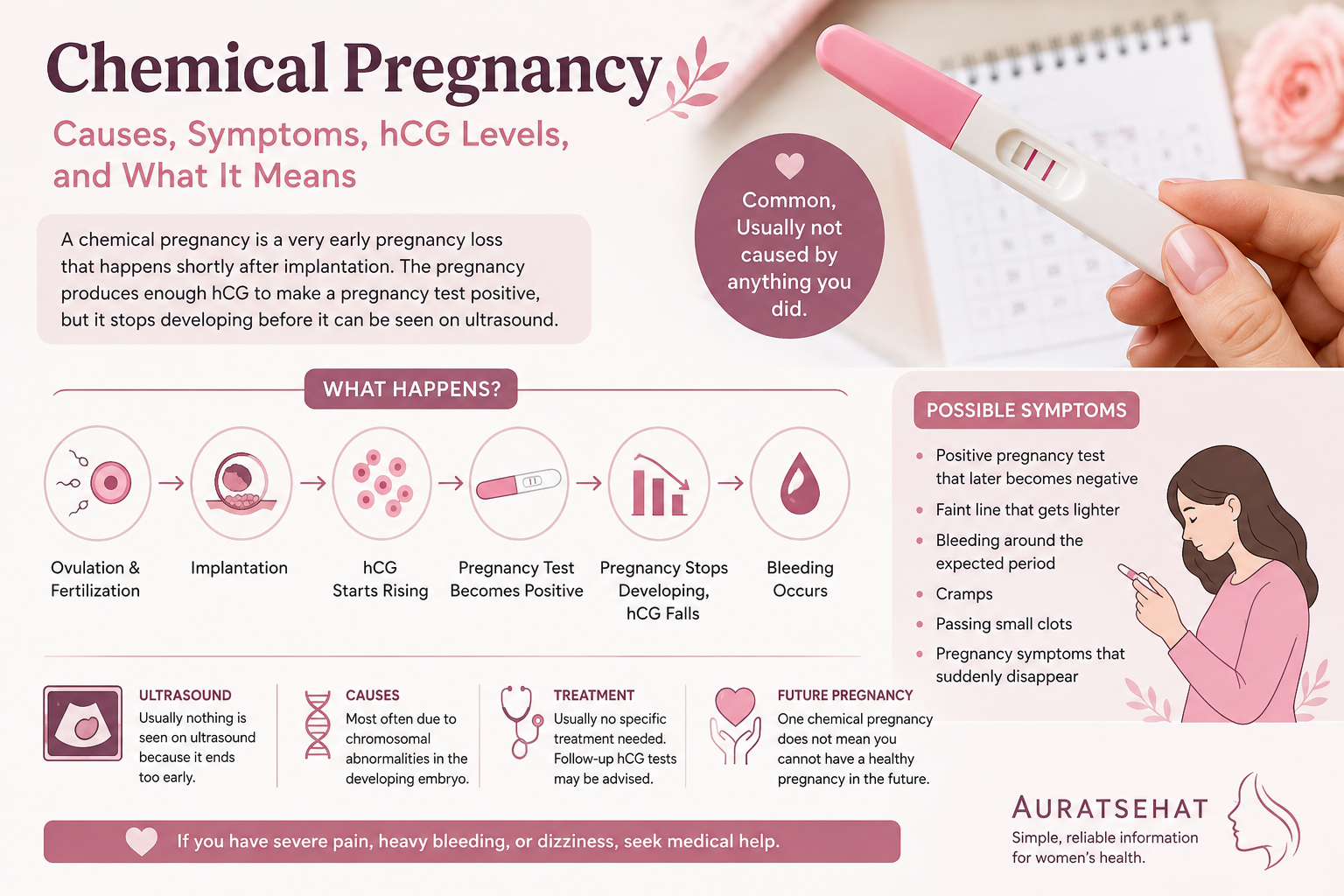
A chemical pregnancy is a very early pregnancy loss that happens shortly after implantation.
The pregnancy produces enough hCG to make a pregnancy test positive, but development stops before the pregnancy can usually be seen on ultrasound.
Some women only notice a positive pregnancy test followed by bleeding or a later negative test.
What is a chemical pregnancy?
A chemical pregnancy happens when an embryo implants in the uterus and begins producing human chorionic gonadotropin — hCG — but the pregnancy stops developing extremely early.
Because the pregnancy ends so early, an ultrasound usually does not yet show a gestational sac.
Why is it called “chemical” pregnancy?
The word chemical refers to the fact that pregnancy can be detected through the pregnancy hormone hCG before it can usually be confirmed visually on ultrasound.
It does not mean that the pregnancy was somehow false or unreal. Implantation occurred and pregnancy hormone was produced.
Symptoms of a chemical pregnancy
Some women have no obvious symptoms other than a positive pregnancy test that later becomes negative.
- a positive pregnancy test followed by a negative test
- a faint test line that becomes lighter
- bleeding around the expected period or shortly afterward
- bleeding that feels heavier than a usual period
- menstrual-like cramps
- passing small blood clots
- a decrease in early pregnancy symptoms
These symptoms cannot diagnose a chemical pregnancy by themselves.
Bleeding after a positive pregnancy test can have other causes, and in some situations an ectopic pregnancy must be excluded.
Chemical pregnancy and beta-hCG
hCG is the pregnancy hormone detected by urine and blood pregnancy tests.
After implantation, hCG normally begins to rise. With a chemical pregnancy, the level may initially become high enough to produce a positive test and then begin falling when the pregnancy stops developing.
Your doctor may use quantitative beta-hCG blood tests, sometimes repeated approximately 48 hours apart, to understand the trend.
One hCG number is not the whole diagnosis
A single beta-hCG result cannot tell the complete story. Doctors interpret the trend in hCG, symptoms and ultrasound findings together.
Can a chemical pregnancy be seen on ultrasound?
Usually, no.
A chemical pregnancy typically ends before a gestational sac becomes visible on ultrasound. This is one reason why chemical pregnancy can be confusing — the pregnancy test proves that hCG was produced, but there may never have been anything visible on the scan.
Read our guide to Early Pregnancy Ultrasound to understand what doctors expect to see at different stages.
What causes a chemical pregnancy?
In many cases, the exact reason is never identified.
A common explanation is a chromosomal problem in the developing embryo that prevents normal development. These changes usually occur by chance.
Ordinary activities such as walking, working, normal exercise, sexual intercourse and travelling are not generally considered causes of a chemical pregnancy.
Is a chemical pregnancy the same as miscarriage?
A chemical pregnancy is a form of very early pregnancy loss. The key difference is timing.
In a chemical pregnancy, the loss occurs before the pregnancy can usually be confirmed on ultrasound. A miscarriage occurring later may involve a pregnancy that has already become visible on ultrasound.
You can read the full explanation in our guide to Miscarriage in the First Trimester .
Chemical pregnancy vs ectopic pregnancy
This distinction is particularly important.
A positive pregnancy test followed by bleeding and falling hCG may fit with a very early pregnancy loss, but similar findings can occur when the location of the pregnancy has not yet been established.
Doctors may therefore continue follow-up until they are satisfied that an ectopic pregnancy is not present.
Seek urgent medical care if you have
- severe or worsening abdominal or pelvic pain
- strong one-sided abdominal pain
- shoulder-tip pain
- dizziness or fainting
- significant weakness or collapse
- very heavy bleeding
- severe pain with a positive pregnancy test
These symptoms can occur with a potentially dangerous ectopic pregnancy and need urgent medical assessment.
Do you need treatment?
Usually, no specific treatment is required because a chemical pregnancy happens so early that the body generally passes the pregnancy tissue naturally.
Your doctor may recommend follow-up beta-hCG testing when the diagnosis is uncertain or when an ectopic pregnancy has not yet been confidently excluded.
Can you try for pregnancy again?
Ovulation can return relatively quickly after a very early pregnancy loss.
For many women there is no medical reason to wait several months solely because of a chemical pregnancy, although the right timing depends on your individual circumstances and whether you feel physically and emotionally ready.
Planning another pregnancy?
Take folic acid before conception and continue it during early pregnancy unless your doctor has advised a different dose.
Read: Folic Acid in Pregnancy
Does a chemical pregnancy affect future fertility?
Having one chemical pregnancy usually does not mean that you will have difficulty becoming pregnant or carrying a future pregnancy.
Many women go on to have healthy pregnancies afterward.
If pregnancy losses happen repeatedly, speak with your doctor because further evaluation may sometimes be appropriate.
Frequently asked questions
Can a chemical pregnancy give a positive pregnancy test?
Yes. Implantation has occurred and hCG is being produced, so urine or blood pregnancy testing can become positive.
Can it happen without symptoms?
Yes. Some women only notice that a positive pregnancy test later becomes negative.
How long can hCG remain positive?
It varies. hCG falls after the pregnancy ends, but it may take some time before it reaches a non-pregnant level.
Can normal stress cause a chemical pregnancy?
Everyday emotional stress is not generally considered a typical cause. Many very early losses are associated with developmental or chromosomal problems that occur by chance.
Was it a real pregnancy?
Yes. Implantation occurred and detectable pregnancy hormone was produced. The pregnancy simply ended before it could usually be seen on ultrasound.
My Pregnancy
Follow pregnancy information according to where you are now and what comes next.
Open My PregnancyAsk a Doctor for Free
Have questions about a positive test, bleeding, hCG results or an early pregnancy concern?
Ask a Doctor