
Molar Pregnancy
A clear guide to what a molar pregnancy is, why it happens, how it is diagnosed and treated, and why β-hCG follow-up is important afterwards.
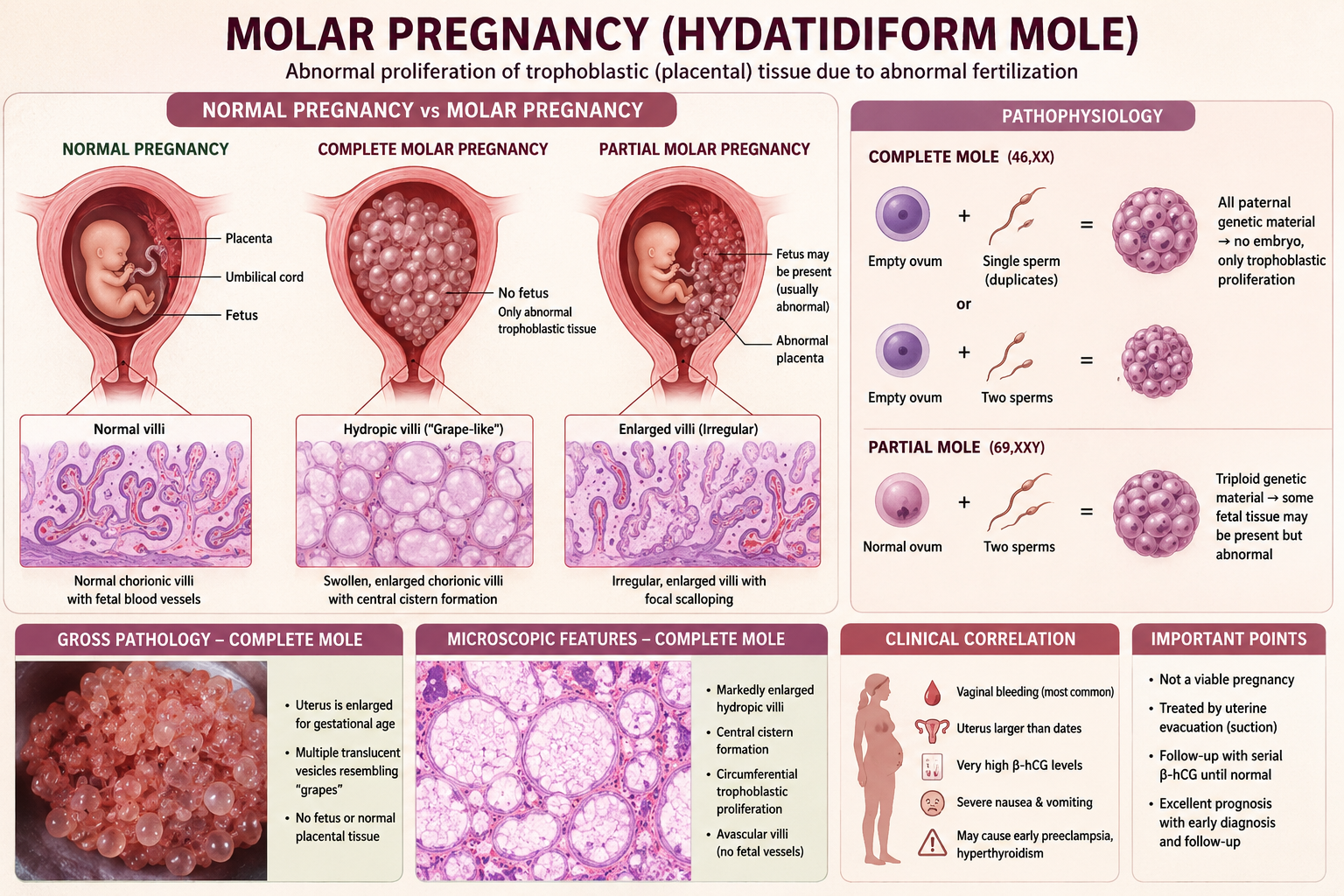
A molar pregnancy, also called a hydatidiform mole, happens when abnormal fertilization causes placental tissue to develop abnormally. It cannot develop into a normal healthy pregnancy. Treatment usually involves removing the abnormal pregnancy tissue, followed by careful monitoring of β-hCG until your healthcare team is satisfied that the molar tissue has resolved.
What is a molar pregnancy?
In a normal pregnancy, fertilization provides the genetic instructions needed for an embryo and placenta to develop.
In a molar pregnancy, an abnormal combination of genetic material at fertilization causes the cells that normally contribute to the placenta — called trophoblastic cells — to grow abnormally.
Molar pregnancy belongs to a group of conditions called gestational trophoblastic disease (GTD).
A molar pregnancy is not caused by something you ate, something you did, exercise, stress, travelling or ordinary daily activity. It results from an abnormal fertilization event.
Complete vs partial molar pregnancy
There are two main types of molar pregnancy, and understanding the difference helps explain why ultrasound findings can vary.
Complete molar pregnancy
There is no normally developing embryo or fetus. Abnormal placental/trophoblastic tissue grows inside the uterus, and β-hCG can become unusually high.
Partial molar pregnancy
Some fetal or embryonic tissue may develop alongside an abnormal placenta, but the chromosome combination is abnormal and the pregnancy cannot develop normally.
Why does a molar pregnancy happen?
A molar pregnancy occurs because something goes wrong with the genetic material during fertilization.
In a complete mole
The egg does not contribute functional maternal genetic material. The genetic material comes from the sperm — commonly after one sperm fertilizes the egg and duplicates its chromosomes, although other patterns can occur.
In a partial mole
An egg is usually fertilized by two sperm, producing an abnormal chromosome number. This is commonly a triploid pregnancy, meaning there are three sets of chromosomes instead of the usual two.
A molar pregnancy is a biological error at fertilization. It is not something a woman causes through her behaviour during pregnancy.
What are the symptoms of a molar pregnancy?
Some women have noticeable symptoms, while others have few or no obvious symptoms and first learn something is wrong during an ultrasound.
Possible features include:
- Vaginal bleeding in early pregnancy
- Brownish vaginal discharge
- Severe nausea and vomiting
- A uterus measuring larger than expected
- β-hCG levels that are unusually high
- Pelvic pressure or discomfort
- Passage of unusual tissue from the vagina
- Symptoms of an overactive thyroid in some women
- High blood pressure occurring unusually early in pregnancy
Bleeding, nausea and abnormal β-hCG can occur for several reasons in early pregnancy. Molar pregnancy is diagnosed using the overall clinical picture, ultrasound, laboratory testing and examination of the pregnancy tissue where appropriate.
Why can molar pregnancy cause bleeding?
Abnormally developing trophoblastic and placental tissue can disrupt the normal pregnancy environment inside the uterus and lead to vaginal bleeding.
Bleeding can range from spotting or brown discharge to heavier bleeding.
But bleeding is not specific to molar pregnancy. Miscarriage, ectopic pregnancy and other causes can also produce bleeding in early pregnancy.
Read our guide to Bleeding in Early Pregnancy if this is your main symptom.
Why can β-hCG become very high?
The hormone human chorionic gonadotropin (hCG) is produced by trophoblastic cells — the same type of cells that are growing abnormally in a molar pregnancy.
When there is a large amount of abnormal trophoblastic tissue, the pregnancy may produce much more hCG than expected.
Very high levels can contribute to:
- Severe nausea and vomiting
- Breast tenderness
- Rapid uterine enlargement
- Occasionally symptoms resembling an overactive thyroid
Doctors do not diagnose a molar pregnancy from one β-hCG result. The hormone level is interpreted together with ultrasound findings, pregnancy dates and the overall clinical picture.
Our Pregnancy Test: UPT & Blood β-hCG guide explains how this hormone normally behaves in early pregnancy.
How is molar pregnancy diagnosed?
Diagnosis usually involves a combination of ultrasound, β-hCG testing and clinical assessment. Examination of tissue removed from the uterus can also be important in confirming the diagnosis.
Ultrasound
A complete molar pregnancy can produce a characteristic abnormal appearance with many small cystic spaces within the pregnancy tissue. The traditional description is a “snowstorm” appearance.
Partial molar pregnancy can be more difficult to recognize. An embryo or fetal tissue may initially be present together with an abnormal placenta.
Very early molar pregnancies do not always have the classic ultrasound appearance.
β-hCG blood testing
Quantitative β-hCG may be unusually high, particularly with a complete mole, although the result cannot confirm the diagnosis on its own.
Examination of pregnancy tissue
After the pregnancy tissue is removed, it may be examined in the laboratory. This can help confirm whether a molar pregnancy was present and whether it was complete or partial.
How is a molar pregnancy treated?
A molar pregnancy cannot develop into a normal viable pregnancy, so the abnormal pregnancy tissue usually needs to be removed.
Confirm the diagnosis
Your healthcare team assesses the ultrasound, β-hCG level, symptoms and other clinical findings.
Remove the abnormal pregnancy tissue
The usual treatment is uterine evacuation using suction evacuation or aspiration. The exact approach depends on your individual clinical situation.
Examine the tissue
The removed pregnancy tissue may be sent for laboratory examination to establish or confirm the diagnosis.
Monitor β-hCG afterwards
Follow-up blood or urine testing is essential because hCG should fall after the molar tissue has been removed.
Why is follow-up so important?
Treatment does not end on the day the molar tissue is removed. β-hCG follow-up is an important part of care.
What doctors are looking for
After treatment, β-hCG should progressively fall towards normal. Your healthcare team continues monitoring according to the type of molar pregnancy and how quickly the hormone becomes normal.
If β-hCG remains elevated, plateaus or starts rising again, it can indicate that active trophoblastic cells remain and further assessment is required.
The exact duration and schedule of surveillance can differ between complete and partial molar pregnancy and according to the specialist centre or local protocol. Follow the schedule given by the team responsible for your care.
This monitoring is important even when you feel completely well.
Can a molar pregnancy become cancer?
Most women are successfully treated after removal of the molar pregnancy.
In some cases, however, abnormal trophoblastic cells continue growing after the pregnancy tissue has been removed. Persistent disease is called gestational trophoblastic neoplasia (GTN).
Doctors can often detect this through the β-hCG pattern before a woman develops obvious symptoms.
Rarely, gestational trophoblastic disease can include more aggressive forms such as choriocarcinoma.
Persistent trophoblastic disease and GTN are generally highly treatable, particularly with appropriate specialist follow-up. This is one of the reasons completing your β-hCG surveillance is so important.
Can I get pregnant normally afterwards?
Yes. Most women can have a normal pregnancy after a molar pregnancy.
Your healthcare team will usually advise you not to start another pregnancy until the recommended hCG surveillance period has been completed.
The reason is practical as well as medical: a new pregnancy naturally causes hCG to rise, which can make it difficult to distinguish a new pregnancy from persistent trophoblastic disease.
Once your follow-up is complete, your doctor or specialist team can advise you when you can start trying again.
Could it happen again?
Having had one molar pregnancy does increase the chance of another compared with someone who has never had one, but the absolute recurrence risk remains low.
Published guidance and reviews generally place the recurrence risk after one molar pregnancy at around 1% — roughly 1 in 100, although estimates vary somewhat between populations. [oai_citation:1‡PubMed Central (PMC)](https://pmc.ncbi.nlm.nih.gov/articles/9298230/?utm_source=chatgpt.com)
In a future pregnancy, your healthcare team may recommend an early ultrasound and any additional follow-up appropriate to your history.
When should you seek urgent medical care?
If you are pregnant or are being treated for a molar pregnancy, seek urgent medical assessment for:
- Heavy vaginal bleeding
- Severe or worsening abdominal or pelvic pain
- Fainting or severe dizziness
- Difficulty breathing
- Severe or persistent vomiting with inability to keep fluids down
- Marked weakness or symptoms suggesting significant blood loss
Do not wait for a routine follow-up appointment if you become acutely unwell.
Frequently asked questions
Can a molar pregnancy have a heartbeat?
A complete molar pregnancy does not contain a normally developing fetus. In a partial mole, fetal or embryonic tissue can be present and cardiac activity may occasionally be detected initially, but the pregnancy cannot develop normally.
Is a molar pregnancy the same as a miscarriage?
No. Both can result in pregnancy loss, but a molar pregnancy is a specific condition involving abnormal trophoblastic or placental development caused by abnormal fertilization.
Will a pregnancy test be positive?
Yes. Molar tissue produces hCG, so urine and blood pregnancy tests are usually positive. β-hCG can sometimes be much higher than expected.
Can molar pregnancy be seen on ultrasound?
Often it can, but very early or partial molar pregnancies may not have the classic appearance. Ultrasound is therefore interpreted alongside β-hCG and other clinical findings.
Why do I need β-hCG tests after treatment?
Falling hCG helps show that the molar tissue has resolved. Persistently elevated, plateauing or rising hCG can indicate remaining active trophoblastic tissue that needs further assessment.
Will I need chemotherapy?
Most women do not need chemotherapy simply because they had a molar pregnancy. It may be required if follow-up shows persistent gestational trophoblastic neoplasia. Treatment is determined by the specialist team.
Can I have a healthy baby afterwards?
Yes. Most women can have healthy pregnancies in the future after completing the recommended follow-up.
Related Pregnancy guides
My Pregnancy
Follow your pregnancy stage, important milestones and what may be coming next in your pregnancy journey.
Open My PregnancyAsk a Doctor for Free
Have an abnormal ultrasound, unusually high β-hCG, bleeding or questions about your pregnancy? Send your question to AuratSehat.
Ask a DoctorMedical references
- Royal College of Obstetricians and Gynaecologists (RCOG). Gestational Trophoblastic Disease — Green-top Guideline No. 38.
- NHS. Molar pregnancy — diagnosis, treatment and follow-up.
- FIGO / international guidance on the diagnosis and management of gestational trophoblastic disease.
Medical Content & Editorial Team, AuratSehat
AuratSehat provides educational health information and does not replace examination, ultrasound, laboratory assessment or individual medical care. Suspected molar pregnancy requires medical assessment, appropriate treatment and completion of the recommended β-hCG follow-up.