

A pregnancy test detects the hormone hCG, which starts rising after implantation. A blood beta-hCG test may detect pregnancy earlier than a home urine pregnancy test (UPT), while a UPT becomes much more reliable around the time your period is due.
1. When should I take a pregnancy test?
If your periods are regular, a home urine pregnancy test is generally most useful around the time your next period is expected. Some sensitive tests may become positive earlier, but testing early also increases the chance of getting a negative result even though you are pregnant.
If your period is already late, you can take a home pregnancy test. Follow the instructions supplied with your particular test because different brands can have different sensitivities and reading times.
First-morning urine can be helpful because it is usually more concentrated. Avoid drinking a very large amount of fluid immediately before testing, as very dilute urine may make very early pregnancy harder to detect.
2. How does a pregnancy test work?
Pregnancy does not become detectable immediately after sex or fertilisation. First, an egg must be released and fertilised. The developing pregnancy then travels toward the uterus and implants.
After implantation, hCG begins to rise. Pregnancy tests look for this hormone.
Ovulation → fertilisation → implantation → hCG rises → blood beta-hCG may become detectable → urine pregnancy test becomes detectable.
3. When does pregnancy become detectable in a 28-day cycle?
The easiest way to understand early pregnancy testing is to look at an example of a woman with a regular 28-day menstrual cycle. The days below are approximate—not fixed rules.
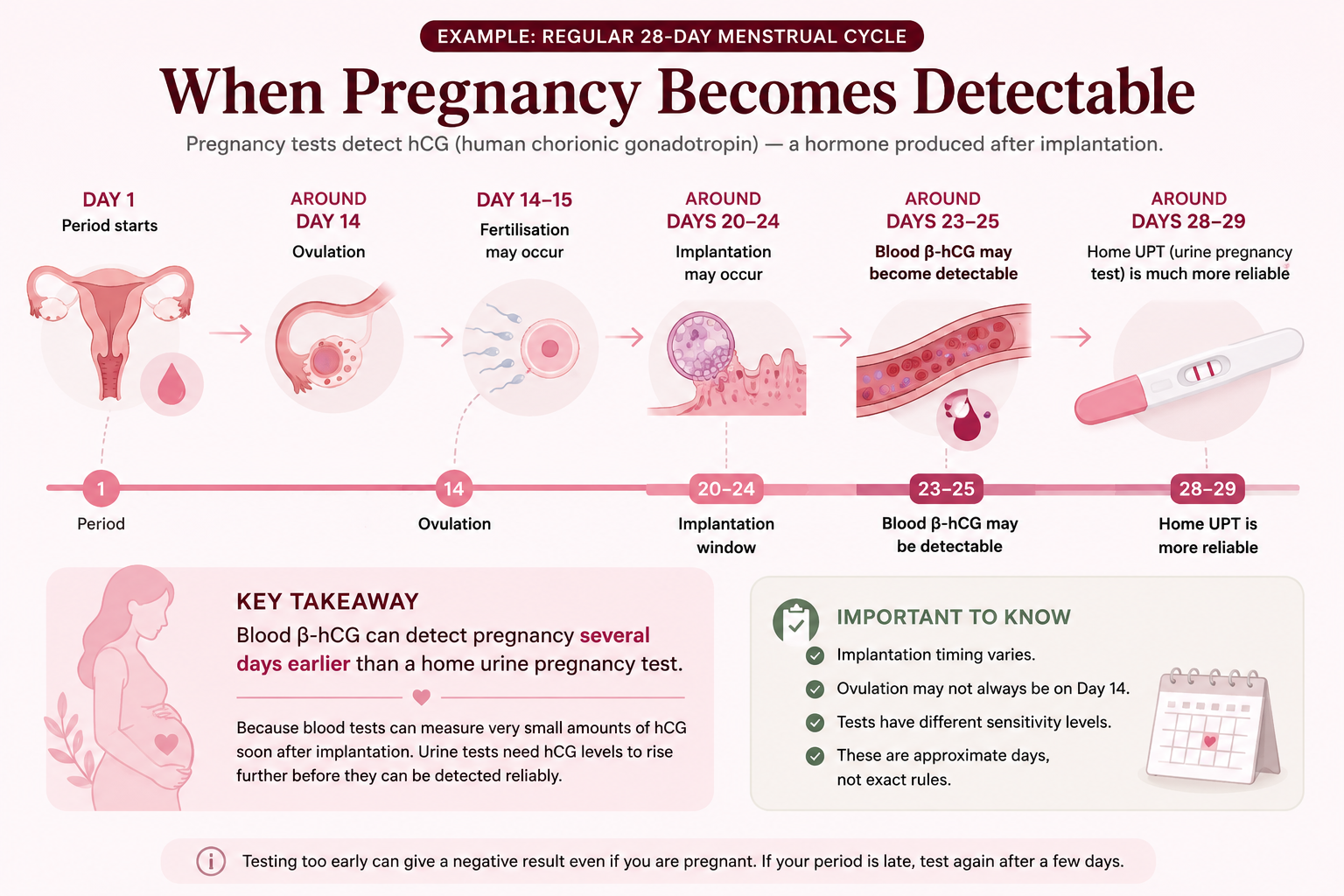
A quantitative blood test can measure very small amounts of hCG. Very early after implantation, there may be enough hCG in the blood to measure while the concentration in urine is still too low for a home pregnancy test to detect reliably.
This is why we can say that blood beta-hCG may detect pregnancy several days earlier than a home urine pregnancy test. It does not mean that every pregnancy will become detectable on exactly Day 23, 24 or 25.
4. UPT vs beta-hCG blood test
Home UPT
Detects hCG in urine. It usually answers the practical question: positive or negative?
It is inexpensive, private and convenient, and becomes more reliable around the expected period.
Blood beta-hCG
Detects hCG in blood. A quantitative beta-hCG test gives an actual numerical concentration.
It can detect smaller amounts of hCG and may therefore identify pregnancy earlier.
Most women do not need repeated blood tests simply to confirm an uncomplicated pregnancy. Beta-hCG testing becomes particularly useful when the pregnancy is very early or when doctors need more information because of symptoms, uncertain dates or an inconclusive ultrasound.
5. Understanding your home pregnancy test
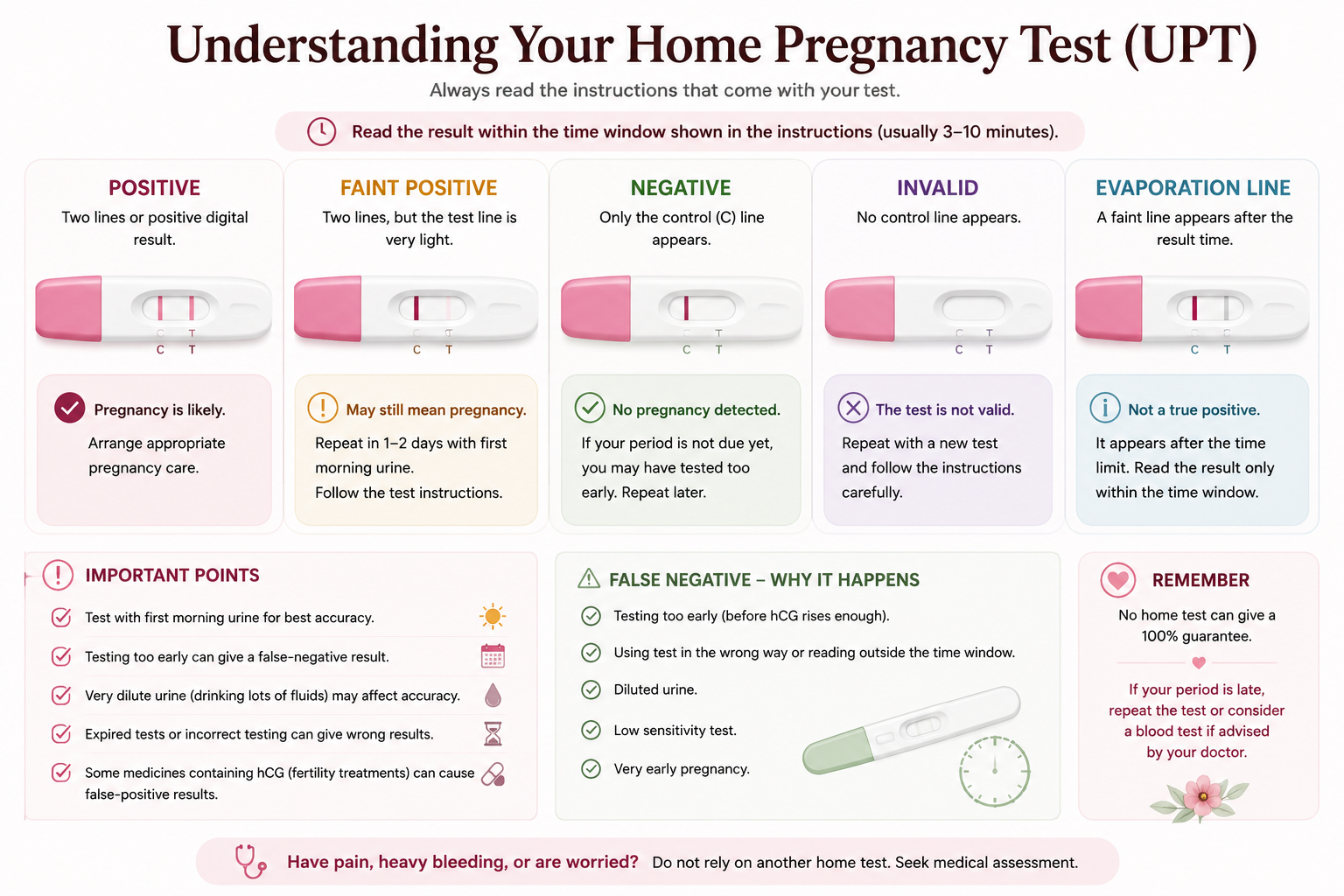
Always follow the instructions supplied with your test and read the result within the manufacturer’s recommended time window.
A correctly performed positive pregnancy test usually means pregnancy is likely.
A faint test line appearing within the correct reading time may still represent pregnancy. Follow the test instructions and repeat testing when appropriate.
No pregnancy was detected by that test at that time. If you tested early, pregnancy may still be possible.
If the control line does not appear, the test has not worked correctly. Use a new test.
6. What does a faint positive line mean?
A faint line can happen when hCG is present but still at a low concentration, such as in very early pregnancy. If a coloured test line appears within the manufacturer’s correct reading window, it may represent a positive result even if it is lighter than the control line.
However, do not keep checking the test long after the recommended reading time. Changes appearing later may not represent a true positive result.
Home pregnancy tests are designed primarily to detect hCG, not to tell you whether your pregnancy is progressing normally.
7. My test is negative, but my period hasn’t come
This is common. One of the most important reasons is simply testing too early.
You may have ovulated later than expected, implantation may have occurred later, or the amount of hCG may still be below the detection threshold of your urine test.
wait until the appropriate testing time and test again.
repeat the UPT after a short interval according to the test instructions.
consider medical assessment. Pregnancy is only one possible cause of a delayed period.
8. Why can a pregnancy test be falsely negative?
A negative result can occur despite pregnancy when:
- you tested too early;
- ovulation occurred later than expected;
- implantation occurred later than expected;
- your urine was very dilute;
- the test was used incorrectly;
- the result was read incorrectly; or
- the test has a higher hCG detection threshold.
This is why the timing of the test matters just as much as the test itself.
9. Can a pregnancy test be falsely positive?
True false-positive home tests are much less common than false-negative tests, but misleading results can occur.
Examples include reading a test outside its recommended time window, recent pregnancy or pregnancy loss while hCG is still present, and some fertility treatments that contain or involve hCG.
If the result is unexpected or confusing, repeating the test or discussing appropriate blood testing with a healthcare professional may help clarify the situation.
10. My UPT is positive — what should I do next?
A correctly performed positive home pregnancy test usually means pregnancy is likely.
- Arrange appropriate pregnancy care.
- Start or continue folic acid if appropriate.
- Review regular medicines and medical conditions with your doctor.
- Avoid smoking and alcohol.
- Plan an ultrasound at an appropriate stage when clinically indicated.
You can also read our Folic Acid in Pregnancy guide for practical advice on when folic acid matters and how much is usually recommended.
11. What does my beta-hCG number mean?
This is where early pregnancy testing can become confusing. There is no single beta-hCG number that proves a pregnancy is healthy.
hCG concentrations vary widely between pregnancies. Two healthy pregnancies at a similar stage can have very different beta-hCG values.
- the exact gestational age;
- whether the pregnancy will continue normally;
- whether the pregnancy is inside the uterus;
- whether a pregnancy is ectopic; or
- what an ultrasound should definitely show in every woman.
Doctors interpret beta-hCG together with your dates, symptoms, examination when needed, previous results and ultrasound findings.
12. Why is beta-hCG sometimes repeated?
In some early pregnancies, a doctor may order another beta-hCG measurement after an appropriate interval. The important information is often the change over time, rather than one isolated number.
Serial beta-hCG measurements may be used when there is early pregnancy bleeding or pain, uncertain pregnancy dates, an inconclusive ultrasound, or when the location or progression of a pregnancy is not yet clear.
No simple “must double every 48 hours” rule can accurately describe every normal pregnancy. The expected change depends on the clinical situation and starting hCG concentration. Your doctor should interpret serial results rather than relying on a DIY doubling calculation.
13. Positive test but nothing seen on ultrasound?
Very early in pregnancy, a positive pregnancy test can occur before an ultrasound can clearly identify the pregnancy. This can simply mean the scan was performed too early.
However, when a pregnancy test is positive and the pregnancy has not yet been located on ultrasound, follow-up can be important because the possibilities may include a very early intrauterine pregnancy, a pregnancy that is not continuing, or an ectopic pregnancy.
Read our Pregnancy of Unknown Location (PUL) guide for a fuller explanation.
14. When does ultrasound become useful?
Ultrasound becomes increasingly useful as pregnancy progresses, but what can be seen depends on how far along the pregnancy really is, whether the dates are accurate, the type and quality of ultrasound, and the individual clinical situation.
Doctors therefore avoid interpreting an early scan or beta-hCG value in isolation.
Our Early Pregnancy Ultrasound guide explains what doctors look for during the first weeks.
15. Pregnancy tests after a chemical pregnancy or pregnancy loss
hCG does not necessarily disappear immediately when a pregnancy ends. It can take time for the hormone concentration to fall, so a pregnancy test may remain positive for a period after a very early pregnancy loss or miscarriage.
This is one reason why a positive test does not always tell us exactly what is happening at that moment.
If you are trying to understand a very early positive test followed by bleeding or a later negative result, our Chemical Pregnancy guide explains this in more detail.
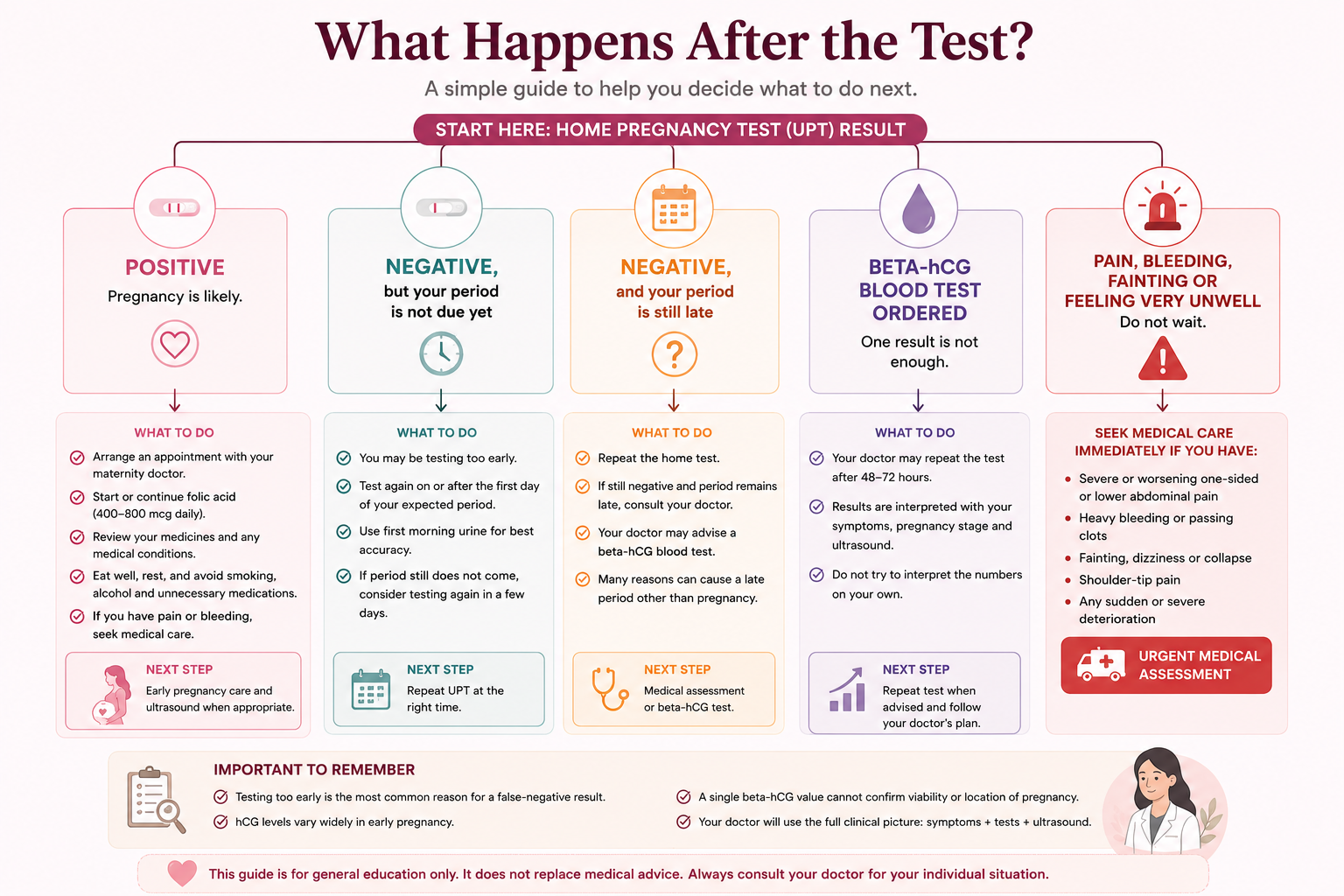
16. What happens after the test?
What you do next depends on the result, when you tested and whether you have symptoms.
Your pregnancy, personalized
If your pregnancy test is positive, build your personalized AuratSehat pregnancy journey and see the important milestones, timing and care information that may matter as your pregnancy progresses.
Start My Pregnancy →When should I seek urgent medical care?
Do not rely on another home pregnancy test if you may be pregnant and develop concerning symptoms.
Seek urgent medical assessment for symptoms such as:
- severe or worsening abdominal or pelvic pain;
- significant one-sided pain;
- heavy bleeding;
- fainting, collapse or severe dizziness;
- shoulder-tip pain; or
- feeling seriously unwell.
These symptoms can have several causes, but early pregnancy complications including ectopic pregnancy need to be considered.
Frequently Asked Questions
How early can a blood beta-hCG test detect pregnancy?
Beta-hCG can become measurable in blood soon after implantation. In an example 28-day cycle, this may be around Days 23–25 in some pregnancies, but the exact timing varies because ovulation and implantation do not occur on identical days in every woman.
Can beta-hCG detect pregnancy before a urine pregnancy test?
Yes. Quantitative blood testing can detect smaller amounts of hCG, so it may identify pregnancy several days before a home urine test becomes reliably positive.
When is the best time to do a home pregnancy test?
A home UPT becomes much more reliable around the time your period is expected or after it is late. Testing several days earlier increases the chance of a false-negative result.
Can I be pregnant with a negative UPT?
Yes, particularly if you tested too early. Later ovulation, later implantation, dilute urine and differences in test sensitivity can all contribute to an early negative result.
Does a faint line mean I am pregnant?
A faint test line appearing within the manufacturer’s correct reading window may represent pregnancy. Follow the instructions for your specific test and repeat testing when appropriate.
Should I compare the darkness of pregnancy-test lines every day?
Home pregnancy tests are not designed to reliably assess pregnancy progression by line darkness. If pregnancy progression needs medical assessment, your doctor may use clinical evaluation, beta-hCG testing and/or ultrasound as appropriate.
Can one beta-hCG result confirm that my pregnancy is normal?
Usually not. A single beta-hCG value has limited meaning by itself. Doctors interpret it with symptoms, pregnancy dates, repeat values when indicated and ultrasound findings.
Can beta-hCG tell whether I have an ectopic pregnancy?
Beta-hCG alone cannot determine the location of a pregnancy. Symptoms, serial testing and ultrasound may all be needed when an ectopic pregnancy is a concern.
Medical References
- American College of Obstetricians and Gynecologists (ACOG). Guidance and patient information relating to early pregnancy, pregnancy testing and early pregnancy loss.
- National Institute for Health and Care Excellence (NICE). Ectopic pregnancy and miscarriage: diagnosis and initial management.
- NHS. Pregnancy testing and early pregnancy patient information.
- Barnhart KT et al. Clinical research describing early human chorionic gonadotropin patterns and the limitations of rigid hCG “doubling” rules in early pregnancy.
Ask a Doctor for Free
Confused by a faint line, negative test with a late period, beta-hCG result or what you should do next? Send your question to the AuratSehat medical team.
Ask a Doctor for FreeMedical Content & Editorial Team, AuratSehat
Obstetrics & Gynaecology