
Dark Spots on the Face
A dark mark on your face is not a diagnosis by itself. It might be a mark left after acne, irritation after threading or waxing, melasma, a sun-related spot, or another type of pigmentation. The first step is not choosing the strongest cream — it is working out what kind of spot you are treating.
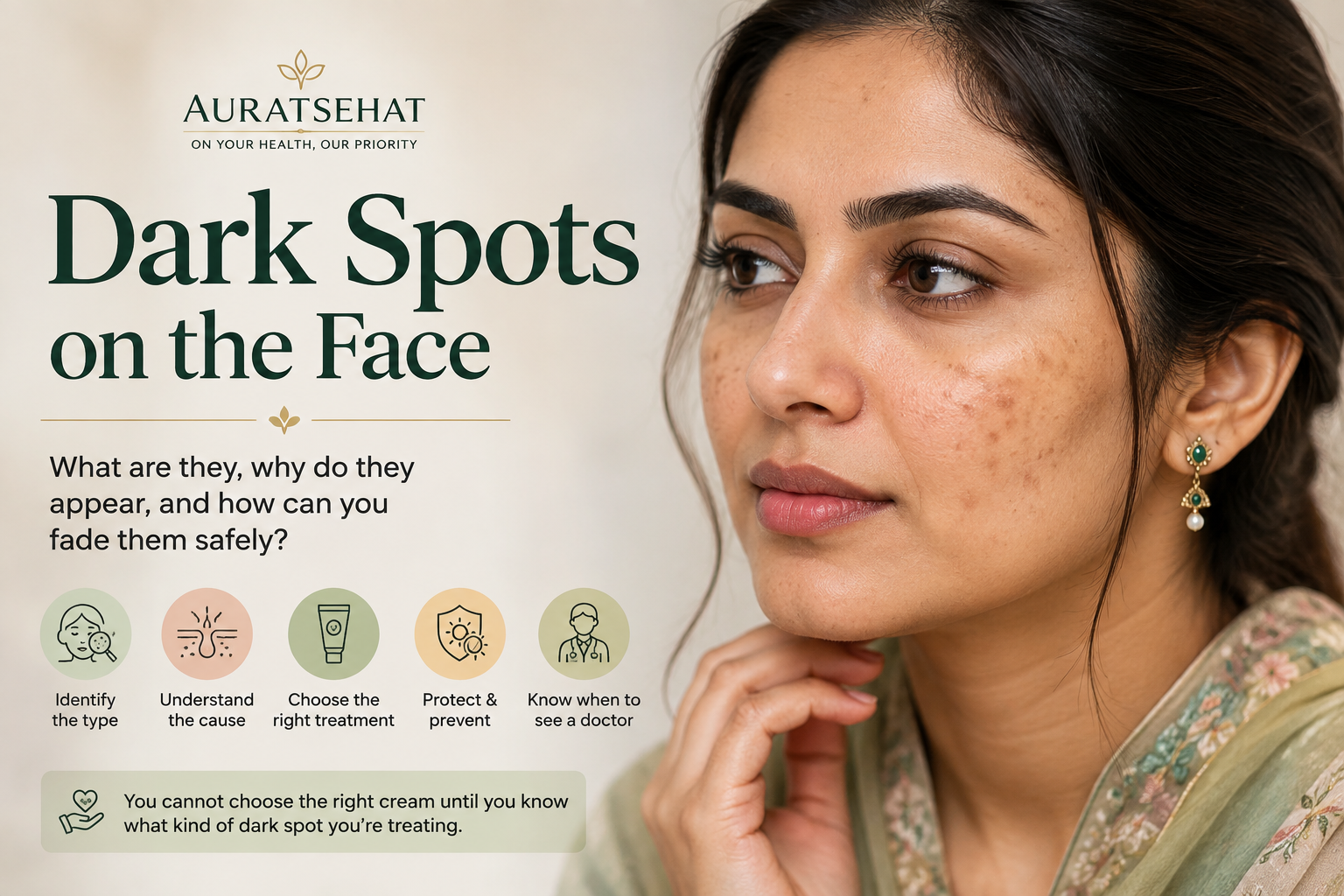
You cannot choose the right cream until you know what kind of dark spot you are treating. Different causes need different approaches, and repeatedly irritating the skin with strong products can make pigmentation worse.
What are dark spots on the face?
“Dark spots” is a broad everyday term. It usually means an area of skin that looks darker than the surrounding skin. In many women, especially those with medium to deeper skin tones, inflammation can trigger the skin to make extra melanin. Once the original pimple, rash or irritation settles, some of that extra pigment may remain.
This is called post-inflammatory hyperpigmentation (PIH). But PIH is only one possibility. Melasma, sun-related pigmentation, freckles, lentigines and other skin conditions can also look like “dark spots.”
If you keep treating every brown mark with the same brightening cream, you can easily miss the real cause. Pattern, location and what happened before the pigmentation appeared matter.
What kind of dark spots do I have?
Start by looking at where the pigmentation is, whether it is symmetrical, and what happened before it appeared. The visual below shows the most useful patterns to recognise.
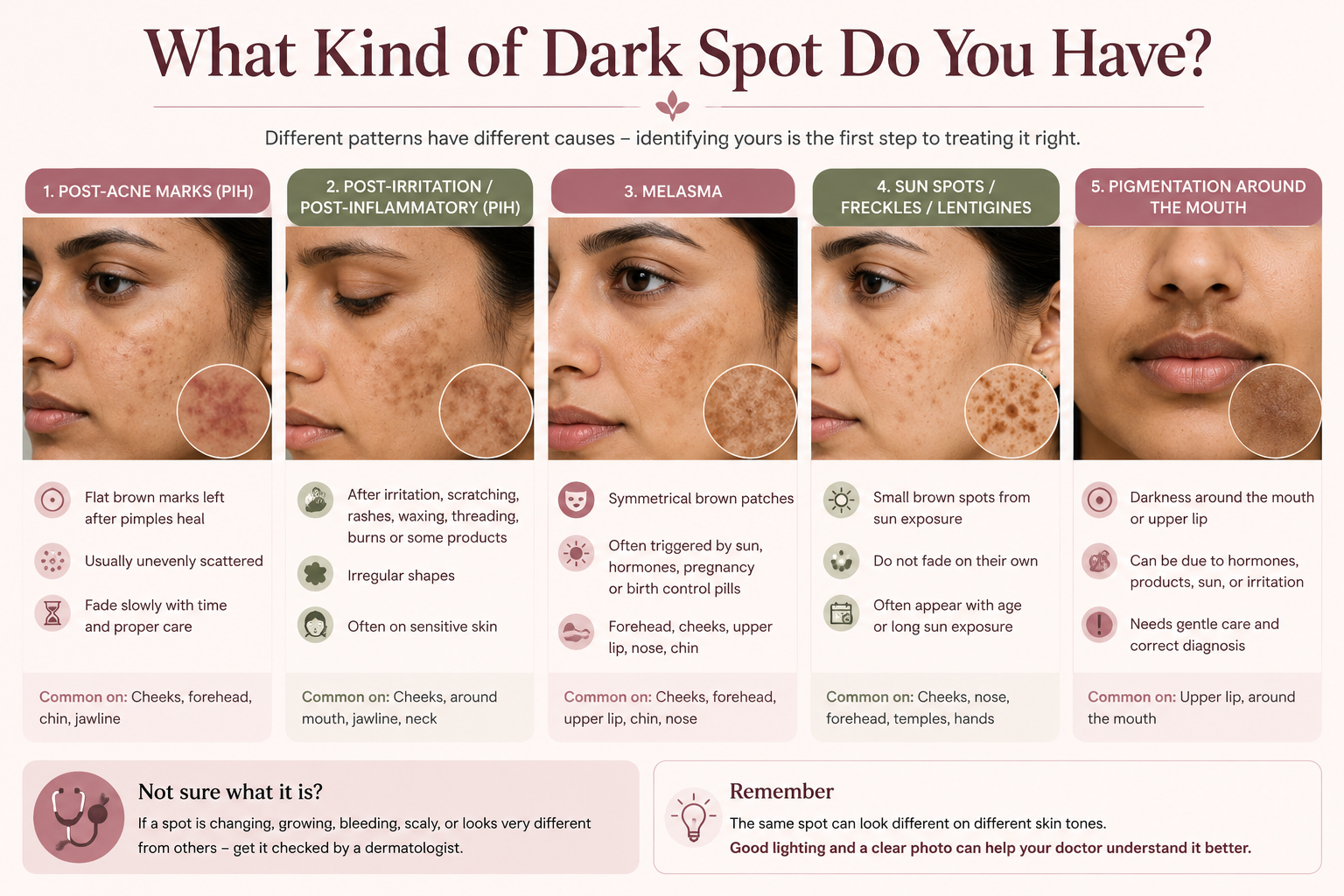
Flat brown marks where pimples healed
These are commonly post-acne hyperpigmentation rather than true acne scars. They may be brown, dark brown or greyish depending on your skin tone and how deep the pigment lies.
Marks after threading, waxing, scratching or a rash
Pigmentation can appear exactly where the skin was inflamed or injured. Continuing the trigger can keep producing new marks even while you try to fade the old ones.
Brown patches on both cheeks, forehead or upper lip
This pattern may be melasma rather than isolated PIH, especially if it is worsened by sunlight, pregnancy or hormonal changes.
Small individual brown spots on sun-exposed skin
Freckles and solar lentigines can look quite different from PIH. They may not respond in the same way to ordinary acne-mark treatment.
Why do dark spots appear?
Many facial dark spots develop through the same basic pathway: something irritates or stimulates the skin, the skin produces more pigment, and some of that pigment remains after the trigger settles.
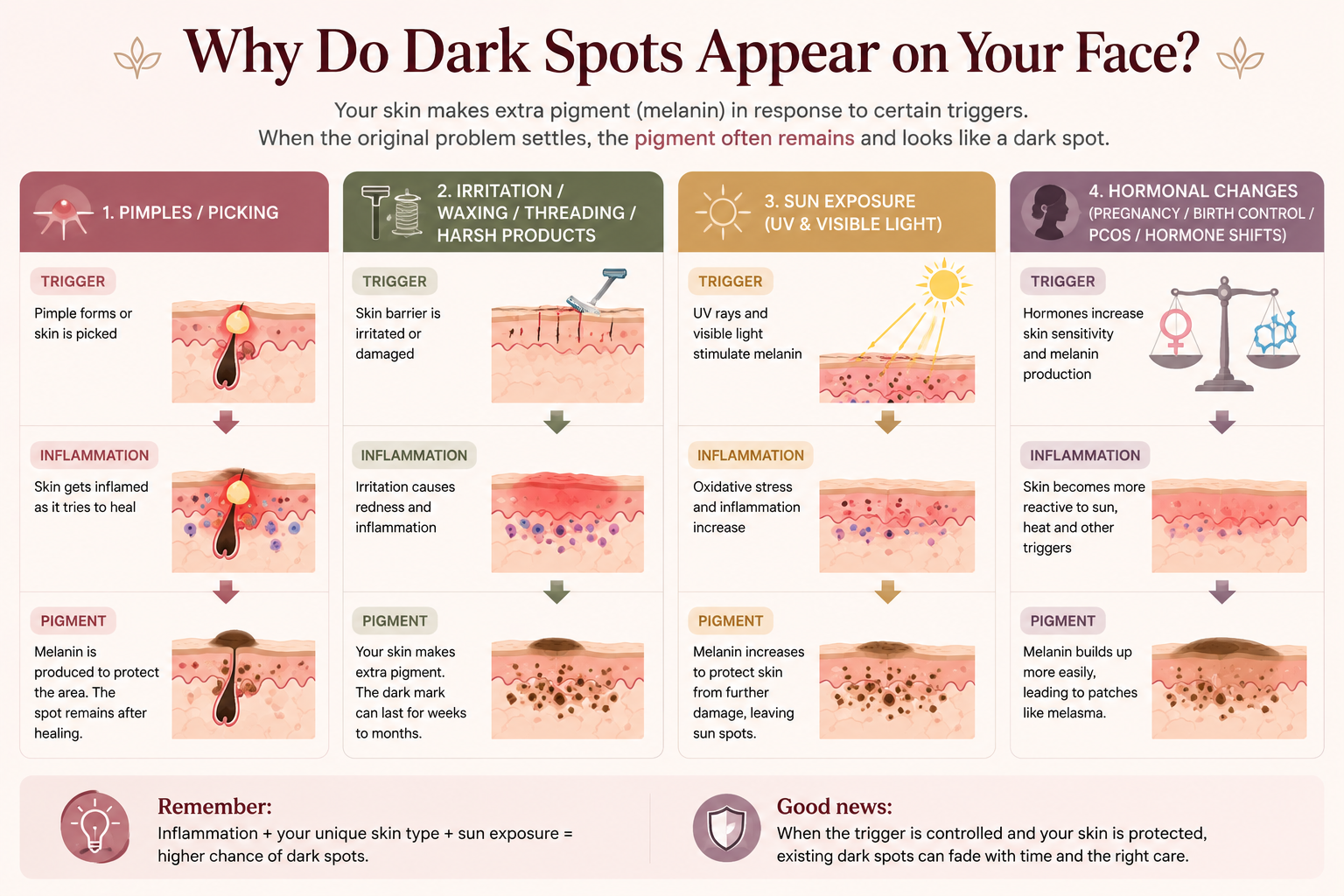
Common triggers include:
- Acne and inflammatory pimples
- Picking or squeezing spots
- Threading, waxing or shaving irritation
- Scratching, eczema or other rashes
- Burns or skin injuries
- Harsh skincare or products that repeatedly sting or inflame the skin
- Sun and visible-light exposure
- Hormonal changes, particularly in melasma
The American Academy of Dermatology similarly emphasizes that effective hyperpigmentation treatment begins by identifying and controlling the cause. Once the trigger is removed, many marks gradually fade, although deeper pigmentation can take much longer.
Dark spots after pimples
This is one of the most common situations in younger women. A pimple becomes inflamed, heals, and leaves a flat brown or grey mark behind. The mark is often called an “acne scar,” but if the skin surface is flat, it is usually pigmentation rather than a true scar.
The key mistake is treating only the marks while new acne continues. Every new inflamed pimple can create another mark, so you may feel that your pigmentation treatment “is not working” even though old spots are fading.
Stop new acne first + avoid picking + use sunscreen + fade the remaining pigmentation. Our dedicated Acne Marks & Dark Spots article goes deeper into that pathway.
Dark spots after threading, waxing, picking or irritating products
Pakistani women commonly remove facial hair using threading or waxing, and some skin becomes irritated afterward. Friction, repeated trauma and harsh products can trigger inflammation followed by pigmentation.
You can also develop marks after scratching, allergic or irritant reactions, acne picking, strong exfoliating products or combinations of several actives at once.
Do not keep repeatedly waxing, scratching, exfoliating or using the product that is burning the area.
Use a gentle cleanser, simple moisturiser and sun protection while active redness, burning or peeling settles.
Starting multiple strong actives on already irritated skin can restart the entire inflammation → pigmentation cycle.
Are my dark spots actually melasma?
Melasma usually looks less like several random individual spots and more like symmetrical brown or grey-brown patches. Common areas include the cheeks, forehead, nose and upper lip.
Sunlight, visible light, pregnancy and hormonal factors can contribute. Melasma is usually more persistent and recurrence-prone than an ordinary dark mark left after a pimple.
The pigmentation appears on both sides of the face in a similar pattern, especially across the cheeks, forehead or upper lip. Do not simply keep escalating ordinary “dark spot creams.”
Read our complete Melasma (Chehre Ki Chaiyan) treatment guide.
What about freckles and sun spots?
Small brown spots that occur mainly on sun-exposed areas may represent freckles or solar lentigines rather than post-inflammatory pigmentation. Their behaviour is different: they may become more visible with sun exposure and some persistent lentigines do not simply fade away when inflammation settles because there was no inflammatory trigger.
Daily photoprotection remains important, but if you have a persistent discrete lesion and want it treated, the diagnosis should be clear first. Dermatologists may consider selected topical treatments, chemical peels, lasers or other procedures depending on the type of lesion and your skin tone.
Why is the skin around my mouth darker?
Pigmentation around the mouth is common, but it is not a single diagnosis. Possible contributors include irritation, friction, lip licking, eczema, sun exposure, previous inflammation, hair-removal irritation and sometimes a melasma-like pattern.
This is why repeatedly applying stronger bleaching products around the mouth can backfire. If the skin is irritated, the treatment itself may create more pigmentation.
If there is itching, scaling, burning, recurrent rash or significant colour change around the lips, treat or diagnose the underlying skin problem rather than trying to “lighten” it blindly.
What should I do for my dark spot?
This article deliberately does not turn into another huge list of pigmentation products. The correct treatment depends on the pattern you identified above.
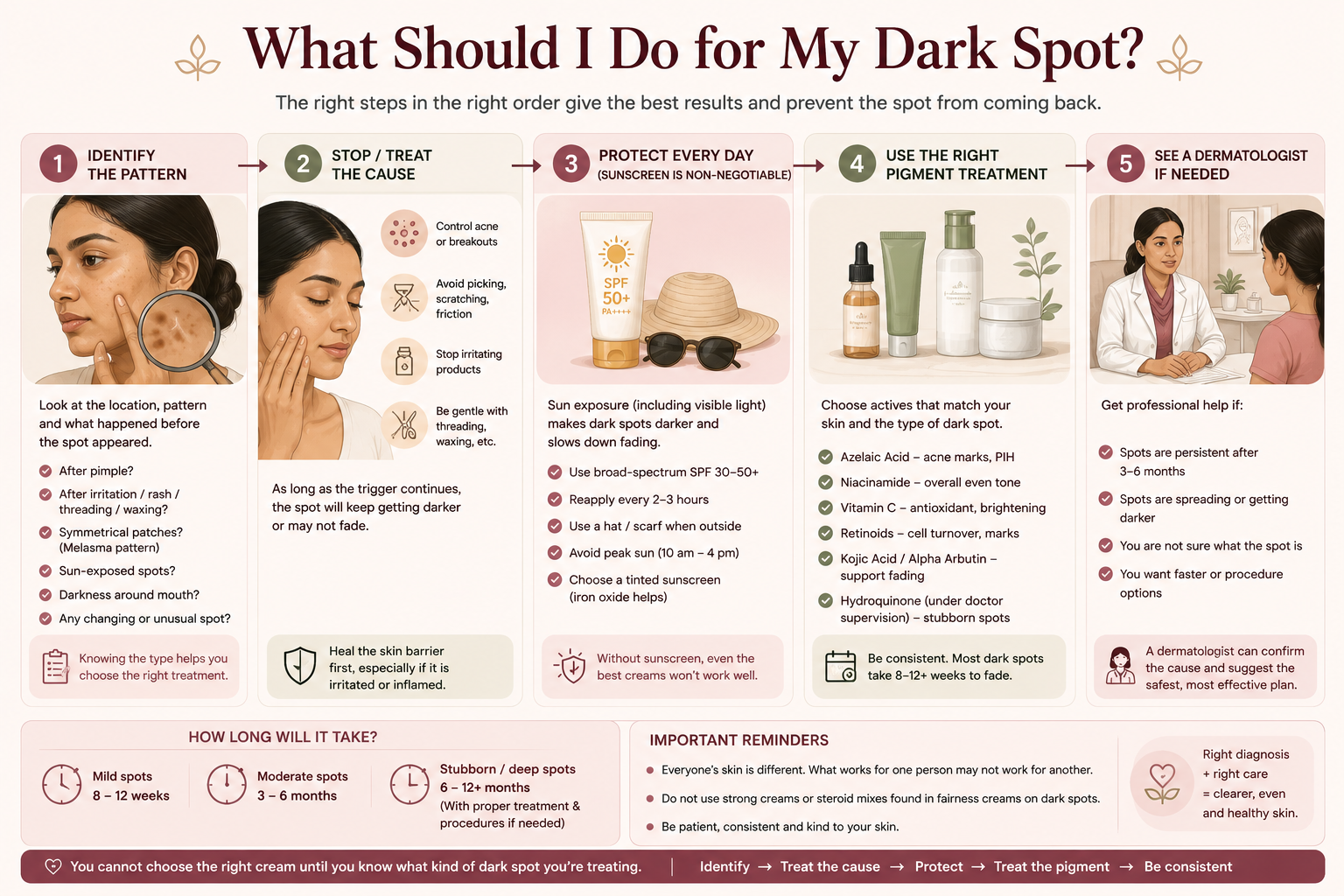
| Your dark spot looks like… | First priority | What may help |
|---|---|---|
| Flat mark after a pimple | Control active acne | Sunscreen plus a suitable pigment/acne treatment such as azelaic acid or a retinoid when appropriate |
| Mark after threading, waxing, scratching or a harsh product | Stop the irritation | Barrier recovery first, then a gentle pigment treatment |
| Symmetrical cheek, forehead or upper-lip patches | Consider melasma | Melasma-specific treatment and rigorous photoprotection |
| Small sun-related discrete brown spots | Confirm the diagnosis | Photoprotection plus diagnosis-specific topical or procedural options |
| Persistent or unclear pigmentation | Reassess the cause | Dermatologist assessment before moving to stronger prescription treatment or procedures |
Do I really need sunscreen for dark spots?
Yes. Sunlight can darken existing pigmentation and make treatment slower. For pigmentation-prone skin, daily broad-spectrum sunscreen with at least SPF 30 is one of the most important parts of treatment.
Tinted sunscreens containing iron oxides can provide additional protection against visible light, which is particularly relevant in melasma and pigmentation-prone darker skin tones. Reapplication is especially important when you are outdoors for prolonged periods, sweating or exposed to intense sunlight.
You may continue stimulating pigment while simultaneously trying to fade it. Sunscreen does not “bleach” your skin — it helps stop excess pigmentation from being reinforced.
Which ingredients can fade dark spots?
Several ingredients can help pigmentation, but this is intentionally a compact overview. Our separate Best Ingredients for Pigmentation guide will compare them in much greater depth.
Layering several acids, retinoids, scrubs, brightening serums and fairness creams can damage the skin barrier. In pigmentation-prone skin, irritation itself can create additional dark marks.
A simple routine for facial dark spots
You usually do not need a ten-step routine. A simple routine that you can tolerate consistently is often more useful than repeatedly changing products.
Morning
- Gentle cleanser
- One suitable pigment-targeting ingredient if needed
- Moisturiser
- Broad-spectrum SPF 30–50+
Night
- Gentle cleanser
- Your selected treatment
- Moisturiser
If your skin becomes persistently red, painful, itchy, swollen or intensely peeling, stop escalating treatment. Irritation is not proof that the product is “working.”
What if I am pregnant or trying to conceive?
Pregnancy can itself contribute to facial pigmentation, including melasma. More importantly, not every pigmentation treatment is suitable during pregnancy.
Avoid starting prescription or strong pigment treatments without checking pregnancy safety. In particular, topical retinoids are generally avoided during pregnancy, and hydroquinone is usually not recommended because of substantial systemic absorption and limited pregnancy safety data.
Gentle skincare, moisturiser, careful sun protection and pregnancy-compatible options such as azelaic acid are usually more appropriate starting points.
Do home remedies remove dark spots?
Pakistani women are often advised to try lemon, potato juice, aloe vera, Multani mitti, besan, turmeric or rose water. The important question is not whether something is “natural,” but whether it has good evidence and whether it irritates your skin.
| Home remedy | What to know |
|---|---|
| Lemon juice | Can irritate skin and increase sensitivity. Irritation may worsen pigmentation. Not recommended as a dark-spot treatment. |
| Potato / potato juice | Popular online, but there is not strong clinical evidence that it reliably treats facial hyperpigmentation. |
| Aloe vera | May soothe some irritated skin, but it should not be expected to remove established pigmentation on its own. |
| Multani mitti | Can absorb oil but may dry or irritate some skin. It is not a proven treatment for established dark spots. |
| Besan / turmeric mixtures | May be tolerated by some people but can irritate others. Evidence for significant treatment of persistent pigmentation is limited. |
If a home remedy burns, stings, causes redness or repeatedly dries your skin, stop it. The irritation can become another trigger for pigmentation.
Should I use a fairness or whitening cream for dark spots?
Be cautious. A product advertised as a “fairness cream” is not automatically an appropriate dark-spot treatment. Some unregulated lightening products may contain potent corticosteroids, mercury or other problematic ingredients, and ingredients may not always be clearly disclosed.
Long-term misuse of steroid-containing mixtures can contribute to acne-like eruptions, thinning skin, visible blood vessels, irritation and abnormal pigmentation. Strong hydroquinone-containing products also should not be used indefinitely without appropriate supervision.
If a cream promises dramatic fairness in a few days, do not assume faster means better. Healthy pigmentation treatment aims to reduce excess pigment, not change your natural skin colour.
What if creams are not enough?
Dermatologists can sometimes use procedures such as chemical peels, selected lasers or other pigment-targeting treatments. But procedures are not automatically the “next stronger step” for every dark spot.
Skin of colour can develop additional post-inflammatory pigmentation after aggressive procedures. The diagnosis, procedure type, settings and experience of the treating dermatologist therefore matter.
This is especially important for melasma, in which aggressive procedures can sometimes worsen or trigger recurrence.
How long do dark spots take to fade?
Dark spots usually fade slowly rather than disappearing in days. The American Academy of Dermatology notes that once the trigger has been controlled, a superficial spot only a few shades darker than the natural skin colour may take months to fade, while deeper pigmentation may take much longer.
Your timeline depends on the cause, depth of pigment, your natural skin tone, ongoing inflammation, sun exposure and how consistently you use treatment.
For many pigmentation treatments, meaningful improvement is measured over weeks to months. Constantly switching products can make it difficult to know what is helping and increases the chance of irritation.
Why do my dark spots keep coming back?
Often because the trigger is still active.
- New pimples keep creating new marks.
- You continue picking or squeezing acne.
- Threading or waxing repeatedly irritates the same area.
- A skincare product continues causing inflammation.
- You are not consistently protecting the skin from sunlight.
- The underlying problem is actually melasma, which commonly recurs.
Instead of asking only, “Which cream is stronger?” ask: “Why am I still making new pigment?”
When should a dark spot be checked by a dermatologist?
Most post-inflammatory pigmentation is harmless, but not every dark lesion should be assumed to be cosmetic pigmentation.
Seek medical assessment if a spot is new and rapidly changing, growing, bleeding, ulcerating, repeatedly crusting, very different from your other spots, or has an unusual shape or colour pattern.
You should also consider dermatologist review when pigmentation has not improved despite several months of sensible treatment, is spreading, repeatedly returns, or you are unsure whether it is PIH, melasma, a sun-related lesion or something else.
Common questions about dark spots on the face
Can dark spots disappear completely?
Many post-inflammatory marks can fade substantially or completely, especially when the trigger is controlled. Deeper pigmentation and some other types of brown spots may persist longer or require targeted treatment.
What is the best cream for dark spots on the face?
There is no single best cream for every dark spot. An acne mark, melasma patch, irritation-related PIH and a solar lentigo are not the same problem. Identifying the type first is more useful than choosing the strongest product.
Can vitamin C remove dark spots?
Vitamin C can support treatment of uneven pigmentation, but it is usually one part of a broader routine rather than a guaranteed stand-alone cure.
Can niacinamide fade dark spots?
Niacinamide may gradually support a more even skin tone and is usually well tolerated, but persistent pigmentation may need other treatments as well.
Why do my pimples always leave dark marks?
Some skin tones are more prone to post-inflammatory pigment production. Deeper or more inflamed acne, picking, sun exposure and repeated irritation can increase the likelihood of lingering marks.
Does sunscreen actually lighten dark spots?
Sunscreen is not a bleaching product. It prevents UV exposure from repeatedly darkening pigmentation and makes your other treatment more likely to succeed.
Can dark spots be removed in one week?
Usually not. Products promising dramatic removal within days should be approached cautiously. Genuine pigmentation treatment generally takes weeks to months.
Identify → treat the cause → protect from sun → treat the remaining pigment → be consistent.
If the spot is actually acne-related, melasma or another specific condition, treating that condition correctly will usually help more than buying another generic whitening cream.
Trusted dermatology resources
American Academy of Dermatology — How to fade dark spots in darker skin tones
DermNet — Postinflammatory hyperpigmentation
AuratSehat patient education is intended to help you understand common health and skin concerns. It does not replace an individual diagnosis or treatment plan from your own doctor.