
Pregnancy of Unknown Location (PUL)
What it means when your pregnancy test is positive but an ultrasound cannot yet show where the pregnancy is — and why follow-up matters.
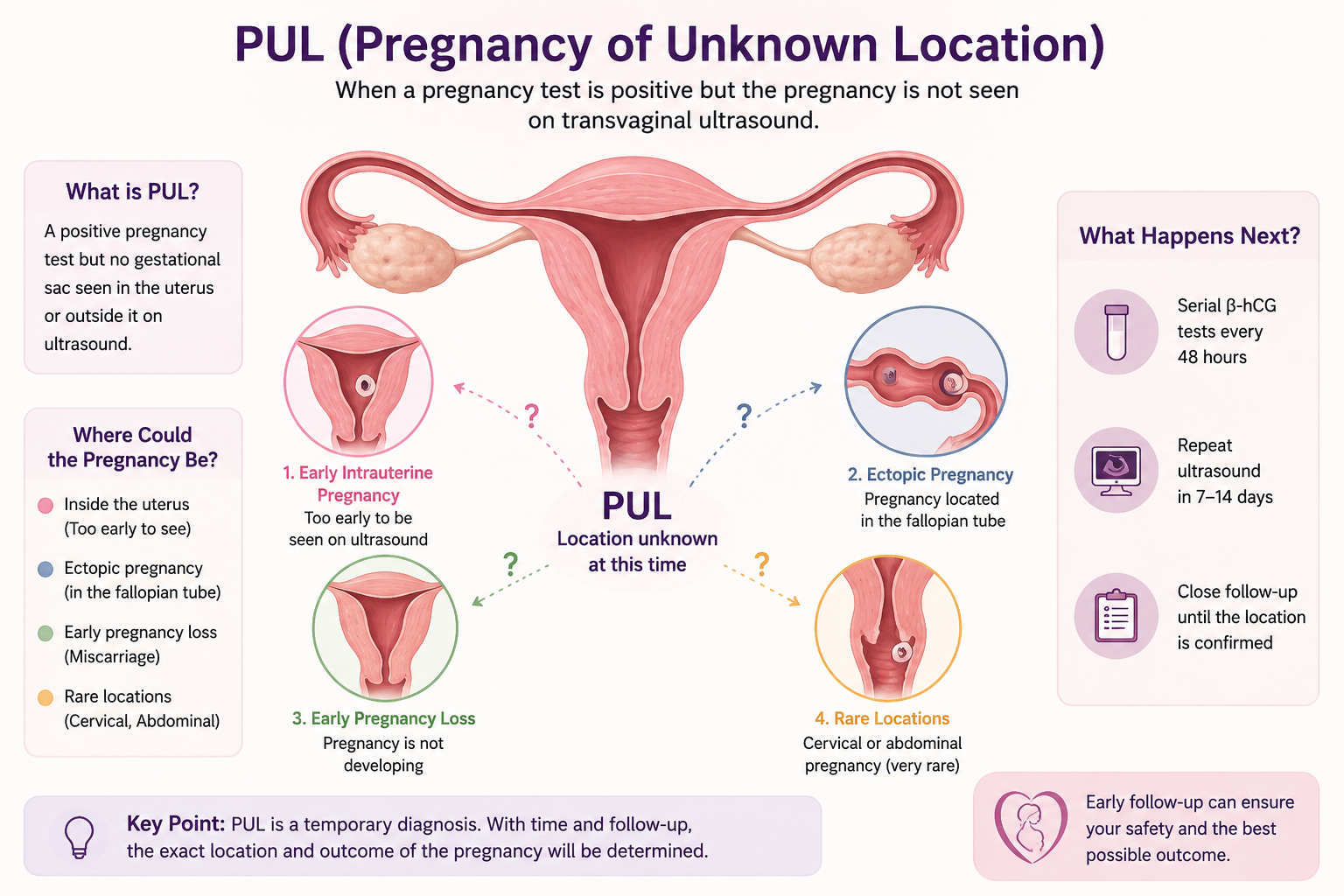
A pregnancy of unknown location (PUL) means your pregnancy test is positive, but an ultrasound has not yet shown a definite pregnancy inside the uterus or outside it. It is not the same as an ectopic pregnancy. Sometimes the pregnancy is simply too early to see, sometimes an early pregnancy loss has occurred, and sometimes the pregnancy is ectopic. Follow-up is needed until the situation becomes clear.
What is a pregnancy of unknown location?
Doctors may use the term pregnancy of unknown location when three things are true:
- Your pregnancy test is positive.
- No definite pregnancy is seen inside the uterus on ultrasound.
- No definite ectopic pregnancy is seen outside the uterus.
This situation is particularly common very early in pregnancy. Modern pregnancy tests can become positive before a pregnancy is large enough to be clearly seen on ultrasound.
PUL describes what doctors know at that moment. It is not the final diagnosis. The aim of follow-up is to work out where the pregnancy is, or whether the pregnancy has already ended.
What can a PUL turn out to be?
There are three main possibilities.
A very early pregnancy in the uterus
The pregnancy may be developing normally but may simply be too early or too small to appear clearly on the first scan.
An early pregnancy loss
The pregnancy may have stopped developing or already passed. Pregnancy tests can remain positive while hCG gradually falls.
An ectopic pregnancy
A very small ectopic pregnancy may not yet be visible on ultrasound. This is the important possibility doctors must continue to consider.
1. A very early normal pregnancy
If the pregnancy is simply earlier than expected, a repeat ultrasound may later show a gestational sac inside the uterus, followed by a yolk sac, embryo and eventually cardiac activity.
This is why doctors usually avoid making a diagnosis of miscarriage or ectopic pregnancy from one very early inconclusive scan alone when the woman is clinically stable.
Our Early Pregnancy Ultrasound guide explains why scan findings change so quickly during the first few weeks.
2. An early pregnancy loss
Sometimes a PUL represents a pregnancy that has stopped developing or has already been lost before an ultrasound could show its location.
The pregnancy test may stay positive for some time because β-hCG does not disappear immediately. Doctors may therefore follow the hormone level until the pregnancy has clearly resolved.
If you are experiencing bleeding or cramping, see our guide to Miscarriage in the First Trimester .
3. An ectopic pregnancy
An ectopic pregnancy develops outside the normal cavity of the uterus, most often inside a fallopian tube.
During the earliest stages it may be too small to identify on ultrasound. A first scan that does not show an ectopic pregnancy therefore does not automatically exclude one.
Read the full Ectopic Pregnancy guide for symptoms, diagnosis and treatment.
A PUL can eventually become a confirmed normal pregnancy inside the uterus, an early pregnancy loss, or an ectopic pregnancy. Until that becomes clear, doctors continue follow-up because ectopic pregnancy remains one of the possibilities.
What symptoms can occur with PUL?
Some women with a pregnancy of unknown location have no symptoms at all.
Others may experience:
- Light spotting
- Vaginal bleeding
- Lower abdominal or pelvic pain
- Pelvic cramping
- One-sided pelvic pain
- Nausea or other early pregnancy symptoms
Symptoms alone cannot tell whether a pregnancy is inside or outside the uterus. Their severity and whether they are changing are nevertheless very important when doctors decide how urgently you need reassessment.
If bleeding is your main concern, see Vaginal Bleeding in Early Pregnancy .
How do doctors investigate a PUL?
Doctors usually combine your symptoms and examination with transvaginal ultrasound and quantitative blood β-hCG.
Transvaginal ultrasound
A transvaginal ultrasound places the probe closer to the uterus and is generally more useful than an abdominal scan during very early pregnancy.
The clinician may look for:
- A gestational sac inside the uterus
- A yolk sac
- An embryo and cardiac activity when far enough along
- A mass near a fallopian tube or ovary
- Free fluid or blood within the pelvis
If the scan cannot establish where the pregnancy is, the pregnancy may be temporarily classified as a PUL.
Quantitative β-hCG blood tests
Quantitative β-hCG measures the amount of pregnancy hormone in the blood. Doctors commonly take two measurements around 48 hours apart and compare how the level changes.
A single β-hCG result cannot tell you whether a pregnancy is inside the uterus or ectopic. Even the pattern over 48 hours is only one part of the assessment. Doctors interpret it together with your symptoms and ultrasound.
If you want to understand what β-hCG is and why blood tests are sometimes repeated, read Pregnancy Test: UPT & Blood β-hCG .
What is the β-hCG “discriminatory level”?
You may hear doctors use the term discriminatory level or discriminatory zone. It refers to a β-hCG level above which an intrauterine pregnancy may usually be expected to become visible on a high-quality transvaginal ultrasound.
However, this is not an absolute cut-off. Pregnancy dates, ultrasound equipment, the person performing the scan and normal biological variation can all affect what is visible.
Not seeing a pregnancy in the uterus at a particular β-hCG level does not, by itself, prove that the pregnancy is ectopic. When the woman is stable, repeat assessment can help avoid ending a potentially wanted pregnancy based on an uncertain early result.
What happens after a PUL diagnosis?
The exact plan depends on your symptoms, ultrasound findings, β-hCG results and how clinically stable you are.
Clinical assessment
Your doctor considers your pain, bleeding, examination findings, pregnancy dates and ectopic-pregnancy risk factors.
Repeat β-hCG when appropriate
Two blood measurements are often taken approximately 48 hours apart to understand the direction in which the pregnancy hormone is moving.
Repeat transvaginal ultrasound
If the pregnancy may simply be too early to see, another ultrasound may be arranged after several days according to the clinical situation.
Continue until the outcome is clear
Follow-up continues until doctors confirm an intrauterine pregnancy, establish that the pregnancy has resolved, or diagnose and manage an ectopic pregnancy.
If pain, bleeding, dizziness or other symptoms become worse while you are being followed for a PUL, you need reassessment even if an earlier β-hCG result seemed reassuring.
Will a PUL need treatment?
Not necessarily. PUL itself is not a condition that automatically needs treatment. Treatment depends on what the follow-up eventually shows.
If an intrauterine pregnancy becomes visible
Once ultrasound confirms that the pregnancy is developing inside the uterus, PUL follow-up is no longer needed and pregnancy care continues according to the individual situation.
If the pregnancy is resolving
If β-hCG is falling and you remain clinically well, your healthcare team may continue monitoring until they are satisfied that the pregnancy has resolved. The exact follow-up plan depends on your results and local clinical protocol.
If ectopic pregnancy is suspected or confirmed
Management may include observation in carefully selected stable cases, methotrexate, or surgery, depending on the pregnancy, your symptoms, β-hCG levels, ultrasound findings and overall clinical condition.
These options are explained in detail in our Ectopic Pregnancy article.
When is PUL an emergency?
Until the pregnancy location is known, an ectopic pregnancy cannot always be excluded. A ruptured ectopic pregnancy can cause serious internal bleeding.
Seek urgent medical care if you develop:
- Severe or rapidly worsening abdominal or pelvic pain
- Severe one-sided pain
- Shoulder-tip pain, particularly with abdominal pain or bleeding
- Fainting or collapse
- Severe dizziness or feeling unusually weak
- Heavy vaginal bleeding
These symptoms need urgent assessment rather than waiting for your next planned β-hCG test or ultrasound.
PUL vs ectopic pregnancy
| Pregnancy of unknown location | Ectopic pregnancy |
|---|---|
| Pregnancy test is positive. | Pregnancy test is usually positive. |
| The pregnancy location has not yet been established. | The pregnancy is developing outside the normal uterine cavity. |
| May still be a very early normal pregnancy. | Cannot develop into a normal viable pregnancy. |
| May represent an early pregnancy loss. | Can rupture and cause internal bleeding. |
| Requires follow-up until the outcome is established. | Requires appropriate monitoring or treatment. |
Common questions about PUL
Can a PUL become a normal pregnancy?
Yes. If the pregnancy is simply too early to visualize on the first ultrasound, a later scan may show a normally developing pregnancy inside the uterus.
Can a PUL turn out to be a miscarriage?
Yes. Some PULs represent pregnancies that stopped developing or were lost before their location could be confirmed. β-hCG usually falls as the pregnancy resolves.
Can a PUL turn out to be ectopic?
Yes. A very small ectopic pregnancy may initially be invisible on ultrasound. This is why follow-up should continue until the pregnancy location or outcome is clear.
Is pregnancy of unknown location dangerous?
A PUL is not automatically dangerous. The reason doctors monitor it carefully is that an ectopic pregnancy can initially present as a PUL and can become dangerous if it ruptures.
How long does a PUL take to resolve?
It varies. Some pregnancies become visible on a repeat scan within days, while others require longer follow-up as β-hCG falls or doctors clarify the diagnosis.
Can an ultrasound miss an ectopic pregnancy?
Yes. A very early ectopic pregnancy may be too small to identify on the first scan. New or worsening symptoms therefore need reassessment even after an inconclusive ultrasound.
Does a high β-hCG mean I have an ectopic pregnancy?
No. A β-hCG value by itself cannot diagnose an ectopic pregnancy or identify where the pregnancy is located.
Can I have a healthy baby after being told I have a PUL?
Yes. A PUL may simply represent an intrauterine pregnancy that was too early to see. If a later ultrasound confirms normal development inside the uterus, the pregnancy can continue normally.
Related Pregnancy guides
My Pregnancy
Follow your pregnancy stage, important milestones and what may be coming next in your pregnancy journey.
Open My PregnancyAsk a Doctor for Free
Have a positive pregnancy test, an inconclusive ultrasound, unusual β-hCG results, bleeding or cramping? Send your question to AuratSehat.
Ask a DoctorMedical references
- National Institute for Health and Care Excellence (NICE). Ectopic pregnancy and miscarriage: diagnosis and initial management (NG126).
- Royal College of Obstetricians and Gynaecologists (RCOG). Ectopic pregnancy — patient information.
- Royal College of Obstetricians and Gynaecologists (RCOG). Bleeding and/or pain in early pregnancy — patient information.
Medical Content & Editorial Team, AuratSehat
AuratSehat provides educational health information and does not replace examination, ultrasound, laboratory assessment or individual medical care. A pregnancy of unknown location requires appropriate follow-up because an ectopic pregnancy cannot always be excluded immediately.