
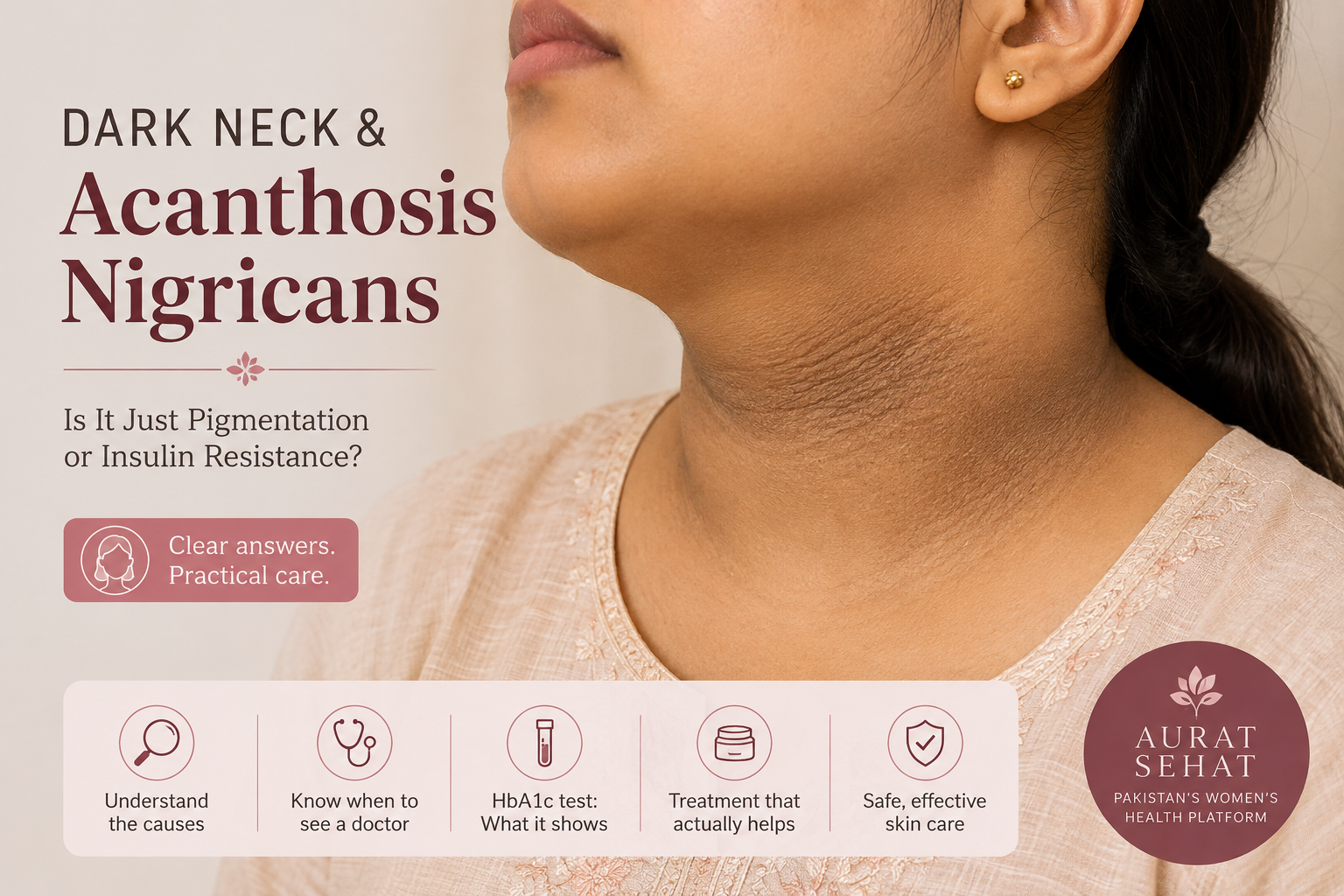
Dark Neck & Acanthosis Nigricans — Is It Just Pigmentation or Insulin Resistance?
A dark neck does not automatically mean insulin resistance. Sometimes the colour change is tanning, friction, eczema or post-inflammatory pigmentation. But when the skin becomes darker, thicker and velvety, especially in the neck folds, acanthosis nigricans becomes more likely.
The important question is not simply, “Which cream will lighten my neck?” It is: what is actually causing the change?
Colour alone is not enough. Texture, pattern, location and what happened before the darkening appeared are what help separate tanning, post-inflammatory pigmentation and acanthosis nigricans.
Why is my neck darker than my face?
The neck can become darker for several reasons. Sun exposure, friction, previous eczema or rash, perfume irritation, jewellery reactions and post-inflammatory pigmentation can all create colour changes.
Some people also naturally have slightly more pigment around folds and creases. This does not necessarily mean disease.
Acanthosis nigricans is different because the change is usually not only about colour. The skin also becomes thicker, more textured and velvety.
Is it tanning, pigmentation or acanthosis nigricans?
This is the most useful question to answer before choosing any treatment.
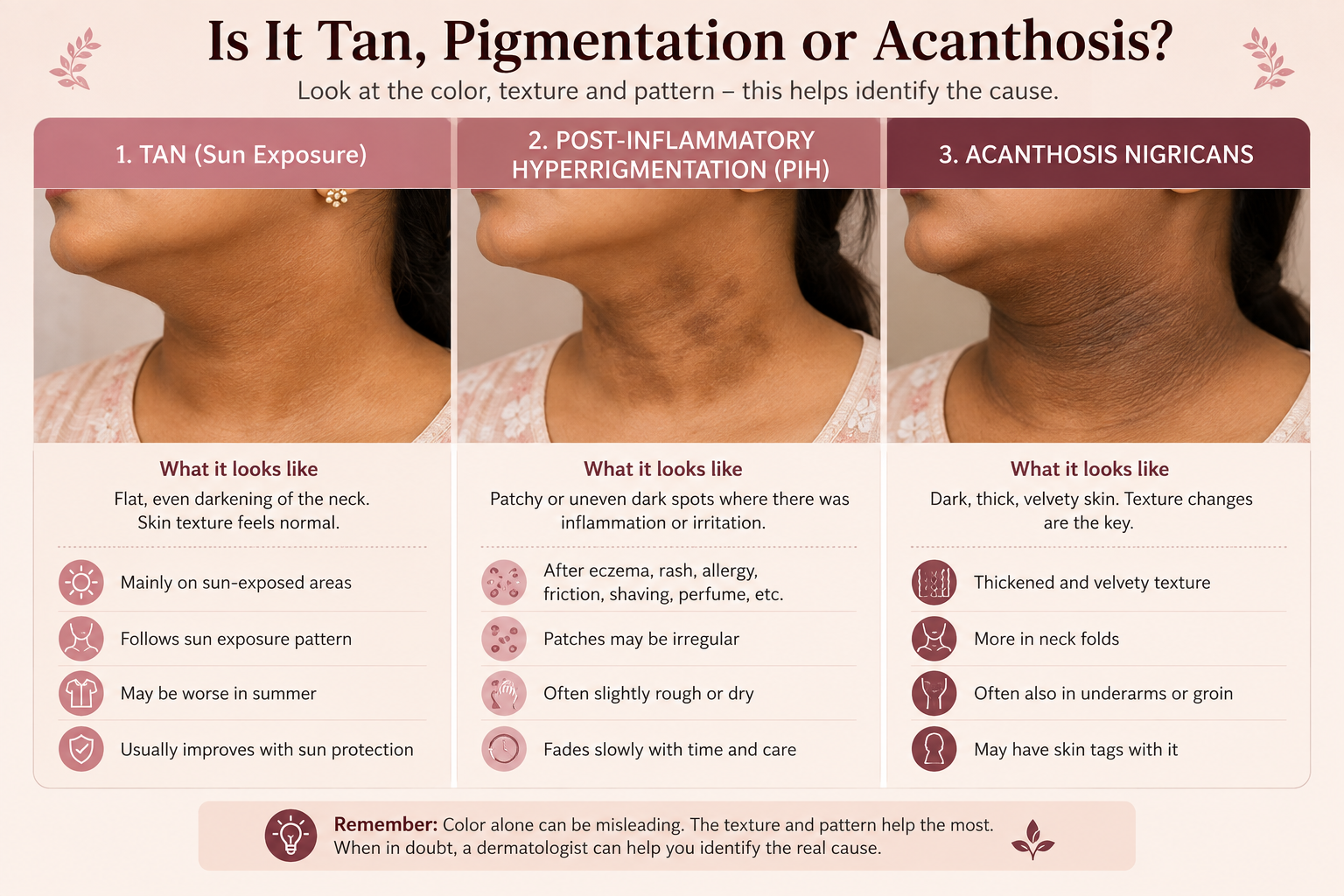
| Feature | Tan / ordinary pigmentation | Post-inflammatory pigmentation | Acanthosis nigricans |
|---|---|---|---|
| Texture | Usually normal and flat | Usually flat; may be dry if eczema is present | Thickened, velvety or rough |
| Pattern | Often follows sun exposure | Follows previous irritation or inflammation | Often more noticeable in neck folds |
| Common history | Outdoor exposure, tanning | Eczema, rubbing, perfume, jewellery, rash | May coexist with metabolic or hormonal factors |
| Other areas | Other sun-exposed areas | Wherever inflammation occurred | Underarms, groin and other folds may also be affected |
“My neck looks dirty but it won’t wash off”
This is a very common description. Acanthosis nigricans can look like a layer of dirt or dead skin, but it is actually a change within the skin itself.
Scrubbing harder does not remove the cause. In fact, repeated scrubbing, loofahs and harsh exfoliation can irritate the neck and create additional pigmentation.
Persistent darkening — especially with thick or velvety texture — should be understood and treated, not repeatedly scraped or bleached.
What is acanthosis nigricans?
Acanthosis nigricans is a skin condition in which areas of skin become darker, thicker and velvety. It commonly affects body folds such as the neck, underarms and groin.
Skin tags may sometimes occur alongside it. In darker skin tones, the change can be particularly noticeable.
Acanthosis nigricans itself is usually not dangerous, but it can be a visible clue to an underlying metabolic or hormonal condition.
Why does acanthosis nigricans happen?
One of the most common pathways is insulin resistance. The body becomes less responsive to insulin, so the pancreas compensates by producing more insulin.
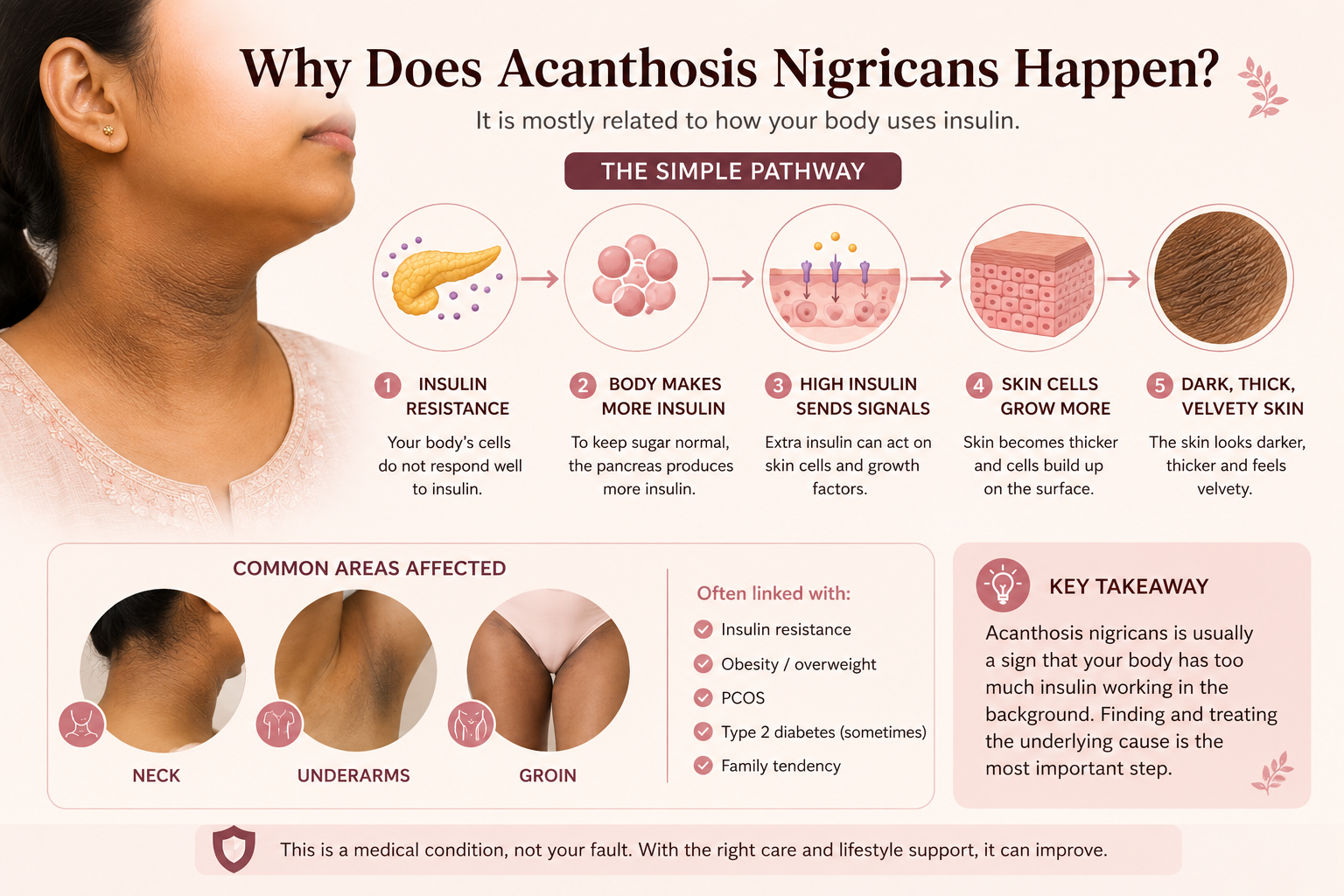
Higher circulating insulin can interact with growth-related receptors in the skin. This can encourage skin-cell growth and lead to the characteristic thickened, velvety appearance.
The characteristic appearance comes from both increased pigmentation and thickening of the skin. That is why ordinary whitening creams alone often disappoint.
What is insulin resistance?
Insulin helps move glucose from the blood into cells where the body can use it for energy. In insulin resistance, the cells do not respond to insulin as effectively as they should.
The pancreas often compensates by producing more insulin. For a period of time, that extra insulin may keep blood glucose in a normal range.
This is important because insulin resistance can exist before blood sugar or HbA1c becomes abnormal.
Does a dark neck mean I have diabetes?
No. A dark neck alone does not mean diabetes.
Even confirmed acanthosis nigricans does not automatically mean that someone already has diabetes. However, acanthosis can sometimes be associated with insulin resistance, prediabetes and type 2 diabetes, so a clinician may decide that metabolic evaluation is appropriate.
It is a reason to look at the whole health picture rather than assume the skin change is purely cosmetic.
What test might your doctor recommend?
One useful blood test is HbA1c. It reflects your average blood glucose over roughly the previous two to three months and can help identify prediabetes or diabetes.
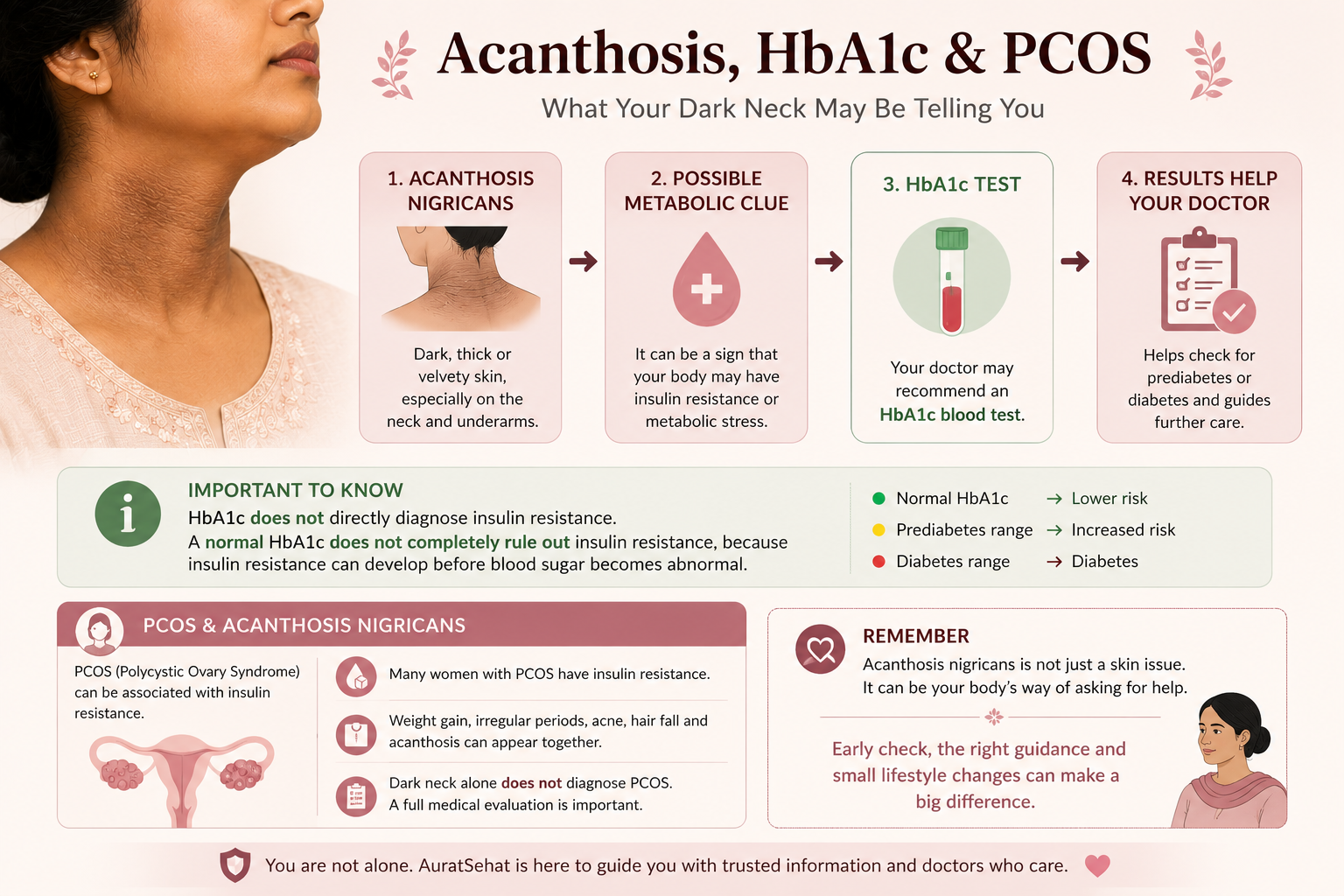
HbA1c does not directly diagnose insulin resistance. A normal HbA1c does not completely rule out insulin resistance because the body can initially compensate by producing more insulin while keeping blood glucose relatively normal.
You do not need to order a long list of metabolic tests simply because your neck looks darker. A doctor can decide whether testing is appropriate based on the skin pattern and your overall health history.
What is the connection between dark neck, acanthosis and PCOS?
PCOS can coexist with insulin resistance. When insulin resistance is significant, acanthosis nigricans may appear on the neck, underarms or other skin folds.
But this relationship is often oversimplified online.
PCOS is diagnosed using the overall clinical picture. Irregular periods, androgen-related symptoms and other features matter. Neck pigmentation alone is not enough.
If you already have PCOS and develop dark, thick, velvety skin, it may be reasonable to discuss the possible metabolic connection with your doctor.
You can also explore our PCOS Hub for detailed guidance on periods, metabolism, fertility, skin and treatment.
What if my neck and underarms are both dark?
This combination becomes more meaningful when both areas are not only darker but also thickened or velvety.
Acanthosis commonly affects the neck and underarms together. If you have dark underarms but the skin is flat and the problem began after shaving, waxing or irritation, the cause may be very different.
Read our dedicated Dark Underarms guide for the hair-removal, irritation and pigmentation pathway.
Can a thin woman get acanthosis nigricans?
Yes. Although obesity and insulin resistance are common associations, acanthosis nigricans is not restricted to people who are overweight.
Genetics, hormonal conditions, certain medicines and other causes can also be involved. That is another reason not to diagnose the cause from body size alone.
Will weight loss make a dark neck go away?
If excess weight and insulin resistance are major contributors to acanthosis, improving the underlying metabolic problem can lead to meaningful skin improvement.
But weight loss is not a guaranteed cosmetic cure, and skin changes may take time to improve even after metabolic health improves.
When acanthosis is related to insulin resistance, lifestyle and metabolic management are often more important than repeatedly changing whitening creams.
What else can make the neck dark?
Not every dark neck is acanthosis. Common alternatives include:
- Sun tanning
- Post-inflammatory hyperpigmentation after eczema or rash
- Friction from clothing, collars or repeated rubbing
- Perfume irritation
- Jewellery or metal-related contact dermatitis
- Hair products repeatedly touching the neck
- Sweat and chronic irritation
- Natural variation in skin pigmentation
- Certain medicines or less common medical conditions
If there is itching, scaling, redness or burning, think about active dermatitis or another skin disorder rather than treating only the pigment.
Can perfume or jewellery make my neck darker?
Yes, indirectly. Perfumes, cosmetics and metals in jewellery can trigger irritant or allergic contact dermatitis in susceptible skin.
Once the inflammation settles, a darker mark can remain. This is post-inflammatory hyperpigmentation rather than acanthosis nigricans.
If the darkening appeared after itching, burning, redness or a rash exactly where perfume or jewellery touches, treat the irritation first.
How do I actually treat a dark neck?
Treatment depends on the pattern. The first goal is to identify the cause and stop anything that continues to trigger the change.
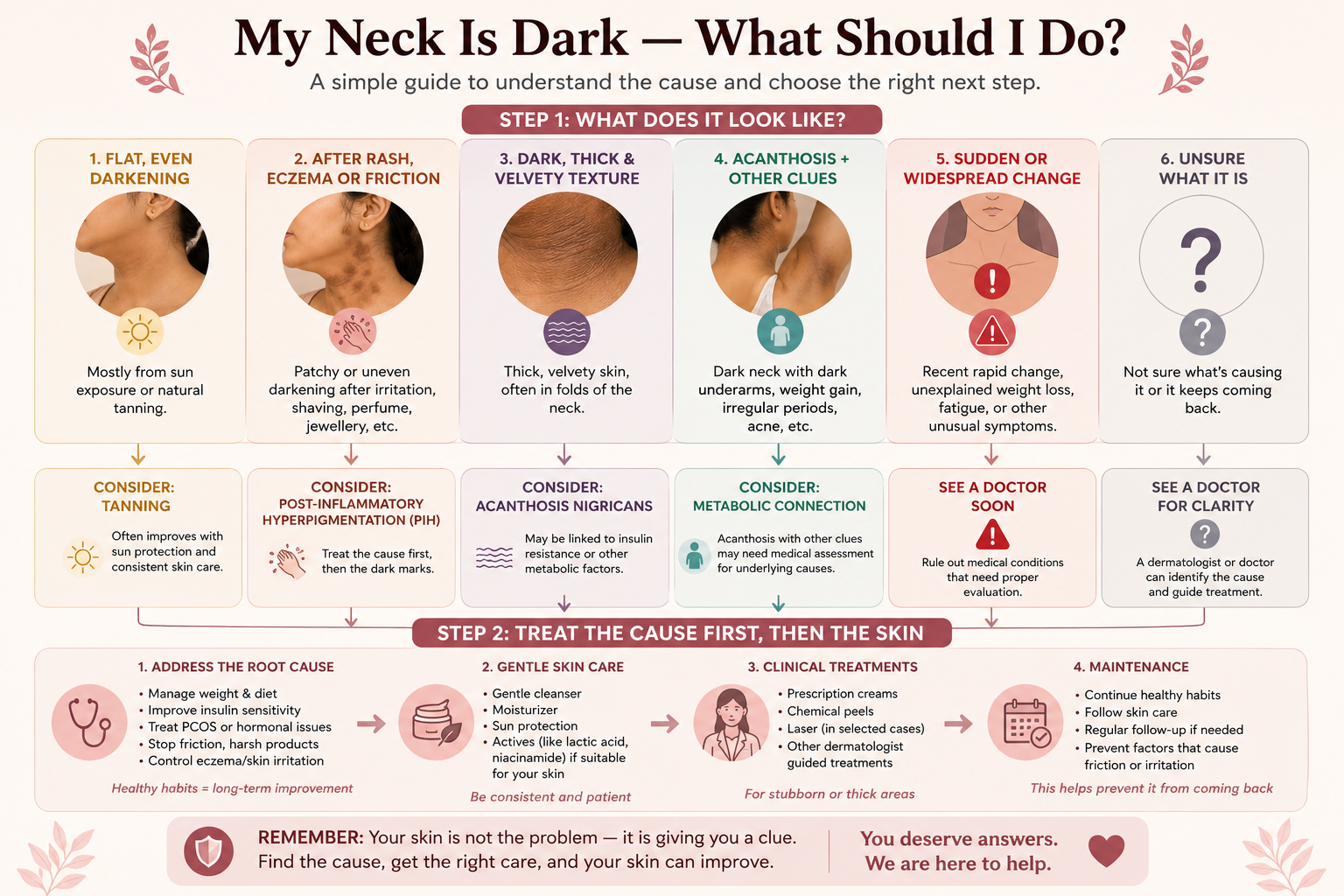
| If your neck looks like… | Think about… | First step |
|---|---|---|
| Flat, even pigmentation mainly on exposed skin | Tanning / ordinary pigmentation | Sun protection and gentle pigmentation care |
| Dark patches after eczema, perfume, jewellery or friction | Post-inflammatory hyperpigmentation | Stop and treat the irritation first |
| Dark + thick + velvety neck folds | Acanthosis nigricans | Assess the possible underlying cause |
| Acanthosis + dark underarms or metabolic clues | Possible metabolic connection | Discuss medical evaluation with your doctor |
| Sudden widespread thickening or unexplained rapid change | Less common underlying causes | Seek medical assessment rather than self-treating |
Does glycolic acid work for a dark neck?
Glycolic acid can exfoliate the outer layers of skin and may help some forms of superficial pigmentation. It can sometimes improve the appearance and texture of acanthosis as well.
But it is important to understand what it cannot do: glycolic acid does not treat insulin resistance.
If the underlying driver remains active, the skin can remain dark or become dark again.
The neck can become irritated by frequent glycolic acid, scrubbing, retinoids and multiple brightening products used together. Irritation can create additional PIH.
Which skincare ingredients may help?
Topical treatment is mainly used to improve the appearance and texture of the skin. The best option depends on whether you have ordinary pigmentation, PIH or confirmed acanthosis.
A simple routine for a dark neck
If the skin is calm
- Clean gently.
- Use moisturiser if needed.
- Use one suitable pigment or texture-targeting active.
- Use sun protection on exposed neck skin.
- Avoid unnecessary scrubbing.
If the skin is irritated
- Stop acids, scrubs and harsh bleaching products.
- Identify perfume, jewellery or skincare triggers.
- Use gentle cleansing and moisturising.
- Treat active eczema or dermatitis properly.
- Only restart pigmentation treatment after the skin settles.
Why can whitening or steroid creams be dangerous?
A strong cream can sometimes make the neck look lighter very quickly. That does not necessarily mean the underlying problem has been treated.
Inappropriate long-term steroid use can thin the skin, cause visible blood vessels, acne-like eruptions and other complications. Once the product is stopped, the original pigmentation may return because the underlying trigger remains.
Avoid unknown fairness mixtures or potent steroid creams unless they have been specifically prescribed for a diagnosed condition.
Why does a facial or bleach make my neck look lighter for only a few days?
Some salon treatments temporarily change surface appearance through exfoliation, hair bleaching, hydration or removal of superficial buildup.
If the underlying problem is tanning, chronic irritation or acanthosis nigricans, the improvement may be brief because the actual cause has not changed.
Repeated aggressive bleaching can also irritate sensitive neck skin and eventually worsen pigmentation.
Can ubtan, besan, lemon or potato remove a dark neck?
These remedies are extremely popular in Pakistan, but they do not all have the same safety profile.
| Home remedy | What to know |
|---|---|
| Lemon | Can irritate the skin and potentially worsen PIH. Not recommended as a dark-neck treatment. |
| Besan / ubtan | May feel cleansing, but aggressive rubbing can increase friction and irritation. |
| Potato juice | Popular online, but strong clinical evidence for treating established neck pigmentation is lacking. |
| Turmeric | Used traditionally, but homemade mixtures are not a substitute for treating the actual cause. |
| Yogurt | May feel soothing in some people, but it is not a reliable treatment for acanthosis nigricans. |
Most importantly, true acanthosis nigricans cannot be scrubbed away with a home remedy.
Do chemical peels or lasers help a dark neck?
Selected procedures can sometimes improve pigmentation or texture, but they should not be used as a substitute for understanding the cause.
For ordinary PIH or tanning, a dermatologist may consider appropriate chemical peels or other treatments. In acanthosis nigricans, procedures can improve appearance in selected cases, but addressing the underlying metabolic or hormonal factor remains important.
South Asian skin is prone to post-inflammatory pigmentation, so aggressive peels or lasers can sometimes create more darkness rather than less.
How long does a dark neck take to improve?
Improvement depends entirely on the cause.
A simple tan or PIH may gradually improve over weeks to months once the trigger is controlled. Acanthosis nigricans often takes longer because the skin change is related to more than superficial pigment.
Do not repeatedly switch products because the neck did not become lighter after one week. Consistent care and control of the underlying trigger matter more than rapid bleaching.
Why does the darkness keep coming back?
- The underlying insulin resistance or metabolic driver has not improved.
- Sun exposure continues.
- Eczema or dermatitis keeps recurring.
- Perfume or jewellery continues irritating the area.
- You keep scrubbing or over-exfoliating.
- A whitening cream only temporarily changed the appearance.
- The diagnosis was incorrect from the beginning.
When pigmentation repeatedly returns, reconsider the cause rather than simply moving to a stronger cream.
When should I see a doctor?
Consider medical assessment if:
- Your neck is becoming progressively thicker and more velvety.
- You have similar changes in the underarms, groin or other folds.
- You have metabolic or PCOS-related concerns.
- The change appeared suddenly or is spreading rapidly.
- You develop widespread new thick velvety pigmentation.
- The area is painful, very itchy, inflamed or repeatedly develops a rash.
- You are unsure whether the change is acanthosis, PIH or another skin condition.
Most acanthosis nigricans is associated with common metabolic or hormonal factors. Rarely, sudden extensive acanthosis in an adult can occur with other serious underlying conditions, so an abrupt unexplained change should not simply be treated cosmetically.
Common questions about dark neck and acanthosis nigricans
Does a dark neck always mean insulin resistance?
No. Tanning, eczema, friction, perfume irritation, jewellery reactions and ordinary pigmentation can all make the neck darker. Insulin resistance is more relevant when the skin has the classic thick, velvety acanthosis pattern.
Can acanthosis nigricans go away?
It can improve significantly when an underlying cause is identified and treated, although improvement may be gradual and some residual texture or pigmentation can remain.
Can I have insulin resistance with a normal HbA1c?
Yes. HbA1c measures average blood glucose, not insulin sensitivity. Early insulin resistance can be compensated for by higher insulin levels while HbA1c remains normal.
Does acanthosis nigricans mean I have diabetes?
No. It can be associated with insulin resistance, prediabetes or diabetes, but it does not by itself diagnose any of those conditions.
Does PCOS cause a dark neck?
PCOS can coexist with insulin resistance, which may contribute to acanthosis nigricans. But a dark neck alone does not diagnose PCOS.
Can glycolic acid remove acanthosis nigricans?
Glycolic acid may improve superficial texture and pigmentation in some people, but it does not correct an underlying metabolic cause.
Why does my neck look dirty even after washing?
If the change is acanthosis nigricans, it is caused by thickened altered skin rather than dirt. Scrubbing harder will not remove it.
Can losing weight help acanthosis nigricans?
When excess weight and insulin resistance are major contributors, improving metabolic health and losing excess weight can help the skin improve.
A dark neck is not one diagnosis.
Flat sun-related pigmentation, post-inflammatory marks and acanthosis nigricans can all look dark, but the texture and pattern help tell them apart.
If the skin is dark, thick and velvety, think beyond whitening creams. Identify the underlying cause first, then treat the skin gently and consistently.
Trusted dermatology resources
American Academy of Dermatology — Acanthosis Nigricans
DermNet — Acanthosis Nigricans
AuratSehat provides patient education and does not replace personalised assessment, diagnosis or treatment from your own healthcare professional.