

Folic Acid in Pregnancy
When to start, how much you need, why it matters so early, and when your doctor may recommend a different dose.
If you are trying for a baby or could become pregnant, 400 micrograms (µg), or 0.4 mg, of folic acid every day is the usual routine recommendation. Ideally, start before conception and continue through the first 12 weeks of pregnancy. If you are already pregnant and have not been taking it, start as soon as possible and discuss your supplements with your maternity doctor.
Folic acid is one of the simplest pregnancy supplements, but its timing matters. Your baby’s brain and spinal cord begin developing extremely early — often before you even know that you are pregnant.
This is why folic acid is recommended before conception whenever possible, rather than waiting for a positive pregnancy test.
Why is folic acid so important?
Folic acid is the supplemental form of folate, or vitamin B9. Folate is needed for normal cell division, DNA formation and the production of healthy new cells.
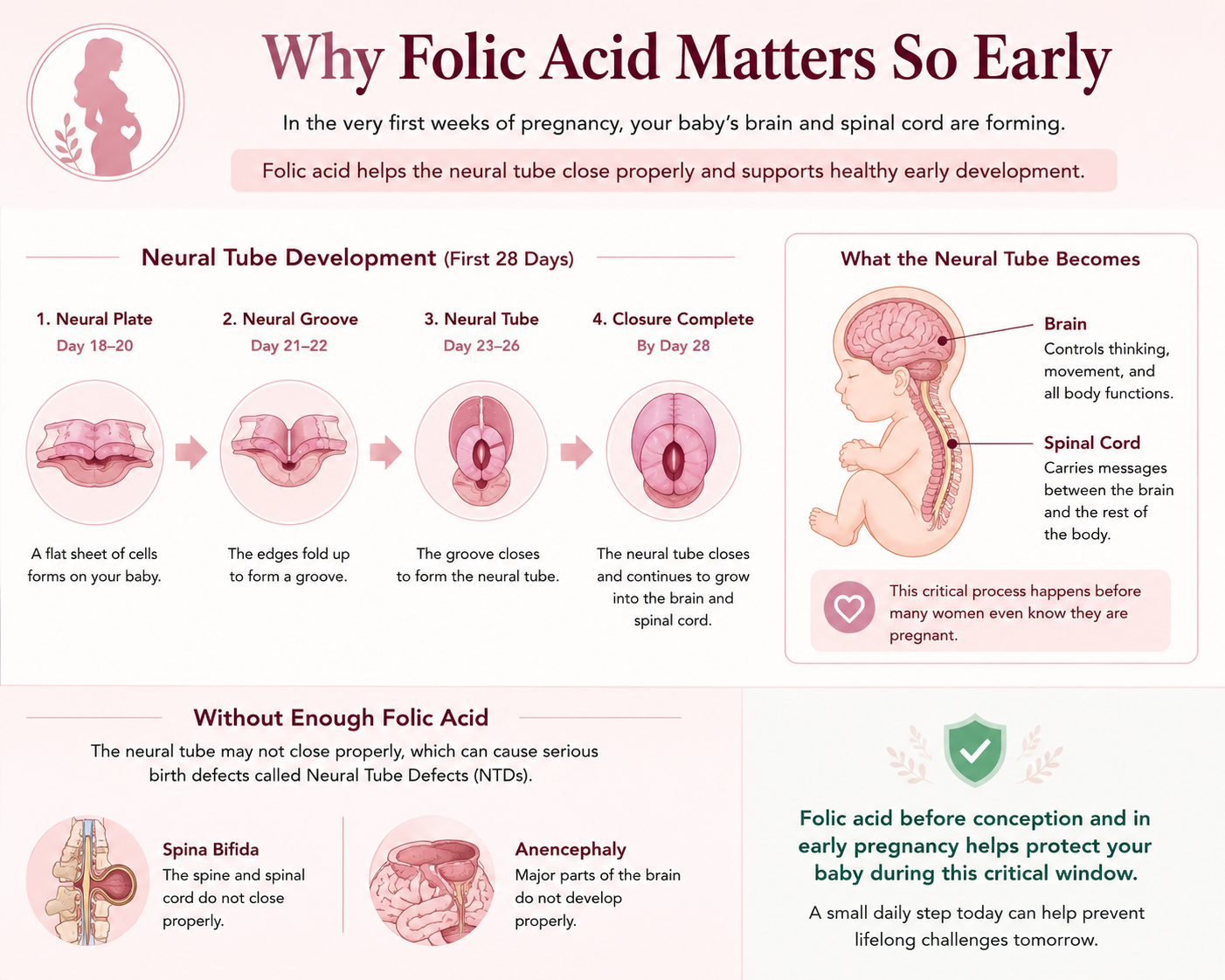
During very early pregnancy, these processes are happening rapidly. One of the most important structures developing at this stage is the neural tube.
The neural tube later develops into your baby’s brain and spinal cord. It begins forming and closing during the first few weeks after conception.
What are neural tube defects?
If the neural tube does not close normally, a baby can develop a serious congenital condition known as a neural tube defect (NTD).
Two important examples are spina bifida, which affects development of the spine and spinal cord, and anencephaly, a severe condition affecting development of the brain and skull.
Taking folic acid around conception and in early pregnancy substantially reduces the risk of neural tube defects. Food folate is important too, but it does not replace the recommended folic-acid supplement.
When should I start taking folic acid?
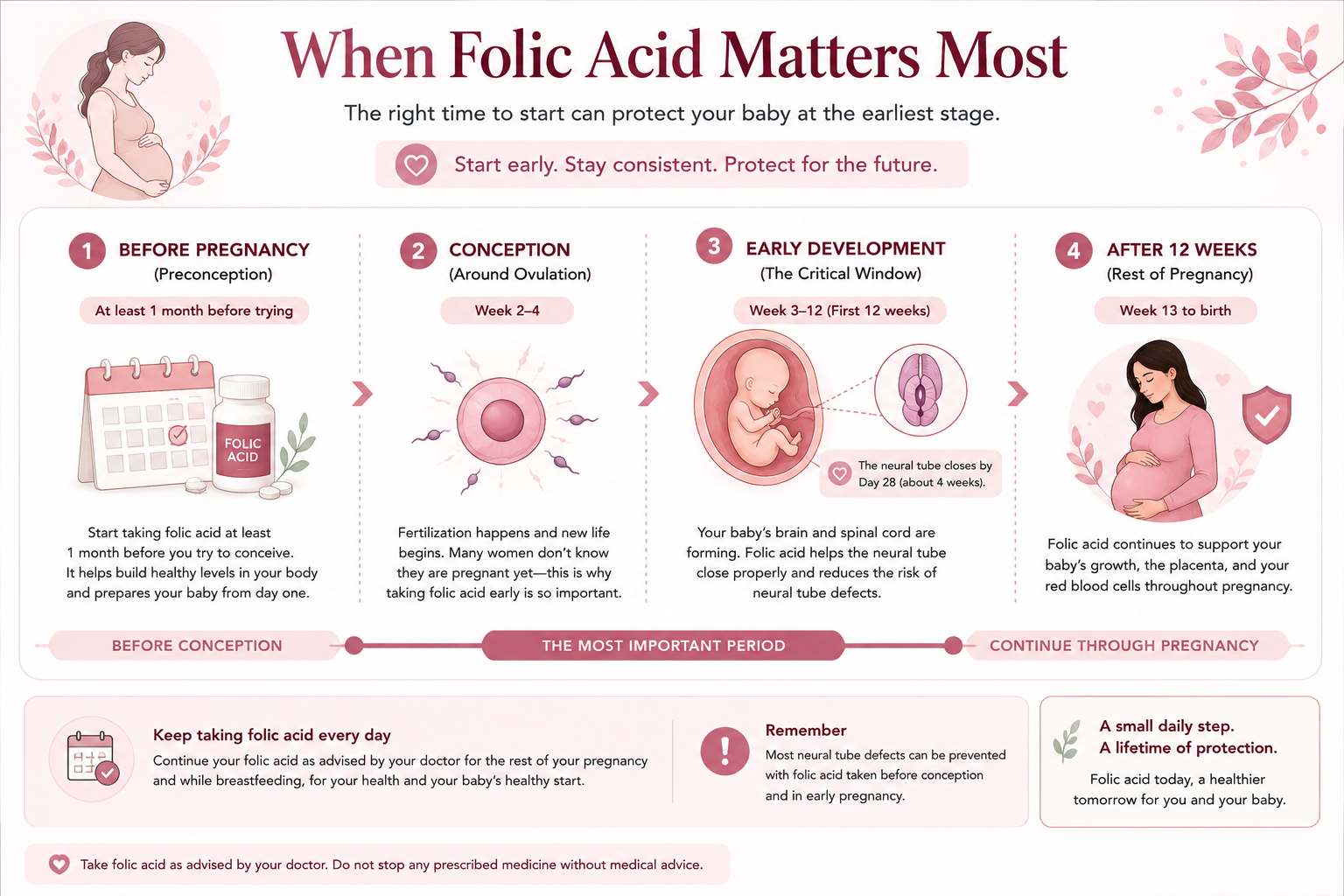
Ideally, folic acid should already be part of your routine before you become pregnant.
WHO recommends 400 µg daily from the time a woman starts trying to conceive until 12 weeks of pregnancy.
Starting beforehand matters because the neural tube closes very early. By the time a missed period leads to a pregnancy test, some of this critical development may already have occurred.
What if I am already pregnant?
Do not panic if you did not take folic acid before conception. Many pregnancies are unplanned, and many women discover that they are pregnant only after several weeks.
If you are in early pregnancy and are not taking folic acid, start the recommended supplement as soon as possible and mention it at your antenatal visit.
Tell your maternity doctor about all vitamins, supplements and medicines you are taking. This is particularly important if you use long-term medicines for epilepsy, diabetes or another medical condition.
How much folic acid do I need?
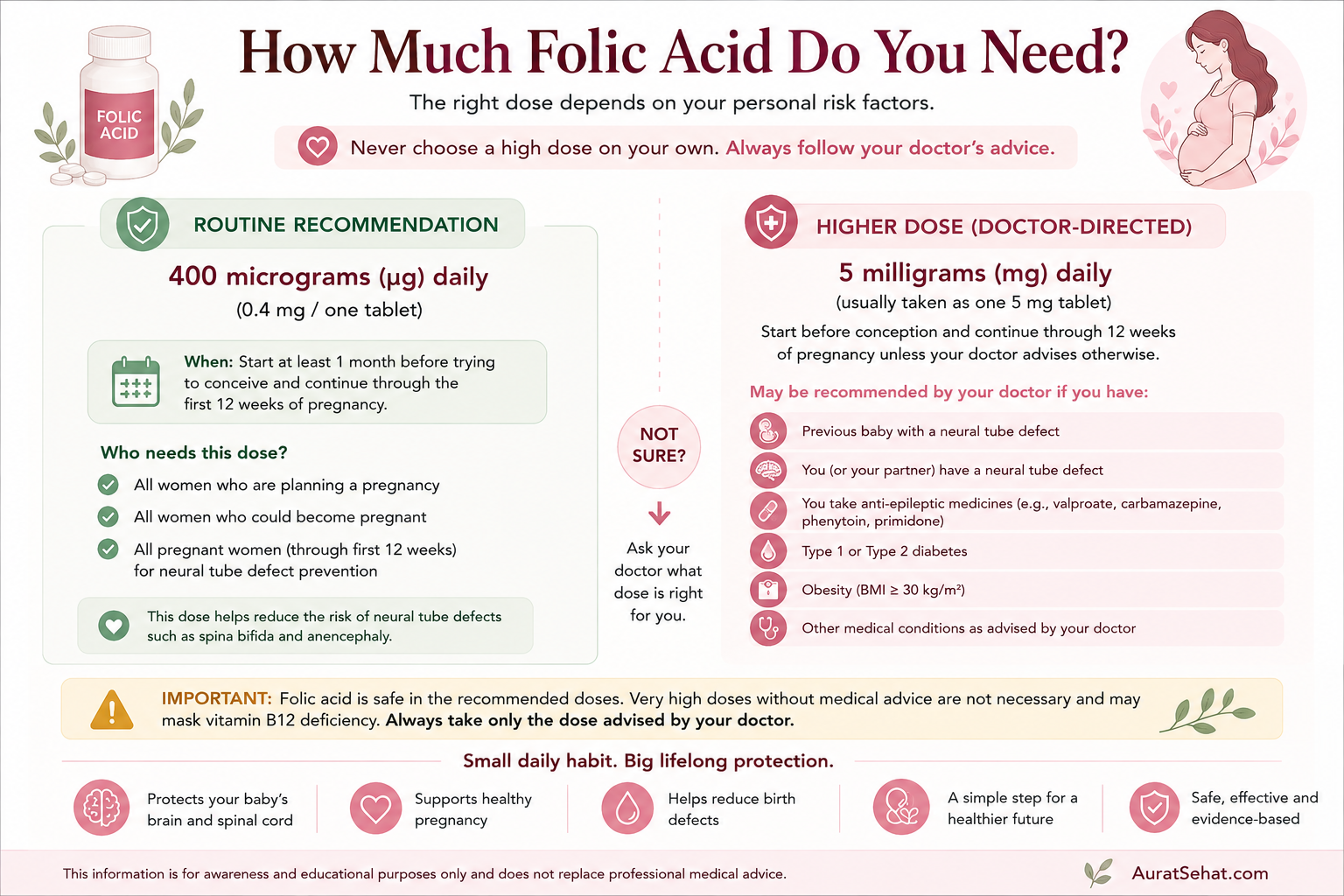
For most women planning pregnancy or in early pregnancy, the routine folic-acid dose is:
This is the same as 0.4 mg daily.
This is the usual routine daily folic-acid dose around conception. A 5 mg tablet is a much higher dose and should be doctor-directed.
Who may need a higher dose?
Some women have a higher underlying risk of a pregnancy affected by a neural tube defect or another reason for needing individualized supplementation.
Depending on your history and the guidance your doctor follows, higher-dose folic acid may be considered in situations such as:
- A previous pregnancy or baby affected by a neural tube defect.
- You or your partner having a neural tube defect, or certain relevant family histories.
- Type 1 or type 2 diabetes.
- Taking certain medicines that affect folate metabolism, including some anti-seizure medicines.
- Certain medical or nutritional conditions where folate requirements or absorption may differ.
A 5 mg tablet contains far more folic acid than the routine 400 µg dose. It should be used when your doctor has identified a reason for it. Do not start, stop or change prescribed medicines because you are planning pregnancy without discussing them with the clinician who manages your treatment.
Do I stop folic acid after 12 weeks?
The first 12 weeks are emphasized for neural tube defect prevention because the neural tube develops extremely early.
However, this does not necessarily mean that folic acid disappears from your pregnancy supplements after week 12.
WHO recommends daily antenatal supplementation containing 30–60 mg of elemental iron plus 400 µg of folic acid during pregnancy to help reduce maternal iron-deficiency anaemia and support pregnancy outcomes.
In practice, the exact supplement you use later in pregnancy should follow your maternity doctor’s plan, particularly if blood tests show anaemia or another nutritional issue.
Folic acid or folate from food — is food enough?
A balanced diet can provide natural folate and remains important during pregnancy, but dietary folate alone is not considered a reliable substitute for the recommended folic-acid supplement around conception.
Foods that can contribute folate include:
Green vegetables
Spinach and other dark-green leafy vegetables can contribute natural folate.
Lentils & beans
Daal, chickpeas and other legumes can be useful sources of folate and other nutrients.
Citrus & some fruits
Fruit contributes folate as part of a varied, balanced diet.
Fortified foods
Some cereals and grain products contain added folic acid; check the nutrition label where available.
Think of the supplement and a healthy diet as complementary. Take the recommended folic acid and continue eating a varied, nutritious diet.
What if my prenatal vitamin already contains folic acid?
Check the label rather than automatically adding another tablet. Many pregnancy multivitamins already contain folic acid.
Look for the amount listed in micrograms (µg) or milligrams (mg). Remember:
400 µg = 0.4 mg. A 5 mg tablet is therefore a much higher dose and is not equivalent to a standard 400 µg pregnancy supplement.
Can I take too much folic acid?
Folic acid is generally safe at recommended pregnancy doses. More is not automatically better, however, and there is usually no advantage to adding multiple folic-acid supplements without a medical reason.
Very high supplemental intake can also complicate recognition of vitamin B12 deficiency in some circumstances. That is another reason to use a higher dose only when clinically indicated.
I forgot my folic acid today — what should I do?
Missing an occasional dose does not mean that you have harmed your baby. Resume your normal daily schedule.
If you repeatedly forget, make it part of an existing habit — for example, keeping your supplement near something you use every morning.
Do not routinely double your dose to compensate for forgotten tablets unless your doctor or the instructions for your specific medicine tell you to do so.
Know what comes next in your pregnancy
Build your personalized AuratSehat Pregnancy Care Map and see the important milestones, timing and questions that may matter as your pregnancy progresses.
Start My Pregnancy →Frequently asked questions
Is 400 µg the same as 5 mg?
No. 400 micrograms is 0.4 mg. A 5 mg tablet is more than ten times the routine 400 µg dose and should generally be used only when a clinician recommends it.
Can I start folic acid after a positive pregnancy test?
Yes. Starting before conception is ideal because early neural-tube development occurs very soon after conception, but if you are already pregnant and were not taking folic acid, start as soon as possible and discuss your supplements with your maternity doctor.
Does taking folic acid guarantee my baby will not develop a neural tube defect?
No intervention can guarantee that outcome. Folic-acid supplementation significantly reduces the risk of neural tube defects, which is why it is recommended before conception and during early pregnancy.
Should I take folic acid for my whole pregnancy?
Folic acid is particularly important from before conception through the first 12 weeks for neural-tube-defect prevention. Folic acid is also commonly included in antenatal iron-and-folic-acid supplements later in pregnancy. Follow the supplement plan recommended for you.
Can I get enough folate from food instead?
Folate-rich foods are valuable, but women trying to conceive and women in early pregnancy are still advised to take the recommended folic-acid supplement.
I am overweight. Do I automatically need 5 mg?
Not necessarily. Recommendations have differed between organizations, and current NICE guidance does not recommend high-dose folic acid solely because of overweight or obesity when no other higher-risk factor is present. Your own maternity doctor should decide the appropriate dose for you.
I take epilepsy medicine. Should I stop it before pregnancy?
No. Do not stop anti-seizure medicine suddenly because you are planning pregnancy or have discovered that you are pregnant. Some medicines can affect pregnancy planning and folic-acid recommendations, so arrange individualized advice with the clinician managing your treatment.
Medical references
- World Health Organization. Periconceptional folic acid supplementation to prevent neural tube defects. WHO recommends 400 µg of folic acid daily from when a woman begins trying to conceive through 12 weeks of gestation.
- World Health Organization. Daily iron and folic acid supplementation during pregnancy. WHO recommends 30–60 mg elemental iron with 400 µg folic acid daily during pregnancy.
- National Institute for Health and Care Excellence (NICE). Maternal and child nutrition: nutrition and weight management in pregnancy and nutrition in children up to 5 years, NG247.
Medical Content & Editorial Team, AuratSehat
Obstetrics & Gynaecology
AuratSehat medical content is created for health education and reviewed for clinical accuracy where appropriate. It does not replace an individual consultation, examination, diagnosis or treatment plan from your own doctor.