Hormonal Acne in Women
Acne that repeatedly appears around your period, affects your lower face, or keeps returning in adulthood may have a hormonal component. Learn how to recognize the pattern — and what can actually help.
Find your acne pattern
Answer a few simple questions about your breakouts and see which acne pattern most closely matches what you’re experiencing.
Find My Acne → Educational guidance only — this tool does not provide a medical diagnosis.What is hormonal acne?
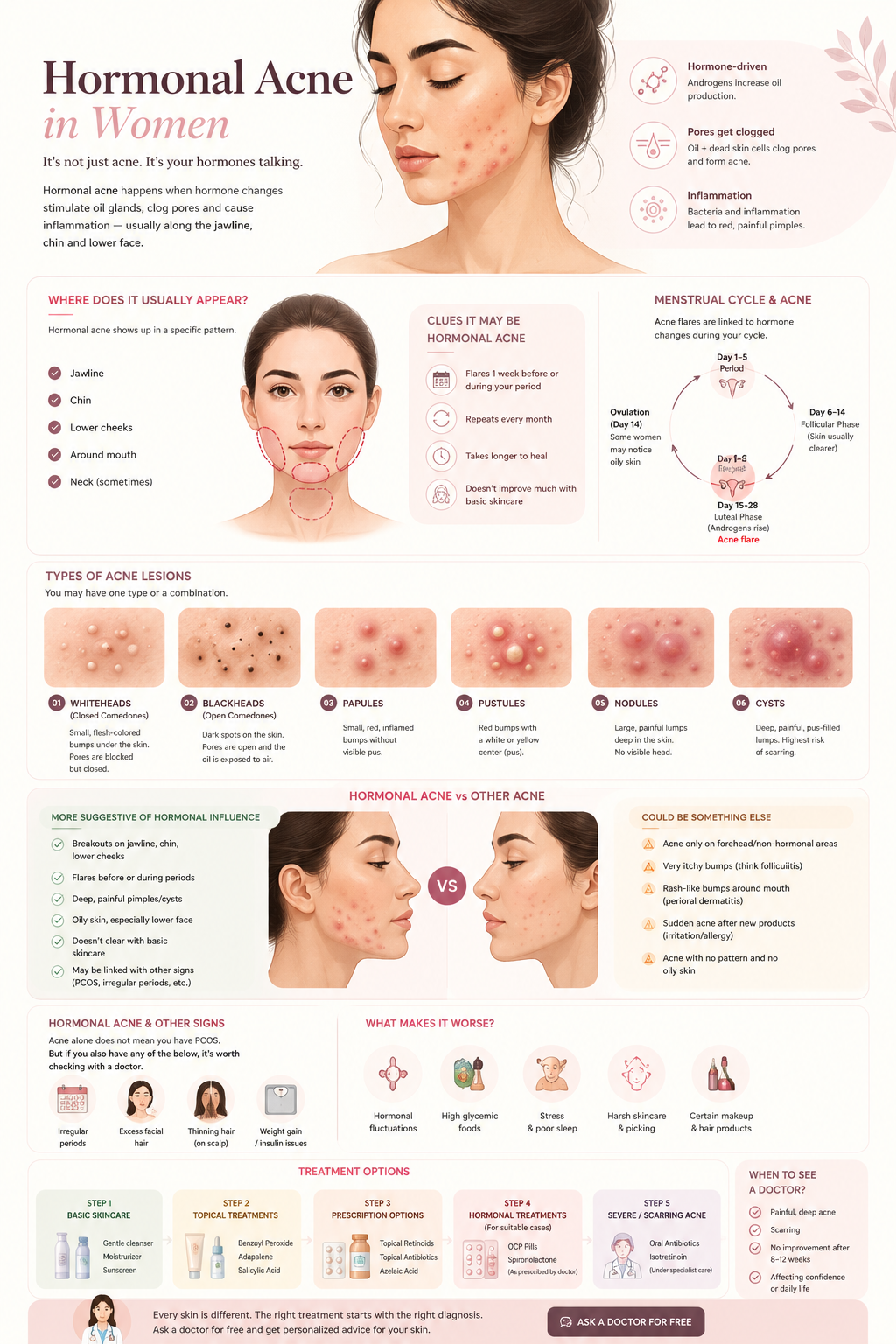
Hormonal acne is acne influenced by hormonal activity, particularly hormones called androgens.
Hormones influence oil
Hormonal signals can influence oil production and make acne-prone skin more likely to develop clogged pores.
Pores become blocked
Oil and dead skin cells can build up inside follicles and contribute to whiteheads, blackheads and inflammatory acne.
Inflammation develops
The blocked follicle can become inflamed, producing red, swollen, tender or pus-filled lesions.
Could your acne be hormonal?
There is no single pimple, location or appearance that proves hormonal acne. The overall pattern is much more useful.
It flares before your period
New pimples repeatedly appear in the days before or around your menstrual period.
It affects the lower face
Acne may repeatedly concentrate around the chin, jawline or lower cheeks.
The pimples are deep and tender
You may develop painful deeper bumps rather than only small surface spots.
It keeps coming back
The skin improves temporarily but breakouts repeatedly return despite a consistent routine.
It continues into adulthood
Persistent acne after the teenage years can sometimes have a hormonal contribution.
Other hormonal symptoms are present
Acne together with irregular periods, excess facial or body hair or scalp hair thinning deserves closer attention.
Jawline acne does not automatically mean hormonal acne
Location alone is not enough to diagnose hormonal acne. What matters is the pattern over time.
More suggestive of hormonal influence
- Breakouts repeatedly affect the jawline, chin or lower face
- Flares repeatedly occur before or around periods
- Deep, painful inflammatory pimples are common
- Acne keeps returning despite consistent skincare
- There are other signs of androgen excess
Does not prove hormonal acne
- Having acne on the jawline alone
- Having oily skin
- Getting an occasional premenstrual pimple
- Having acne in one particular area only
- Having acne without a repeated hormonal pattern
What does the acne itself look like?
Hormonal acne can contain more than one type of lesion. Knowing what you’re looking at makes the skin much easier to understand.
Whiteheads
Small flesh-coloured or white raised bumps caused by a blocked pore that remains closed at the surface.
Blackheads
Open comedones that appear dark because the material inside the follicle is exposed to air. They are not simply dirt.
Papules
Small raised, inflamed bumps that are usually red or pink and do not have a visible pus-filled centre.
Pustules
Inflamed bumps with a visible white or yellow centre containing pus.
Nodules
Larger, deeper and often painful inflammatory lumps that can feel firm beneath the skin.
Cyst-like deep acne
Very deep, painful inflammatory lesions can cause significant inflammation and have a higher risk of scarring.
What can look like acne but may be something else?
Appearance alone cannot always tell you what a skin eruption is.
Folliculitis
Folliculitis can produce acne-like bumps around hair follicles. It may be particularly worth considering when the bumps are very uniform or itchy.
Perioral dermatitis
Small inflammatory bumps around the mouth can sometimes be mistaken for acne and may require a different approach.
Irritation or product-related breakouts
A sudden eruption after introducing a new skincare, cosmetic or hair product may have a different cause.
Does your acne follow your menstrual cycle?
Some women notice predictable acne flares during a particular part of their cycle, often in the days leading up to their period.
Instead of trying to remember when your acne appeared, track it for two or three cycles.
Record the first day of your period and mark the days when new or painful acne appears. A repeated pattern can be useful information when discussing your acne with a doctor.
When could acne be related to PCOS?
Acne can occur with PCOS, but acne alone does not mean you have PCOS.
How is hormonal acne treated?
Treatment depends on severity, age, medical history, pregnancy plans and whether there are signs of an underlying hormonal condition.
Basic skincare
Gentle cleanser, non-comedogenic moisturiser, daily sunscreen and avoiding picking or squeezing.
Topical treatment
Medicines such as retinoids, benzoyl peroxide, azelaic acid or salicylic acid may be appropriate.
Prescription options
Persistent or inflammatory acne may require prescription treatment.
Hormonal treatment
Spironolactone or selected combined oral contraceptives may help some women after medical assessment.
Severe acne
Severe, scarring or treatment-resistant acne may require specialist treatment such as isotretinoin.
Adapalene & tretinoin
These medicines help prevent clogged pores and are commonly used as part of longer-term acne treatment.
Benzoyl peroxide
Benzoyl peroxide helps reduce acne-causing bacteria and inflammation and can be used alone or alongside other acne medicines.
Azelaic acid
Azelaic acid can help acne and may also help with dark marks left after inflammatory acne.
Salicylic acid
Salicylic acid helps remove excess skin cells and can be particularly useful for clogged pores and comedonal acne.
Spironolactone
Spironolactone may be prescribed for women with persistent acne influenced by androgens. It requires medical supervision.
Combined oral contraceptives
Certain combined oral contraceptives can improve acne in some women. They require assessment because they are not suitable for everyone.
Clascoterone
Clascoterone is a topical anti-androgen medicine that acts locally in the skin and may be an option for selected patients.
Oral antibiotics
Medicines such as doxycycline may be prescribed for inflammatory acne when topical treatment alone is not enough. They are generally used for a limited period.
Isotretinoin
Isotretinoin is used for selected cases of severe, scarring or treatment-resistant acne and requires careful medical supervision.
Important before starting acne medicine
Acne medicines are not interchangeable, and some are unsuitable during pregnancy or for certain medical conditions.
If you are pregnant: tell your doctor before using acne medicines. Topical and oral retinoids such as adapalene, tretinoin and isotretinoin should not be used during pregnancy.
If you are trying to conceive: discuss your acne treatment before pregnancy because some medicines need to be stopped or changed before conception.
Hormonal medicines: spironolactone and combined oral contraceptives require medical assessment because they are not appropriate for every woman.
When should you see a doctor?
Professional assessment is especially useful when acne is persistent, painful, scarring or accompanied by other hormonal symptoms.
- Deep or painful acne
- Acne leaving scars
- Acne repeatedly returning despite skincare
- Irregular or absent periods
- New or increased facial or body hair
- Scalp hair thinning
- Sudden severe adult acne
- Acne significantly affecting confidence or quality of life
Hormonal acne: common questions
Is acne on the jawline always hormonal?
No. Jawline acne can have several causes. The timing of breakouts, their persistence and other symptoms are more useful than location alone.
Does hormonal acne mean I have PCOS?
No. Acne is common and can occur without PCOS. However, acne together with irregular periods, excess hair growth or scalp hair thinning may warrant assessment for PCOS or another hormonal condition.
Can hormonal acne be treated?
Yes. Hormonal acne can often be controlled with appropriate skincare, topical medicines and, when suitable, hormonal or other prescription treatments.
Why does my acne get worse before my period?
Hormonal changes during the menstrual cycle can influence oil production and inflammation in acne-prone skin, causing some women to experience predictable premenstrual breakouts.
Can I treat hormonal acne only with skincare?
Mild acne may improve with appropriate topical treatment, but persistent, painful, scarring or strongly hormonally influenced acne may require prescription treatment.
How long does acne treatment take to work?
Acne treatment usually takes several weeks to show meaningful improvement. Consistency is important, and treatment often needs to continue after the skin improves to help prevent new breakouts.
Not sure if your acne is hormonal?
If your acne keeps returning, follows your menstrual cycle, or comes with irregular periods or other hormonal symptoms, you can ask a doctor about your individual situation.
Ask a Doctor for FreeThis article is for educational purposes and does not replace an individual medical examination, diagnosis or treatment plan. Prescription medicines should only be used under appropriate medical guidance.