
The first trimester of pregnancy begins from the first day of your last menstrual period and continues through the end of Week 13.
During these weeks, pregnancy changes from a microscopic group of cells into a rapidly developing baby. At the same time, your own body may be adjusting to major hormonal and physical changes.
This guide follows the first trimester week by week so you can understand what may be happening with your baby, what you may notice in your own body, which early pregnancy tests and scans may be recommended, and which symptoms should not be ignored.
What is the first trimester?
The first trimester is the beginning of pregnancy through 13 completed weeks. Pregnancy is dated from the first day of your last menstrual period (LMP), even though conception usually occurs about two weeks later in a typical menstrual cycle.
This means that during pregnancy Weeks 1 and 2, you usually have not conceived yet. Doctors use LMP because the exact day of fertilization is often difficult to know.
Every pregnancy is different
Symptoms, ultrasound findings and exact developmental timing can vary. Your maternity doctor’s assessment takes priority over general week-by-week descriptions.
Weeks 1–6: From Pregnancy Dating to Early Development
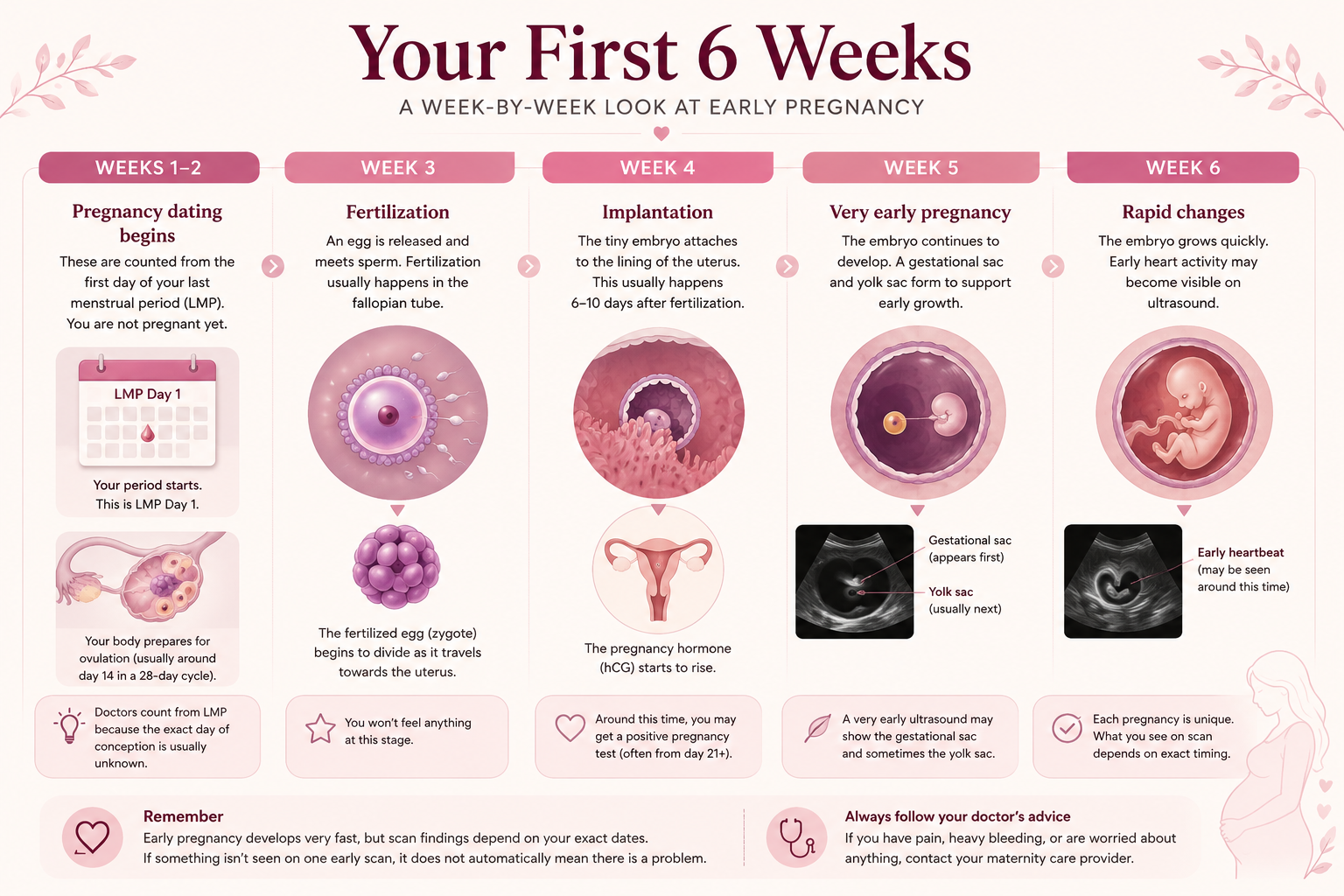
The first six weeks can feel confusing because pregnancy dating begins before fertilization actually occurs. These early weeks also contain some of the biggest biological changes of the entire pregnancy.
Pregnancy dating begins
Week 1 begins on the first day of your last menstrual period. You are not biologically pregnant yet, but doctors begin counting pregnancy from this date.
During these first two weeks, your body prepares for ovulation. In a typical 28-day cycle, ovulation often happens around Day 14, although it can occur earlier or later depending on your cycle.
If you are trying to conceive, this is already an important time to take folic acid as advised.
Fertilization may occur
Around this stage, an egg may be released from the ovary and meet sperm in the fallopian tube. If fertilization occurs, the fertilized egg begins dividing into more cells as it travels towards the uterus.
Most women will not feel anything specific at this stage.
Implantation and the earliest pregnancy changes
The developing pregnancy reaches the uterus and implants into its lining. Pregnancy hormone levels then begin to rise.
Around the time your next period is expected, a home pregnancy test may become positive. Testing very early can still produce a negative result even when pregnancy has begun.
Read our guide to when to test for pregnancy if you are unsure when to use a home pregnancy test.
Very early pregnancy
The embryo is developing rapidly. On an early ultrasound, a gestational sac may begin to become visible, and sometimes a yolk sac can also be seen.
What can be seen depends greatly on your exact gestational age, your ovulation timing and the type of ultrasound performed.
Rapid early development
The embryo remains tiny but is changing quickly. Early body structures and the developing nervous system continue to form.
Cardiac activity may become detectable on ultrasound around this stage, but exact timing varies.
Weeks 7–13: Your Baby Develops Quickly
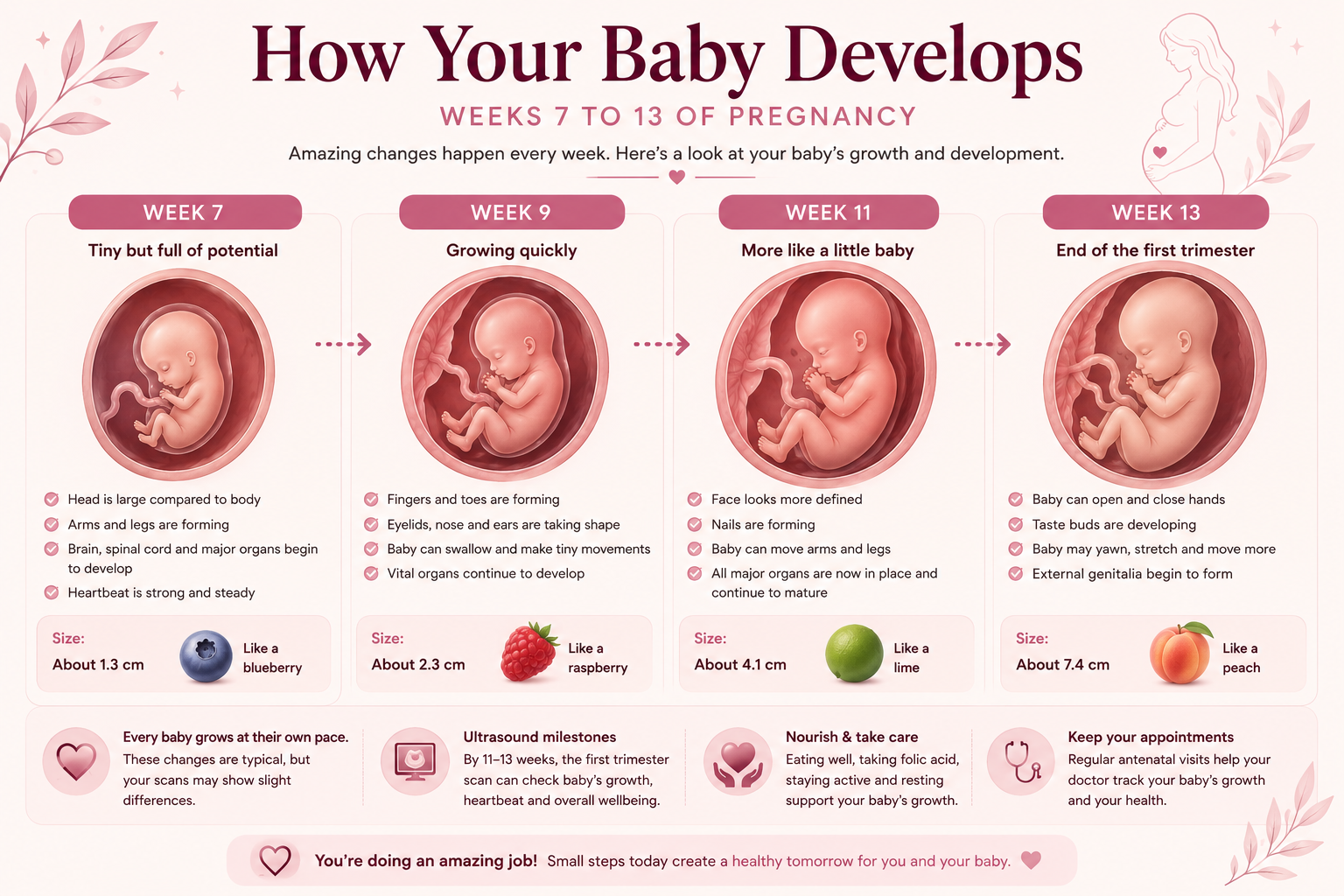
From Week 7 onward, the embryo and then fetus changes rapidly. These descriptions give you a general idea of development, but every pregnancy grows at its own pace.
Brain and body development continues
The head is large compared with the rest of the body because the brain is developing rapidly. The developing arms and legs become more noticeable, and internal organs continue their early development.
For many women, nausea, tiredness and breast tenderness may now be quite noticeable.
Early body structures become more defined
The embryo continues growing rapidly. The developing face and limbs become more defined, while the brain, spinal cord and internal organs continue to mature.
Continued rapid growth
The hands, feet and facial structures continue developing. Small movements may occur, although you cannot feel them yet.
Pregnancy symptoms such as nausea, food aversions, smell sensitivity and fatigue may still be prominent.
From embryo to fetus
Around this stage, the developing baby is referred to medically as a fetus rather than an embryo.
Many major body structures have been established, but development is far from complete. The organs and nervous system continue growing and maturing throughout pregnancy.
Growth and maturation continue
The face becomes more defined, limbs continue developing and the fetus can make small movements. The body is becoming more recognisably human in appearance.
Near the end of the first trimester
The fetus continues growing and its organs continue to mature. Depending on your circumstances, your maternity team may discuss first-trimester ultrasound or screening options around this period.
Approaching the second trimester
Your baby continues growing rapidly as you approach the second trimester. Some women begin to notice that nausea or extreme tiredness starts improving, although symptoms can continue for longer.
There is no exact day on which everyone suddenly feels better. Every pregnancy is different.
What May Happen to Your Body in the First Trimester?
The first trimester can affect women very differently. Some have obvious symptoms, while others feel surprisingly normal.
Nausea or vomiting
Often called morning sickness, although it can happen at any time of day.
Tiredness
Feeling unusually sleepy or exhausted is very common in early pregnancy.
Breast changes
Your breasts may feel tender, heavy or more sensitive than usual.
Frequent urination
You may notice that you need to pass urine more often.
Bloating or constipation
Hormonal changes can slow digestion and make you feel bloated.
Mild cramps
Mild intermittent cramping can occur, but severe or worsening pain needs assessment.
Food and smell changes
Foods you normally enjoy may suddenly feel unpleasant, and smells may feel stronger.
Emotional changes
Mood changes, anxiety and feeling overwhelmed can occur alongside physical symptoms.
For a more detailed explanation, see our guide to early pregnancy symptoms.
Your First Antenatal Visit
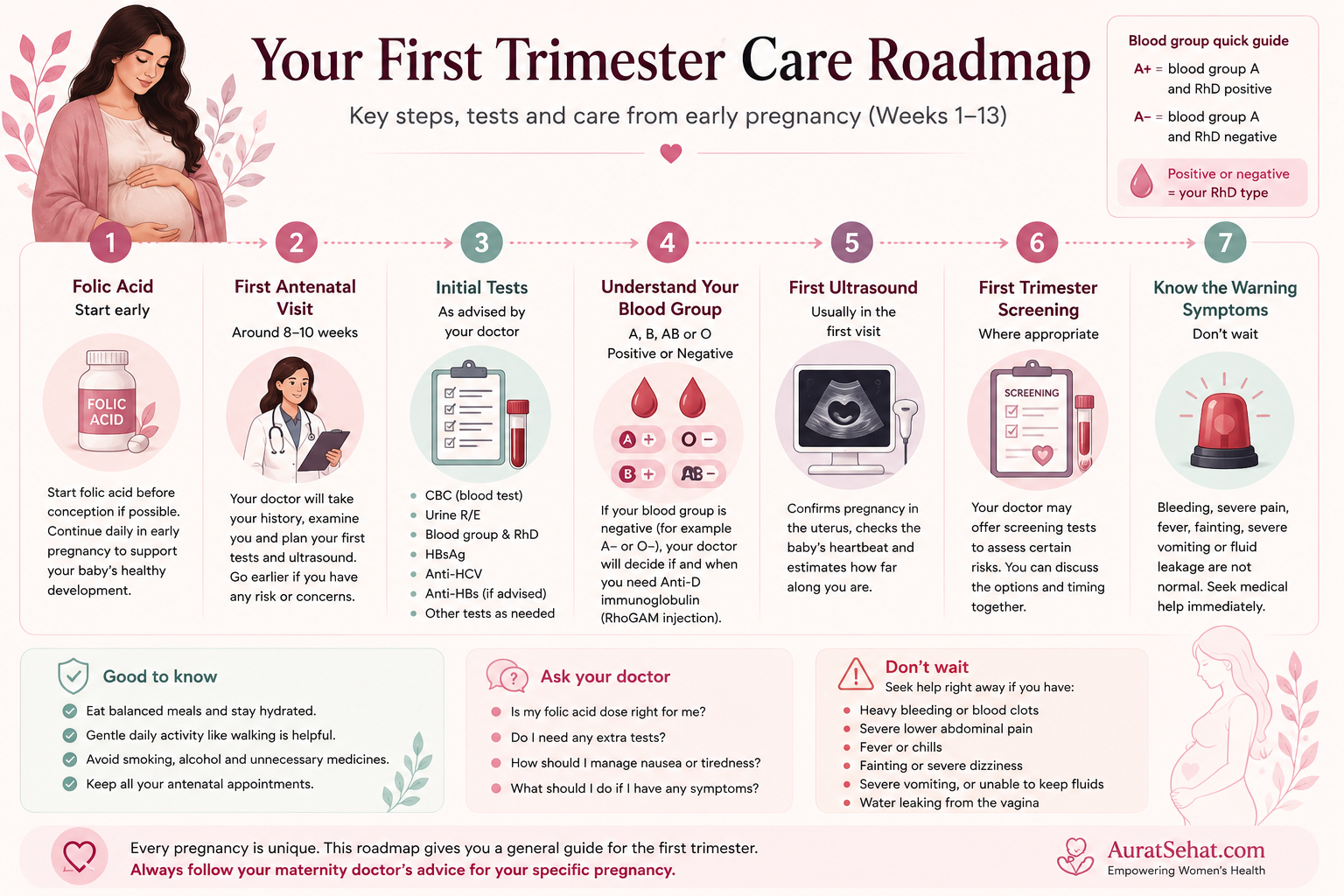
Once pregnancy is confirmed, it is important to establish antenatal care. The exact timing of your first visit may depend on your symptoms, previous pregnancies, medical conditions and your doctor’s advice.
At an early pregnancy visit, your healthcare professional may ask about:
- Your last menstrual period and estimated pregnancy dates.
- Previous pregnancies, miscarriages or pregnancy complications.
- Current medical conditions.
- Medicines and supplements you are taking.
- Your blood pressure and general health.
- Any pain, bleeding, vomiting or other symptoms.
- Your plan for initial blood tests and ultrasound where appropriate.
Which Tests May Be Done in Early Pregnancy?
The investigations advised during your first trimester depend on your medical history, symptoms and maternity care plan. Common early investigations may include:
Understanding Your Blood Group and RhD
What do positive and negative mean?
Your blood group may be A+, A−, B+, B−, AB+, AB−, O+ or O−.
The letters A, B, AB or O tell you your main blood group. The positive (+) or negative (−) part tells you your RhD type.
Positive means RhD is present.
Negative means RhD is absent.
Why does a negative blood group matter in pregnancy?
If the mother is RhD negative and the baby’s biological father is RhD positive, the baby may also have a positive blood group.
In this situation, the current baby or a future pregnancy with an RhD-positive baby can be at risk of a blood disease called haemolytic disease of the fetus and newborn (HDFN), also known as erythroblastosis fetalis.
This is why doctors identify mothers with negative blood groups early in pregnancy. Your doctor will decide whether and when you need Anti-D immunoglobulin (RhoGAM injection) to help prevent this problem.
Continue Folic Acid
Folic acid is especially important before conception and during early pregnancy because it supports the development of your baby’s brain and spinal cord.
Most women should continue the dose recommended for them during the first trimester. Some women require a different dose because of their medical history, medicines or previous pregnancy history.
Read our complete guide: Folic Acid in Pregnancy — Why It Matters and How to Take It.
Eating, Medicines and Everyday Life
Eat regularly
Aim for balanced meals with foods you can tolerate. Small frequent meals may help if nausea makes larger meals difficult.
Stay hydrated
Drink fluids regularly, especially if you are experiencing nausea or vomiting.
Review medicines
Do not start or stop prescribed medicines simply because you are pregnant. Ask the doctor managing your condition about pregnancy safety.
Stay appropriately active
Gentle or moderate physical activity is usually helpful in an uncomplicated pregnancy, unless your healthcare professional has advised otherwise.
Avoid smoking and alcohol
These can harm pregnancy and should be avoided.
Sex in pregnancy
Sex is generally safe in an uncomplicated pregnancy. Your own doctor’s advice takes priority if you have bleeding or another pregnancy complication.
What Can an Early Pregnancy Ultrasound Show?
Ultrasound findings change quickly during the first trimester. In very early pregnancy, the scan may gradually progress from seeing a gestational sac to a yolk sac, then an embryo and eventually detectable cardiac activity.
However, there is no single exact day when every pregnancy must show the same finding. Your actual ovulation date may differ from the date predicted from your LMP.
Learn more in our Early Pregnancy Ultrasound guide.
First-Trimester Screening
Depending on your circumstances, local availability and your maternity team’s advice, you may be offered screening tests or an ultrasound during the first trimester.
These tests can assess particular pregnancy risks, but the exact tests offered and their timing are not identical for every woman. Discuss the options with your maternity doctor so you understand what is appropriate for your pregnancy.
What Can Be Normal — and When Should You Get Help?
Early pregnancy can cause many uncomfortable symptoms. The important thing is to recognise when symptoms are mild and expected versus when they could represent something more serious.
Often seen in normal pregnancy
- Mild nausea.
- Tiredness.
- Breast tenderness.
- Mild bloating.
- Occasional mild cramps.
- Increased urination.
- Changes in food preferences or smell sensitivity.
Do not ignore
- Heavy or significant vaginal bleeding.
- Severe or worsening abdominal or pelvic pain.
- Marked one-sided abdominal pain.
- Shoulder-tip pain with concerning symptoms.
- Fainting or severe dizziness.
- Persistent severe vomiting or inability to keep fluids down.
- Fever or feeling seriously unwell.
Get urgent medical help for:
- Heavy bleeding
- Severe abdominal or pelvic pain
- Marked one-sided pain
- Shoulder-tip pain with concerning symptoms
- Fainting or severe dizziness
- Severe persistent vomiting or inability to keep fluids down
- Feeling seriously unwell
Early pregnancy complications such as miscarriage or ectopic pregnancy can sometimes begin with these symptoms. Do not wait for an online diagnosis if you feel seriously unwell.
Your First-Trimester Checklist
Want to Know What Comes Next for You?
Tell AuratSehat how far along you are and build a personalized pregnancy journey with important milestones, care reminders and your Pregnancy Care Map.
Start My PregnancyFrequently Asked Questions
How many weeks are in the first trimester?
The first trimester runs from the beginning of pregnancy through the end of Week 13. The second trimester begins after this.
Why am I called 4 weeks pregnant if conception happened about 2 weeks ago?
Pregnancy is dated from the first day of your last menstrual period rather than from the day of conception. In a typical cycle, conception occurs approximately two weeks after pregnancy dating begins.
When can a pregnancy test become positive?
A home pregnancy test may become positive around the time your period is expected, but testing too early can produce a negative result. Timing varies between women.
When can cardiac activity be seen on ultrasound?
Cardiac activity may become detectable in early pregnancy, often around the sixth week or later depending on exact dating and the ultrasound technique. One scan performed too early may not show it yet.
What if my ultrasound looks earlier than expected?
Your ovulation may have occurred later than assumed from your LMP, so your pregnancy may simply be younger than expected. Your doctor may advise a repeat ultrasound after an appropriate interval.
Is spotting normal in the first trimester?
Light spotting can occur in pregnancy, but bleeding should not automatically be assumed to be harmless. Contact your healthcare professional for advice, particularly if bleeding becomes heavier or is associated with pain, dizziness or feeling unwell.
Is it normal to have no pregnancy symptoms?
Yes. Some healthy pregnancies cause very few noticeable symptoms. Symptoms alone cannot confirm whether a pregnancy is developing normally.
When should I have my first pregnancy visit?
Establish antenatal care early in pregnancy. Your doctor may want to see you sooner if you have pain, bleeding, significant vomiting, a medical condition, previous pregnancy complications or another reason for closer assessment.
Which blood tests are commonly done in early pregnancy?
Common investigations may include CBC, blood group and RhD typing, HBsAg and Anti-HCV, together with urine testing. Other investigations depend on your clinical circumstances and your doctor’s assessment.
What does positive or negative mean in my blood group?
The positive or negative part describes your RhD type. For example, A+ means blood group A and RhD positive, while A− means blood group A and RhD negative.
Why does RhD-negative blood matter during pregnancy?
If the mother is RhD negative and the baby’s father is RhD positive, the baby may also have a positive blood group. Your doctor will assess whether Anti-D immunoglobulin (RhoGAM injection) is needed to help protect the current baby or future RhD-positive pregnancies from RhD-related blood disease.
When should I seek urgent medical help?
Seek urgent assessment for heavy bleeding, severe or worsening abdominal pain, marked one-sided pain, fainting, severe dizziness, severe persistent vomiting, inability to keep fluids down, or if you feel seriously unwell.
Have a Pregnancy Question?
If something about your symptoms, medicines, blood group, tests or scan is worrying you, you can send your question to AuratSehat.
Ask a Doctor for FreeMedical References
• World Health Organization. Recommendations on antenatal care for a positive pregnancy experience.
• National Institute for Health and Care Excellence (NICE). Antenatal care guidance.
• National Institute for Health and Care Excellence (NICE). Ectopic pregnancy and miscarriage: diagnosis and initial management.
• Royal College of Obstetricians and Gynaecologists (RCOG). Patient information and clinical guidance relating to early pregnancy and RhD prophylaxis.
• NHS. Pregnancy and baby guidance: early pregnancy, antenatal appointments, pregnancy symptoms and ultrasound.
This article is intended for health education and does not replace individual assessment, diagnosis or treatment by your maternity healthcare professional. Pregnancy care may differ depending on your health, pregnancy history and clinical circumstances.